

You set your alarm for eight hours. You wake up tired. And somewhere in the back of your mind, you have started to wonder whether the foggy mornings and the forgotten names are connected to this.
They are.
Adults over 50 who sleep lighter than they once did are losing the one sleep stage responsible for memory consolidation and brain waste clearance, while assuming their only option is to accept it.
The hormonal and brain changes that suppress deep sleep after 50 are biological, which is why standard sleep advice keeps disappointing you. You are not sleeping wrong. Something specific is disappearing.
Deep sleep memory, the process your brain uses to move learning into long-term storage overnight, does not vanish all at once. It goes quietly, decade by decade, starting earlier than most people realize.
This article is for informational purposes only and is not a substitute for professional medical advice. If you are experiencing persistent sleep problems or memory concerns, speak with your doctor before making changes to your routine.
What Deep Sleep Memory Loss Actually Looks Like After 50
You lie down exhausted. Three hours later you are staring at the ceiling. Or you sleep a full eight hours and wake up feeling like you barely rested. The problem is not your attitude toward sleep. The problem is which part of sleep you are actually getting.
Deep sleep, also called slow-wave sleep or N3, is the heaviest stage of the night. It is hard to wake someone from it. During this stage, the brain slows to long, rolling electrical waves. It is the stage that does the work no other stage can replicate.
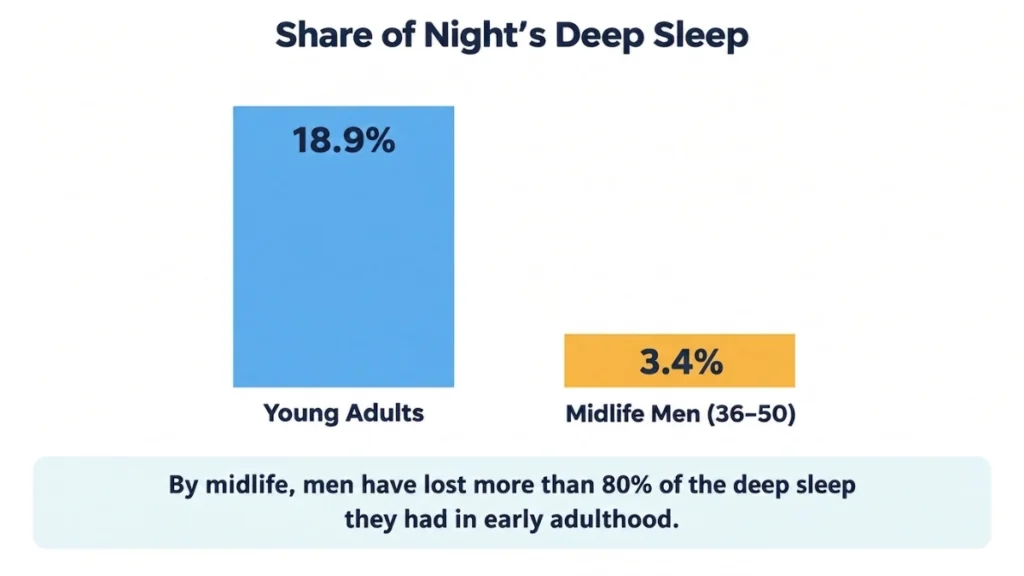
By midlife, men had already lost about 82% of the deep slow-wave sleep seen in early adulthood, with the percentage dropping from 18.9% to 3.4% by ages 36 to 50.¹
Most of that loss happened before anyone noticed anything was wrong.
Deep sleep also drops by about 2 percentage points every decade up to around age 60, based on a meta-analysis of 65 studies with 3,577 participants.²
What fills the gap is lighter sleep, stages N1 and N2. Lighter sleep is real sleep. But it is not doing the same job.
Here are four terms used throughout this article, each in plain language.
Slow-wave sleep (also called SWS or N3) is the deepest stage of non-REM sleep, when the brain produces large, slow electrical waves.
NREM is non-rapid eye movement sleep, the category that includes N1, N2, and N3.
Sleep spindles are brief bursts of brain activity during NREM sleep that act as relays, moving memories from short-term to long-term storage.
The glymphatic system is a fluid-drainage network in the brain that flushes protein waste and is most active during deep sleep.
The question of what deep sleep memory was doing, and what stops happening when it is gone, is more serious than most people expect.
Why This Stage Disappears First and What Takes Its Place
When you lose deep sleep, you don’t lose total sleep time right away. You gain lighter sleep instead. That lighter sleep feels like rest. It is not doing the same work.
Deep sleep specifically supports declarative memory, the hippocampus-dependent kind.³ Declarative memory is the kind that stores names, conversations, and facts. REM sleep handles a different job entirely, the kind used to learn physical skills.
Lighter sleep cannot do the deep sleep memory work of moving declarative memories into long-term storage. The mechanism is a type of brain signal called a sleep spindle.
Spindles are brief bursts of electrical activity generated across the brain during NREM sleep, and they are the mechanism that carries those memories from short-term into long-term storage.
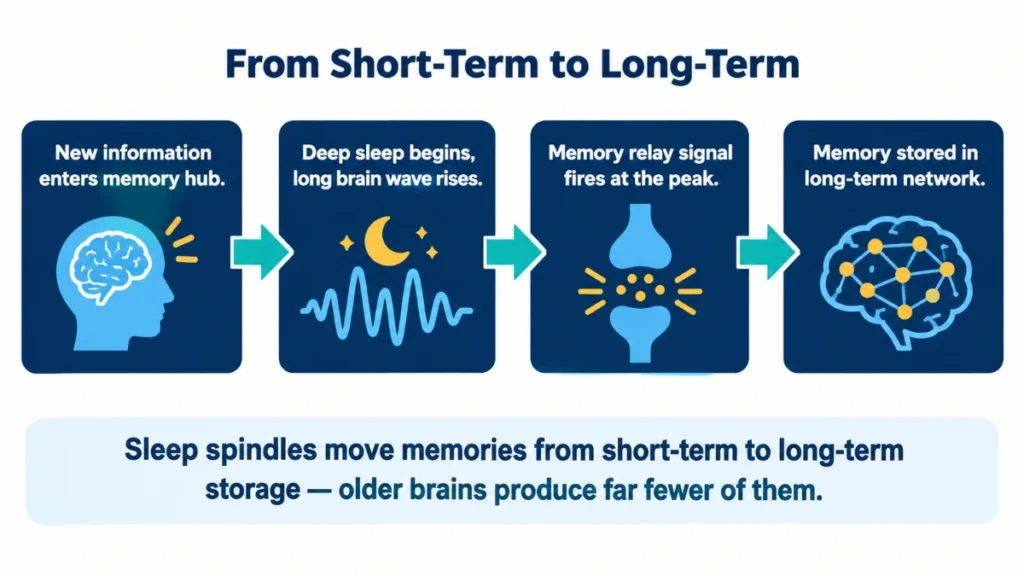
Older adults produce over 40% fewer prefrontal sleep spindles than younger adults.⁴ That reduction statistically explains how much worse older adults are at learning new information the next day.⁴
It is not age causing the memory problem directly. It is the spindle loss that sits between age and the memory problem.
Age-related slow-wave reductions are largest over the prefrontal cortex, where older adults show 75–80% less slow-wave activity than young adults.³ The loss is not in how many hours you sleep.
Most people assume sleeping longer is the answer. Duration is not the broken variable.
What Your Brain Loses Every Night It Skips This Stage
Think about wiping down your kitchen counter every evening. Now stop doing that for a month. Deep sleep is the brain’s version of that nightly cleanup, and skipping it has two specific consequences that nothing else repairs.
The first is the memory transfer failure described above. The second is a failure of physical waste clearance.
The brain has a drainage system called the glymphatic network. It uses fluid to flush protein waste through channels around blood vessels. This system operates mainly during slow-wave sleep and is impaired when sleep is disrupted.⁵
The waste it clears includes amyloid-beta and tau. These are proteins that accumulate in the brain and are found in high concentrations in Alzheimer’s disease.
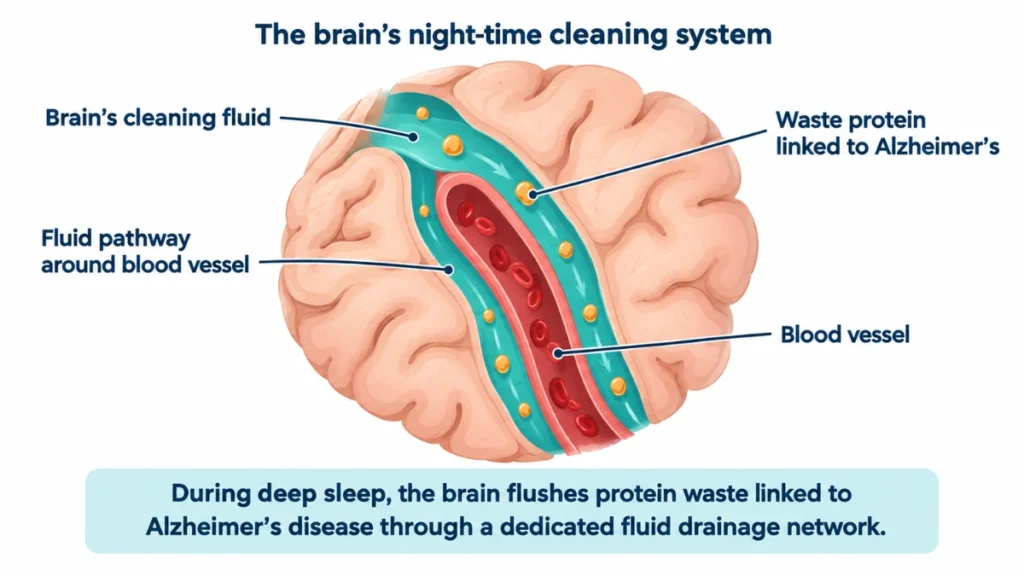
A randomized trial with 39 participants found that glymphatic clearance during normal sleep increased morning plasma levels of Alzheimer’s disease biomarkers compared to sleep deprivation.⁶
The researchers modelled that sleeping normally allowed the brain to clear more of these proteins than staying awake did. That is evidence the brain’s cleaning system runs on sleep.
The research shows the link but has not yet established that reduced deep sleep directly causes Alzheimer’s. What it confirms is that clearance happens during deep sleep and is impaired without it.
Deep sleep memory consolidation and brain waste clearance share the same window. Lose one and you reduce both.
The Glymphatic Window: Why Timing Matters More Than Hours
The problem after 50 is not simply that you get less deep sleep. It is that the deep sleep you do get is poorly coordinated.
During deep sleep, two brain signals work together to transfer memories. The first is a slow oscillation, a long rolling brain wave. The second is a sleep spindle. In younger brains, the spindle arrives precisely when the slow oscillation peaks. That precise timing is what moves the memory.
In older brains, the two signals arrive out of sync. One goes early. The other goes late. The handoff fails.
Medial frontal cortex atrophy in older adults predicted a temporal dispersion of this slow-wave and spindle coupling, impairing overnight memory consolidation and leading to forgetting.⁷ Memories don’t transfer properly when the timing is off. That is the finding.
Picture a relay race where the second runner is looking the wrong direction when the baton arrives. The baton doesn’t get passed. The lap is lost.
That failure is most costly in a specific part of the night.
The first sleep cycle of the night runs roughly 110 minutes from sleep onset.⁹ Both processes, memory transfer and glymphatic cleanup, are concentrated in that cycle.
A late meal, a warm room, or late-night screen time that disrupts that first cycle closes the night’s most productive window. You might sleep eight hours and still miss the work that mattered most.
The question is not whether you slept. It is whether that first window stayed open.
What Partially Restores Slow-Wave Sleep After 50
You’ve probably heard sleep advice before and been disappointed. That is worth naming before anything else. The evidence here is honest. Partial restoration is real. Full reversal of age-related brain changes is not on the table.
In older adults, greater slow-wave activity during sleep is associated with better memory and cognitive ability.⁸ Protecting what remains is worth the effort.
Body temperature is the most direct lever. Your core temperature drops naturally as you fall asleep. That drop helps initiate and sustain deep sleep.
A three-center study of 72 people found that body cooling during sleep increased N3 by an average of 7.5 minutes per night, a statistically confirmed result.⁹
Seven and a half minutes is not dramatic. But it is real, it is accessible, and it requires no medication.

The second lever is sleep pressure. Your drive to enter deep sleep builds the longer you stay awake. Spending too long in bed while only sleeping part of those hours reduces that pressure. A weaker drive means shallower sleep.
The third lever is timing. A fixed wake time anchors your body clock. Consistent timing is associated with better health outcomes. Irregular timing works against you.
None of this reverses the biological changes in the prefrontal cortex. But each of these variables moves the outcome in a direction you can feel.
Tonight Protocol: The Changes That Work While You Sleep
You don’t need a perfect sleep system. You need one change that sticks. Here is what the evidence supports, starting tonight.
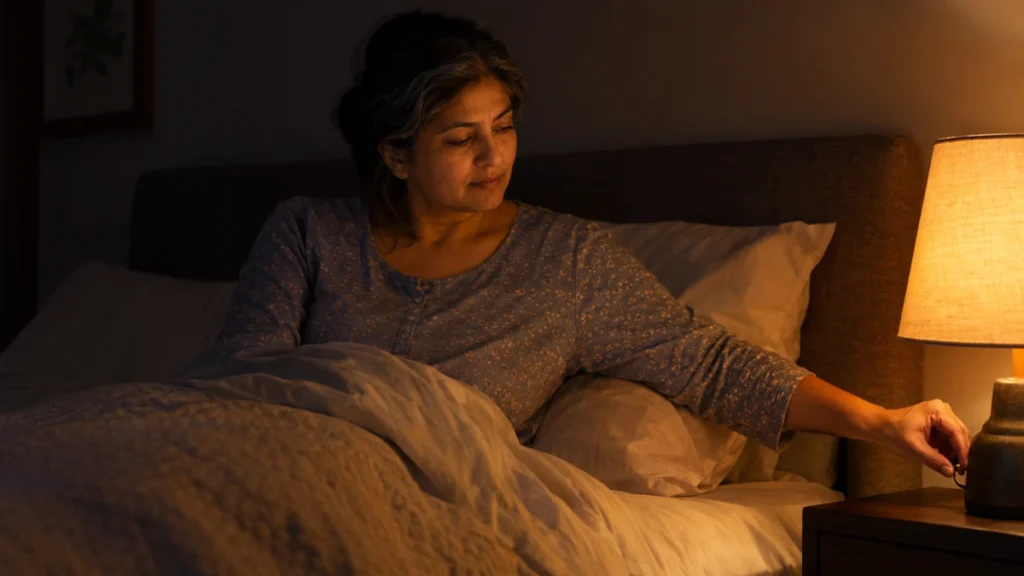
Tonight protocol
- Use a body-cooling method during sleep, such as a cooling mattress pad or similar surface. Body cooling selectively increases N3.⁹
- Avoid alcohol in the hours before bed. Even low doses fragment the second half of the night and suppress REM sleep.¹⁰
- Fix your wake time first. Consistent wake times are favorably associated with health across nearly 100,000 people.¹¹
- Go to bed only when sleepy. Sleep pressure drives slow-wave activity.
- Protect the first 110 minutes. A warm room or late-night screen time before bed closes the window when slow-wave sleep is densest.
The people who feel this most clearly are not the ones who overhaul their entire routine. They are the ones who pick one thing and do it tonight.
That one change is low-effort and has real evidence behind it.
Start Tonight
Acting on what you now know about deep sleep memory gives your brain the environment it needs to do the work it was already designed to do. Start with one change tonight, body cooling, fixed wake time, no alcohol after dinner. Your brain is ready to do this every night when the conditions are right.
References
- Van Cauter E, Leproult R, Plat L. Age-Related Changes in Slow Wave Sleep and REM Sleep and Relationship With Growth Hormone and Cortisol Levels in Healthy Men. JAMA. 2000;284(7):861-868. doi:10.1001/jama.284.7.861. https://pubmed.ncbi.nlm.nih.gov/10938176/
- Edwards BA, O’Driscoll DM, Ali A, Jordan AS, Trinder J, Malhotra A. Aging and Sleep: Physiology and Pathophysiology. Seminars in Respiratory and Critical Care Medicine. 2010;31(5):618-633. doi:10.1055/s-0030-1265902. https://pmc.ncbi.nlm.nih.gov/articles/PMC3500384/
- Mander BA, Winer JR, Walker MP. Sleep and Human Aging. Neuron. 2017;94(1):19-36. doi:10.1016/j.neuron.2017.02.004. https://www.sciencedirect.com/science/article/pii/S0896627317300880
- Mander BA, Rao V, Lu B, Saletin JM, Ancoli-Israel S, Jagust WJ, Walker MP. Impaired prefrontal sleep spindle regulation of hippocampal-dependent learning in older adults. Cerebral Cortex. 2014;24(12):3301-3309. https://pubmed.ncbi.nlm.nih.gov/23901074/
- Santerre M, Shcherbik N, Sawaya BE. AQP4-mediated glymphatic clearance: Sleep, neurodegeneration, and the translational gap. Neuroscience and Biobehavioral Reviews. 2026 Sep;188:106819. doi:10.1016/j.neubiorev.2026.106819. https://pubmed.ncbi.nlm.nih.gov/42288169/
- Dagum P, Elbert DL, Giovangrandi L, Singh T, Venkatesh VV, Corbellini A, Kaplan RM, Rane Levendovszky S, Ludington E, Yarasheski K, Lowenkron J, VandeWeerd C, Lim MM, Iliff JJ. The glymphatic system clears amyloid beta and tau from brain to plasma in humans. Nature Communications. 2026;17:715. doi:10.1038/s41467-026-68374-8. https://www.nature.com/articles/s41467-026-68374-8
- Helfrich RF, Mander BA, Jagust WJ, Knight RT, Walker MP. Old Brains Come Uncoupled in Sleep: Slow Wave-Spindle Synchrony, Brain Atrophy, and Forgetting. Neuron. 2018;97(1):221-230.e4. doi:10.1016/j.neuron.2017.11.020. https://pubmed.ncbi.nlm.nih.gov/29249289/
- Wilckens KA, Habte RF, Dong Y, Stepan ME, Dessa KM, Whitehead AB, Peng CW, Fletcher ME, Buysse DJ. A pilot time-in-bed restriction intervention behaviorally enhances slow-wave activity in older adults. Frontiers in Sleep. 2024;2:1265006. doi:10.3389/frsle.2023.1265006. https://www.ncbi.nlm.nih.gov/pmc/articles/PMC11210605/
- Herberger S, Penzel T, Fietze I, Glos M, Cicolin A, Fattori E, Grimaldi D, Reid K, Zee P, Mason M, Kräuchi K. Enhanced conductive body heat loss during sleep increases slow-wave sleep and calms the heart. Scientific Reports. 2024;14:4669. doi:10.1038/s41598-024-53839-x. https://www.nature.com/articles/s41598-024-53839-x
- Chaput JP. Alcohol, Wine, and Sleep in Adults: Insights from a Narrative Review. Nutrients. 2026;18(4):585. doi:10.3390/nu18040585. https://pmc.ncbi.nlm.nih.gov/articles/PMC12942847/
- Chaput JP, Dutil C, Featherstone R, Ross R, Giangregorio L, Saunders TJ, Janssen I, Poitras VJ, Kho ME, Ross-White A, Zankar S, Carrier J. Sleep timing, sleep consistency, and health in adults: a systematic review. Applied Physiology, Nutrition, and Metabolism. 2020;45(10 Suppl. 2):S232-S247. doi:10.1139/apnm-2020-0032. https://pubmed.ncbi.nlm.nih.gov/33054339/