

You’re standing in the kitchen Monday morning, coffee in hand, staring at nothing, and the week hasn’t even started. Somewhere in the back of your mind is a thought you haven’t said out loud: this fog is getting worse, and you’re not sure what it means.
After 50, your body’s clock recovers more slowly from disruption. What used to clear by Tuesday now lingers until Wednesday or Thursday. Weekend sleep shifts silently reset your circadian clock, making Monday morning fog a predictable biological outcome rather than a sign of laziness or aging.
This article is for informational purposes only and is not a substitute for professional medical advice. If you have a sleep disorder, chronic fatigue, or are managing a health condition, speak with your doctor before making changes to your sleep routine.
Your Weekend Sleep Is Acting Like a Red-Eye Flight
This is what happens. Every Friday night, when you stay up later than your weekday schedule, your body’s internal clock shifts. Every Monday morning, when your alarm pulls you back to an earlier schedule, your body experiences something close to crossing a time zone overnight.
Researchers call this social jetlag. It means the gap between when your biology wants to sleep and when your schedule makes you wake up.
This is not about one bad night. It runs on a repeating cycle, and adults over 50 are caught in it more than most people realize.
Seven in 10 students and workers in industrialized countries experience at least an hour of social jetlag every week.¹ That’s the majority, not the exception. If you feel slow every Monday morning, you are in good company.
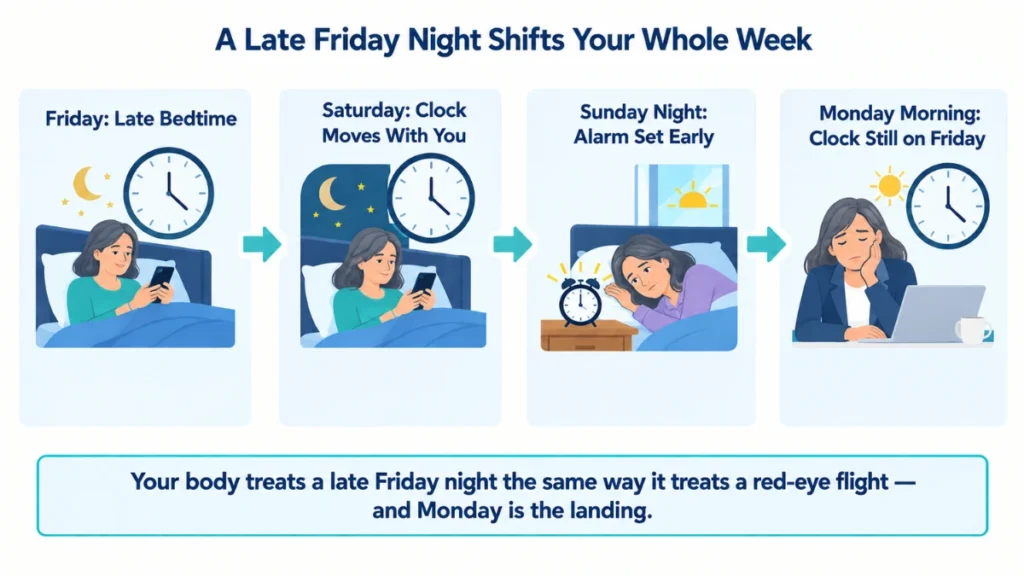
You don’t need poor sleep to feel the fog. You can sleep a full eight hours on Saturday night and still wake Monday feeling like you flew in from a different time zone. The timing of your weekend sleep is the mechanism, not the total hours.
Sunday night gets the attention. Get to bed earlier. Avoid your phone. Try to relax. But the research points to Friday as the start of the problem. Sunday is just where you feel the result.
The fog isn’t random. It runs on the same schedule as your weekends, every single week.
Eight Hours of Sleep Won’t Save You If the Timing Is Wrong
You probably already know that you slept enough. The number of hours isn’t the mystery here.
When your weekend sleep shifts even 90 minutes later than your weekday schedule, your body’s clock moves with it. Your melatonin onset shifts. Your core temperature cycle shifts. By Monday morning, your biology is set to a time that doesn’t match the clock on the wall.
People who experience social jetlag may tend to be less alert, more fatigued, and perform worse at work or school than those whose sleep timing stays consistent.¹ Your body isn’t broken. It’s running on Friday’s time.
This is why the number of hours you slept over the weekend doesn’t fix Monday. Eight hours at the wrong time is still the wrong time.
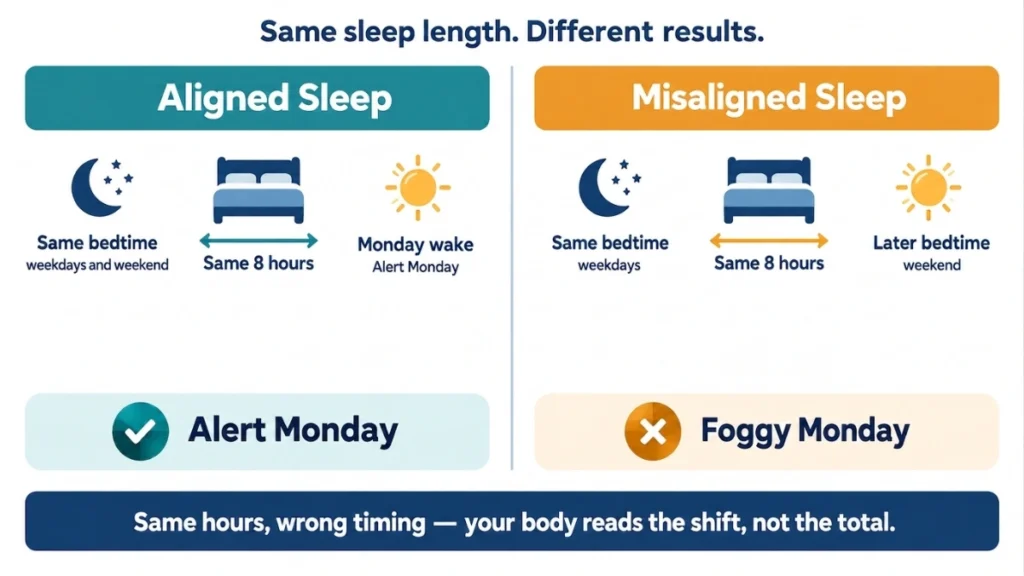
Why does sleeping in on Saturday feel so good and hurt so much by Monday? The answer is that sleeping in reinforces the timing shift. Your body interprets it as a real time zone change. The longer you sleep in, the harder the return trip.
Chronobiologist Till Roenneberg of LMU Munich puts it plainly:
“The more misaligned these clocks are, the higher our odds of developing certain diseases.”²
The fog you feel on Monday isn’t tiredness. It’s your body flying home from a trip you didn’t choose to take.
Why the Same Weekend Hurts You More After 50
Think about the last time you tried to remember a word on a Monday morning and it just wasn’t there. That’s not aging in the broad sense. That’s a clock problem, and after 50, it hits harder.
Your circadian clock sends signals all day. Those signals tell your brain when to be alert, when to rest, when to release hormones, and when to store memories.
In younger adults, those signals are strong. After 50, the strength of those signals, what researchers call the amplitude of the rhythm, decreases.³
A weaker signal takes longer to reset.
Animal studies suggest the brain’s master clock also loses some coordination across its cells with age, though the human data on this specific point is still developing.³
The evidence in humans is clearer in the behavioral outcomes: older adults show longer disruption after a timed schedule shift than younger adults do.
In controlled studies, adults with a mean age of 81 showed reduced sleep quality, reduced alertness, and a disrupted body temperature rhythm that persisted for longer after a structured phase advance, compared with adults aged 37 to 50.³

It’s worth noting that shifting your schedule later is generally better tolerated across age groups. The problem is the return trip: shifting earlier, which is exactly what Monday morning demands.
The contradiction most people don’t expect is this. Adults over 50 often assume they’re sleeping too much on weekends. The research says the problem isn’t how much. It’s when.
A 25-year-old’s clock might recover from a 90-minute weekend shift by Tuesday. After 50, that same shift can push recovery to Wednesday or Thursday. The disruption compounds.
The Fog Doesn’t Stop at Monday
If the clock reset only cost you one morning, it would be manageable. But a slower-recovering clock means the disruption spreads across the week.
Some people reading this will push back here. There is a real question in the research about whether social jetlag directly affects long-term cognitive function in older adults.
A 2025 study of 661 adults aged 50 to 83 found no link between social jet lag and measured cognitive functioning in that population.⁴ That finding matters, and it’s worth being clear about what this article is and is not claiming.
This article is not about dementia or long-term cognitive decline. It’s about how you feel on Monday morning, specifically the acute fog, reduced alertness, and low energy that come from a clock that hasn’t caught up yet.
Those effects are distinct from long-term cognitive measures, and the research does not contradict them.
The weekend sleep timing shift is milder than a transatlantic flight, but for an older adult’s clock, the effect can last just as long.
A weekly timing disruption adds up. Fifty-two weekends a year, each one resetting a clock that takes longer to return to normal, is not a neutral pattern. Your body absorbs that cost whether you feel it clearly or not.
The fog on Wednesday morning that you’ve been calling “just getting older”? It may be Monday’s clock shift, still working its way out.
The Fix Takes 30 Minutes and Costs Nothing
The biggest lever is your Friday and Saturday bedtime. Not Sunday. Friday. If you go to bed more than 30 minutes later on Friday than your typical weekday bedtime, you’ve already started the shift. Your clock moves with you.
Morning light is the strongest signal the body’s clock responds to. A trial in young adults found that 30 minutes of morning bright light, paired with a gradual shift in sleep timing, is an efficient way to advance the circadian clock back toward an earlier phase.⁵
The original study also included a low-dose melatonin protocol alongside the light and the schedule shift. If you’re considering melatonin, speak with your doctor first, particularly if you take medications that affect sleep or hormone levels.
Getting outside within 30 minutes of waking on Monday morning costs nothing and helps your clock understand that the return trip is real.
Light hitting your eyes in the morning tells the suprachiasmatic nucleus, the part of your brain that runs your body clock, that the day has started. That signal is the single strongest reset tool available to you without a prescription.
Weekend Sleep Reset: The 30-Minute Rule
- Friday: Go to bed within 30 minutes of your weekday bedtime.
- Saturday: Same rule applies.
- Sunday: Wake within 30 minutes of your weekday wake time.
- Monday morning: Step outside for 20 to 30 minutes of natural light within 30 minutes of waking.
You don’t have to give up late nights entirely. The 30-minute window is small enough that your body can recover from it cleanly. Push past it, and the return cost grows.
Friday is where Monday starts. Most people try to fix Monday by changing Sunday. The fix is two days earlier.
What Repeating This Pattern 52 Times a Year Does
One disrupted weekend is not a crisis. Fifty-two of them, each one shifting a clock that’s slower to recover, is a different story.
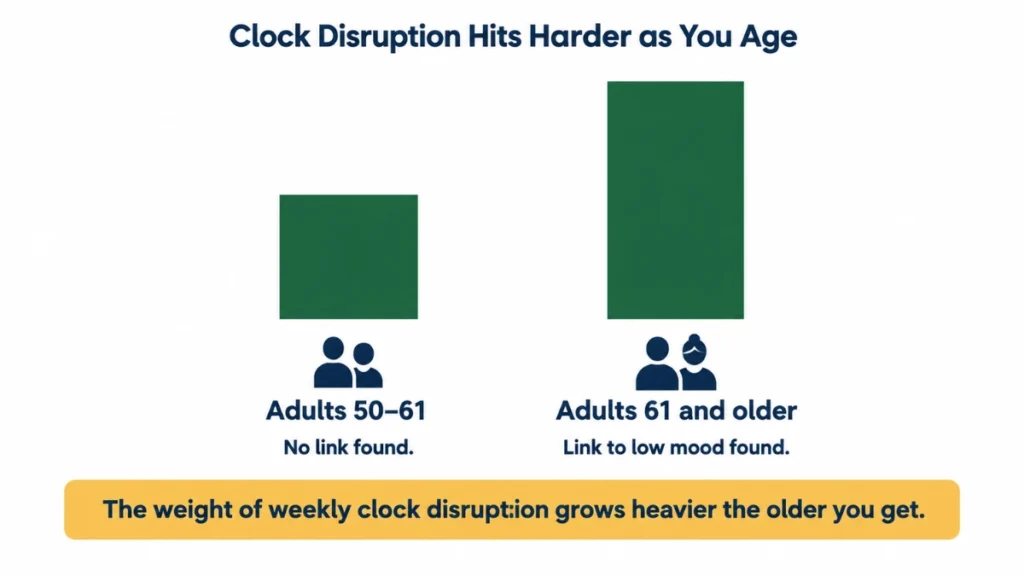
Research on adults aged 50 to 83 found that higher levels of social jet lag were linked to higher depressive symptoms only among adults over age 61. No such link appeared in the 50 to 61 age group.⁴ This is an association from a single cross-sectional study, not a proven cause.
But it points to something worth paying attention to: the cumulative weight of a weekly clock disruption is not the same at every age, and it appears to grow heavier over time.

Social jetlag is now described as a public health concern because of how widespread it is and how consistently it links to negative health patterns.¹ A consistent weekend sleep schedule is the same prevention and the same fix.
The good news is that you don’t need a different strategy for the long-term pattern. The same action that fixes Monday morning is what prevents the 52-repetition toll: keep your Friday and Saturday bedtimes within 30 minutes of your weekday schedule, and get outside for morning light on Monday.
The fix doesn’t change your weekend. It changes what Monday feels like.
Start on Friday Night
Keeping your weekend sleep timing close to your weekday schedule means your circadian clock doesn’t have to cross a time zone every Friday night and fly back every Monday morning. Cap your Friday and Saturday bedtime drift at 30 minutes from your weekday schedule. Monday will still come, but it won’t feel like jet lag.
References
- Caliandro R, Streng AA, van Kerkhof LWM, van der Horst GTJ, Chaves I. Social Jetlag and Related Risks for Human Health: A Timely Review. Nutrients. 2021;13(12):4543. https://pmc.ncbi.nlm.nih.gov/articles/PMC8707256/
- Roenneberg T. How can social jetlag affect health? Nature Reviews Endocrinology. 2023;19(7):383-384. https://pmc.ncbi.nlm.nih.gov/articles/PMC10204006/
- Hood S, Amir S. The aging clock: circadian rhythms and later life. Journal of Clinical Investigation. 2017;127(2):437-446. https://www.jci.org/articles/view/90328
- Tracy EL, Kim E, Meinertz NR, Nyang’au GK. The health cost of irregular sleep timing: age differences in social jet lag and health outcomes among middle-aged and older adults. The Journals of Gerontology: Series A. 2025;80(12):glaf216. https://pubmed.ncbi.nlm.nih.gov/41065186/
- Crowley SJ, Eastman CI. Phase advancing human circadian rhythms with morning bright light, afternoon melatonin, and gradually shifted sleep: can we reduce morning bright-light duration? Sleep Medicine. 2015;16(2):288-297. https://pubmed.ncbi.nlm.nih.gov/25620199/