

That 2 a.m. haze where you can’t tell if you’re awake or still dreaming, then the grogginess that doesn’t lift by lunch, isn’t just “getting older.” At 45, that same sleeping pill wore off by breakfast.
At 68, it might still be working on you at noon. Adults over 65 face a hidden shift: the medications that once helped them sleep now linger in the body far longer, quietly raising the risk of falls, memory problems, and accidents most people never connect back to the pill bottle.
This isn’t about giving up on rest. It’s about understanding what changed in your body, and what actually works now instead.
Why Read This
- Discover the exact number most doctors won’t tell you about how much slower your body clears these drugs after 65.
- Find out why the “safer” pill turns out to carry nearly the same risk as the one it replaced.
- See why a simple bathroom trip at 3 a.m. can be riskier than most people realize.
- Learn why “brain fog” from a sleep aid can look exactly like something far more serious.
- Understand why doctors now recommend trying a non-drug approach before reaching for a prescription.
The Biology of Aging: Why Your Body Processes Drugs Differently
It isn’t just your imagination, sleeping pills after 65 hit harder because of a shift in your internal filtration system. As we age, our liver function and kidney efficiency naturally decline. The liver is responsible for breaking down the chemicals in sleep aids, while the kidneys flush the remnants out of the body.
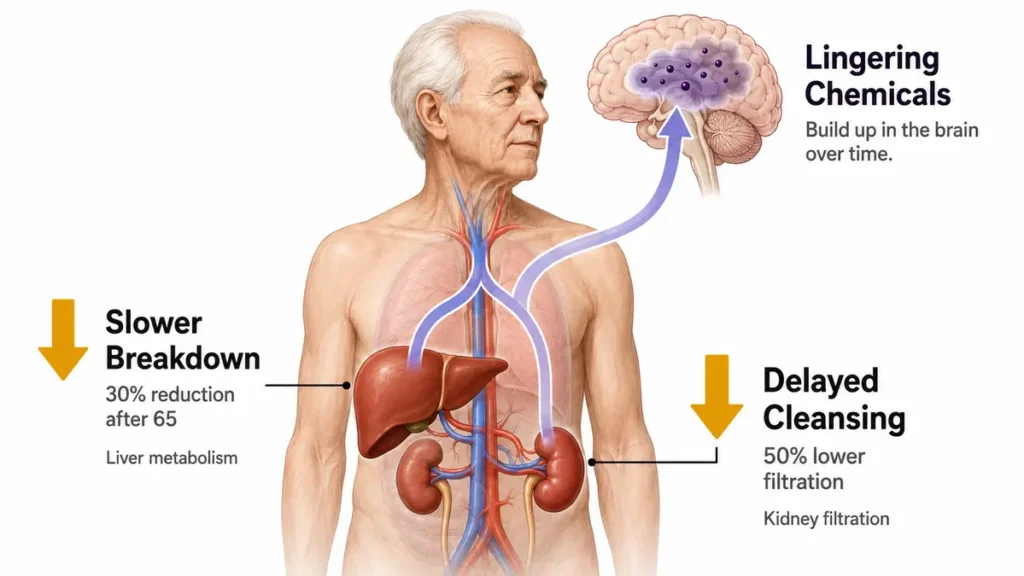
Research in geriatric pharmacology highlights a sobering reality: renal drug clearance is reduced by up to 50% in about two-thirds of elderly adults, and hepatic clearance of some drugs can fall by up to 30%.¹
This creates a dangerous “stacking effect.” If you take a dose of a sedative like a Z-drug (such as Ambien) at 10:00 PM, your body may only have processed a fraction of it by the time you wake up.
Because of this slower drug metabolism in seniors, the medication’s “half-life,” the time it takes for the concentration of the drug in your body to reduce by half, is significantly extended.¹ Instead of being alert by breakfast, many seniors are operating with a brain that is still chemically sedated.
This isn’t just “tiredness”; it is a physiological impairment that affects every decision and movement you make the following day.
The “Big Three” Risks: Falls, Memory, and Accidents
If you’re taking sleeping pills after 65, three specific risks can fundamentally alter your quality of life, and each one is now backed by clinical evidence. The 2023 American Geriatrics Society Beers Criteria update explicitly categorizes most sedative-hypnotics as “Potentially Inappropriate” for those over 65.²
Falls and Hip Fractures: These drugs interfere with proprioception [your brain’s ability to sense where your limbs are in space]. When you wake up in the middle of the night to use the bathroom, your balance is compromised.

A systematic review and meta-analysis found that both benzodiazepines and Z-drugs carry a similarly elevated hip fracture risk, with the greatest danger in the first weeks after a new prescription³. For many, this kind of injury marks the end of independent living.
Cognitive Decline and “Pseudo-Dementia”: A growing body of evidence links chronic benzodiazepine use to an increased risk of cognitive decline and dementia, though researchers note the evidence is still complicated by reverse-causality (early dementia symptoms can themselves prompt a prescription).⁴
These drugs can cause confusion, forgetfulness, and a “brain fog” that looks remarkably like early-stage dementia. While it is sometimes reversible upon stopping the drug, the long-term impact on brain health is a major concern for neurologists.
Vehicular and Daily Accidents: Bedtime use of benzodiazepines and Z-drugs can significantly impair next-day driving performance, though the degree varies by the specific drug’s half-life, dose, and time since the last dose, with some short-acting options carrying less residual risk than others.⁵
Even if you feel “awake,” your reaction times may be slowed. This leads to a higher rate of car accidents and household mishaps, such as burns or trips, because the brain cannot process environmental hazards quickly enough.
The Hidden Trap of “Z-Drugs” and Benzodiazepines
It is a common misconception that “modern” sleeping pills are safer than older ones. Patients are often prescribed two main classes: Benzodiazepines (like Xanax, Restoril, or Valium) and Z-drugs (like Ambien, Lunesta, or Sonatra).
While Z-drugs were originally marketed as a non-addictive, safer alternative to “benzos,” we now know that for the 65+ demographic, the risks are almost identical.³ Both classes of drugs work by enhancing GABA [a brain chemical that slows down the central nervous system].
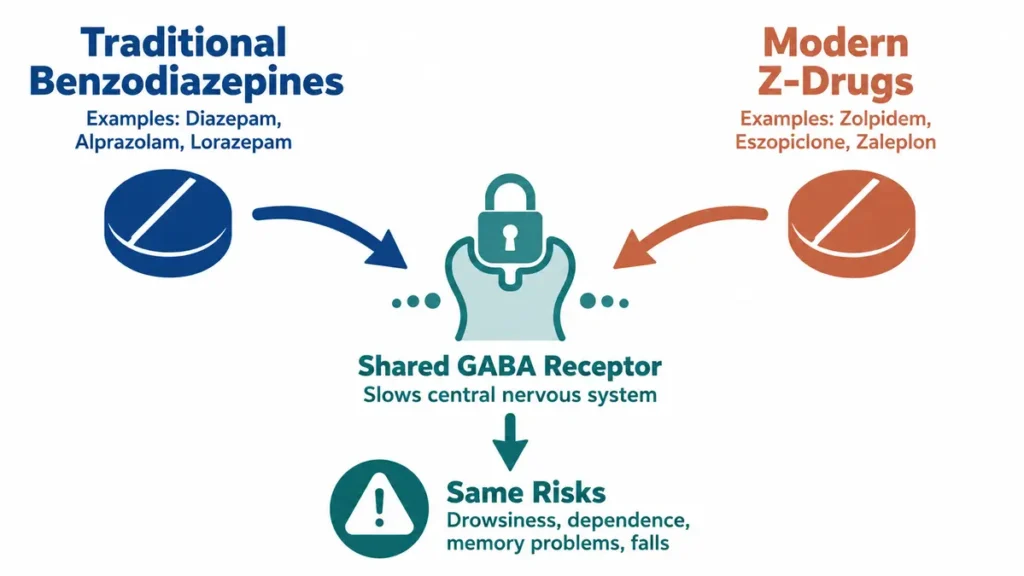
In an older brain, this slowing effect is more profound and harder to “switch off.” Whether it’s a benzodiazepine or a Z-drug, the result is the same: an increased risk of dependency, respiratory depression [dangerously slowed or shallow breathing], and a higher threshold for arousal in case of a nighttime emergency, like a fire or a fall.⁹
Safer Alternatives: The 2026 Guide to Better Sleep
Talk to your doctor before stopping or changing any sleep medication if you are on other prescriptions, have a chronic condition, or have been taking a sedative for more than a few weeks. Stopping some of these drugs abruptly can itself be dangerous.
If the risks of pills outweigh the benefits, how can you find rest? The medical community now recommends non-drug sleep solutions as the first line of defense.
CBT-I [Cognitive Behavioral Therapy for Insomnia]: The American College of Physicians recommends CBT-I as the first-line treatment for chronic insomnia in adults, ahead of medication.⁶ Unlike a pill, CBT-I addresses the thoughts and behaviors that keep you awake. It helps “re-train” your brain to associate the bed with sleep rather than anxiety.
Optimizing Sleep Hygiene: Your “sleep environment” matters more as you age. Most sleep organizations recommend a bedroom temperature around 60-67°F (15-19°C) for adults generally, but older adults often sleep just as well, or better, at the warmer end of that range or slightly above it, since comfort preferences shift with age.
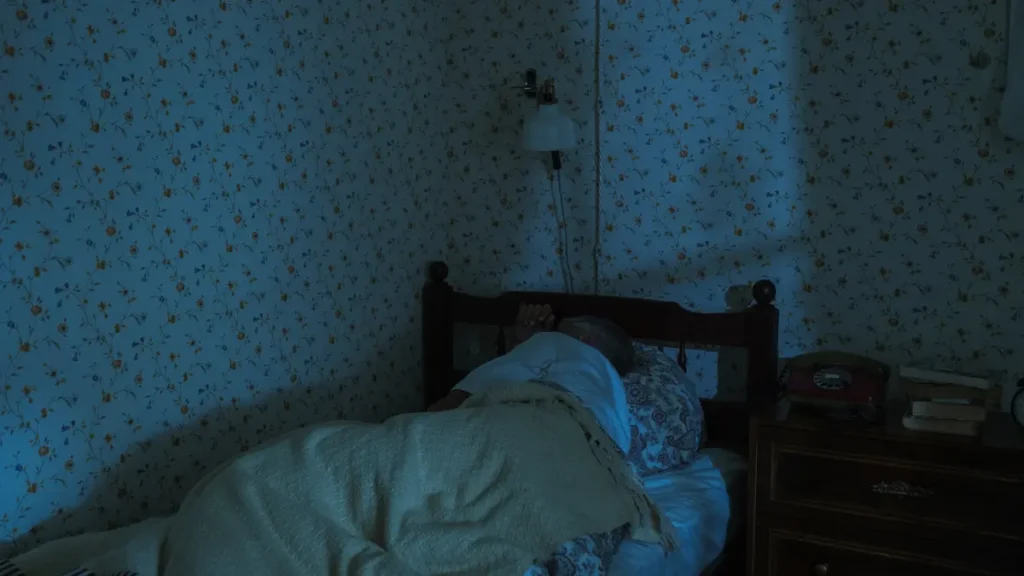
It’s worth experimenting to find your own comfortable range rather than chasing one fixed number.
On blue light: research actually suggests the opposite of what many assume. Age-related changes in the eye, such as a yellowing lens and a smaller pupil, mean older eyes let in less blue light overall, so melatonin suppression from screens may be less pronounced in older adults than in younger ones.⁷ Even so, limiting screens before bed remains a reasonable habit for winding down.
Investigating Underlying Causes: Often, insomnia is a symptom, not the problem. Conditions common in seniors, such as sleep apnea, restless leg syndrome, or chronic pain, are independently associated with insomnia in older adults and should be treated directly.⁸
Treating the pain or the breathing issue often eliminates the need for a sleeping pill entirely.
Rest Without the Risk
The real risk of sleeping pills after 65 isn’t a bad night, it’s what happens the next day while the drug is still working. Falls, memory slips, and slowed reactions don’t announce themselves as medication side effects; they just look like “getting older.”
Talk to your doctor about a CBT-I referral or a supervised tapering plan before your next refill. Good sleep isn’t found in a bottle.
It’s built by understanding what’s actually keeping you awake, and treating that instead.
⚠️DISCLAIMER:
This article is for informational purposes only and does not constitute medical advice, diagnosis, or treatment. The content addresses the risks of sleeping pill use in adults over 65 and safer non-drug alternatives and is intended for general educational purposes only. Health conditions vary significantly between individuals, always consult a licensed physician or qualified healthcare provider before making any decisions about your health or medical care.
References
- Klotz, U. Pharmacokinetics and drug metabolism in the elderly. Drug Metabolism Reviews. 2009. https://pubmed.ncbi.nlm.nih.gov/19514965/
- 2023 American Geriatrics Society Beers Criteria Update Expert Panel. American Geriatrics Society 2023 updated AGS Beers Criteria for potentially inappropriate medication use in older adults. Journal of the American Geriatrics Society. 2023. https://doi.org/10.1111/jgs.18372
- Donnelly, K., Bracchi, R., Hewitt, J., Routledge, P.A., Carter, B. Benzodiazepines, Z-drugs and the risk of hip fracture: A systematic review and meta-analysis. PLoS One. 2017. https://pubmed.ncbi.nlm.nih.gov/28448593/
- Wu CC, Liao MH, Su CH, Poly TN, Lin MC. Benzodiazepine use and the risk of dementia in the elderly population: An umbrella review of meta-analyses. J Pers Med. 2023;13(10):1485. https://pmc.ncbi.nlm.nih.gov/articles/PMC10608561/
- Verster, J.C., Volkerts, E.R. Next-Day Residual Effects of Sleeping Medications on Driving Ability. Sleep Medicine Clinics / Springer. 2006. https://link.springer.com/chapter/10.1007/0-387-27682-3_21
- Qaseem, A., Kansagara, D., Forciea, M.A., Cooke, M., Denberg, T.D. Management of Chronic Insomnia Disorder in Adults: A Clinical Practice Guideline From the American College of Physicians. Annals of Internal Medicine. 2016. https://www.acpjournals.org/doi/10.7326/M15-2175
- Rukmini AV, Milea D, Aung T, Gooley JJ. Pupillary responses to short-wavelength light are preserved in aging. Sci Rep. 2017 Mar 7;7:43832. doi: 10.1038/srep43832. PMCID: PMC5339857. PMID: 28266650. https://www.ncbi.nlm.nih.gov/pmc/articles/PMC5339857/
- Peng YT, Hsu YH, Chou MY, Chu CS, Su CS, Liang CK, Wang YC, Yang T, Chen LK, Lin YT. Factors associated with insomnia in older adult outpatients vary by gender: a cross-sectional study. BMC Geriatr. 2021. https://www.ncbi.nlm.nih.gov/pmc/articles/PMC8650339/
- Johnson, L.C., Spinweber, C.L., Webb, S.C., Muzet, A.G. Dose level effects of triazolam on sleep and response to a smoke detector alarm. Psychopharmacology. 1987. https://pubmed.ncbi.nlm.nih.gov/3108921/