

You’re sitting on the edge of the bed, gripping the mattress with both hands. The room isn’t spinning, but it feels like the floor just dropped an inch. Your vision dims for a heartbeat, and you wait for the “gray” to clear before you dare take that first step toward the bathroom.
If you’re over 50, you might have told yourself this is just what getting older feels like. You might even worry it’s a quiet warning of a looming stroke.
It’s usually neither. While brief lightheadedness becomes more common as we age, it is not a “normal” symptom you have to ignore or accept.
What you’re feeling is a “hydraulic delay” in your circulation. When you stand, gravity pulls nearly a liter of blood toward your legs. In a younger body, internal sensors snap into action, tightening your veins to push that blood back up to your brain.
After 50, those sensors can get a little sluggish. This delay has a name “orthostatic hypotension” and while it feels scary, it is remarkably manageable. You don’t have to feel fragile every time you wake up. By adjusting how you rise and how you hydrate, you can clear the morning fog and stand with total confidence.
The 60-Second Morning Protocol to Stop Dizziness
You feel dizzy standing up because of orthostatic hypotension, a temporary drop in blood pressure when changing positions. After 50, your “baroreflex” sensors slow down, causing blood to pool in your legs instead of reaching your brain. To stop it, use the “Three-Stage Rise”: sit up slowly, dangle your feet for 30–60 seconds, and flex your calves before standing.
Stage 1: The Transition
Before you even think about the floor, sit up in bed and lean against your headboard or pillows. Stay here for 30 seconds. This allows your heart to adjust to a semi-upright position without the full weight of gravity pulling on your lower limbs.
Stage 2: The “Dangle”
Swing your legs over the edge of the mattress. Do not stand up yet. Let your feet hang freely for 30 to 60 seconds. This is the most critical step because it “primes” your vascular system to handle the shift in pressure before you commit to a full standing posture.
You’re doing this right if your head feels clear and your breathing remains steady while your feet are dangling.
Stage 3: The Muscle Pump
While dangling your feet, pump your ankles up and down ten times. Then, squeeze your thigh muscles tightly three times. These “muscle pumps” physically squeeze the veins in your legs, forcing blood upward toward your heart and brain before you take your first step.
You’re doing this right if you feel a slight warmth in your legs or a subtle sense of being “grounded” as you finally stand.
These steps work because they address a common lag in your circulation. By breaking the movement into parts, you give your body the time it needs to catch up. But none of this works if you’re making the dehydration mistake most people don’t discover until their second dizzy spell.
Why Your Internal Hydraulics Slow Down After 50
Your body has an internal pressure sensor called Baroreflex Sensitivity [a thermostat for your veins]. When you stand, these sensors normally tell your heart to beat faster and your vessels to tighten instantly. This prevents blood from pooling in your legs and keeps your brain oxygenated.
As you age, these sensors can become less responsive. Think of it like an old thermostat that takes a few minutes to realize the room has gotten cold. By the time it kicks the heat on, you’re already shivering, or in this case, feeling lightheaded.
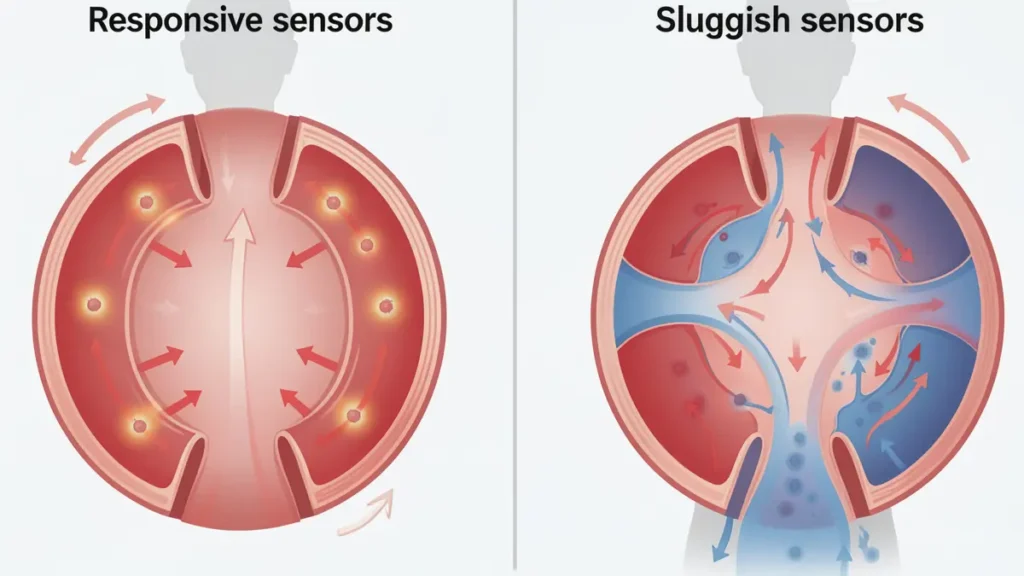
This “hydraulic delay” is often worse in the morning because your blood volume is at its lowest point of the day. You’ve spent eight hours losing fluids through breathing and skin evaporation without a single sip of water to replace them.
When you combine “sleep-dry” blood with sluggish sensors, your blood pressure can’t rebound fast enough to fight gravity. The result is that momentary dimming of vision as your brain briefly starves for oxygen.
But while many people assume this is just a blood pressure issue, it could actually be a balance problem in disguise.
Morning Vertigo vs Dizziness: Know the Difference
It is vital to distinguish between a “head rush” and true vertigo. If you feel lightheaded, faint, or like you’re floating, you are likely experiencing a blood pressure drop. This usually clears up within sixty seconds of sitting or standing still.

True vertigo feels like the room is spinning, tilting, or whirling around you even when your eyes are closed. This is rarely a blood pressure issue. Instead, it often stems from the inner ear, where tiny calcium crystals have shifted out of place while you slept.
- Dizziness (BP Related): Feels like you might pass out; vision may go dark; improves when you sit back down.
- Vertigo (Ear Related): Feels like you are on a merry-go-round; often accompanied by nausea; doesn’t improve just by sitting.
If your “dizziness” includes a spinning sensation that lasts for several minutes or occurs when you simply roll over in bed, the 60-second protocol won’t be enough. You may be dealing with BPPV [benign paroxysmal positional vertigo], which requires different physical movements to fix.
Even if your ears are fine, your breakfast habits might be sabotaging your stability.
Common Mistakes: The “Dry Start” and High-Carb Traps
The biggest mistake most people over 50 make is the “Dry Start.” This is when you wake up, stand up, and head straight for the coffee pot before drinking any plain water. Coffee is a diuretic [a substance that flushes fluid], which further thins your already depleted blood volume.

Another hidden trigger is Postprandial Hypotension [a blood pressure drop after eating]. If you follow your morning dizziness with a high-carb breakfast like toast, cereal, or pancakes, you might feel a second wave of lightheadedness 30 minutes later.
When you eat a heavy load of carbohydrates, your body diverts a massive amount of blood to your digestive tract to process the sugar. In a younger body, the rest of the system compensates. After 50, this diversion leaves even less blood for your brain, making you feel weak or “foggy” an hour after breakfast.
Comparison of Morning Triggers
| Trigger | Timing | Why it happens |
| Orthostatic | Immediate (0-2 mins) | Gravity pulls blood to legs |
| Dehydration | All morning | Low blood volume from sleep |
| Postprandial | 30-60 mins post-meal | Blood diverted to digestion |
If you notice you feel fine while standing but get ‘wobbly’ again after your morning oatmeal, your breakfast choice is the likely culprit.
The real fix happens at 10 PM the night before, and most people skip this step entirely
When Morning Dizziness Is a Red Flag — And When to See a Doctor
A red flag for dizziness is any symptom that suggests a problem with your heart rhythm or neurological system rather than just a simple blood pressure lag. If your dizziness lasts longer than three minutes after standing, it is no longer considered a typical “hydraulic delay” and requires a medical evaluation.
You can tell if your dizziness is heart-related if it is accompanied by chest pain, palpitations, or if you actually faint and lose consciousness. Seek a neurologist if your dizziness comes with slurred speech, numbness, or double vision. Consult an ENT [ear, nose, and throat specialist] if you feel a persistent spinning sensation or have ringing in your ears.
Warning Signs to Watch For:
- Fainting or “blacking out” completely.
- Severe headaches or sudden confusion.
- Dizziness that does not improve after sitting back down.
- Shortness of breath or a racing heart.
If you experience chest pain, fainting, or sudden confusion , do not wait. Seek emergency care immediately.

Advanced Action Plan: Salt, Water, and Leg Strength
To stop the morning head rush permanently, you need to increase your total blood volume. This starts with the Salt Paradox. While we are often told to avoid salt for heart health, those with morning dizziness actually need a small amount of sodium to “hold” water in their veins overnight.
The Evening Hydration Hack
Drink 8 ounces of water with a tiny pinch of sea salt about an hour before bed. The salt acts like a sponge, helping your kidneys retain fluid rather than flushing it out as urine at 3:00 AM. This keeps your “hydraulics” primed for the morning rise.
The Bed Angle Adjustment
Try propping the head of your bed up by 4–6 inches using sturdy blocks or a wedge pillow. If you don’t have one, stacking a few regular pillows can also create a gentle incline. Sleeping at a slight angle may help reduce fluid buildup overnight by changing how your body redistributes fluids

Your dizziness might also stem from internal shortages. Low Vitamin B12 can damage the nerves that signal your blood vessels to tighten, while an iron deficiency reduces the oxygen your blood carries to your brain. If you feel chronic fatigue or tingling in your hands alongside morning lightheadedness, ask your doctor to check your B12 and ferritin [stored iron] levels to ensure your circulation has the raw materials it needs to function.
Start here if overwhelmed:
- Use the “Three-Stage Rise” (Dangle your feet for 60 seconds) tomorrow morning.
- If that helps, add 8 ounces of water immediately upon waking.
- If it doesn’t, try the evening salt-water hack to boost your blood volume.
These lifestyle shifts provide the foundation, but there are specific moments when you must stop self-treating and call a professional.
Your Questions Anwered
Why do I feel dizzy when I first wake up and stand?
This is typically caused by orthostatic hypotension, where gravity pulls blood toward your feet and your aging circulatory system is too slow to push it back up. This leaves your brain momentarily short on oxygen, creating a lightheaded sensation.
Is morning dizziness a sign of high blood pressure?
Actually, it is usually a sign of a sudden drop in blood pressure. Some medications used to treat high blood pressure can make this drop more severe, so it’s important to monitor your levels with a home cuff.
How can I stop feeling lightheaded when standing up?
The most effective way is to use a staged rising protocol: sit up, dangle your legs for 60 seconds, and pump your calf muscles before standing. Increasing your water and salt intake (with a doctor’s approval) also helps maintain higher blood volume.
When should I worry about dizziness after age 50?
You should seek medical attention if the dizziness is accompanied by chest pain, fainting (actually passing out), or if it lasts longer than a few minutes. These “red flags” can indicate underlying heart or neurological issues that need professional diagnosis.
Conclusion
Morning dizziness isn’t an inevitable part of aging; it’s a manageable hydraulic delay in your circulation. By slowing down your transition from the pillow to the floor, you give your body the “Golden Minute” it needs to recalibrate its pressure.
If you want to stand up with a clear head tomorrow, remember the Dizzy Standing Up Protocol:
- Sit up and lean back for 30 seconds.
- Dangle your feet and pump your calves for 60 seconds.
- Drink 10 ounces of water before your first cup of coffee.
⚠️MEDICAL DISCLAIMER
This content is for informational and educational purposes only and does not constitute medical advice, diagnosis, or treatment. Before making changes to your diet, exercise routine, or supplement regimen, consult a qualified healthcare provider. If you experience chest pain, severe shortness of breath, or sudden numbness, seek emergency medical care immediately.