

You followed every instruction on the bottle. You bought the premium brands. You were consistent, more consistent than you have been with anything in years. And it still did not work.
For adults over 50 who take their supplements faithfully and feel nothing, the problem is rarely the supplement. The labels tell you what to take. They do not tell you that taking Vitamin D with black coffee is nearly the same as not taking it at all. That calcium and iron cancel each other out when swallowed together. That the magnesium sitting on your nightstand would do more if you actually took it at night.
Ellen learned this the hard way. Six months and nearly $500 later. By the end of this article, you will know exactly when to take what, and why the timing was the missing piece the whole time.
| # | Section | What You’ll Find |
|---|---|---|
| 1 | Why Timing Beats Dose | The variable most supplement labels never mention |
| 2 | Why Bodies Change After 50 | The internal shift that turns tablets into passengers |
| 3 | Supplements That Need Food | What your gallbladder has to do with Vitamin D |
| 4 | Minerals That Fight Each Other | The competition happening inside your gut right now |
| 5 | Best Taken at Night | The brain signal most people trigger at the wrong hour |
| 6 | Your Simple Schedule | The three-bucket system nobody taught you |
Why Supplement Timing After 50 Matters More Than Dose
To get results from supplements after 50, you must time them based on how they dissolve. Take fat-soluble vitamins (A, D, E, K) and Omega-3s with your largest meal containing healthy fats. Take water-soluble vitamins (B-complex, C) and Iron on an empty stomach, 30 minutes before eating or two hours after. Take Magnesium in the evening to support muscle relaxation and sleep.
The Morning Protocol (Empty Stomach)
If you take a B-complex or Vitamin C, do it first thing in the morning. These vitamins need water to move through your system. Taking them with a large glass of water, and waiting 30 minutes before your first cup of coffee, ensures they don’t have to compete with food for space in your gut.

You’re doing this right if you feel a steady lift in focus by mid-morning rather than a sharp spike and crash.
The Mid-Day/Largest Meal Protocol
This is where most people make a mistake. Vitamin D, Vitamin K2, and Fish Oil are “fat-soluble.” This means they need fat to act as a carrier. If you take them with black coffee or a piece of dry toast, your body can’t grab onto them. They simply pass through you. Pair these with a meal that includes avocado, olive oil, eggs, or nuts.

You’re doing this right if your lab results finally start to trend upward after months of staying stagnant.
The Nighttime Protocol
Magnesium is the “relaxation mineral.” Taking it at night helps calm the nervous system. However, if you are also taking Calcium for bone health, do not take them at the exact same time. They use the same “doorway” to enter your cells, and Calcium usually wins the race, leaving the Magnesium behind.
You’re doing this right if you find it easier to drift off without that “tight” feeling in your legs or back.
But even a perfect schedule fails if your body isn’t actually capable of pulling the nutrients out of the capsules.
Why Your Body Absorbs Differently After 50
As we age, the environment inside our stomach changes. The most significant shift is a decrease in stomach acid [hypochlorhydria]. Stomach acid is the “key” that unlocks vitamins from their pill form. Without enough acid, a tablet might travel halfway through your digestive tract before it even begins to break down.
This matters because your “absorption window” is shorter than it used to be. Most nutrients are absorbed in the first section of the small intestine. If your supplement hasn’t dissolved by the time it reaches that window, you’ve missed your chance.
Think of your digestive tract like a fast-moving conveyor belt. If the package isn’t open by the time it reaches the “pickup station,” it stays on the belt and goes to the trash. This is why many people over 50 find better results with liquids, powders, or capsules rather than hard-pressed tablets.
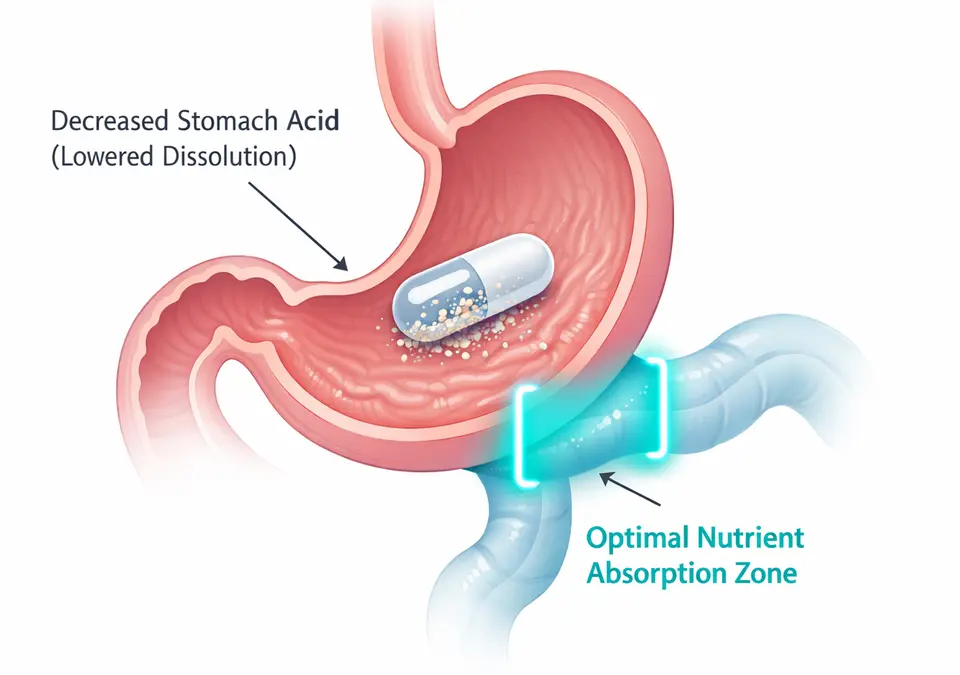
Ellen hit this exact wall. She was taking high-quality tablets, but her digestive system wasn’t “opening the mail” fast enough. What worked in her case won’t be identical to yours, but the underlying pattern of slowing digestion is a biological reality for almost everyone in this age group.
Yet, even if your stomach acid is perfect, a single morning habit could be “clogging” the system entirely.
The Supplements That Need Food to Work
The biggest waste of money in the supplement world is taking Vitamin D on an empty stomach. Because it is fat-soluble, it requires the presence of dietary fat to trigger the release of bile.
The Bile Trigger [Micellization] When you eat fat, your gallbladder releases bile to break that fat into tiny bubbles. These bubbles act like “taxis” that carry Vitamin D through the intestinal wall and into your blood. Without the fat, there is no taxi, and the Vitamin D is left standing on the curb.
To fix this, you don’t need a heavy meal. Just 5g to 10g of fat is enough. This looks like:
- A handful of walnuts
- A spoonful of almond butter
- One whole egg
- A slice of salmon
If you take your “D” with a meal, you can increase your absorption by as much as 50%. If you take it with a fat-free breakfast, you are essentially paying full price for half the benefit.
The real shift shows up when you stop looking at your vitamins as “pills” and start looking at them as “food components.”
The Ones That Fight Each Other
Minerals are competitive. They are like toddlers trying to squeeze through a narrow playground slide; only one can go at a time. This is known as Inhibitor Interaction.
The most common “fights” happen between:
- Calcium and Iron: Calcium is a bully. If you take your calcium supplement with your iron-rich lunch, the calcium will block the iron from being absorbed.
- Zinc and Copper: High doses of zinc over time can “starve” your body of copper because they compete for the same transport proteins.
- Coffee/Tea and Everything: The tannins in tea and the caffeine in coffee act like a “velcro” that sticks to minerals like Iron and Calcium, dragging them out of the body before they can be used.
The 2-Hour Rule: If you take Iron, keep it two hours away from your coffee and your Calcium. This simple gap can be the difference between feeling exhausted from low iron and finally feeling like yourself again.
Yet the mineral that does the most repair work isn’t one most people take at all.
The Ones Best Taken at Night
While most people focus on their “morning energy,” the most important supplements for recovery happen while you sleep. Magnesium and Melatonin (if used) are obvious choices for the evening, but there is a specific reason for the timing of others.
Your body does most of its repair work at night. Taking a low-dose Magnesium Glycinate [glycinate] about an hour before bed supports the parasympathetic nervous system. This is the “rest and digest” mode.
The Sleep-Mineral Loop [GABA Signaling] Magnesium binds to GABA receptors in the brain. GABA is a neurotransmitter that tells your brain to “turn down the noise.” Taking Magnesium at night, you aren’t just helping your muscles; you are signaling to your brain that the day is over.

If you take your Magnesium in the morning, you might feel a bit too relaxed or “heavy” during the day. Move it to 8:00 PM and that relaxation works for you, improving your sleep quality and helping your body process everything else you took during the day.
But that doesn’t explain why some people take everything at the right time and still see no change.
How to Build a Simple Schedule That Works for 50+
You don’t need a complicated spreadsheet to get this right. You just need a three-part “bucket” system.
• Vitamin C
• Iron
• Fish Oil (Omega-3)
• Multivitamin
• Zinc
1. The Bedside Table Bucket (Morning)
Keep your Vitamin B-complex, Vitamin C, and Iron here. Take them the moment you wake up with 8 ounces of water. Do not touch your coffee for at least 30 minutes.
2. The Kitchen “Fat” Bucket (Lunch or Dinner)
Keep your Vitamin D3, K2, Fish Oil (Omega-3s), and Vitamin E here. Take these with your most substantial meal. If you skip breakfast or just have toast, wait until lunch.
3. The Bedtime Bucket (Evening)
Keep your Magnesium and Zinc here. Take them about an hour before you plan to turn out the lights.
Checklist for a “Perfect” Week:
- Monday-Wednesday: Notice if your morning energy feels more stable without the coffee-supplement clash.
- Thursday-Friday: Observe your digestion. Taking fat-soluble vitamins with food often reduces the “nausea” some people feel with Fish Oil.
- Saturday-Sunday: Evaluate your sleep. Does the evening Magnesium ritual help you stay asleep?
The real results aren’t found in a higher dose. They are found in the window of time you choose.
Your Questions Answered
Can I take all my vitamins at once if I eat a big meal?
No. Even with a large meal, minerals like Calcium and Iron will still fight for absorption. It is best to split “empty stomach” vitamins (B, C) from “food-required” vitamins (D, Omega-3).
Does it matter if I use coffee to wash down my pills?
Yes. The caffeine and acids in coffee can speed up digestion too much and bind to minerals, reducing their effectiveness. Use plain water and wait 30 minutes before your latte.
Should I take my multivitamin in the morning or night?
Mid-day with food is usually best. Multivitamins contain both fat-soluble and water-soluble ingredients, so having a little fat in your stomach helps the “D” and “E” while the water you drink helps the “B” and “C.”
What happens if I forget my “empty stomach” window?
Wait at least two hours after you eat. If you take a B-vitamin on a full stomach, it won’t hurt you, but you may not get the full energy-boosting benefit.
Are liquid supplements better for people over 50?
Often, yes. Because stomach acid decreases with age, liquids or “liposomal” sprays bypass the need for heavy mechanical breakdown in the stomach, making them easier to absorb quickly.
Conclusion
The frustration of “wasting money” on supplements is rarely about the quality of the brand. For most adults over 50, the problem is a mismatch between the pill and the clock. Getting supplement timing after 50 right means understanding that your body’s ability to pull nutrients from a capsule isn’t a guarantee. It is a process that requires the right environment, the right cofactors, and the right timing.
Separate your minerals, pair your fats, and give your B vitamins a head start in the morning. That’s when you stop hoping for results and start creating the conditions for them.
Your Supplement Timing Protocol:
- Move your Vitamin D and Fish Oil to your largest meal today.
- Clear a 30-minute gap between your morning vitamins and your first cup of coffee.
- Shift your Magnesium to one hour before bed to support better rest.
You’ve already done the hard part by being consistent. Now, let the timing do the rest.
⚠️DISCLAIMER
This article is for informational purposes only and does not constitute medical advice or a recommendation to use any supplement. The content addresses supplement timing, absorption, and nutrient interactions for adults over 50 and is intended for general educational purposes only. Supplements can interact with medications and may not be appropriate for everyone, always consult a licensed healthcare provider before starting, changing, or stopping any supplement regimen.