

You walked into the kitchen and forgot why you went. Again. You stood there for a second, a little longer than you’d like to admit, and felt that quiet flicker of dread. You might have joked about a “senior moment” later, but in that private silence, you wondered if this was the start of something you couldn’t fix.
If that’s where you are right now, this is for you. Here’s the truth: nutrient deficiency memory loss after 50 is more common than most doctors check for and it’s often entirely reversible. The forgetfulness, the “brain fog,” and the slowed thinking are real. But the cause might not be what you fear. Often, these gaps are entirely reversible.
Elena was 57 when she started writing notes on her hand before calling her daughter. Not because she was busy. Because she kept forgetting what she wanted to say mid-conversation. She mentioned it to her doctor almost as an afterthought. He ordered a B12 panel. Her levels came back low. After addressing the gap, she noticed her thinking felt less like wading through water. Words came faster. She stopped writing on her hand.
Elena’s experience is real and it may not look identical for you. What she noticed after addressing a specific nutrient gap was a shift in her daily clarity. Individual circumstances and medications will shape your outcome.
Use this as a starting point, not a guarantee. Before taking any step described in this article, consult a qualified healthcare professional. What applies generally may not apply to your situation, and acting without professional guidance here carries real risk.
Can a nutrient deficiency cause memory loss?
Yes. Nutrient deficiency memory loss after 50 is a documented, frequently overlooked condition. Deficiencies in B12, folate, and vitamin D can produce symptoms identical to age-related memory loss including forgetfulness, brain fog, and slowed thinking. Unlike dementia, these are functional gaps. Restore the missing nutrients and the symptoms often lift.
While we often associate memory slips with permanent changes in the brain, nutrition-related forgetfulness is different. It is a functional issue, meaning the brain has the capacity to work correctly but lacks the chemical tools to do so. When you restore those tools, the “fog” often lifts.
Normal aging might make you slower to recall a name. Dementia affects your ability to function day to day. What nutrient deficiencies affect is different from both. It’s the speed and clarity of retrieval, not the memory itself.
But the most common culprit is a vitamin your body becomes less efficient at absorbing every single year after 50.
The “Master” Brain Nutrient: Why B12 Matters
Your brain uses B12 to maintain the protective coating around your nerves, called the myelin sheath [a fatty layer that insulates nerve fibers]. Think of it like the plastic insulation on an electrical wire. When it wears thin, signals slow down and words stop coming.
As we age, our stomachs produce less acid, which is required to break B12 away from the proteins in our food. You might be eating enough B12, but your body isn’t “unlocking” it. This creates a silent gap where your blood levels might look “normal” on a standard test, even though your brain tissue is starving for fuel.
Elena noticed this exact frustration. She could remember things from twenty years ago, but forgot what she told her daughter twenty minutes ago. It wasn’t that her memory was “gone.” It was that the retrieval system was lagging. What worked in her case won’t be identical to yours, but the underlying pattern of “slow retrieval” is a classic sign of this specific gap.
But eating more B12-rich food often won’t fix it. The problem isn’t what you eat, it’s what your body can no longer absorb.
The Folate Connection and the “Signal Clog”
When you don’t have enough folate, a compound called homocysteine [an amino acid] builds up in your blood. High levels damage the small blood vessels in the brain and interfere with how clearly you think and recall information.
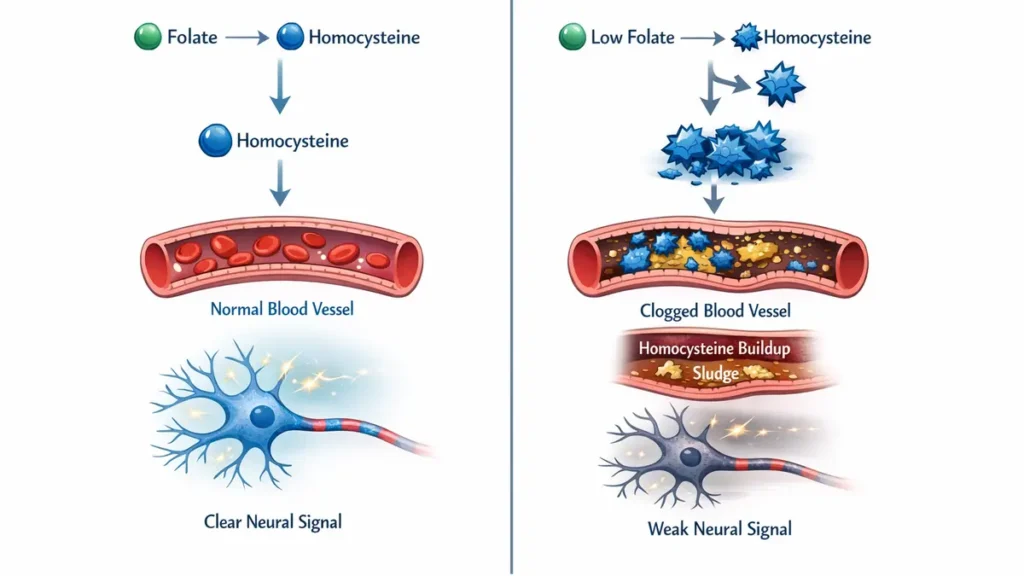
Without enough folate to keep the “sludge” at bay, your brain’s communication lines get clogged. This often feels like:
- Losing your train of thought mid-sentence.
- Feeling “dimmed down” or less sharp than usual.
- Irritability or low mood that accompanies the forgetfulness.
Many people over 50 reach for more caffeine to cut through this feeling, but caffeine only masks the symptoms. It doesn’t clear the chemical clog that low folate creates.
That still doesn’t explain why some people on a perfect diet are still forgetting things.
The Silent Drain: How Common Medications Deplete Your Brain
Many of the most common medications prescribed to adults over 50 have a side effect that is rarely mentioned: they “rob” your body of the very nutrients your brain needs to stay sharp. This is known as medication-induced depletion.
Two major groups of drugs are famous for this:
- Acid Reflux Medications (PPIs): Drugs that reduce stomach acid also block your ability to absorb B12. If you’ve been on these for years, your “memory loss” might actually be a long-term B12 gap.
- Metformin: This common blood sugar medication can interfere with B12 absorption in the intestines.

When your medication creates the gap, no amount of “brain games” or puzzles will fix the forgetfulness. Your brain’s “wiring” is physically missing the nutrients it needs to maintain its signals. This is often where the “senior moment” excuse fails because the cause isn’t age, it’s a chemical side effect.
That’s the physical trigger. What surprises most people is that their doctor probably never flagged it.
Vitamin D: The “Brain Hormone” Most Doctors Miss
We usually think of Vitamin D for bone health, but your brain is actually covered in Vitamin D receptors [specialized “locks” on cells that only a specific nutrient can open]. In the brain, Vitamin D acts like a cleaning crew. It helps clear out plaques and supports the growth of new neurons [brain cells].
When you are low on “D,” your brain’s ability to repair itself and process new information slows down. Because we spend more time indoors as we age, and our skin becomes less efficient at making Vitamin D from sunlight, this deficiency is incredibly common after 50.
If you feel like your memory slips are worse in the winter or that your “brain fog” is accompanied by bone aches or a heavy feeling in your limbs, this could be the missing piece.
Knowing these gaps exist is the first step. The second step is knowing exactly what to ask for at your next appointment.
Your Action Plan: What to Ask Your Doctor
Don’t wait for your annual physical to bring this up, and don’t accept “it’s just part of getting older” as an answer if you haven’t had a nutrient panel done. You are looking for specific numbers, not just a “you’re fine” phone call.
The “Memory Gap” Blood Panel

Request these four specific tests to rule out a nutrient-related cause:
| Test Name | What It Checks | Why It Matters |
| Serum B12 | Total B12 in blood | The baseline for nerve health. |
| Methylmalonic Acid (MMA) | Tissue-level B12 | The “gold standard” to see if your brain is actually getting the B12. |
| Homocysteine | “Sludge” levels | High levels suggest a folate or B12 deficiency. |
| 25-Hydroxy Vitamin D | Storage Vitamin D | Shows if you have enough “repair fuel” for brain cells. |
Once you have these results, look at where you fall. Many labs list a “normal” range for B12 as 200–900 pg/mL, but many neurologists prefer to see patients over 50 stay above 500 pg/mL for optimal memory.
Get the test. Without that number, everything else in this article is just theory.
Your Questions Answered
Can vitamin B12 deficiency cause memory problems?
Yes. B12 is essential for maintaining the insulation around your nerves. When that insulation is damaged due to low levels, nerve signals in the brain slow down, causing symptoms that look like early dementia but are often reversible with treatment.
What nutrient deficiencies cause brain fog?
Brain fog is most commonly linked to deficiencies in B12, Vitamin D, and Folate. These nutrients regulate neurotransmitter balance and blood flow to the brain; without them, you may feel mentally “cloudy” or unable to focus.
What blood tests check for memory-related deficiencies?
Ask your doctor for four specific tests: Serum B12, Methylmalonic Acid (MMA), Homocysteine, and 25-Hydroxy Vitamin D. Standard panels often miss subclinical deficiencies. These four give you the full picture
Can low vitamin D affect memory?
Yes. Your brain contains vitamin D receptors throughout its tissue. When levels drop, the brain’s ability to repair itself and process new information slows. This produces symptoms that feel like mental cloudiness or forgetfulness, particularly in winter months.
What medications deplete B12?
The most common medications that lower B12 levels are Proton Pump Inhibitors (PPIs) for acid reflux, H2 blockers, and Metformin for blood sugar management. If you take these daily, it is important to monitor your B12 levels closely.
Conclusion
Memory slips after 50 don’t have to be a source of constant anxiety. While we are taught to fear the worst, the reality is often much more manageable: a simple nutrient deficiency memory loss after 50 is a common, documented, and frequently treatable condition. Check for gaps in B12, folate, and Vitamin D. That alone takes the dread out of the equation and replaces it with data.
If you have been blaming yourself for “losing your edge,” stop. You weren’t doing anything wrong; you might just be missing a few key ingredients.
Your Memory Health Protocol:
- Audit your cabinet: Check if your medications (like PPIs or Metformin) are known B12-depleters.
- Request the panel: Book an appointment and specifically ask for the Serum B12, MMA, and Vitamin D tests.
- Track your “fog”: Keep a 3-day log of when you feel most forgetful to show your doctor.
⚠️MEDICAL DISCLIAMER
This content is for informational and educational purposes only and does not constitute medical advice, diagnosis, or treatment. Before making changes to your diet, exercise routine, or supplement regimen, consult a qualified healthcare provider. If you experience sudden, severe memory loss, confusion, or a sudden change in personality, seek emergency medical care immediately.