That slow, heavy feeling that shows up a full day after your workout, the one that no amount of sleep seems to touch, is not a sign you didn’t try hard enough. It’s not a sign of anything you did wrong at all.
If you’re over 50 and finding that the same walk or workout that once left you refreshed by morning now leaves you drained for two or three days, the problem is not your effort.
Why exercise feels more exhausting after 50 comes down to what’s happening inside your cells while you rest, not what you did during the workout itself.¹
Why Read This
- Discover why staying fit doesn’t guarantee faster recovery after 50.
- Find out which part of your recovery responds to training and which part doesn’t.
- Learn what actually changes inside your body after 50 that most fitness advice overlooks.
The Fatigue That Shows Up a Day Later
You finish the workout feeling fine. It’s the next afternoon that hits different: a heaviness in your legs, a tiredness that sleep didn’t fix, a pull toward the couch you didn’t feel at 40. That delay is the first clue that something other than effort is running this show.
Most people assume soreness and fatigue peak right after exercise, then fade. After 50, the pattern often shifts.¹
The tired feeling can build over 24 to 48 hours, then linger. You didn’t push harder than usual. Your body is just processing the session on a slower clock than it used to.
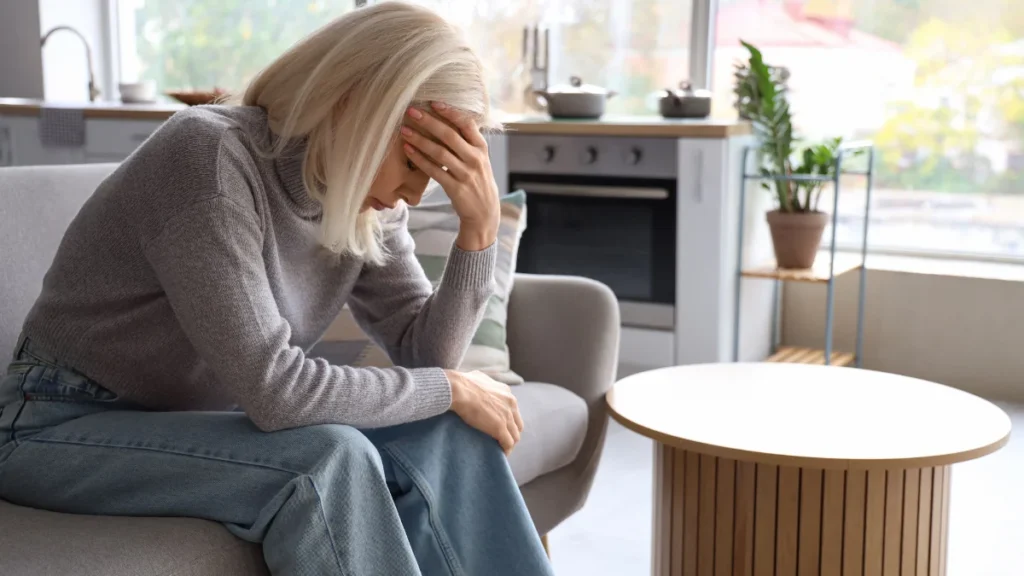
This isn’t about being out of shape. Plenty of people who exercise consistently, sometimes for decades, notice this same lag showing up more and more.
If you’ve caught yourself wondering whether you’re overtraining, or whether your body has simply started keeping score differently, you’re not imagining it. Why exercise feels more exhausting after 50 has an answer, and it isn’t your discipline.
What follows is what that delay is actually made of, and why pushing harder or resting more doesn’t always fix it the way it used to.
The Energy System That Slows Down on Its Own Schedule
The tiredness you feel a day later starts inside your cells, in structures called mitochondria [the parts of a cell that turn oxygen and fuel into usable energy]. After 50, these structures produce energy less efficiently, even in people who exercise regularly.¹
Even the fit ones.
A 2021 study comparing young and older adults found that muscle mitochondrial function was lower in older adults even when their physical activity levels were well above general recommendations.¹
The same research found that older adults who trained for endurance still showed a decline in mitochondrial energy production compared to similarly trained younger adults.¹
Being fit didn’t cancel it out. It only slowed it down.
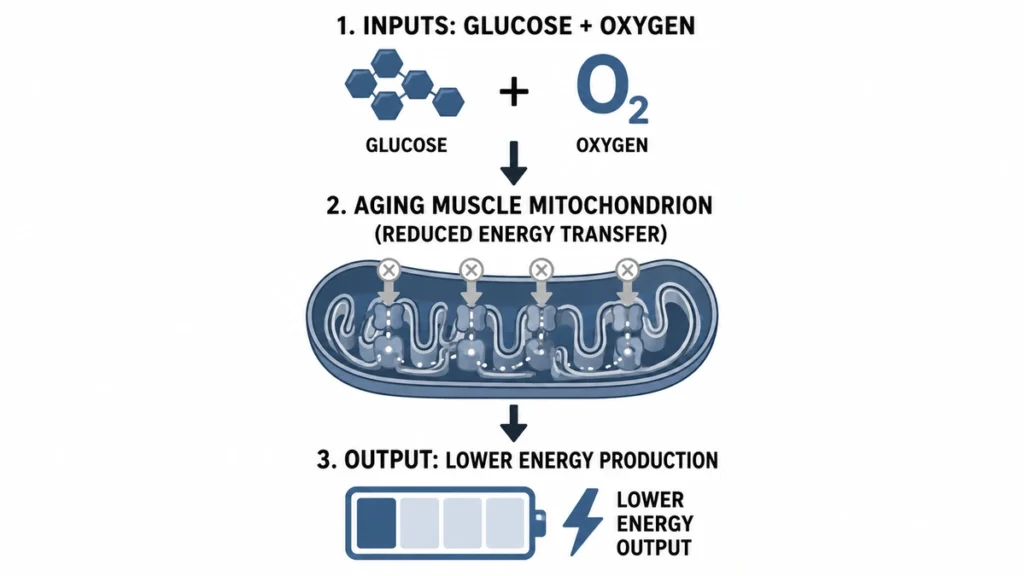
Your muscles are not tired because you pushed too hard. They are tired because the machinery that turns oxygen into usable energy is running at a lower capacity than it did ten years ago, even if you have exercised every single day since.¹
Ten years of consistent training, and the machinery still slows down anyway.
The same research found that even older adults who exercise regularly have lower mitochondrial function than young adults with similar daily step counts.¹ Fitness helps. It was never going to be the whole answer.
Why Your Recovery Response Runs Slower Too
Here’s what that means for the day-after ache you can’t sleep off: it’s not just your energy system running slower. Your recovery response is running behind schedule too, and no single study has tested both slowdowns together as one chain. Each has been proven on its own.
A narrative review of exercise recovery in older adults found that aged muscle appears to show delayed, prolonged, and inefficient recovery after exercise, linked to a combination of anabolic resistance, stiffer connective tissue, and unresolved inflammation.²
Anabolic resistance [a reduced ability of muscle to rebuild itself in response to exercise or protein] means the repair process itself has slowed down, not just the energy behind it.
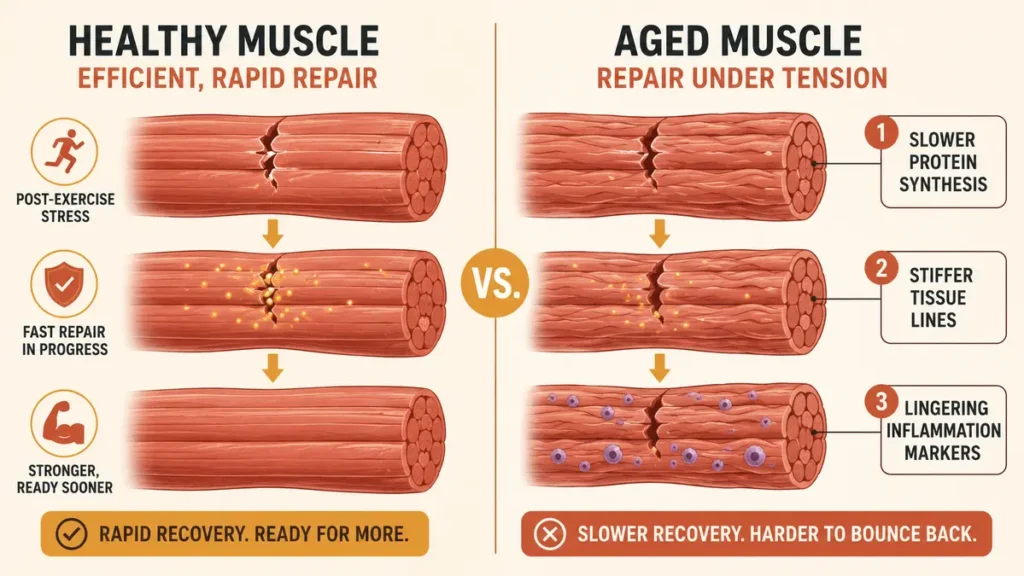
You are probably not overtraining. That instinct to blame your workout intensity or your rest days is aimed at the wrong target. Your body’s repair crew is simply showing up later to the job.
The inflammation piece is where the evidence gets messier. A study measuring healthy older adults directly found no meaningful difference in exercise-triggered anti-inflammatory activity between fitter and less-fit participants, which suggests fitness level alone does not explain why this response can run blunted in older age.³
Researchers have not settled on a single clear pattern here, and that uncertainty matters more than a tidy answer would.
What is consistent, across the studies that do agree, is the timeline. Recovery in older adults isn’t just slower start to finish. It stretches out and stays incomplete longer, which is the direct-experience version of the fatigue you feel a day or two after a hard session.²
What Fitness Level Does and Does Not Change
You can be in the best shape of your life after 50 and still feel this lag. That’s not a contradiction. It’s the honest answer nobody puts in a headline.
Fitness does change some things. Exercise-trained older adults showed roughly 30 percent higher mitochondrial respiration compared to older adults with normal activity levels in the same study that found the overall age-related decline.¹
That’s a real, meaningful difference. It’s also not a full reversal. The decline compared to younger adults was still present in the trained group, just smaller.
Data from the National Institute on Aging’s long-running study of human aging shows that muscle strength and power decline slowly at first, then accelerate after age 65 for women and age 70 for men, though an active lifestyle can substantially slow that decline.⁴ Fitness moves the timeline. It does not erase it.
So what does exercise recovery time after 50 actually depend on. Partly training history, partly genetics, partly how well you’re sleeping and eating, and partly a biological clock that runs regardless of any of it.¹
If you’ve been chasing the idea that the right program would make the fatigue disappear entirely, that idea was never going to hold up against what’s happening at the cellular level.
A Simple Way to Track What’s Actually Happening
If the fatigue feels unpredictable, that’s often because you’re only tracking the workout, not what happens after it. Recovery time is the more useful number.
Talk to your doctor before changing your exercise routine significantly if you’re managing a chronic condition, taking medication, or recovering from an injury.
A simple way to see your own pattern:
- Note the date and type of workout right after you finish.
- Rate how you feel the next morning on a one-to-five scale.
- Rate how you feel 48 hours later on the same scale.
- Write down anything unusual: poor sleep, stress, illness, a new medication.
- After three or four sessions, look for a pattern rather than judging any single day.

This costs five minutes a week and gives you something a single “I feel tired” complaint never can: a pattern you can actually act on, or bring to a doctor if something looks off.
When Delayed Fatigue Signals Something Else
If your fatigue follows a predictable shape, sore a day later, better within two or three days, gone by the next workout, it fits everything described so far. If it doesn’t follow that shape, that’s worth paying attention to.
The National Institute on Aging notes that while fatigue is a normal response to physical activity and can also come from stress or poor sleep, it can sometimes signal an underlying medical condition, and tiredness that continues for multiple weeks is a reason to see a doctor.⁵
A few patterns worth mentioning to a doctor rather than working around on your own:
- Fatigue that shows up without a clear trigger, not tied to a workout at all.
- Exhaustion that doesn’t improve no matter how much you rest.
- Tiredness lasting more than two or three weeks straight.
- New fatigue paired with chest pain, shortness of breath, or dizziness.

None of this means the delayed soreness from your Tuesday workout is a red flag. It almost certainly isn’t. The distinction is duration and pattern, not the fact that you feel tired at all.
Your Cells Are Aging, Not Your Willpower
The single most important thing to remember: why exercise feels more exhausting after 50 has nothing to do with effort. It comes down to slower energy production and a slower recovery response, both running on their own timeline.
Track your recovery time after your next three workouts, not just the workout itself, and bring that pattern to your doctor if it consistently runs past 48 hours.
Effort was never the missing piece. Your body is doing exactly what aging cells do, and staying active still matters, even though it won’t make that timeline disappear.
⚠️DISCLAIMER:
This article is for informational purposes only and does not constitute medical or professional fitness advice. The content addresses why exercise recovery slows down after age 50 and is intended for general educational purposes only. Exercise carries inherent risk, consult a qualified healthcare or fitness professional before beginning or modifying any training program, particularly if you have an existing injury or medical condition.
References
- Grevendonk L, Connell NJ, McCrum C, Fealy CE, Bilet L, Bruls YMH, Mevenkamp J, Schrauwen-Hinderling VB, Jorgensen JA, Moonen-Kornips E, Schaart G, Havekes B, de Vogel-van den Bosch J, Bragt MCE, Meijer K, Schrauwen P, Hoeks J. Impact of aging and exercise on skeletal muscle mitochondrial capacity, energy metabolism, and physical function. Nature Communications. 2021. https://www.nature.com/articles/s41467-021-24956-2
- Li DCW, Rudloff S, Langer HT, Norman K, Herpich C. Age-Associated Differences in Recovery from Exercise-Induced Muscle Damage. Cells. 2024. https://www.ncbi.nlm.nih.gov/pmc/articles/PMC10854791/Windsor MT, Bailey TG, Perissiou M, Meital L, Golledge J, Russell FD, Askew CD. Cytokine Responses to Acute Exercise in Healthy Older Adults: The Effect of Cardiorespiratory Fitness. Frontiers in Physiology. 2018. https://www.frontiersin.org/journals/physiology/articles/10.3389/fphys.2018.00203/full
- Windsor MT, Bailey TG, Perissiou M, Meital L, Golledge J, Russell FD, Askew CD. Cytokine Responses to Acute Exercise in Healthy Older Adults: The Effect of Cardiorespiratory Fitness. https://www.nia.nih.gov/news/how-can-strength-training-build-healthier-bodies-we-age
- National Institute on Aging. How can strength training build healthier bodies as we age? 2022. https://www.nia.nih.gov/news/how-can-strength-training-build-healthier-bodies-we-age
- National Institute on Aging. Fatigue in Older Adults. 2023. https://www.nia.nih.gov/health/fatigue/fatigue-older-adults