

You finished the workout. You did the right thing. And now, two days later, you feel worse than you did before you started: heavy, flat, unmotivated, maybe a little irritable. Part of you wonders if exercise is actually working for you anymore.
That feeling is not failure. It is not aging catching up. For adults over 50 who exercise regularly, it may be something far more specific: cortisol that your body produced during the last session and never fully cleared, sitting in your system when the next workout piled more on top.
Exercise recovery after 50 is not just about sore muscles. It is about a hormonal pattern that changes with age in ways most exercise advice never addresses.
Why Read This
- Why feeling worse after exercise can signal a cortisol shift, and what that means for your next session
- The one morning marker that shows whether your body has cleared its training stress, and why it matters more after 50
- What training out of debt looks like, and why the fix is not less exercise but different timing
- How rest earns the same physiological return as a workout, once you understand what the body does during it
This article is for informational purposes only and does not constitute medical advice. The research discussed involves different populations and study designs and findings may not apply to every individual. Consult your doctor or a qualified exercise professional before making changes to your training, especially if you have a chronic health condition.
Why You Feel Worse, Not Better, After a Workout
You push through a workout feeling proud of yourself, and then the next 48 hours feel like a punishment.
The tiredness is different from ordinary fatigue. It sits behind your eyes. It makes you shorter with people. It does not lift after a good night’s sleep.
If this sounds familiar, you are not imagining it, and you are not fragile.

Cortisol is the body’s primary stress hormone. Every workout triggers a cortisol spike: your body reads physical exertion as a stressor and responds accordingly, raising cortisol to free up energy, sharpen focus and drive blood to working muscles.
That is normal and necessary. The problem arises in the hours and days that follow, when that cortisol is supposed to clear and the body is supposed to recover.
Exercise recovery after 50 depends on how completely that clearing happens before the next session.
Research in healthy aging men found that low cardiorespiratory fitness is associated with a higher total daily cortisol output compared to high-fit peers: an area under the curve of 131.59 versus 77.24 in the fitter group, a difference that held after adjusting for age and body mass index.¹
Fitness is not just the result of training well. This relationship runs in both directions. It reflects whether the body has been given enough space between sessions to clear the cortisol each session produced.
That post-workout heaviness is not a mystery. It is a signal worth learning to read.
How Cortisol Debt Builds Between Sessions
Most people think about exercise as discrete events: Monday’s workout, Wednesday’s run, Friday’s weights. The body does not. It is running a continuous accounting of stress and recovery, and cortisol is the currency.
When Monday’s cortisol clears before Wednesday’s workout begins, the account is settled. When it does not, Wednesday’s session charges against a balance that is already negative.
The workout you did yesterday is still inside you today, and if its cortisol was never cleared, today’s session adds to a debt your body cannot yet pay.
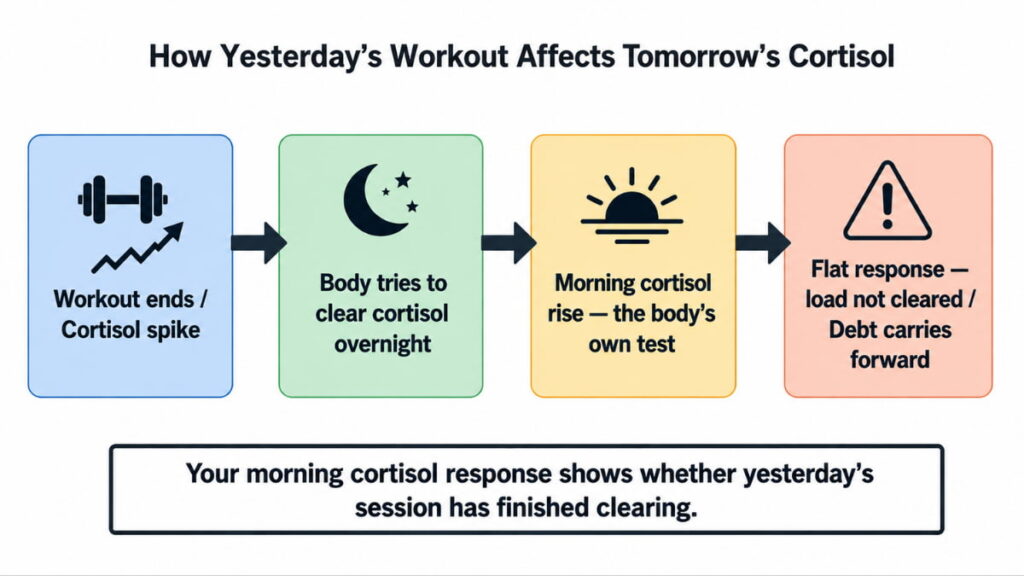
This is not metaphor. Research into overtraining syndrome in male athletes found a measurable disruption to the cortisol awakening response [the sharp rise in cortisol in the first 30 to 45 minutes after waking, which reflects how reactive and well-regulated the HPA axis is that day].²
The CAR showed a time-by-group interaction in overtrained athletes compared to controls, with a beta of negative 9.33 (P less than .001).²
Blunted CAR is what the body produces when the training load has outrun the recovery capacity.
This finding rarely enters standard exercise advice for people over 50. Most people never take a CAR test. But it is the body’s own morning report on whether the previous session was cleared. A muted response means the system is still carrying yesterday’s load into today.
No single study establishes this picture. No one study has tested cortisol debt specifically in adults over 50 who exercise regularly.
What the research shows, taken together, is a convergence: low fitness is associated with higher daily cortisol output, overtraining disrupts the morning cortisol response, and the cortisol-clearance mechanism gets slower with age.
Each of those findings was established in a different population and under different conditions. The argument connecting them is strong but assembled, not proven in one shot.
Between sessions, the body is not building strength. It is building a ledger. And after 50, that ledger closes more slowly than it used to.
The Recovery Gap That Widens After 50
Most people arrive in their fifties expecting the same workout that tired them at 45 to still do the job at 55. And if it does not feel as hard, the impulse is to do more. That logic is understandable. It does not match what the body is actually doing.
Age changes how the HPA axis [the signaling system connecting the hypothalamus, pituitary gland and adrenal glands, which controls cortisol release and the body’s stress response] behaves over a full day.
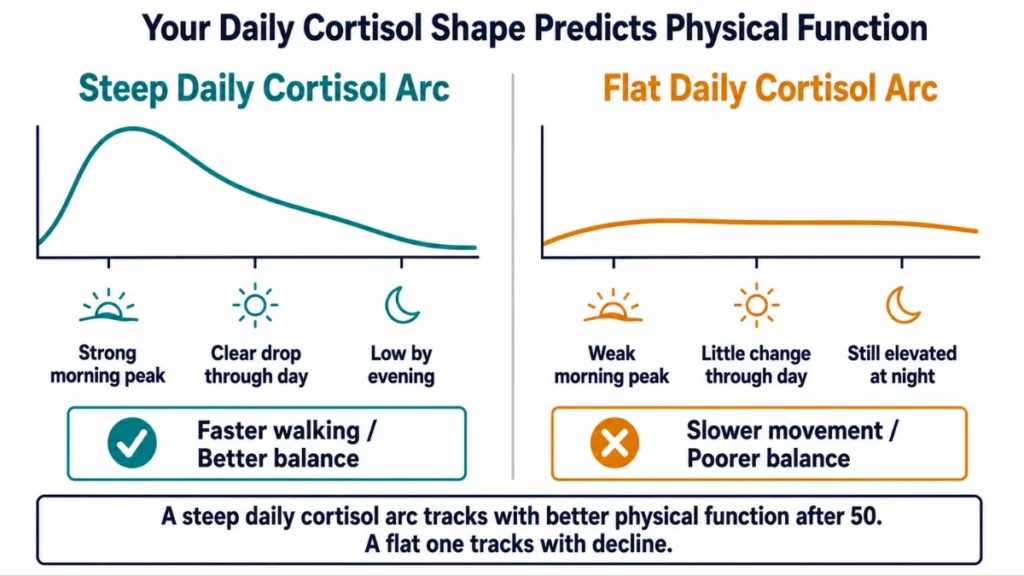
In a meta-analysis of six adult cohorts involving up to 8,448 people aged 50 to 92, researchers found that a flatter daily cortisol decline and higher night-time cortisol were both associated with slower walking speed and poorer balance.³
Larger daily cortisol drops were associated with faster walking speed (effect size 0.052, p less than .001) and quicker chair rise times.³ Generating a cortisol response and then bringing it back down appears to be a marker of physical function in older adults, not just a side effect of it.
Notice what that means: it is not just how much cortisol a workout produces. It is whether the body can mount a strong response and then bring it back down. A flattened arc is the pattern that tracks with slower movement and poorer function.
Feeling worse after exercise is often interpreted as a sign of not working hard enough. The actual data points the other way. When the cortisol pattern flattens, physical performance declines. Adding more training stress to an already-flattened system does not restore the pattern. It deepens it.
What the studies here do not show, directly, is what happens to an average 55-year-old who exercises three days a week and feels worse on the fourth.
Gardner et al. (2013) used a cross-sectional design, meaning it shows associations between cortisol patterns and physical performance, not causes. Reverse causation cannot be ruled out: poor physical function may produce a flatter cortisol pattern rather than the other way around.
The picture is suggestive and consistent, but it is not a controlled experiment.
Recovery gaps widen not because the body gives up. They widen because the machinery for clearing cortisol requires more time than it used to, and standard advice about training frequency does not account for that.
What Your Body Is Actually Telling You
Your muscles are sore two days after a workout and you push through anyway. Your resting heart rate is slightly elevated on the morning of your next session and you lace up regardless. Your sleep has been patchy and you blame the weather.
Each of those signals is the body presenting its recovery ledger, and reading it matters.
Age changes how muscle recovers from exercise, and the change goes deeper than soreness. A 2024 narrative review of aging skeletal muscle found that aged muscle displays delayed, prolonged and inefficient recovery after exercise-induced damage.⁴

The mechanisms behind this are not mysterious. With age, the extracellular matrix [the structural scaffolding surrounding muscle fibers that guides repair and regeneration] becomes stiffer and less responsive to exercise-driven remodeling.⁴ Mitochondrial function declines.⁴
The inflammatory signals that initiate repair fire adequately, but the anti-inflammatory signals that resolve the repair and allow adaptation are slower to arrive.⁴
Inflammation is not the problem with aging muscle recovery. It is that inflammation does not stop when it should. The body’s system for resolving the acute repair phase and moving on to adaptation runs slower. That slowdown is what sits between a workout and the fatigue that follows it two days later.
Aging does not reduce the damage from exercise. It reduces the capacity to resolve it.
These findings come from studies not uniformly drawn from the same population, and recovery timelines varied across the research reviewed.
The extent of the delay differs by exercise type, training history and individual fitness level.
Someone who has trained consistently for years may show more resilient recovery than someone who resumed exercise in their fifties after a long gap.
Three signals that most often mean the body has not cleared the previous session’s load: resting heart rate more than five beats above your normal baseline on a training day; sleep quality that deteriorated in the 48 hours following a workout; and motivation that dropped sharply rather than gradually the day after training.
None of those is diagnostic. All of them are worth tracking.
The body is not complaining. It is reporting.
How to Train Out of Debt, Not Into It
Less exercise is not the answer. Timing is.
A systematic review and meta-analysis of 17 randomized controlled trials found that exercise interventions of at least 12 weeks in adults aged 65 and older may reduce cortisol levels compared to no intervention (standardized mean difference of negative 0.61, 95% confidence interval negative 0.90 to negative 0.33).⁵
The same analysis found that DHEA(S) [dehydroepiandrosterone sulfate, a hormone that counterbalances many of cortisol’s effects on the body] levels may improve with exercise (standardized mean difference of 0.39, 95% confidence interval 0.10 to 0.68).⁵
Subgroup analyses showed no meaningful differences between exercise types, intensities or durations.⁵ The modality does not matter as much as the consistency and the recovery between sessions.
Contrary to what most fitness culture suggests, the recommendation here is simpler: choose activity you enjoy, at an intensity you can sustain, and do it regularly over months rather than seasons. The cortisol benefit accrued to people who moved consistently, not to those who trained hardest.
What this looks like in practice depends on your starting point, your current training load, medications and any conditions your doctor knows about. Talk to your doctor or a qualified exercise professional before changing how you train if you have heart disease, type 2 diabetes, osteoporosis, or any condition that affects how your body handles physical stress.
Train out of debt: a practical framework
Start with two full-body sessions per week and one lower-intensity session at a conversational pace. Keep this for eight weeks before changing anything.
Each training morning, check resting heart rate. More than five beats above your baseline: treat that day as recovery.
Protect sleep. A poor night raises next-day cortisol, so the next workout begins in deficit.
Three or more consecutive days of flat motivation: cut volume by half for one full week.
Broader application is possible but not universal. Experienced endurance athletes in their fifties may tolerate higher volumes than someone returning to exercise after a long break. The principle holds across both groups: the session you recover from is more valuable than the session you push through.
Improving the cortisol pattern also strengthens the DHEA side of the ratio, and that shift compounds over months, not days.
When Rest Is the Training
Rest is not what happens when you skip a workout. It is when the physiological work of training actually gets done.
One meta-analysis of 10 randomized controlled trials found that exercise may reduce cortisol levels (standardized mean difference of negative 0.37, 95% confidence interval negative 0.52 to negative 0.21) and improve sleep quality (standardized mean difference of negative 0.30, 95% confidence interval negative 0.56 to negative 0.04) in adults.⁶
Those two outcomes reinforce each other: lower cortisol supports better sleep, and better sleep creates conditions for lower cortisol the following morning.
One honest limit applies to this picture.
The trials in that meta-analysis were conducted predominantly in adults aged 26 to 64, the majority of whom were women with breast cancer.
No randomized controlled trials meeting that review’s criteria were found in adults over 65.
The direction of effect is consistent with what other evidence suggests about the cortisol-sleep relationship in aging, but it has not been confirmed in a study designed specifically for adults over 50 who exercise regularly. This is a gap worth naming plainly.
Resting is not passive. When the body is given adequate time between sessions, the hormonal system that cortisol disrupts has a chance to reset.

The cortisol:DHEA ratio begins to shift in a more favorable direction. The diurnal cortisol pattern steepens slightly, which the evidence discussed earlier associates with better physical function in older adults.
After 50, a rest day earns something that an extra training session cannot: the chance for the previous session to finish its job.
Each person has to answer one remaining question from their own data. How long does it actually take you to feel ready again? Not eager. Ready. That gap, measured honestly over a few weeks, tells you more about your recovery capacity than any training plan.
The Debt Comes Due Either Way
Feeling worse after exercise past 50 is not a character flaw or a sign the body has given up. Exercise recovery after 50 is a hormonal accounting problem, and the account responds to how you manage it.
Track one recovery metric (resting heart rate or sleep quality) for two weeks before adding any new training load. What you find may be more useful than any new workout program.
What remains open is not whether this matters. It is how much room each person has before the debt outpaces rest.
References
- Lucertini F, Ponzio E, Di Palma M, Galati C, Federici A, Barbadoro P, D’Errico MM, Prospero E, Ambrogini P, Cuppini R, Lattanzi D, Minelli A. High Cardiorespiratory Fitness Is Negatively Associated with Daily Cortisol Output in Healthy Aging Men. PLoS ONE. 2015. https://journals.plos.org/plosone/article?id=10.1371/journal.pone.0141970
- Anderson T, Wideman L, Cadegiani FA, Kater CE. Effects of Overtraining Status on the Cortisol Awakening Response-Endocrine and Metabolic Responses on Overtraining Syndrome (EROS-CAR). International Journal of Sports Physiology and Performance. 2021. https://pubmed.ncbi.nlm.nih.gov/33662935/
- Gardner MP, Lightman S, Sayer AA, Cooper C, Cooper R, Deeg D, Ebrahim S, Gallacher J, Kivimaki M, Kumari M, Kuh D, Martin RM, Peeters G, Ben-Shlomo Y; Halcyon Study Team. Dysregulation of the hypothalamic pituitary adrenal (HPA) axis and physical performance at older ages: An individual participant meta-analysis. Psychoneuroendocrinology. 2013. https://www.sciencedirect.com/science/article/pii/S0306453012001667
- Li DCW, Rudloff S, Langer HT, Norman K, Herpich C. Age-Associated Differences in Recovery from Exercise-Induced Muscle Damage. Cells. 2024. https://www.mdpi.com/2073-4409/13/3/255
- De Nys L, Ofosu EF, Ryde GC, Connelly J, Whittaker AC. Physical activity influences cortisol and dehydroepiandrosterone (sulphate) levels in older adults: a systematic review and meta-analysis. Journal of Aging and Physical Activity. 2022. https://eprints.gla.ac.uk/278293/1/278293.pdf
- De Nys L, Anderson K, Ofosu EF, Ryde GC, Connelly J, Whittaker AC. The effects of physical activity on cortisol and sleep: A systematic review and meta-analysis. Psychoneuroendocrinology. 2022. https://eprints.gla.ac.uk/275029/1/275029.pdf