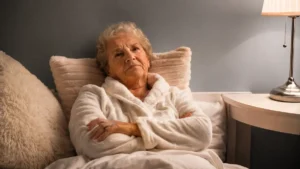
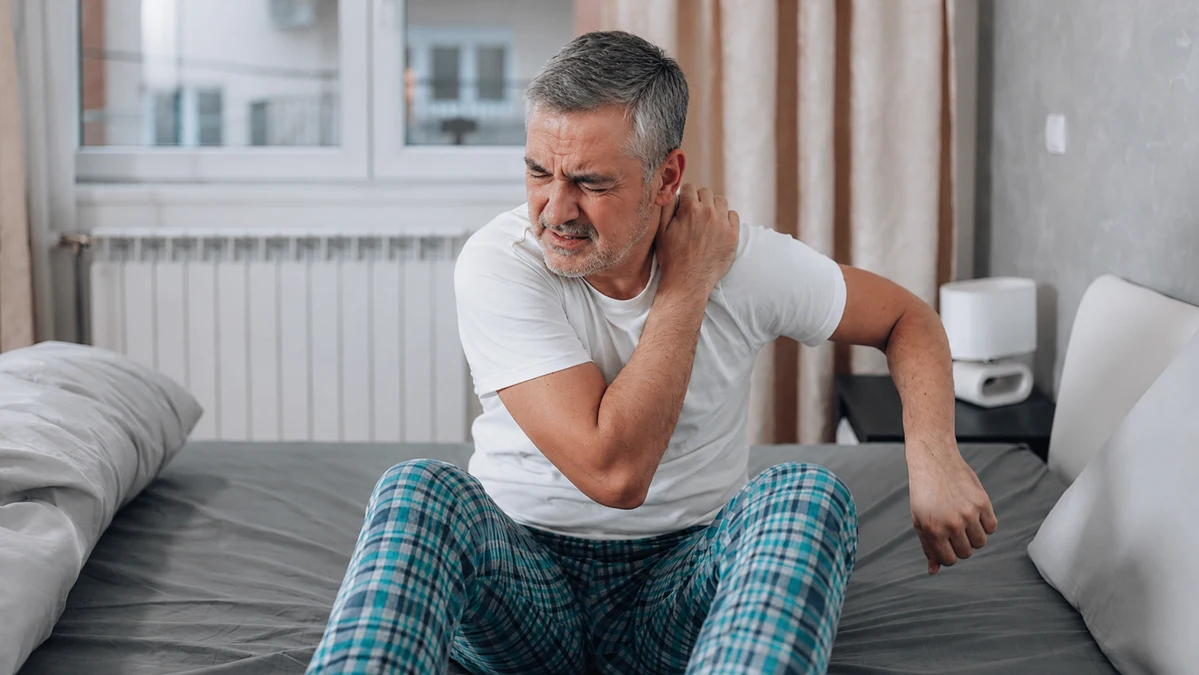
You wake up after seven hours of sleep and still feel like you dragged yourself through the night. Your muscles take longer to stop aching after a workout. The weight around your middle keeps creeping up even though nothing obvious changed.
You are an adult over 50 who wants to understand what is actually happening inside your body while you sleep, and most people in your position have never been told that the hormone responsible for fixing exactly those problems releases almost entirely during one specific sleep stage you are getting less of every year.
That is not a motivational reframe. It is a biological fact that has been in the medical literature for decades and almost never reaches the people who need it most.
Why keep reading:
- The sleep stage tied to growth hormone release begins shrinking years before most people notice. Learn when that window starts closing
- One common evening habit blocks growth hormone secretion by more than 70 percent, even when you sleep through the night
- Your rising evening cortisol after 50 does something specific to your deep sleep that most sleep advice never addresses
- The evidence on what actually protects deep sleep is narrower than supplement ads suggest, and more actionable
What Growth Hormone Actually Does in Your Body After 50
Your muscles ache longer after a walk. Your body moves fat toward your middle no matter what you eat. You feel like recovery takes twice as long as it used to.
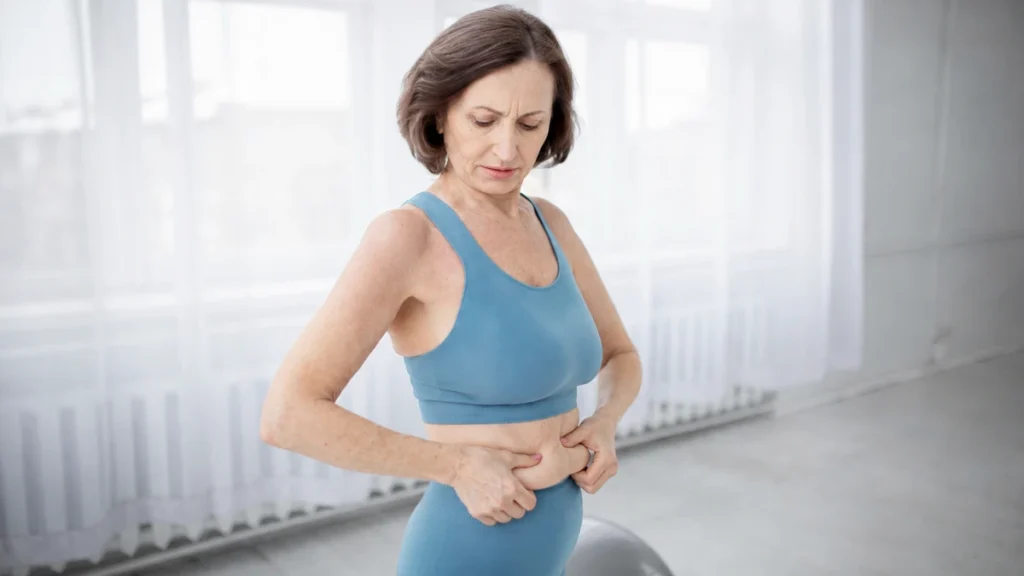
These are not just signs of getting older. They are consistent with what researchers observe when growth hormone levels drop, and for adults over 50, that drop is real and measurable.
Growth hormone [a chemical signal the pituitary gland releases to direct tissue repair, fat breakdown, and muscle maintenance] does not disappear after childhood.
It remains active throughout adult life, maintaining lean body mass, promoting the breakdown of fat (particularly the visceral fat that collects around the abdomen) and supporting cardiovascular and cognitive function.¹
The problem is that in adults, GH secretion declines progressively with age, producing physical changes that closely resemble those seen in younger adults with medically confirmed growth hormone deficiency: less muscle, more visceral fat, reduced aerobic capacity, and altered lipid profiles.¹
In men over 50, lean body mass contracts at an average rate of approximately 0.6 percent per year.² That shrinkage reflects the gradual loss of skeletal muscle, skin thickness, and organ tissue.
These changes are consistent with reduced GH activity, though the causal link is not fully confirmed.¹
Growth hormone secretion falls by approximately 14 percent per decade of adult life, beginning well before most people associate the word “aging” with their bodies.³
That last number matters. Not because it determines your fate, but because it tells you this is not a cliff you fall off in your sixties. It is a slope that has been declining since your thirties, quietly, in the middle of the night.
The Sleep Stage That Drives the Surge (and When It Starts Shrinking)
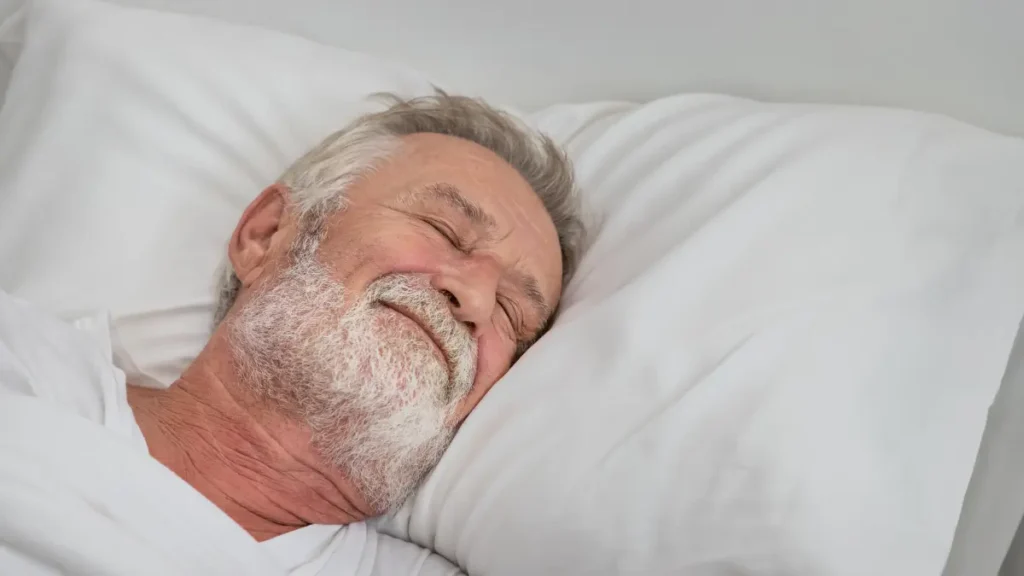
The repair work your body does while you sleep is not evenly distributed across the night.
It concentrates in the first few hours after you fall asleep, locked to a specific stage called slow-wave sleep [the deepest stage of non-REM sleep, identified by large, slow electrical oscillations in the brain, also called N3 or deep sleep], and almost all of the growth hormone released in a 24-hour period depends on this window.⁴
In men, roughly 70 percent of growth hormone pulses during sleep coincide directly with this stage, and the amount of hormone released correlates with how much slow-wave sleep occurs.⁵
Here is what that means in practical terms. If your deep sleep is shallow or short, your GH release is low. Not eventually. That same night.
You have likely noticed that your sleep does not feel as deep as it once did. You wake more often. You drift in and out instead of going under. That experience has a measurable counterpart in the laboratory.
A landmark study published in JAMA in 2000, following 149 healthy men from ages 16 to 83, mapped the full chronology of age-related sleep change across the adult lifespan.⁵
Slow-wave sleep declined from approximately 18.9 percent of total sleep time in early adulthood to just 3.4 percent by midlife, between ages 36 and 50. Not in old age. That collapse in deep sleep was paralleled by a major decline in GH secretion across the same age range.⁵
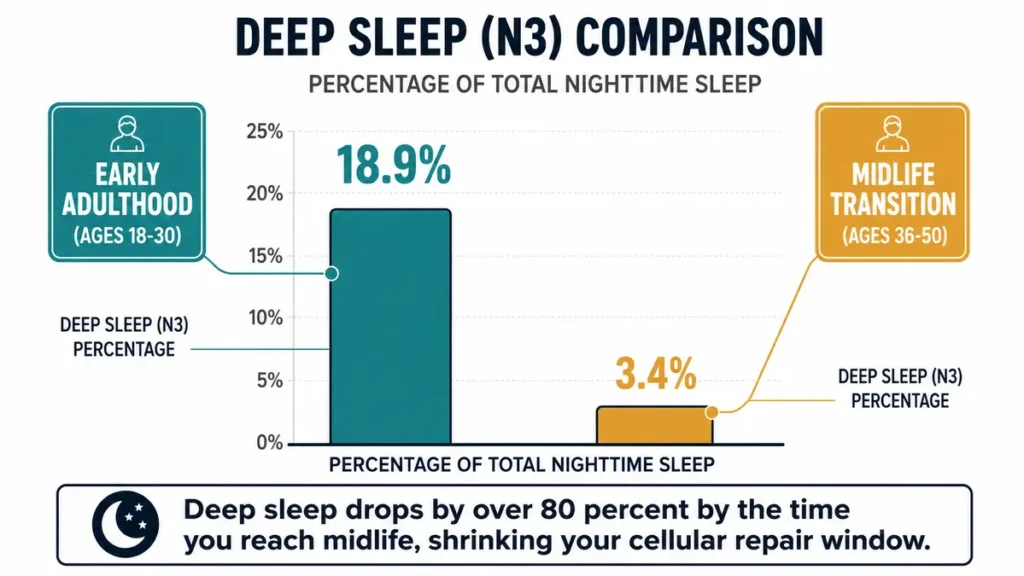
Aging alone does not cause both changes through separate mechanisms. The two are linked. Sleep leads. Hormone follows.
No single study has tested the complete chain from sleep behavior to deep sleep to growth hormone secretion to measurable physical outcomes in older adults. The picture here is assembled from multiple studies, each confirming one piece of it.
That is the real finding: the sleep stage fails first, and the hormone loss is a consequence, not an independent sign of aging running on its own track.
After 50, a second stage of disruption begins. Sleep becomes more fragmented, REM sleep declines, and evening cortisol levels begin to rise significantly, a pattern that is associated with further disruption of sleep architecture.⁵
Three Common Habits That Shut the Window Before It Opens
You probably already know that alcohol disrupts sleep. What most people have not been told is the specific way it disrupts the growth hormone release that depends on that sleep.
Research measuring nighttime hormone levels in healthy men found that alcohol consumed before bed suppressed plasma GH values by 70 to 75 percent: on both the first night and after nine consecutive nights of drinking.⁶
The critical detail is what else the same study found: slow-wave sleep was not eliminated by alcohol in those subjects. The deep sleep appeared to continue. But the hormone release did not come.⁶
Alcohol suppresses growth hormone secretion by 70 to 75 percent on the night you drink it, even when slow-wave sleep appears intact, meaning you can sleep through the night and still rob your body of its primary recovery signal.⁶
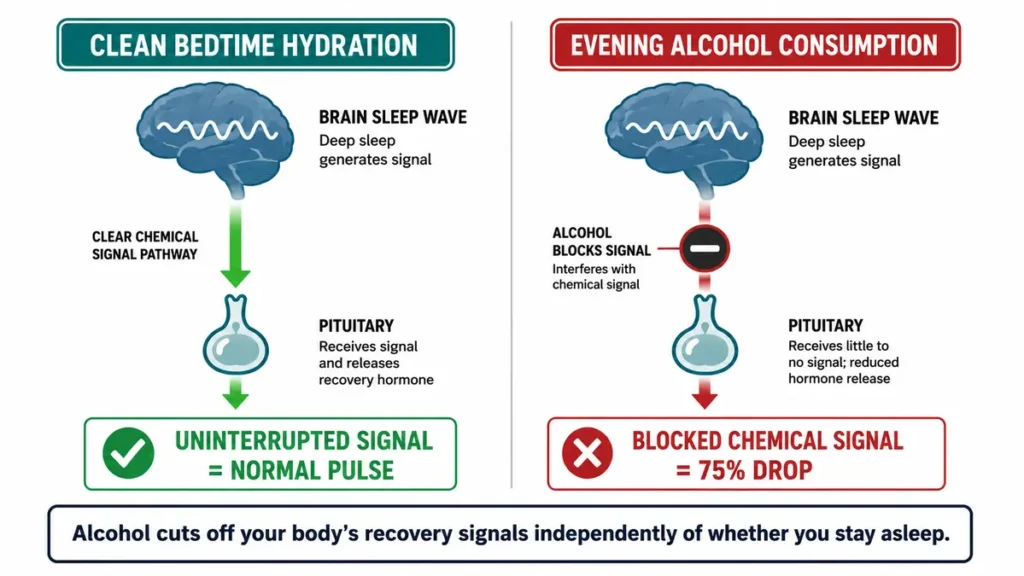
That is not a temperance argument. It is a mechanism. Alcohol appears to suppress growth hormone secretion independently of what it does to sleep architecture, though the precise mechanism is not understood.⁷
Evening alcohol [drinks consumed within three to four hours of bedtime] is the most direct self-administered disruptor of nocturnal GH secretion that has been tested in controlled studies.
Two other habits compound the problem:
Irregular sleep timing disrupts the circadian rhythm [the body’s internal 24‑hour clock, governed by a cluster of neurons in the hypothalamus], and that disruption can alter the timing of the GH release window. The surge is tied not only to sleep depth but also to a stable sleep‑wake cycle; when that cycle shifts regularly, the tightly regulated pulse may weaken or become misaligned.
Untreated sleep apnea directly fragments deep sleep, and that fragmentation is associated with reduced nocturnal GH secretion.⁸ The connection runs through the same mechanism: obstructive sleep apnea [a condition where the airway repeatedly collapses during sleep, interrupting breathing and briefly waking the brain] prevents sustained slow-wave sleep, and no sustained slow-wave sleep means the GH pulse either weakens or never fully fires.⁸
Why Your Body Clock Works Against You After 50 (and What That Means at Midnight)
If you have noticed that waking up feels harder after 50 even when nothing is obviously wrong with your sleep, the reason may be hormonal rather than behavioral.
The deep sleep decline and the growth hormone drop do not happen in isolation. They happen alongside a parallel shift in cortisol, and the timing of that shift is specific to the years after 50.
The JAMA study that mapped the full lifespan of sleep changes found that rising evening cortisol levels became statistically significant only after age 50, not before.⁵
Cortisol [a hormone released by the adrenal glands in response to stress and as part of the normal daily cycle, which peaks in the early morning and should be low by evening] follows a rhythm that normally drops to its lowest point in the hours before bed, creating the hormonal conditions that allow deep sleep to begin.
When that evening floor rises (as it does progressively after 50), the conditions for slow-wave sleep become harder to achieve. The body is still running a low-level stress signal at the time it needs to descend into its deepest sleep stage.
Growth hormone and cortisol are biochemical opposites in this context: one rises as the other falls.⁵
This is the compounding problem that most sleep advice for older adults fails to name directly. It is not just that you sleep lighter as you age. A hormonal shift is also pushing against the sleep you still manage to get.
The two changes reinforce each other: lighter sleep is associated with higher cortisol the following evening, and elevated evening cortisol is associated with lighter deep sleep the next night.⁵
For adults dealing with untreated obstructive sleep apnea, this dynamic is accelerated.
CPAP therapy [continuous positive airway pressure, a mask-based treatment that keeps the airway open during sleep] is associated with improvements in nocturnal hormone profiles in OSA patients, suggesting that restoring sleep architecture has downstream effects on the hormonal environment, though the evidence is specific to OSA patients rather than to healthy aging adults.⁸
Sleep after 50 is not just lighter by default. It is fighting a second opponent.
What the Evidence Actually Supports for Protecting Deep Sleep
You cannot replace what age takes from deep sleep, but you can stop making the loss worse. Three behavioral interventions have meaningful evidence behind them for protecting the deep sleep that growth hormone release depends on. They are not equivalent in strength, and the distinctions matter.
Talk with your doctor before adding supplements or changing exercise intensity, especially if you are managing a chronic condition, on medication, or have cardiovascular concerns.
Timing a warm bath or shower before bed is the most consistently supported non-pharmacological sleep intervention identified in systematic research.
A meta-analysis of 17 studies found that water-based passive heating at 40 to 42.5 degrees Celsius, taken 90 minutes before bed for as little as 10 minutes, was associated with improvements in sleep efficiency and reduced time to fall asleep.⁹
Some individual studies in the review also suggest effects on slow-wave sleep, though this was not a consistent meta-analysis finding.
The mechanism is thermal: warm water draws blood to the skin, which releases core body heat, and the drop in core temperature that follows mimics and amplifies the natural circadian signal for deep sleep to begin.
Resistance training has direct evidence in older adults.
A randomized controlled trial in sarcopenic older adults found that 12 weeks of resistance exercise training increased the percentage of slow-wave sleep compared with controls, with a statistically significant difference between groups.¹⁰
The effect on growth hormone secretion itself, specifically during sleep, requires more direct study in healthy aging populations, but the increase in deep sleep is the relevant proximate outcome.
Consistent sleep timing reinforces the circadian anchoring that governs when the GH release window opens.
No single RCT has isolated this factor in older adults with growth hormone as the outcome, but the mechanism linking GH secretion to sleep depth and circadian timing is supported by the same evidence base that links slow-wave sleep to GH secretion.⁵
Magnesium supplementation is frequently cited in consumer sleep content.
The best available systematic review of magnesium for older adults with insomnia found that sleep onset latency improved by approximately 17 minutes compared with placebo across two pooled trials, but the evidence was rated as low to very low quality, and the review noted the literature is insufficient for clear clinical recommendations.¹¹
The warm bath, the resistance training, and the consistent schedule have the strongest footing. The supplements market is running ahead of the evidence.
What This Still Cannot Tell You
The evidence connecting slow-wave sleep and growth hormone in older adults is real and consistent.
What it has not yet answered is the question you most want answered: if you improve your deep sleep, will your growth hormone secretion meaningfully increase, and if it increases, will that translate into the physical changes you are hoping for?
The honest answer is: probably not in isolation.

The decline in GH secretion across the adult lifespan is substantial, beginning in the thirties and continuing steadily.⁵
The interventions that support deep sleep can preserve and partially protect what remains. Whether restoring slow-wave sleep in a 60-year-old produces GH levels comparable to those of a 35-year-old is not established by the current evidence in healthy adults without diagnosed GH deficiency.¹
The association between GH decline and the physical changes of aging (more fat, less muscle, slower recovery) is consistent across studies. Whether those changes are caused by GH decline, or whether both are parallel consequences of a third underlying process, remains genuinely uncertain.¹
What is clear, and what the evidence does support, is this: the behaviors that protect deep sleep are the same behaviors that protect the hormonal conditions in which growth hormone release is possible. You cannot boost GH directly through lifestyle. You can stop closing the window before it opens.
The Window Is Still There
Growth hormone does not vanish after 50. The deep sleep that triggers its release becomes harder to reach and easier to disrupt. That is the real story: not a slow fade, but a sensitive process that responds to what you do before bed.
Tonight, take a warm bath or shower 90 minutes before bed, set your alarm for the same time tomorrow, and put your phone in another room. Three steps that support the deep sleep your body needs to release growth hormone.
How much this helps will depend on factors no article can settle. But the window is still there.
⚠️DISCLAIMER:
This article is for informational purposes only and does not constitute medical advice or an endorsement of any longevity intervention. The content addresses protecting growth hormone release through deep sleep habits and is intended for general educational purposes only. Individual health, genetics, and medical history significantly affect outcomes, consult a qualified physician before adopting any protocol discussed in this article.
References
- Fredrick JR, Blackman MR, Corpas E, Merriam GR, Kargi AY, Garcia JM. Growth Hormone and Aging. Endotext [Internet]. NCBI Bookshelf. Last Update: March 10, 2026.https://www.ncbi.nlm.nih.gov/books/NBK279163/
- Rudman D, Feller AG, Cohn L, Shetty KR, Rudman IW, Draper MW. Effects of human growth hormone on body composition in elderly men. Horm Res. 1991;36 Suppl 1:73-81. doi: 10.1159/000182193. PMID: 1806490. https://pubmed.ncbi.nlm.nih.gov/1806490/
- Toogood AA. Growth hormone (GH) status and body composition in normal ageing and in elderly adults with GH deficiency. Horm Res. 2003;60(Suppl 1):105-111. doi: 10.1159/000071234. PMID: 12955026.
https://pubmed.ncbi.nlm.nih.gov/12955026/ - Van Cauter E, Plat L. Physiology of growth hormone secretion during sleep. Journal of Pediatrics. 1996. https://pubmed.ncbi.nlm.nih.gov/8627466/
- Van Cauter E, Leproult R, Plat L. Age-related changes in slow wave sleep and REM sleep and relationship with growth hormone and cortisol levels in healthy men. JAMA. 2000. https://pubmed.ncbi.nlm.nih.gov/10938176/
- Prinz PN et al. Effect of alcohol on sleep and nighttime plasma growth hormone and cortisol concentrations. Journal of Clinical Endocrinology and Metabolism. 1980. https://pubmed.ncbi.nlm.nih.gov/7419664/
- Roehrs T, Roth T. Sleep, Sleepiness, and Alcohol Use. Alcohol Research and Health. 2001. https://pmc.ncbi.nlm.nih.gov/articles/PMC6707127/
- Saini J, Krieger J, Brandenberger G, Wittersheim G, Simon C, Follenius M. Continuous positive airway pressure treatment. Effects on growth hormone, insulin and glucose profiles in obstructive sleep apnea patients. Horm Metab Res. 1993;25(7):375-381. doi: 10.1055/s-2007-1002123. PMID: 8406324.
https://pubmed.ncbi.nlm.nih.gov/8406324/ - Haghayegh S et al. Before-bedtime passive body heating by warm shower or bath to improve sleep: a systematic review and meta-analysis. Sleep Medicine Reviews. 2019. https://www.sciencedirect.com/science/article/abs/pii/S1087079218301552
- Souza H et al. Resistance training improves sleep and anti-inflammatory parameters in sarcopenic older adults: a randomized controlled trial. International Journal of Environmental Research and Public Health. 2022. https://pmc.ncbi.nlm.nih.gov/articles/PMC9736460/
- Mah J, Pitre T. Oral magnesium supplementation for insomnia in older adults: a Systematic Review & Meta-Analysis. BMC Complement Med Ther. 2021;21:125. doi: 10.1186/s12906-021-03297-z. PMID: 33865376. PMCID: PMC8053283. https://pmc.ncbi.nlm.nih.gov/articles/PMC8053283/