

You turn up the TV a little more. You ask someone to repeat themselves and then smile and nod anyway. In a noisy restaurant, you follow maybe half the conversation and fill in the rest. None of this feels like a memory problem.
Here is the reframe: every moment your brain strains to decode garbled sound, it spends resources it would otherwise use on remembering. The drain from untreated hearing loss on memory and thinking is not a future risk for adults over 60 with hearing difficulties they have not yet addressed. It is already happening, quietly, in real time, with every conversation that costs more effort than it should.
In this article:
- Why your brain is already paying a cognitive price, even if your hearing loss seems mild
- The specific finding about subclinical hearing loss that almost no article mentions
- What happens inside the brain’s structure after years without treatment
- Why the ACHIEVE trial’s headline number is more complicated than most headlines suggest
- One practical action you can take this week that costs nothing
Your Brain Is Already Paying a Price Every Time You Strain to Hear
You already know the effort it takes. Someone speaks from the next room and you have to hold your breath and concentrate just to catch the words. That moment of straining is your brain doing extra work, and something else is losing resources because of it.
The cognitive tax is real.
When the brain is forced to work harder to decode degraded sound, it pulls cognitive resources away from other tasks, including holding information in working memory long enough to use it.¹
The research on this is consistent: among 1,984 older adults followed for six years, those with hearing loss showed significantly faster cognitive decline than those without it, a gap that was independent of age, cardiovascular health, and other confounding factors.¹
This is not a distant projection. The study found that adults with hearing loss could be expected to reach a meaningful threshold of cognitive impairment roughly three years earlier than peers with normal hearing.¹ Three years is not a small difference.

Untreated hearing loss is now identified as the single largest modifiable risk factor for dementia, accounting for an estimated 8% of population-attributable dementia risk, which is more than smoking, physical inactivity, or depression individually.²
That statistic comes from the 2020 Lancet Commission on Dementia, a review led by an international group of dementia researchers.²
The 8% figure is a population-level calculation. Your individual risk depends on degree of loss, how long it has been untreated, and other health factors. The direction of the evidence is clear.
Even Mild Hearing Loss Has Already Started Changing Your Cognitive Performance
Most people assume the risk starts when hearing loss becomes hard to ignore, when you need to ask for repeating, when background noise defeats you entirely. The research says the cognitive impact begins earlier than that. Much earlier.
The subclinical threshold is where this gets uncomfortable.
A study using data from two large U.S. cohorts found that even adults classified as having normal hearing (those who had not yet crossed the clinical threshold for a diagnosis) showed measurable drops in cognitive performance as their hearing declined.³
Every 10 decibels of hearing decrease was associated with a 2.28-point drop on a standard cognitive processing test, even among people told their hearing was fine.³
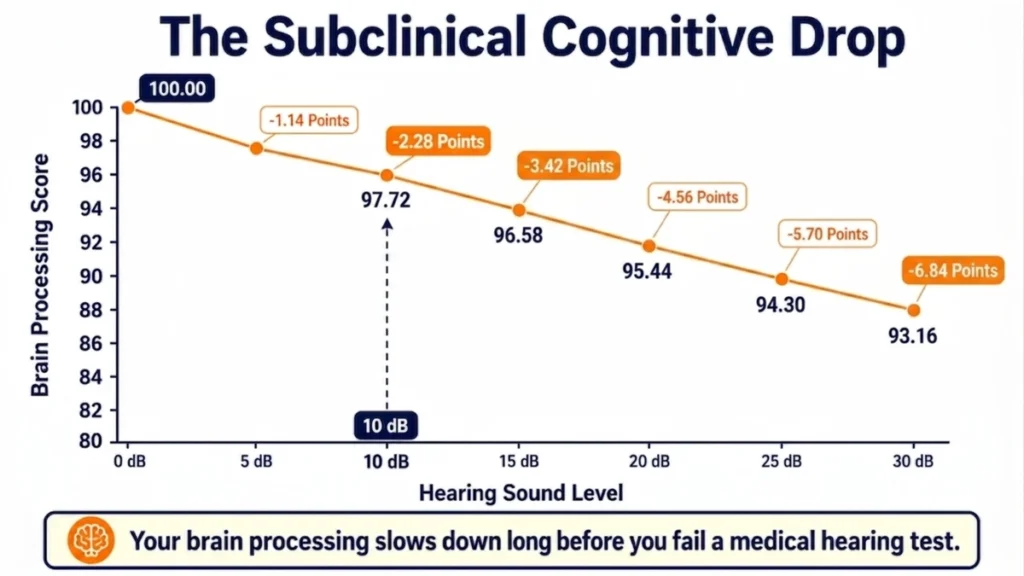
The brain does not wait for hearing loss to become severe before it starts reallocating cognitive resources away from memory; research shows that even subclinical hearing loss, the kind that does not yet meet the clinical threshold for diagnosis, is already associated with measurable drops in cognitive performance.³
That finding reframes what “normal hearing” actually means. The current clinical cutoff for diagnosing adult hearing loss sits at 25 decibels. But the evidence from this study suggests the relationship between hearing and cognition may begin at levels far below that line.³
Hearing loss cognitive decline, in other words, is not a switch that flips at diagnosis. It appears to operate as a continuum, and if you are waiting for a diagnosis before worrying about your cognition, the evidence suggests you may be waiting too long.
What Happens Inside the Brain When Hearing Goes Untreated for Years
The hearing problem you notice at dinner is the surface. Underneath, something more permanent may be taking shape.

Research using brain scans from the UK Biobank, one of the largest population health databases in the world, found that adults with poorer hearing performance showed significantly lower volume in three brain regions that matter most for memory: the temporal cortex [the outer layer of the brain that processes language and sound], the hippocampus [the brain’s primary memory-storage structure], and the precuneus [a region involved in recalling personal memories and events].⁴
The same study found that poorer hearing was associated with higher levels of a protein in the spinal fluid called tau [an abnormal protein that builds up in the brain and is a marker of neurodegenerative disease].⁴
That is the detail that separates this finding from abstract risk statistics.
Tau is not a precursor to memory problems in general; it is specifically associated with the pathology seen in Alzheimer’s disease and related dementias.⁴
The study found that brain structure and tau levels together partly explained the link between hearing and cognitive decline, suggesting a biological path rather than just a behavioral one.⁴
This does not mean untreated hearing loss causes Alzheimer’s disease. The study design is observational: it shows association, not causation.
The evidence connecting hearing to these specific brain changes is assembled from multiple sources each testing a different piece, and no single study directly proves the full causal chain from untreated hearing loss to dementia.
But it does mean the brain changes linked to long-term poor hearing are not simply a matter of using the wrong organ less.
They appear in the same structures, and involve the same proteins, that are implicated in dementia.
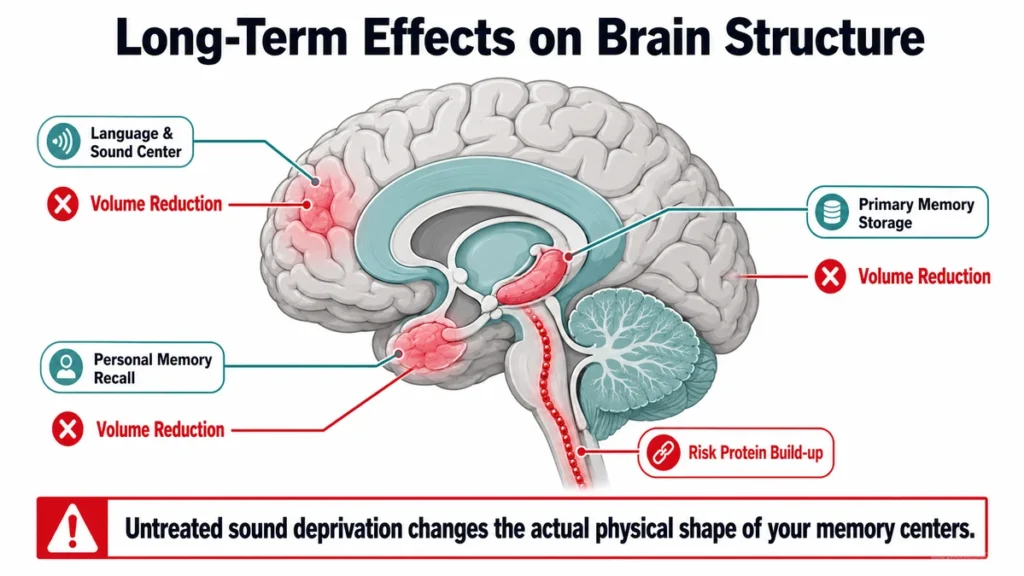
If you have been telling yourself that hearing loss is just inconvenient and not a real health matter, that framing is worth reconsidering.
The Social Withdrawal Loop: How Hearing Loss Quietly Shrinks Your Mental World
Following a group conversation when you have hearing difficulty is exhausting, and that exhaustion has its own consequences for the brain. After a while, many people quietly stop trying: fewer dinner parties, shorter phone calls, more evenings alone.
This is not weakness or preference. It is the predictable result of a communication system that requires too much effort.
The cascade effect describes what researchers call the mechanistic path from hearing to cognition through social life.
A 2024 systematic review examined whether social isolation mediates the link between hearing loss and cognitive decline. The authors concluded that while this is a widely discussed theory, the longitudinal evidence is currently insufficient to confirm it.⁵
When you stop joining conversations, you lose more than company.

You lose the cognitive exercise that comes from following fast speech, switching topics, holding names and details in mind while someone else is still talking.⁵
The brain regions that handle these tasks need regular use to maintain their function. Social withdrawal appears to reduce that use.⁵
This matters because hearing loss social isolation and cognitive decline may be connected through more than one path at the same time: the direct cognitive load on the brain, the structural changes described earlier, and the loss of social engagement that keeps the brain exercised.⁵
Treating the hearing problem could interrupt the withdrawal loop, but only if it happens before the withdrawal becomes a habit.
What the Best Evidence Actually Shows About Treating Hearing Loss and Memory
You have probably seen the headline: hearing aids may cut the risk of cognitive decline by nearly half. The story is more complicated than the headline.
The ACHIEVE trial enrolled 977 older adults, aged 70 to 84, all with untreated mild-to-moderate hearing loss.⁶ Participants were randomly assigned to either a hearing intervention (fitted with hearing aids and supported by an audiologist) or a healthy aging education program, and then followed for three years with regular cognitive testing.⁶
The full-cohort result was negative. Across the total study population, the hearing intervention did not significantly reduce cognitive decline compared to the control group.⁶
The subgroup result was different.
Among the 238 participants drawn from an ongoing cardiovascular study, a group that was older and had more risk factors for cognitive decline than the community volunteers, and the hearing intervention slowed cognitive decline by 48% over three years.⁶
This was a prespecified analysis, not a data-dredging exercise, which gives it scientific credibility. But it applies to a specific, higher-risk subset, not to all older adults with hearing loss.⁶
Hearing loss is very treatable in later life, which makes it an important public health target for reducing the risk of cognitive decline, according to Frank Lin, MD, PhD, Johns Hopkins University, who led the study.⁶
Whether treating hearing loss protects cognitive function in the broader population of adults over 60 remains an open question. What is not in question is that leaving hearing loss untreated carries its own documented risks across every other mechanism described in this article.
If you are over 60 with hearing difficulties, the most useful question is no longer whether hearing treatment helps but whether you are one of the people for whom it helps most, and the only way to find out is to know your actual hearing status.
What to Do This Week If You Are Over 60 and Have Not Had Your Hearing Checked
You do not need a diagnosis to take the first step. You need to know where you actually stand.
Getting a hearing evaluation is not a commitment to hearing aids. It is information: the kind that determines whether you are at the beginning of a problem or already well into it.
The average adult waits nearly nine years from the time they notice hearing difficulties to the time they seek evaluation.⁷
Nine years is a long time for the processes described in this article to continue unchecked.
Here is what an evaluation looks like and what to do before, during, and after:
- Before you go: Write down three situations where hearing feels harder: specific places, specific people, specific conditions. Bring this list. An audiologist uses context to calibrate what tests matter most.
- At the appointment: Ask for a pure-tone audiogram and a speech-in-noise test [a test that measures how well you understand words in the presence of background noise, which is more sensitive to early cognitive and hearing changes than the basic audiogram]. The audiogram measures threshold sensitivity; the speech-in-noise test catches problems the basic test alone may miss.
- After results: Ask two questions: where do I fall on the severity scale, and what does this mean for my cognition specifically? A good audiologist will have a concrete answer.
- If you are not ready for an in-person visit: ASHA, the American Speech-Language-Hearing Association, provides a free online hearing screener and a tool to locate a licensed audiologist near you at asha.org/public/hearing/hearing-evaluation.
Hearing loss is treatable. Waiting is a choice with consequences the evidence has now made visible.
The Memory Risk Is Not Waiting for You
Hearing and memory are more tightly connected than most people realize, and the connection runs through real biological changes, not just inconvenience.
Schedule a hearing evaluation with an audiologist this month, not to get a hearing aid, but to know where you actually stand. Whether treating hearing loss will protect memory for all older adults, not just those already at elevated risk, is a question the evidence has not yet fully answered.
That question is worth watching.
⚠️DISCLAIMER:
This article is for informational purposes only and does not constitute medical advice, diagnosis, or treatment. The content addresses the cognitive and memory effects of untreated hearing loss in adults over 60 and is intended for general educational purposes only. Health conditions vary significantly between individuals, always consult a licensed physician or qualified healthcare provider before making any decisions about your health or medical care.
References
- Lin FR, Yaffe K, Xia J, et al. Hearing Loss and Cognitive Decline Among Older Adults. JAMA Intern Med. 2013;173(4):. doi:10.1001/jamainternmed.2013.1868.
https://pmc.ncbi.nlm.nih.gov/articles/PMC3869227/ - Livingston G, Huntley J, Sommerlad A, et al. Dementia prevention, intervention, and care: 2020 report of the Lancet Commission. Lancet. 2020. https://www.thelancet.com/journals/lancet/article/PIIS0140-6736(20)30367-6/fulltext
- Golub JS, Brickman AM, Ciarleglio AJ, Schupf N, Luchsinger JA. Association of subclinical hearing loss with cognitive performance. JAMA Otolaryngol Head Neck Surg. 2019. https://pmc.ncbi.nlm.nih.gov/articles/PMC6865840/
- Wang HF, Zhang W, Rolls ET, et al. Hearing impairment is associated with cognitive decline, brain atrophy and tau pathology. eBioMedicine. 2022;86:104336. doi:10.1016/j.ebiom.2022.104336. https://pmc.ncbi.nlm.nih.gov/articles/PMC9649369/
- Dhanda N, Hall A, Martin J. Does social isolation mediate the association between hearing loss and cognition in adults? A systematic review and meta-analysis of longitudinal studies. Front Public Health. 2024;12:1347794. doi:10.3389/fpubh.2024.1347794.
https://www.ncbi.nlm.nih.gov/pmc/articles/PMC10824982/ - Lin FR, Pike JR, Albert MS, et al. (ACHIEVE Collaborative Research Group). Hearing intervention versus health education control to reduce cognitive decline in older adults with hearing loss in the USA (ACHIEVE): a multicentre, randomised controlled trial. Lancet. 2023. https://www.thelancet.com/journals/lancet/article/PIIS0140-6736(23)01406-X/abstract
- American Speech-Language-Hearing Association. Adult hearing screening. ASHA Practice Portal. https://www.asha.org/practice-portal/professional-issues/adult-hearing-screening/