

You’ve done everything the doctor said. You filled the prescription, you took the pills, and you came back for the follow-up. But nothing feels different. Somewhere in the back of your mind, you’ve started to wonder whether this flatness is just who you are now.
At this stage, the medical system expects men to slow down, so slowness rarely gets investigated. It gets accepted.
Millions of men over 50 are being medicated for depression they do not have, while a hormonal root cause goes undetected and untreated. Men over 50 on antidepressants that aren’t working deserve to know why. Low testosterone depression is one answer that almost never gets checked.
This article is for informational purposes only and does not constitute medical advice. The information presented is based on published research and is not a substitute for a consultation with a qualified healthcare provider. If you believe your symptoms may be related to low testosterone or another medical condition, speak with your doctor before making any changes to your care.
Low Testosterone Depression: The Prescription in Your Cabinet Is Not Proof
Look at the bottle on your shelf. That prescription is evidence that something is wrong. But it isn’t proof that depression is the cause.

Roughly one in three men over 55 has a low testosterone reading. That’s not a fringe statistic. That’s the finding from a study published in Archives of General Psychiatry, the same journal system that trains the doctors writing those antidepressant prescriptions.¹
Testosterone doesn’t drop overnight. It falls slowly, at roughly 1.6% per year for total testosterone and 2–3% per year for bioavailable testosterone [the portion your body can actually put to use].²
By the time you’re in your early 60s, your usable testosterone may be a third lower than it was in your 40s. The drop is slow enough that no single change feels alarming. That’s part of what makes low testosterone depression so easy to miss.
The antidepressant treats the label. It doesn’t treat the hormone.
THE HORMONE NOBODY CHECKED
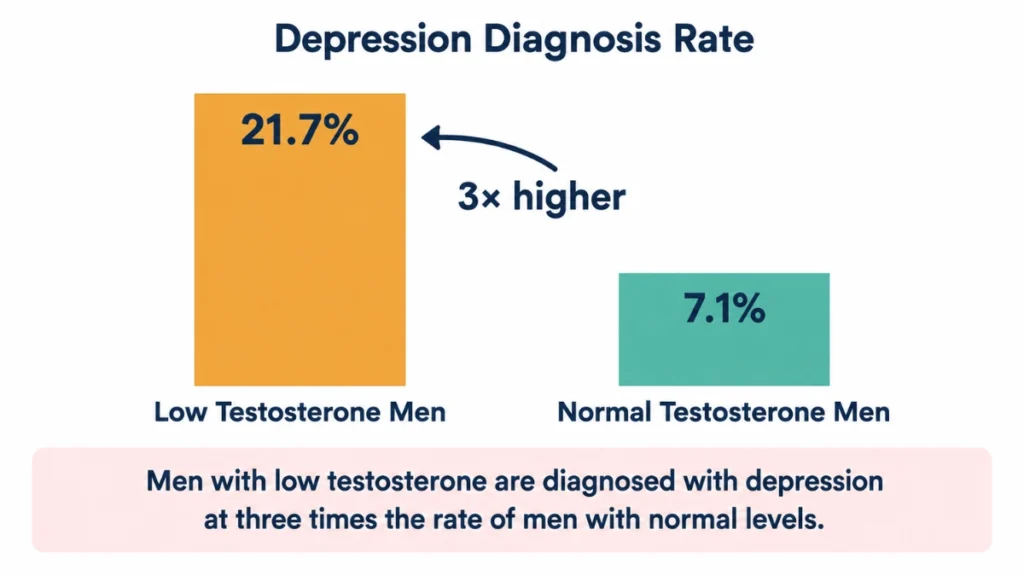
- In that study, 21.7% of men with low testosterone were diagnosed with depression within two years, against 7.1% of men with normal levels.¹
- In a large U.S. primary care study of men 45 and older, 38.7% had low testosterone readings, including men already on testosterone therapy.³
- In a UK primary care audit, the overall testosterone screening rate was just 4.3%.⁴
What Low Testosterone Actually Feels Like From the Inside
You wake up flat. Not sad, exactly. Just empty. You’re not crying in the car. You’re not having dark thoughts. You just can’t seem to care about the things you used to care about.
That description fits depression. It also fits something else entirely.
Depressive symptoms have been reported in 35–50% of male patients with clinically low testosterone in cross-sectional studies [research that measures a population at one point in time].⁵
That means between a third and half of men with a hormonal deficiency show up to a doctor’s appointment looking depressed, because every checklist says they are.
The symptoms of low testosterone include flat mood, low energy, fatigue, reduced motivation, and loss of interest. Those are also the first five items on a standard depression screen.
The Androgen Deficiency in the Aging Male scale measures low testosterone symptoms. The Patient Health Questionnaire-9, called the PHQ-9, is the checklist most primary care doctors use to screen for depression. Place both side by side, and they share most of their questions.
The more specific signs of low testosterone, including loss of libido, reduced morning erections, and muscle loss, often go unreported by men over 50. Most assume these are normal parts of aging. They stop mentioning them. The doctor never asks.

Depression and anxiety are the most common mood-related symptoms reported in men with hypogonadism [a condition where the body’s testosterone-making system has dropped below the level needed for normal function].⁶
If the symptoms of low testosterone and clinical depression are this similar, how does a doctor tell them apart without a blood test?
Why Doctors Keep Missing the Hormonal Cause
The system isn’t broken because doctors are careless. It’s broken because the referral pathway runs the wrong direction.
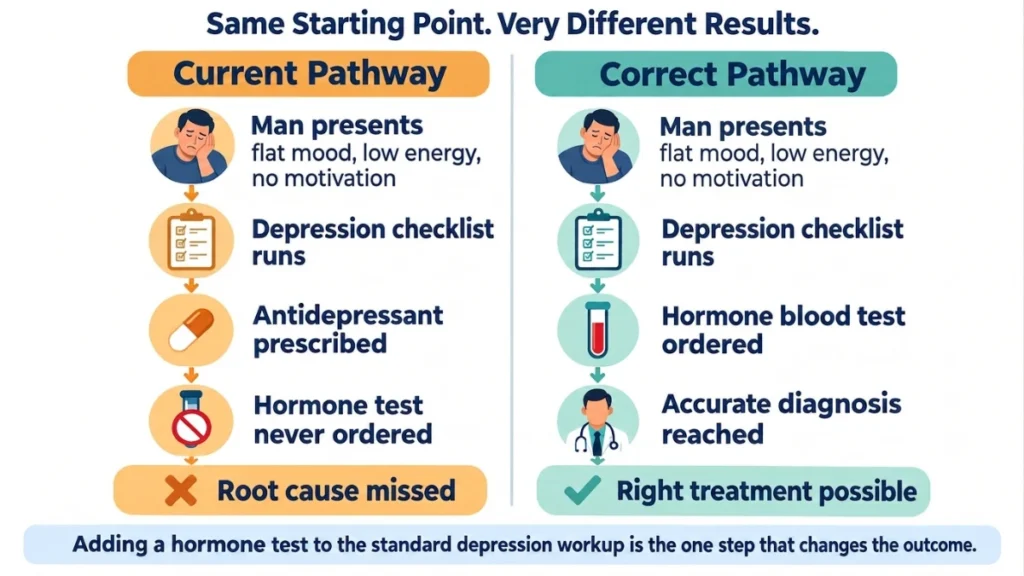
A man walks in feeling flat, tired, and unmotivated. The doctor opens a depression checklist. The checklist confirms depression. An antidepressant is prescribed.
Testosterone is never mentioned because testosterone belongs to a different category in the medical system. It lives in urology and endocrinology, not in mood disorders.
A 2025 longitudinal study that followed 4,107 men over a median of 8.4 years found no statistically significant association between testosterone levels and the risk of developing depression.⁷ That’s the strongest recent study on this question, and it cuts against the simple story.
But the study’s own authors noted a key problem. Depression screening tools may not adequately separate hormone-driven mood states from psychiatric ones.
The study also did not measure free testosterone [the biologically active fraction your cells can actually use]. And when antidepressant use was treated as a signal of depression in the data, some men taking antidepressants for other reasons were likely counted as depressed.
The confusion between low testosterone depression and psychiatric depression is structural, not personal. The tools used to identify depression were not designed to check for hormones.
When symptoms like fatigue and sexual dysfunction persist despite antidepressant treatment, a 2026 clinical case report states it is “clinically reasonable to consider LOH in the differential diagnosis.”⁸
LOH [late-onset hypogonadism: low testosterone that develops as men age] is rarely considered in a standard depression workup.
That recommendation exists in the research. It is rarely followed in the clinic.
The Testosterone Blood Test Your Doctor Probably Didn’t Order
Only 3.2% of men in a health-system dataset of over 321,000 patients ever had testosterone tested.⁹
A man dealing with low testosterone depression has almost no chance of being diagnosed if the test is never ordered.
Of the men flagged with a low reading in the UK primary care audit, only 19.1% were subsequently started on testosterone replacement.⁴
The testing gap is only part of the problem. The test itself matters.
Many doctors order total testosterone only. Total testosterone is the overall amount in your blood. But much of it is bound to proteins and can’t be used by the body.
Free testosterone is what’s actually available for your cells. SHBG [sex hormone-binding globulin: a protein that binds testosterone and keeps it out of reach of your cells] is what limits how much your body can actually use.
In the same UK audit, only 7.8% of men who had testosterone measured also had SHBG measured.⁴
A man can get tested, come back with a borderline total testosterone result, and walk out still undiagnosed. The test ran. The right test didn’t.
Blood must also be drawn in the morning, before noon. Testosterone peaks in the early morning and falls throughout the day. An afternoon draw can miss a genuine deficiency entirely.
Getting tested isn’t enough. Getting tested correctly is what changes the outcome.
What Happens When the Right Condition Finally Gets Treated
Here is what the research found when men with confirmed low testosterone received treatment for the right condition.
The Testosterone Trials were a coordinated set of seven double-blind, placebo-controlled [neither the participants nor the researchers knew who received the real treatment] studies. These are the most rigorous type of medical trial. They followed 788 older men with confirmed low testosterone for one year.¹⁰
A 2019 review of those trials found that testosterone treatment “slightly improved” mood, vitality and depressive symptoms on validated scales.¹⁰
The effect was not dramatic. The researchers used the word “slightly.”
This is not a cure for major depression. A man with a true psychiatric condition needs different care entirely.
But for a man whose flat mood comes from a hormone that’s been dropping for a decade without anyone checking, improvement in mood, energy, and vitality is not a small thing. It’s the difference between a prescription that changes nothing and a treatment aimed at the actual cause.

The results of low testosterone depression treatment for you specifically are unknown. They stay unknown until the test is run.
How to Walk Into Your Next Appointment and Ask the Right Question
You don’t need to challenge your doctor. You need to add a data point that was never collected.
Talk to your doctor before acting on any of this if you are on medication, managing a chronic condition, or have been told your testosterone levels are a concern for another reason.
Here is what to ask for:
- A total testosterone test, drawn in the morning, ideally before 10 a.m.
- A free testosterone test at the same draw
- An SHBG level to give the free testosterone result context
Tell your doctor about your physical symptoms, not just your mood. Mention fatigue, muscle loss, reduced libido, or changes in sleep.
These are the symptoms that trigger a hormonal workup [a set of blood tests to check whether a hormone imbalance is the cause] rather than only a psychiatric one.
If your total testosterone comes back borderline, ask for the free testosterone result specifically. Borderline total testosterone with low free testosterone can still indicate a deficiency worth treating.
One test on one morning may not be enough. Low testosterone should be confirmed on at least two separate morning draws before any treatment decisions are made.
The reframe here matters. You’re not arguing with a diagnosis. You’re completing a workup that should already exist.
The depression checklist ran. The hormone panel didn’t. You’re asking for the second half of the picture.
Men who finally get the right diagnosis don’t feel like they won an argument. They feel like someone looked at the whole picture for the first time.
Start With the Test That Was Never Ordered
Identifying low testosterone depression starts with one blood test that most men over 50 have never been offered. Ask your doctor for a total and free testosterone blood test at your next appointment. The diagnosis on your prescription bottle may be wrong, and the only way to know is to check.
References
- Shores MM, Sloan KL, Matsumoto AM, et al. Increased Incidence of Diagnosed Depressive Illness in Hypogonadal Older Men. Archives of General Psychiatry. 2004; 61(2):162-167. https://jamanetwork.com/journals/jamapsychiatry/fullarticle/481955
- Feldman HA, Longcope C, Derby CA, Johannes CB, Araujo AB, Coviello AD, Bremner WJ, McKinlay JB. Age Trends in the Level of Serum Testosterone and Other Hormones in Middle-Aged Men: Longitudinal Results from the Massachusetts Male Aging Study. The Journal of Clinical Endocrinology and Metabolism. 2002; 87(2):589-598. https://academic.oup.com/jcem/article/87/2/589/2846777
- Mulligan T, Frick MF, Zuraw QC, Stemhagen A, McWhirter C. Prevalence of hypogonadism in males aged at least 45 years: the HIM study. International Journal of Clinical Practice. 2006; 60(7):762-769. https://pmc.ncbi.nlm.nih.gov/articles/PMC1569444/
- Livingston M, Jones R, Hackett G, Donnahey G, Moreno GY, Duff CJ, Heald AH. Screening for Hypogonadism in Primary Healthcare: How to do this Effectively. Experimental and Clinical Endocrinology & Diabetes. 2018; 126(3):176-181. https://pubmed.ncbi.nlm.nih.gov/29365335/
- Indirli R, Lanzi V, Arosio M, Mantovani G, Ferrante E. The association of hypogonadism with depression and its treatments. Frontiers in Endocrinology. 2023; 14:1198437. https://www.frontiersin.org/journals/endocrinology/articles/10.3389/fendo.2023.1198437/full
- Khera M. Patients with testosterone deficit syndrome and depression. Archivos Españoles de Urología. 2013; 66(7):729-736. https://pubmed.ncbi.nlm.nih.gov/24047633/
- Forbes M, Lotfaliany M, Tran C, Mohebbi M, Woods RL, McNeil JJ, Berk M. Testosterone Concentration and Incident Depression in Older Men: A Longitudinal Cohort Study. The Journals of Gerontology: Series A, Biological Sciences and Medical Sciences. 2025; 80(6):glaf019. https://pmc.ncbi.nlm.nih.gov/articles/PMC12070475/
- Ichino K, Okui N, Ide H, Horie S. Self-Referred Late-Onset Hypogonadism Hypothesis and Testosterone Replacement Therapy in Major Depressive Disorder Under Polypharmacy: A Case Report. Cureus. 2026; 18(2):e103956. https://pmc.ncbi.nlm.nih.gov/articles/PMC13005956/
- Malik RD, Lapin B, Wang CE, Lakeman JC, Helfand BT. Are we testing appropriately for low testosterone?: Characterization of tested men and compliance with current guidelines. The Journal of Sexual Medicine. 2015; 12(1):66-75. https://pubmed.ncbi.nlm.nih.gov/25382540/
- Matsumoto AM. Testosterone Replacement in Men with Age-Related Low Testosterone: What Did We Learn From The Testosterone Trials? Current Opinion in Endocrine and Metabolic Research. 2019; 6:34-41. https://pmc.ncbi.nlm.nih.gov/articles/PMC7009797/