

You wake up stiff. Your shoulders take 20 minutes to loosen. Your energy is low by mid-morning even though you slept. You have been quietly adding these things to the list you call “just getting older,” but your body is doing something more specific than aging.
Most adults over 50 who develop a treatable inflammatory condition spend months, sometimes more than a year, dismissing the same symptoms. The problem is not that aging causes inflammation and aging go together.
The problem is that some of that inflammation is a disease, one that responds to treatment, and learning to tell the difference is what a rheumatologist does first.
Why this is worth your time:
- The duration of your morning stiffness is a clinical signal doctors actually measure
- Older-onset inflammatory arthritis looks nothing like the textbook picture
- A specific blood test pattern can distinguish normal aging inflammation from active disease
- Lifestyle changes and diagnosis are not interchangeable; one does not replace the other
- There is a way to talk to your doctor that shortens the road to answers
Normal Aging Feels Like Stiffness. Inflammatory Disease Does Too. Here Is the Difference.
You feel it every morning, and by now you have stopped mentioning it.

That ten-minute shuffle to the bathroom, the shoulder that has to warm up before you can reach overhead, the deep ache that lifts only after you have been moving for a while: none of it surprises you anymore.
Your body has been doing it long enough to feel ordinary. This is exactly the problem.
Stiffness duration is the single most useful distinction between mechanical aging and active inflammation. Stiffness that comes from normal wear on joints and cartilage typically fades within one hour of movement, while prolonged morning stiffness suggests an inflammatory cause.¹
Stiffness that persists for an hour or longer after waking is a recognized clinical threshold that rheumatologists use to distinguish inflammatory joint disease from degenerative conditions.²
The American College of Rheumatology lists morning stiffness lasting more than one hour as a characteristic sign of inflammatory conditions like rheumatoid arthritis.²
Symmetry is the second signal. Inflammation driven by the immune system tends to affect the same joints on both sides of the body at the same time.¹
If your right hand and your left hand both swell and ache, or both shoulders feel locked in the morning, that bilateral pattern points away from mechanical wear and toward an immune-driven process.
What triggers it also separates the two. Mechanical joint pain from normal aging is typically aggravated by activity and improves with rest.¹
Inflammatory joint pain often appears without a clear physical trigger and may come with fatigue or other systemic symptoms that suggest something internal rather than a physical strain.¹
A low-grade chronic increase in circulating inflammatory molecules accompanies normal aging; researchers call this inflammaging [the slow, lifelong rise in background inflammation that is a normal feature of getting older].³ This background inflammation is real, is measurable, and does rise after 50.³
Researchers distinguish this background inflammation from the active, disease-driven inflammation that produces the specific symptoms described above; those symptoms generally point to a more specific driver rather than normal aging alone.³
The Symptoms Rheumatologists See First That Patients Wait Months to Report
The body does not inflame silently as a default feature of aging; it inflames when something specific is driving it, and the job is to find out what.
You probably expected inflammatory arthritis to show up as swollen, red, clearly tender small joints, the kind of picture you have seen in a medical diagram. In older adults, it frequently does not look like that at all.
This is one of the most consequential things competing articles leave out, and it is why people wait.
Elderly-onset rheumatoid arthritis [RA that begins after age 60] tends to present differently than the same disease in a younger person. ⁴
Research comparing older-onset and younger-onset RA found that the older group showed significantly higher disease activity and more pronounced systemic inflammatory markers at the time of diagnosis, but the clinical picture that brought them in was less obvious.⁴
Older patients frequently present with large-joint involvement first, affecting shoulders, hips, and knees rather than fingers and wrists.⁴ They also arrive with more constitutional symptoms: persistent fatigue, unintentional weight loss, and a general feeling of being unwell.⁴
These are symptoms a person their age might reasonably assume are just part of getting older.
Polymyalgia rheumatica [an inflammatory condition causing pain and stiffness in the shoulder and hip girdle, almost always in adults over 50] is one of the most common inflammatory rheumatic diseases in this age group.⁵
Its hallmarks are shoulder and hip pain, pronounced morning stiffness, and systemic symptoms like fatigue and low-grade fever.⁵
Many people with this condition assume the symptoms are a normal part of aging. They are not.⁶ The condition is both diagnosable and treatable.⁶

This gap between symptom onset and doctor visit is not trivial.
Research on older rural patients with RA found that older age itself, plus isolation and the specific character of their joint symptoms, all contributed to significant delays in seeking care, partly because older patients tend to perceive mild symptoms as part of the natural aging process.⁷
Older-onset inflammatory arthritis does not announce itself the way the textbook says. If you are over 50 and carrying fatigue, shoulder ache, and low energy alongside your joint pain, those symptoms carry the same clinical weight as swollen red knuckles would in a younger patient.
Why the Gap Between Symptom and Diagnosis Does Real Damage
Here is what actually happens in the months between when symptoms start and when a rheumatologist sees a patient.
Joint inflammation that goes unaddressed is not paused during that time. It continues. In rheumatoid arthritis, ongoing inflammation is associated with progressive joint erosion.⁸ Early treatment is the only thing that interrupts it.⁸
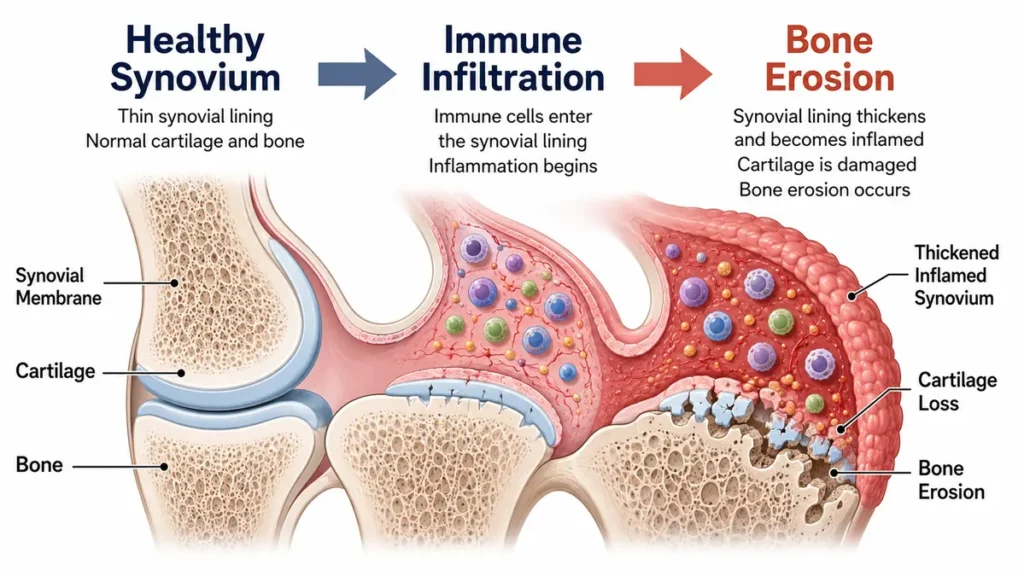
The numbers behind this gap are striking. One observational cohort study found that nearly half of RA patients (48.3%) had been misdiagnosed before reaching a rheumatologist, and the median delay from symptom onset to rheumatologist consultation was 12 months.⁸
Studies tracking the full path from symptom onset to diagnosis found that the average delay ranged from nine months to just under a year before a formal RA diagnosis was made.⁹ The delay was significantly associated with higher disease activity scores and worse functional disability at follow-up.⁸
That is the real finding here: the symptom is not the only problem. The wait is.
Delayed diagnosis does not just affect joints.
Untreated systemic inflammation over months is associated with greater functional decline and structural damage that later treatment cannot fully reverse.⁸
In a documented case of elderly-onset RA, delayed diagnosis allowed peripheral neuropathy [damage to nerves outside the brain and spinal cord] and muscle weakness to develop alongside the joint disease because the condition’s atypical presentation meant it went unrecognized for years.¹⁰
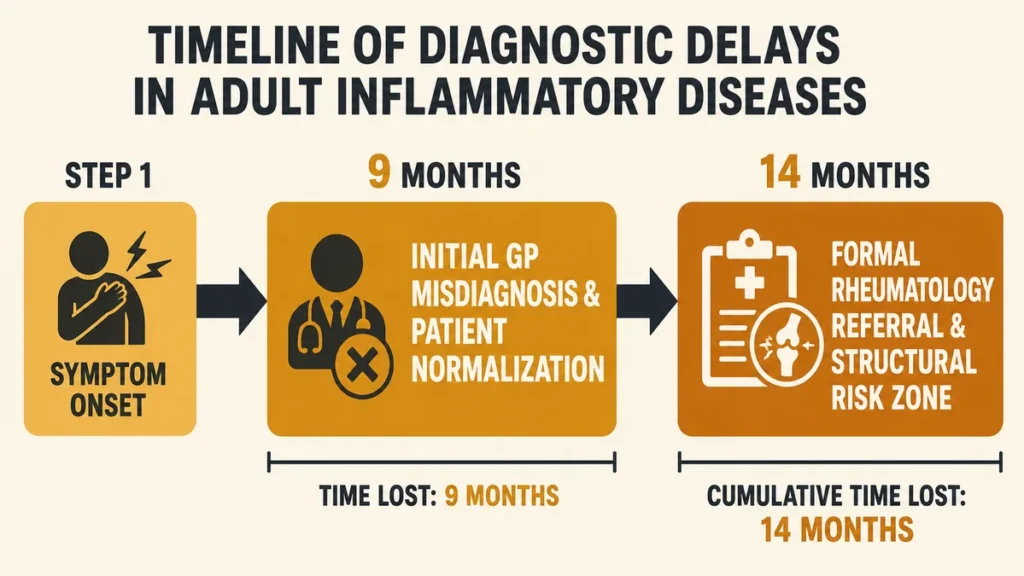
Older patients face specific barriers that younger patients do not.
Older age, low education, low socioeconomic status, and social isolation all increased diagnostic delay in research examining which patients took longest to reach a rheumatologist.⁷
Ageism also plays a role: both patients and clinicians may normalize symptoms in older adults that would trigger immediate investigation in a 35-year-old.⁷
The evidence available to support each claim in this section comes primarily from observational cohort studies and retrospective chart reviews rather than randomized controlled trials.
The design necessary to fully test the relationship between diagnostic delay and long-term outcomes would require withholding care from a control group, which is not ethically possible.
What the observational evidence consistently shows is still meaningful: waiting longer is not neutral.
What Is Actually Pushing Your Inflammation Higher After 50
Inflammaging is real, but it is not inevitable in its severity. Several specific, modifiable drivers push inflammatory markers higher than the baseline aging process alone would explain.
Visceral fat [the fat stored deep in the abdomen around organs, as distinct from the fat under the skin] is an active producer of pro-inflammatory molecules. ¹¹
Excess visceral fat tissue continuously releases cytokines [small proteins that signal the immune system, including interleukin-6 and tumor necrosis factor-alpha] that maintain a low-grade inflammatory state.¹¹
This is not the same as being overweight; a person can carry significant visceral fat while appearing lean, and the inflammatory signal comes from the visceral deposit specifically.¹¹
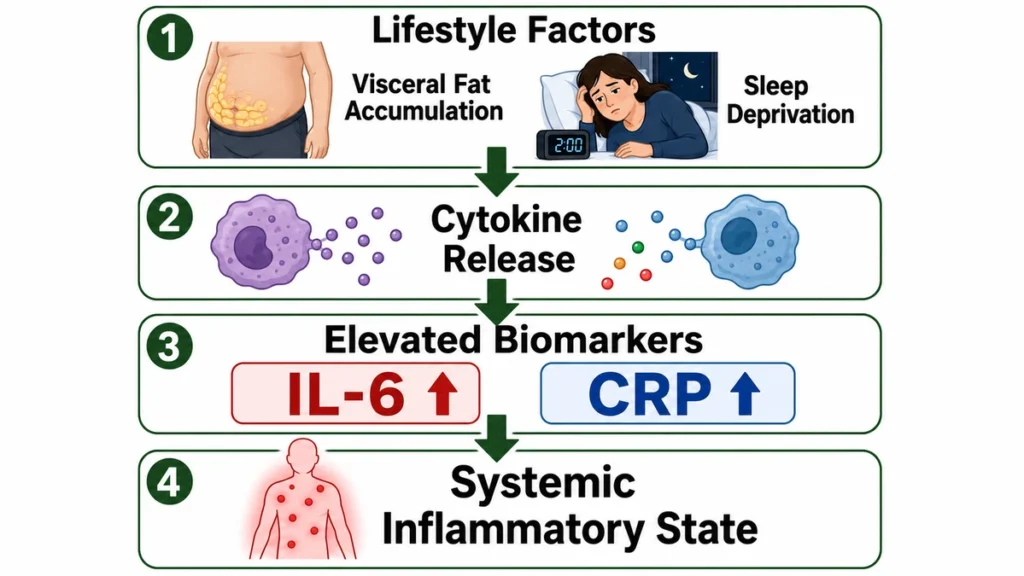
Poor sleep accumulates inflammatory load in measurable ways. Research across 35 studies found that multiple nights of partial sleep deprivation, with sleep reduced to approximately 4.3 hours for three or more consecutive nights, was associated with significant increases in both interleukin-6 and CRP [C-reactive protein, a protein the liver produces in response to inflammation that is commonly measured in blood tests].¹²
A single night of disrupted sleep did not produce this effect; the signal appeared with persistence.¹²
Smoking directly promotes systemic inflammation and is a confirmed risk factor for rheumatoid arthritis.¹³
This combination of visceral fat, disrupted sleep, smoking, and unmanaged stress does not simply make you feel worse.
Each contributes to higher circulating levels of inflammatory molecules, and higher baseline inflammation is associated with greater long-term risk of cardiovascular disease, cognitive decline, and disability.³
One important qualification: the research linking specific lifestyle drivers to measured inflammatory markers in people over 50 is largely observational.
The association between poor sleep and raised CRP, for example, is well documented, but the evidence that fixing the sleep directly reduces disease-level inflammation is less clear.¹² Does that mean these changes are not worth making?
The Lifestyle Levers That Move Your Inflammatory Markers
Knowing your inflammatory markers are elevated is one thing. What you can actually do about it, without a prescription, is more limited than most health articles imply, but what is available is well-supported.
Regular aerobic exercise is the intervention with the strongest, most consistent evidence for reducing inflammatory markers in adults over 50. ¹⁴
A meta-analysis of 11 randomized controlled trials across 1,250 middle-aged and older adults found that aerobic exercise significantly reduced CRP [C-reactive protein], tumor necrosis factor-alpha, and interleukin-6.¹⁴

Resistance training showed a similar, significant reduction in CRP in adults over 50 across multiple trials.¹⁵
You do not need to reach high intensity to see these effects; the evidence supports moderate, consistent movement rather than extreme effort.¹⁴
Mediterranean diet is the dietary pattern with the best evidence for reducing inflammatory markers. A 2025 meta-analysis of 33 randomized controlled trials across 3,476 participants found that a Mediterranean-style diet was associated with significant reductions in high-sensitivity CRP, interleukin-6, and interleukin-17.¹⁶
A separate meta-analysis examining olive-oil-enriched Mediterranean diet specifically found measurable reductions in both CRP and interleukin-6.¹⁷
Talk to your doctor before making significant dietary or exercise changes if you have a chronic joint condition, are on blood-thinning medications, or are managing cardiovascular disease.
These changes matter, and they are worth making. But this is the critical boundary most articles blur:
- Lifestyle changes can lower your background inflammatory markers
- They cannot diagnose an inflammatory disease
- They cannot treat active joint inflammation the way disease-modifying medication does
- If your symptoms meet the duration and pattern thresholds described earlier, lifestyle change is not a substitute for evaluation
Lowering your CRP through diet and exercise while an undiagnosed inflammatory condition continues doing joint damage is not the same as treating the condition. These are parallel actions, not alternatives.
How to Talk to Your Doctor Before More Time Is Lost
Getting evaluated for an inflammatory condition requires more than telling a doctor your joints hurt. What you say, and how you say it, shapes what happens next.
Rheumatologists ask specific questions that general practitioners may not. The most diagnostically useful information you can bring is documented rather than described.
Johns Hopkins Arthritis Center’s published clinical guidance notes that morning stiffness “persisting more than one hour but often lasting several hours” is especially characteristic of rheumatoid arthritis, and that fatigue, malaise, and depression can precede other symptoms by weeks to months as indicators of ongoing disease activity.¹⁸

What to document before your visit:
- How long your morning stiffness lasts (set a timer; do not estimate)
- Which joints are stiff and which are painful
- Whether both sides of your body are affected
- Any fatigue, unexplained weight changes, or low-grade fever
- How long these symptoms have been present
The distinction between a 20-minute morning stiffness and a 90-minute morning stiffness is not minor. It is a diagnostic signal. Having it documented across one to two weeks gives your doctor something measurable, not a vague complaint.
The ACR recognizes that persistent symmetric joint symptoms and morning stiffness lasting more than one hour are signs of RA that warrant medical evaluation.²
The American College of Rheumatology provides a free Find a Rheumatologist tool at rheumatology.org for anyone ready to take the next step.
What You Do Next Determines How Much Time You Lose
Adjusting to your body is a survival skill. It becomes the problem when it trains you to accept symptoms that are treatable. That line requires a blood test and an exam, not a lifestyle checklist.
Write down the time your morning stiffness lasts, which joints feel it, and whether both sides of your body are affected, and bring that log to your next doctor’s visit.
The gap between symptom onset and diagnosis is not neutral time. Research on how early intervention changes long-term outcomes is still developing, but the direction is already clear.
⚠️DISCLAIMER:
This article is for informational purposes only and does not constitute medical advice, diagnosis, or treatment. The content addresses distinguishing inflammatory arthritis from normal aging symptoms and is intended for general educational purposes only. Health conditions vary significantly between individuals, always consult a licensed physician or qualified healthcare provider before making any decisions about your health or medical care.
References
- Pujalte GGA, Albano-Aluquin SA. Differential diagnosis of polyarticular arthritis. Am Fam Physician. 2015;92(1):35-41. https://www.aafp.org/afp/2015/0701/p35
- American College of Rheumatology. Rheumatoid Arthritis. ACR Patient and Caregiver Resources. https://www.rheumatology.org/I-Am-A/Patient-Caregiver/Diseases-Conditions/Rheumatoid-Arthritis
- Wu Z, Li J, Li R, et al. “Chronic Inflammation and Aging in Rheumatic Diseases.” Aging and Disease. 2026. https://doi.org/10.14336/AD.2025.1182
- Targońska-Stępniak B, Grzechnik K, Kolarz K, et al. “Systemic Inflammatory Parameters in Patients with Elderly-Onset Rheumatoid Arthritis (EORA) and Young-Onset Rheumatoid Arthritis (YORA)—An Observational Study.” Journal of Clinical Medicine. 2021. https://www.ncbi.nlm.nih.gov/pmc/articles/PMC7999139/
- Atzeni F et al. Polymyalgia Rheumatica: a Common Disease in Seniors. PubMed. 2020. https://pubmed.ncbi.nlm.nih.gov/32562020/
- Cleveland Clinic. “Polymyalgia Rheumatica (PMR).” Medically Reviewed. Last updated 11/19/2025. (Patient education webpage) https://my.clevelandclinic.org/health/diseases/25215-polymyalgia-rheumatica
- Ohta R, Sano C. “Factors affecting the duration of initial medical care seeking among older rural patients diagnosed with rheumatoid arthritis: a retrospective cohort study.” BMC Rheumatology. 2024 https://pmc.ncbi.nlm.nih.gov/articles/PMC11155024/
- Javaid U, Mahmud TH, Rasheed A, et al. “Factors Leading to Diagnostic and Therapeutic Delay of Rheumatoid Arthritis and Their Impact on Disease Outcome.” Cureus. 2023. https://pmc.ncbi.nlm.nih.gov/articles/PMC9982193/
- HealthCentral. “What Is the Age of Onset for Rheumatoid Arthritis?” Updated May 18, 2023. (Consumer health website) https://www.healthcentral.com/condition/rheumatoid-arthritis/age-of-onset
- Stiebitz S, von Streng T, Strickler M. “Delayed diagnosis of rheumatoid arthritis in an elderly patient presenting with weakness and desolation.” BMJ Case Reports. 2021. https://pmc.ncbi.nlm.nih.gov/articles/PMC7871278/
- Ghigliotti G, Barisione C, Garibaldi S, et al. “Adipose tissue immune response: novel triggers and consequences for chronic inflammatory conditions.” Inflammation. 2014. https://pubmed.ncbi.nlm.nih.gov/24823865/
- Ballesio A et al. Effects of Experimental Sleep Deprivation on Peripheral Inflammation: An Updated Meta-Analysis of Human Studies. PMC. 2025. https://pmc.ncbi.nlm.nih.gov/articles/PMC12856123/
- Brown University Health Blog Team. “Inflammaging: What You Should Know About Inflammation and Aging.” Brown University Health. March 14, 2024. https://www.brownhealth.org/be-well/inflammaging-what-you-should-know-about-inflammation-and-aging
- Zheng G, Qiu P, Xia R, et al. “Effect of Aerobic Exercise on Inflammatory Markers in Healthy Middle-Aged and Older Adults: A Systematic Review and Meta-Analysis of Randomized Controlled Trials.” Frontiers in Aging Neuroscience. 2019. https://www.ncbi.nlm.nih.gov/pmc/articles/PMC6497785/
- Sardeli AV, Tomeleri CM, Cyrino ES, et al. “Effect of resistance training on inflammatory markers of older adults: A meta-analysis.” Experimental Gerontology. 2018. https://pubmed.ncbi.nlm.nih.gov/30071283/
- Keshani M, Rafiee S, Heidari H, et al. “Mediterranean Diet Reduces Inflammation in Adults: A Systematic Review and Meta-analysis of Randomized Controlled Trials.” Nutrition Reviews. 2025 https://academic.oup.com/nutritionreviews/advance-article-abstract/doi/10.1093/nutrit/nuaf213/8317880
- ehrani SD, Ahmadi AR, Sadeghi N, Keshani M. PMC. The effects of the Mediterranean diet supplemented with olive oils on pro-inflammatory biomarkers: a systematic review and meta-analysis. 2025. https://pmc.ncbi.nlm.nih.gov/articles/PMC12105412/
- Johns Hopkins Arthritis Center. Rheumatoid Arthritis Symptoms. https://www.hopkinsarthritis.org/arthritis-info/rheumatoid-arthritis/ra-symptoms/