
You’ve told yourself there’s nothing to worry about a thousand times. Still, your heart pounds. Your palms sweat. Why can’t you think yourself into being calm?
It is because anxiety isn’t just a thought. It is a physical event in your autonomic nervous system [the part of your body that controls heart rate, breathing, and stress responses without you thinking about it].
Most people try top down fixes. They think that if they change their mind, their body will follow.
But about 80% of the fibers in your vagus nerve carry signals from your gut and heart up to your brain. Only about 20% go the other way.¹
This means your body is telling your brain to be scared before you even have a chance to think. If your body stays in fight or flight, no amount of logic will stop it.
This means working with your body to signal safety to your brain.
This article is for educational purposes only and is not medical or mental health advice. The body-based techniques here may ease everyday anxiety, but they do not replace professional diagnosis, therapy, or treatment. If your anxiety is severe, constant, or comes with chest pain, see a doctor or licensed mental health professional.
Why Your Thinking Brain Can’t Stop Panic?
Your brain has two key areas working against each other here. The upper region is your prefrontal cortex [the front part of your brain that handles thinking, planning, and decision-making]. This is where you do your logic and math.
The lower region is your amygdala [a small brain region that acts as your alarm system, triggering fear and survival responses]. This is your survival center.
When you feel a threat, the lower region takes over. This is called an amygdala hijack [when your fear center overrides your thinking brain and takes full control of your response].
Once this happens, your thinking brain gets cut off. Your logic brain goes offline. Your sympathetic nervous system [the body’s emergency response system that prepares you to fight or run] hits the gas pedal. This floods your body with stress chemicals.
You might wonder why you can’t just relax. It’s because the part of your brain that relaxes isn’t even plugged in right now.
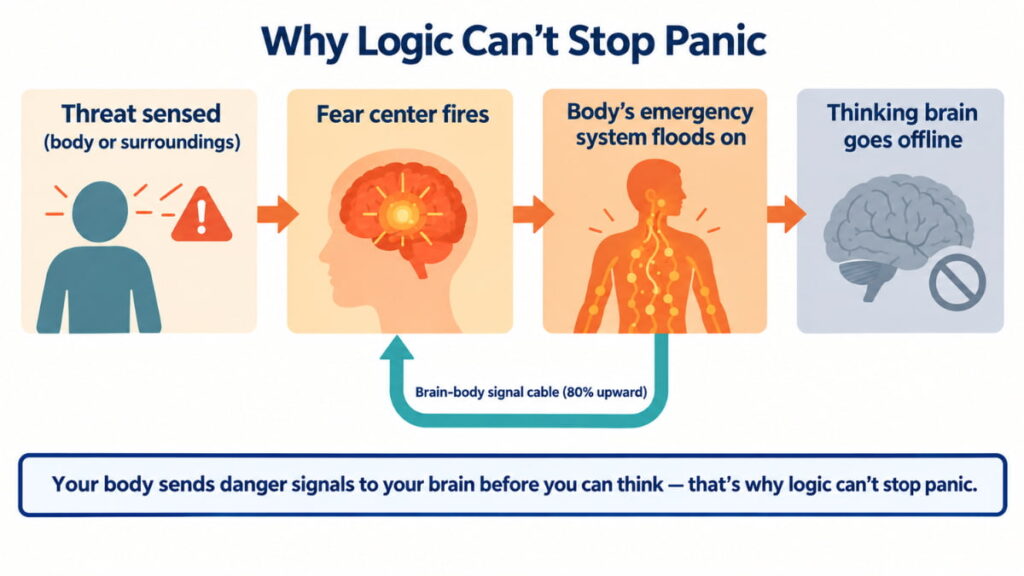
The vagus nerve [a long nerve running from your brain down through your heart, lungs, and gut] is the key here. It is like a long data cable that connects your brain to your organs.
About 80% of its fibers send data from your heart and lungs up to your brain.² If your heart is racing, your brain assumes you are in danger.
It doesn’t matter if you are just sitting on your couch. Your brain believes the body’s data more than your thoughts. You are stuck in a trap.
The Three Settings of Your Nervous System
There is a theory called Polyvagal Theory [a framework developed by scientist Stephen Porges explaining how your nervous system shifts between safety, danger, and shutdown states].
It explains that your nervous system has three main settings.³ Picture them as rungs on a ladder.
- Ventral Vagal (Top): This is the safe zone. You feel social and happy. You can think clearly here.
- Sympathetic (Middle): This is the fight or flight zone. You feel anxious, angry, or jittery. Your heart beats fast. You are ready to run.
- Dorsal Vagal (Bottom): This is the freeze zone. Your body decides it can’t fight or run, so it shuts down.
Some therapists use an informal name for one version of this state: Functional Freeze.⁴
You might go to work and do your chores, but you feel numb inside. You feel tired, even after you sleep. You feel like a ghost in your own life. This is nervous system regulation going wrong.
You aren’t lazy. Your body is just trying to protect you by hiding. Understanding where you are on this ladder is the first step.
If you are in a freeze, you can’t jump straight to being happy. You have to climb back up the ladder one step at a time. This starts with moving your body, not just changing your mind.

Why Talking About Anxiety Isn’t Enough?
Many people go to talk therapy for years. They use Cognitive Behavioral Therapy [CBT: a talk-based approach that helps you identify and challenge anxious thoughts] to track their thoughts. This can be helpful, but some experts think it has a limit.⁵
CBT is a top down fix. It asks the brain to calm the body. But if your body is screaming danger, your brain struggles to listen. It feels like a lie to say I am safe when your chest feels tight.

This is why logic fails. You need bottom up processing. This means you fix the body first so the brain can finally listen. Instead of just talking about a bad memory, you feel where that memory lives in your muscles.
In one body-based therapy, Somatic Experiencing [a body-based trauma therapy that focuses on physical sensations rather than analyzing thoughts], you let your body shake it off.⁶ When your body feels safe, the anxiety starts to ease.
4 Body First Ways to Calm Down Fast
Here are four somatic exercises you can use right now.
Talk to your doctor before trying new physical techniques if you are pregnant, on medication, or managing a heart condition or chronic illness.
1. The Physiological Sigh
In a 2023 Stanford study, five minutes of this breathing lowered anxiety and lifted mood.⁷
Take a deep breath in through your nose. Then, take a tiny second sip of air at the very top. Now, exhale very slowly through your mouth. Repeat for about five minutes.
This deep double breath can help reinflate tiny air sacs in your lungs, and the long, slow exhale signals your heart to settle.⁸
2. The Cold Water Reset
If your mind is racing, splash ice cold water on your face, or hold your breath and dip your face into a bowl of cold water.
This triggers a reflex that tells your brain to slow your heart down to save oxygen.⁹ It is a hard reset for your system. If you have a heart condition, check with your doctor first.
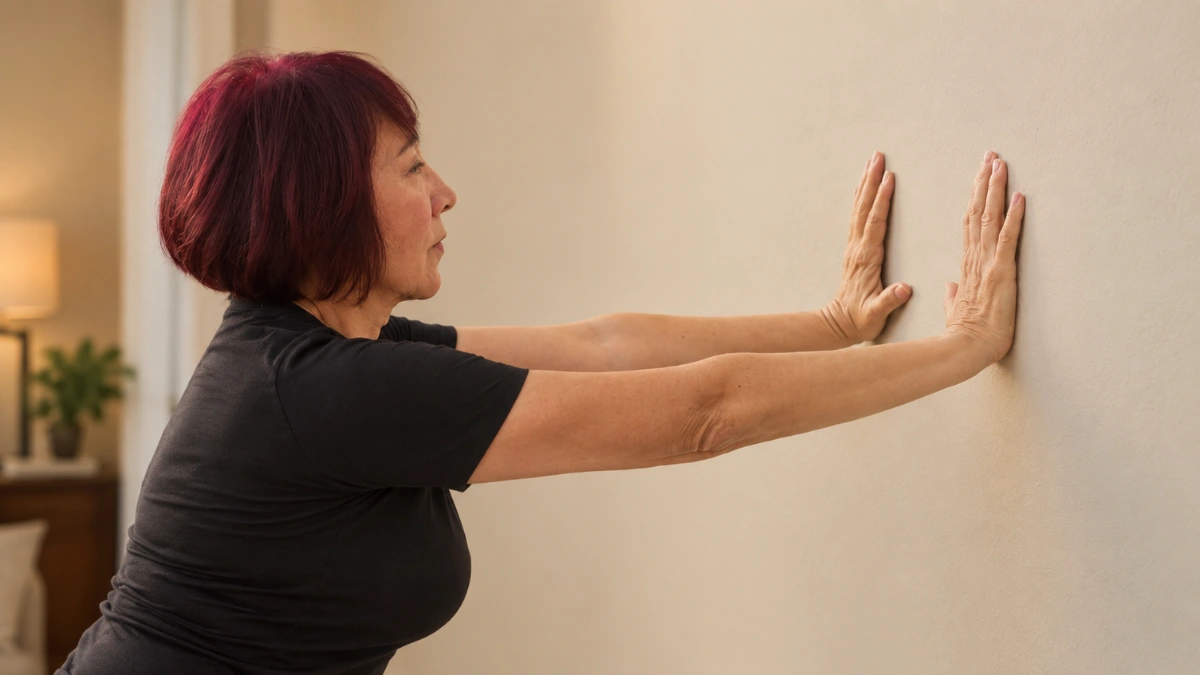
3. Wall Pushing
Sometimes you feel floaty when anxious. Find a wall. Put your hands on it and push firmly for 10 seconds. Feel your muscles work.
This tells your brain where your body is in space.¹⁰ Some therapists use pushing exercises like this to help anxious clients feel grounded.¹¹
4. The Eye Reset
Lie on your back. Interlock your fingers behind your head.
Without moving your head, look with your eyes to the right as far as you can. Keep looking until you yawn, sigh, or swallow. Then do the left side.
This may ease tension in the small muscles at the top of your neck. Some therapists believe this helps calm the vagus nerve.¹²
3 Signs Your Body is Stuck in Survival Mode
Most people think anxiety is just a bad feeling. But it shows up in your body in sneaky ways.
- Maybe you always have a tight jaw or clenched teeth.
- Maybe your stomach hurts or feels bloated after every meal.
- You might even find it impossible to sit still for five minutes without checking your phone.

These are signs your sympathetic nervous system is stuck on high alert. It is like a car with the gas pedal floored while the car is in park. You are burning all your energy but going nowhere.
If you notice these signs, stop trying to think happy thoughts. Your body is telling you it feels unsafe. You need to move, shake, or rest to reset that energy.
The 2-Minute Reset for Your Senses
When anxiety spikes, your brain begins to spin. You need to pull your focus out of your head and back into the physical world. This is called sensory grounding.
A great way to do this is the 5-4-3-2-1 method. Stop what you are doing and find:

- 5 things you can see (like a lamp or a tree).
- 4 things you can touch (like your shirt or a cold desk).
- 3 things you can hear (like traffic or a fan).
- 2 things you can smell (like coffee or fresh air).
- 1 thing you can taste (like mint or just the inside of your mouth).
This pulls your attention to real data from the world around you. It can help break the loop of scary thoughts.¹³ It is a fast way to get somatic anxiety relief when you are in a crowded place or at work.
How to Sleep Better by Calming Your Nerves?
You are exhausted, but your brain won’t shut up at 2 AM. This happens because your body’s threat level is still too high.
Your survival brain thinks it must stay awake to watch for danger. To fix this, you have to signal safety to your body before you get into bed.
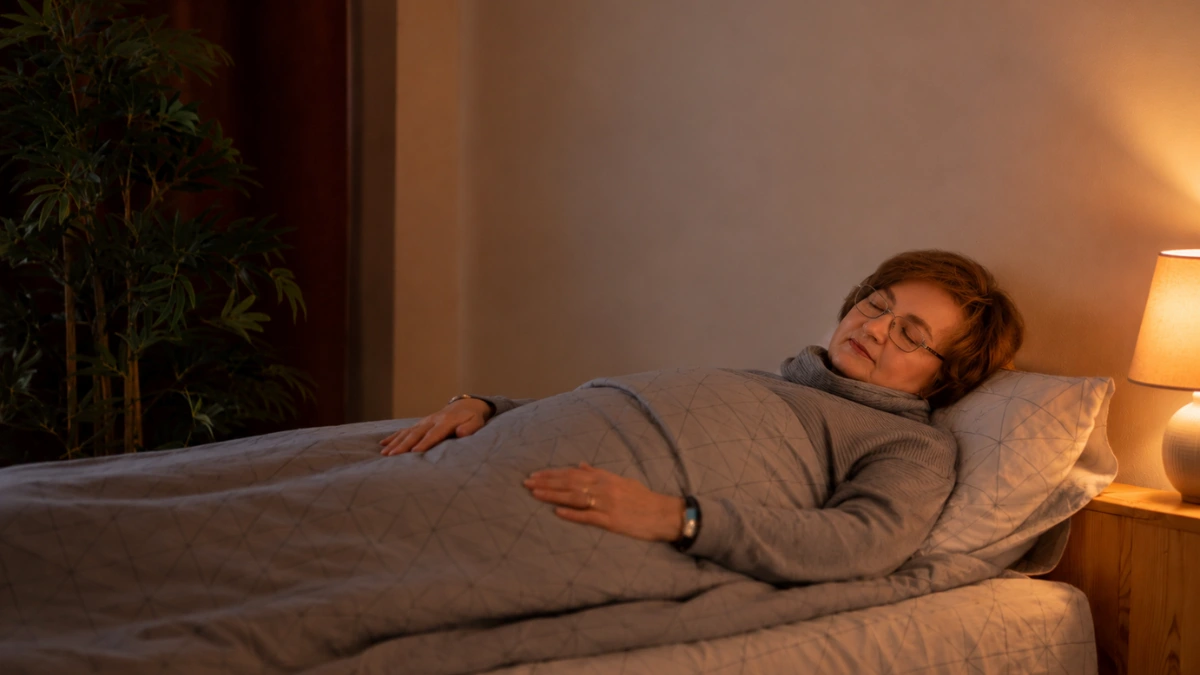
Try using a weighted blanket. The heavy pressure can help your body feel tucked away and safe. In one hospital study, 20 minutes under a weighted blanket eased anxiety and lowered pulse rates.¹⁴
This is a bottom up way to get better rest without needing to fight your thoughts. Skip weighted blankets for young children or if you have breathing problems.
Your Body Already Knows the Way Back
It is about being a good friend to your body. Your heart and nerves are just trying to keep you alive. They aren’t your enemy. When you start mastering somatic anxiety relief for long term peace, you stop fighting yourself.
You start working with your biology. Try the physiological sigh today. Or just push against a wall when you feel stressed.
Small body shifts, done often, add up to real mental changes. You don’t have to think your way out of this. You can feel your way back to safety.
References
- Breit S, Kupferberg A, Rogler G, Hasler G. Vagus Nerve as Modulator of the Brain-Gut Axis in Psychiatric and Inflammatory Disorders. Frontiers in Psychiatry. 2018;9:44. https://doi.org/10.3389/fpsyt.2018.00044
- Dolphin H, Dukelow T, Finucane C, Commins S, McElwaine P, Kennelly SP. “The Wandering Nerve Linking Heart and Mind”: The Complementary Role of Transcutaneous Vagus Nerve Stimulation in Modulating Neuro-Cardiovascular and Cognitive Performance. Frontiers in Neuroscience. 2022;16:897303. https://doi.org/10.3389/fnins.2022.897303
- Porges SW. Polyvagal theory: a journey from physiological observation to neural innervation and clinical insight. Frontiers in Behavioral Neuroscience. 2025;19:1659083. https://doi.org/10.3389/fnbeh.2025.1659083
- Wright A. Functional Freeze: When Your Body Shuts Down but Your Life Keeps Running. anniewright.com. 13 April 2026. https://anniewright.com/functional-freeze-driven-women/
- Porges SW. Polyvagal theory: a journey from physiological observation to neural innervation and clinical insight. Frontiers in Behavioral Neuroscience. 2025;19:1659083. https://doi.org/10.3389/fnbeh.2025.1659083; Kuhfuss M, Maldei T, Hetmanek A, Baumann N. Somatic experiencing – effectiveness and key factors of a body-oriented trauma therapy: a scoping literature review. European Journal of Psychotraumatology. 2021;12(1):1929023. https://doi.org/10.1080/20008198.2021.1929023; Arnsten AFT, Raskind MA, Taylor FB, Connor DF. The effects of stress exposure on prefrontal cortex: Translating basic research into successful treatments for post-traumatic stress disorder. Neurobiology of Stress. 2015;1:89-99. https://doi.org/10.1016/j.ynstr.2014.10.002
- Kuhfuss M, Maldei T, Hetmanek A, Baumann N. Somatic experiencing – effectiveness and key factors of a body-oriented trauma therapy: a scoping literature review. European Journal of Psychotraumatology. 2021;12(1):1929023. https://doi.org/10.1080/20008198.2021.1929023; Simply Psychology Editorial. Bottom-Up vs Top-Down Trauma Therapy: Which Approach Is Right for You? Simply Psychology. 1 May 2026. https://www.simplypsychology.com/articles/bottom-up-trauma-therapy
- Balban MY, Neri E, Kogon MM, et al., Huberman AD. Brief structured respiration practices enhance mood and reduce physiological arousal. Cell Reports Medicine. 2023;4(1):100895. https://doi.org/10.1016/j.xcrm.2022.100895
- Severs LJ, Vlemincx E, Ramirez JM. The psychophysiology of the sigh: I: The sigh from the physiological perspective. Biological Psychology. 2022;170:108313. https://doi.org/10.1016/j.biopsycho.2022.108313; Porges SW. Polyvagal theory: a journey from physiological observation to neural innervation and clinical insight. Frontiers in Behavioral Neuroscience. 2025;19:1659083. https://doi.org/10.3389/fnbeh.2025.1659083
- Malinowski KS, Wierzba TH, Neary JP, Winklewski PJ, Wszedybyl-Winklewska M. Resting Heart Rate Affects Heart Response to Cold-Water Face Immersion Associated with Apnea. Biology (Basel). 2023;12(6):869. https://doi.org/10.3390/biology12060869
- Proske U, Gandevia SC. The Proprioceptive Senses: Their Roles in Signaling Body Shape, Body Position and Movement, and Muscle Force. Physiological Reviews. 2012;92(4):1651-1697. https://doi.org/10.1152/physrev.00048.2011
- Neiman B. Using Tactile and Proprioceptive Activities to Help Clients with Emotional Dysregulation and Anxiety. New Harbinger Publications blog. 11 February 2020. https://www.newharbinger.com/blog/quick-tips-therapists/using-tactile-and-proprioceptive-activities-to-help-clients-with-emotional-dysregulation-and-anxiety/
- Schwartz A. The Vagus Nerve and Eye Movements: Tools for Trauma Recovery. Dr. Arielle Schwartz (blog). n.d. https://drarielleschwartz.com/the-vagus-nerve-and-eye-movements-tools-for-trauma-recovery-dr-arielle-schwartz/
- Scott KM, Duncan K, McCoy TP. Ground yourself: Using five senses technique to cope with test anxiety among nursing students. Teaching and Learning in Nursing. 2026;21(1):35-40. https://doi.org/10.1016/j.teln.2025.09.022
- Becklund AL, Rapp-McCall L, Nudo J. Using weighted blankets in an inpatient mental health hospital to decrease anxiety. Journal of Integrative Medicine. 2021;19(2):129-134. https://doi.org/10.1016/j.joim.2020.11.004