You slept seven hours. You know you slept seven hours because the app said so. And yet by midmorning you snapped at someone you like, and by afternoon a small frustration left you blinking back tears. You are not falling apart.
You are not more anxious than you used to be because of stress, or hormones, or some vague accumulation of life. You are losing a specific stage of sleep, one that has nothing to do with how tired you feel and everything to do with how stable you feel.
For adults over 50 who notice their emotions are harder to manage, this is the explanation that changes how you understand your own nights.
The information in this article is for educational purposes only and does not constitute medical advice. If you are experiencing significant changes in sleep, mood, or emotional regulation, speak with your doctor before making changes to your exercise routine or sleep habits.
Why Read This
- Your tracker is not measuring the stage that regulates your emotional life, and that gap explains more than any diagnosis.
- Find out why sleeping the same hours still leaves you emotionally raw after 50, and what that reveals about “enough sleep.”
- Discover why the most common fix makes almost no difference to the stage driving emotional volatility.
- Learn what a 12-week behavioral change showed when researchers measured the sleep stage quietly disappearing.
The Sleep Stage That Quietly Disappears After 50
Something is leaving your nights that your phone will never flag. You are not getting less rest.
The pattern is changing, and the difference is not in duration. It is in depth.
Sleep moves through stages each night. The deepest of those stages is called slow-wave sleep [the phase of non-rapid eye movement sleep characterized by large, slow electrical oscillations in the brain, also known as N3 or deep sleep].
During this stage, the brain produces the rolling electrical patterns that distinguish genuine rest from simply lying still in the dark. It is the stage most associated with physical restoration and, as the evidence now shows, emotional recovery.
Here is what happens to it after midlife. A large observational study combining data from 149 healthy men across four research laboratories found that slow-wave sleep drops from roughly 18.9% of a night’s total sleep time in early adulthood to just 3.4% by midlife.¹
That is a fall of more than 80%. And it happens, on average, before most adults start paying attention to this at all.
Deep sleep erodes quietly, in the years before anyone starts asking why their emotions feel harder to carry.
By the time you turn 50, slow-wave sleep has already dropped from nearly one-fifth of your night to almost none. The steepest fall happens before most people start looking for an explanation.
Lighter non-REM stages fill in where slow-wave used to be. Total time asleep stays roughly the same. This is why the problem goes unnoticed for so long: the hours look fine. Only the architecture has changed.
One limitation shapes how to read these figures: the study followed men only, aged 16 to 83, pooled across separate studies conducted over more than a decade.
Parallel changes in women are supported by other research, but the specific figures above come from a men-only dataset.
Why slow-wave sleep declines so sharply is outside this article’s scope. The mechanisms involve shifts in brain structure, neural circuitry and the underlying drive for deep rest.
The consequence is what the next section is about, and it is not what most people expect.
Why Your Emotions Take the First Hit, Not Your Energy
Most adults over 50 who notice they are snapping more, tearing up unexpectedly, or lying awake with a low-level unease they cannot name do not connect those experiences to what happens during the night. They connect them to stress, to life, to the assumption that emotional steadiness gets harder with age.
The sleep and emotions after 50 connection is the one explanation most doctors do not raise.
Here is what the research now shows.
A 2026 study in Communications Psychology recruited 61 cognitively healthy adults over age 65, brought them into a sleep laboratory for overnight polysomnography [a comprehensive sleep study that records brain waves, eye movements, muscle activity and breathing throughout the night], and measured their slow-wave activity throughout the night.²
The following morning, each participant completed an anxiety questionnaire.
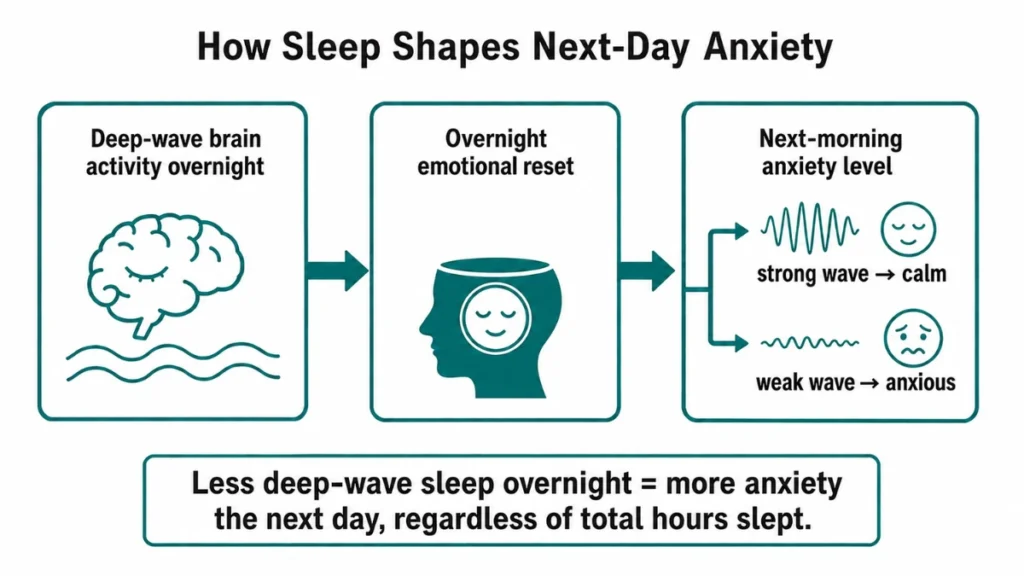
A consistent pattern appeared: the less slow-wave activity a participant generated during the night, the higher their anxiety the next day.
The sleep stage you are losing is not the one that makes you tired; it is the one that empties your emotional reserves overnight, and by 50 most of it is already gone.
Even after the researchers controlled for age, sex, total sleep time, REM sleep, and sleep efficiency, that pattern held.² In other words, it was not that anxious people simply slept fewer hours, or that older participants skewed the result.
The slow-wave loss itself appeared to be doing something to emotional regulation overnight, independently of everything else measured.
Brain structure helps explain why. Participants with more tissue loss in emotion-processing regions of the brain also produced fewer slow waves during sleep.²
A mediation analysis then showed that the slow-wave deficit fully accounted for the link between brain structure changes and disrupted emotional regulation. This is the research signal this article is built on: the emotional cost of that deficit is not an indirect effect of feeling tired.
It is specific. It is measurable.
This insight runs against what most adults in this age group are told. The assumption is that if you slept seven hours, your emotional system got what it needed.
That assumption is wrong. Hours measure quantity.
What slow-wave activity measures is the part of sleep that processes and resets the emotional weight of the day before.
One thing to hold in view: no single study connects all the pieces simultaneously. The van Cauter data established how much slow-wave sleep declines with age; the Ben Simon data shows what that decline costs emotionally in adults over 65.
These are separate bodies of evidence, and this article is assembling them rather than citing one source that proves the whole chain.
What Slow-Wave Sleep Loss Actually Feels Like at 50-Plus
You probably do not wake up feeling wrecked. That is part of what makes this so hard to trace back to what happened overnight.
Classic deprivation looks a specific way: heavy eyelids, slowed thinking, a craving for caffeine before 9 a.m. What slow-wave sleep loss produces is quieter than that, and more targeted.
Researchers ran a controlled experiment comparing young adults (18-30) with older adults (60-72): when both groups were kept awake for an entire night, the older group showed a noticeably smaller decline in negative mood than the young group.³
Older adults, in this study, were emotionally more resilient to total deprivation, not less. That finding runs against the common assumption that sleep problems hit older adults harder across the board.

Taken together, this tells us that the emotional impact of these changes after 50 does not look like a younger person’s bad night. It does not arrive as a collapse. It arrives as a gradual lowering of the floor: a reduction in how much emotional friction the nervous system can absorb before it shows.
Emotionally, it tends to show up in relational and situational moments rather than as raw distress. Crying at something that would not have moved you a year ago.
A short fuse during a conversation that was mildly irritating rather than genuinely upsetting. A sense of emotional thinness that appears at specific moments: when something goes unexpectedly wrong, when plans change, when someone says something that lands harder than it should.
None of this is a mood disorder. It is not a personality change.
It is a nervous system that lost its overnight reset and is operating on a shorter reserve than it used to have.
Older adults generally become more skilled at managing their emotional responses to ordinary stress over time. That hard-won steadiness can mask a real physiological change happening in the sleep stage doing the underlying work, which is what makes the connection so easy to miss.
Why Sleeping Longer Does Not Solve This Problem
Getting more rest is the obvious response to feeling emotionally worn down from poor sleep. Go to bed earlier.
Stay in bed longer on the weekend. Add an hour. This logic feels sound, and for most nights of disrupted rest, it is. For this specific one, it runs into a biological wall.
Built into the brain is a repair system for this. When it is deprived of slow-wave activity on one night, it attempts to compensate with extra slow-wave output on the next.⁴
In younger adults, this rebound works reasonably well: the body reads the deficit and responds with more deep-wave intensity the following night.
In middle age, that system weakens. A study comparing 29 young adults (average age 27) with 34 middle-aged adults (average age 51) put both groups through 25 hours of wakefulness and then measured the slow-wave rebound during their recovery sleep.⁴
Middle-aged participants showed significantly lower slow-wave density rebound and weaker restoration of slow-wave amplitude and slope than younger participants, particularly in the frontal brain regions where this activity matters most for emotional regulation.
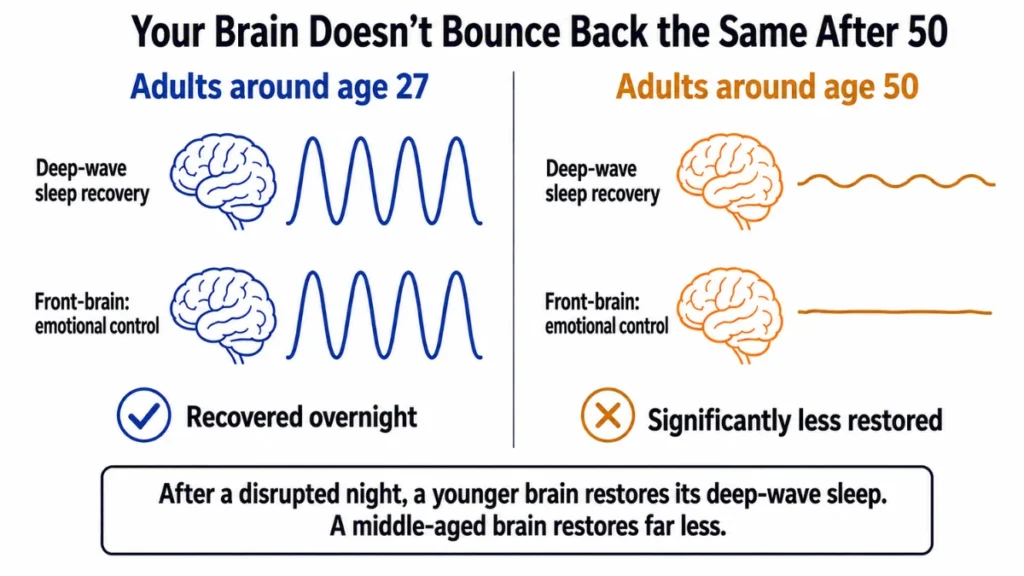
Extra hours cannot repay the emotional toll of disrupted nights after 50. The issue is not the quantity of a recovery period but the brain’s diminished capacity to generate the kind of deep-wave activity that extra time would theoretically allow.
Devices cannot show it. Your tracker might show you getting eight hours on a Saturday and report it as a good night.
What the number on the screen does not show is whether those eight hours included the slow-wave activity that makes sleep emotionally restorative. The hours are visible. The stage is not.
This is the direct challenge to one of the most common pieces of sleep advice given to adults over 50: the instruction to prioritize more hours in bed. More hours help many things.
They do not reliably restore the specific stage being lost, because the mechanism that would do the restoring has already diminished.
How Fast the Loss Moves and What It Is Doing in the Meantime
If slow-wave sleep were stable in older adults, the picture would be manageable. The evidence suggests it is not.
Framingham Heart Study researchers followed 346 adults aged 60 to 87, measuring each participant’s slow-wave sleep twice with approximately five years between assessments.⁵ Aging was associated with a mean annual decline of 0.6% in that stage.
Over the 17-year follow-up that followed the second measurement, there were 52 cases of dementia in the group. Each one-percentage-point annual decrease in slow-wave sleep was associated with a 27% increase in the risk of dementia.⁵
That association is with dementia, not with emotional regulation, and the two bodies of evidence cover different ground. The Framingham data shows that the loss is progressive and measurable year over year, and that it carries consequences beyond how someone feels on a given morning.
Ben Simon’s research, reviewed earlier, shows the emotional cost in terms of overnight anxiety regulation in adults over 65. These are two separate datasets: Himali tracked dementia incidence, Ben Simon tracked anxiety.
Together, they sketch a direction. The stage is not simply low at 50 and then stable.
It continues to fall. The emotional toll appears to scale with the loss, as the longitudinal data from Ben Simon’s 4-year follow-up suggests: participants whose slow-wave activity declined most over four years also showed the greatest increase in anxiety over the same period.²
No clean intervention has yet been shown to fully reverse the trajectory. The loss is real, the pace is measurable, and the downstream effects are documented.
Whether the curve can be bent substantially, and by how much, remains an active question rather than a settled one.
The One Habit That Protects the Sleep Stage You Are Losing
If the decline is real and the rebound mechanism is weakened, the practical question is whether anything can slow or partially reverse it. One behavioral intervention has direct evidence from polysomnography in older adults: resistance training.
A randomized controlled trial enrolled 28 older adults aged 65 and above who had been diagnosed with sarcopenia [age-related loss of muscle mass and strength that reduces physical function], then assigned half to a 12-week resistance training program and half to a placebo control group.⁶ Sleep was measured before and after using polysomnography.
Over 12 weeks, the resistance training group’s N3 percentage rose by 0.70%, while the control group’s declined by 4.90%, a difference that reached statistical significance.⁶
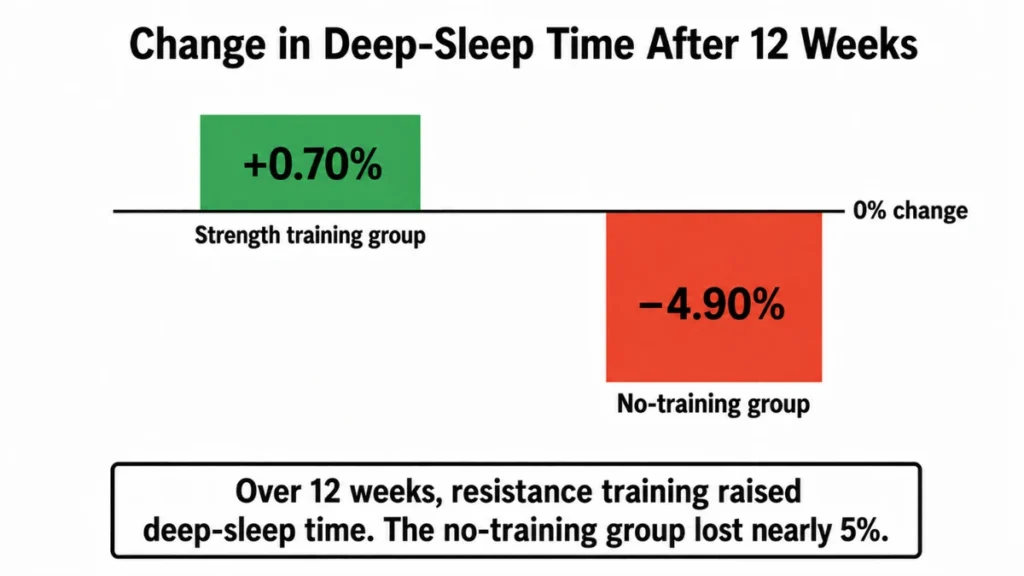
Fourteen people per arm is a small trial, and the authors note that the small sample size and high variability between participants mean the results warrant replication in larger studies. The study was also unblinded, which is inherent to exercise interventions but adds some risk of bias.
These are the limits of what a single small trial can confirm.
What it does confirm is that the slow-wave stage is not entirely fixed. A structured behavioral change produced a measurable difference in objective sleep architecture in a population already experiencing age-related decline.
It is a small finding, but it is a real one.
Applying this finding requires individual judgment. A person already doing regular resistance training may see different returns than someone starting from a sedentary baseline.
Someone managing a joint condition, heart disease, or another chronic illness should discuss a new exercise program with their doctor before starting.
Talk to your doctor before beginning a resistance training program if you are managing a chronic health condition, taking medication that affects heart rate or blood pressure, or recovering from an injury.
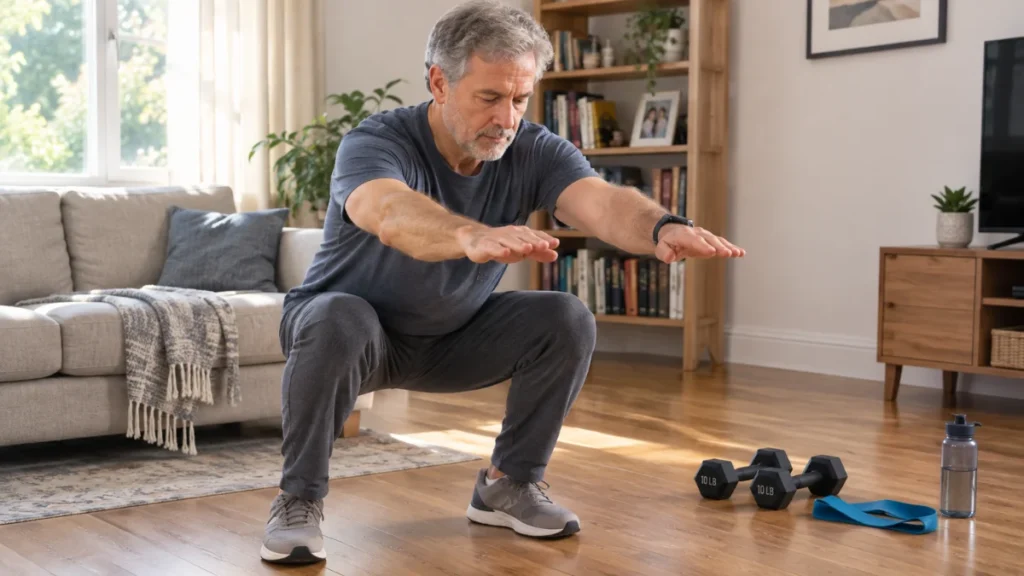
What a resistance training protocol looks like
The trial used a 12-week supervised program. Resistance training does not require a gym; the principle is progressive muscular load. Work two to three sessions per week on non-consecutive days. Begin with bodyweight or light resistance and add load gradually. Focus on large muscle groups: legs, back, chest, shoulders. Aim for two to three sets of eight to twelve repetitions per exercise, resting 60 to 90 seconds between sets. Sessions of 30 to 45 minutes are sufficient.
What the research cannot yet tell you is how much of the stage this approach restores, or whether the gains hold indefinitely: the open questions worth keeping in mind as the science continues to develop.
The Sleep Stage Worth Protecting
The emotional changes adults over 50 blame on stress or hormones often have a more specific cause: a progressive loss of the sleep stage responsible for overnight emotional recovery. That loss begins before most people start looking for explanations.
Start resistance training at least twice a week: the one behavioral change with direct polysomnography evidence for rebuilding the sleep stage you are losing.
Knowing what is happening is not the same as being able to stop it, but it is a better starting point than blaming stress.
References
- Van Cauter E, Leproult R, Plat L. Age-related changes in slow wave sleep and REM sleep and relationship with growth hormone and cortisol levels in healthy men. JAMA. 2000. https://pubmed.ncbi.nlm.nih.gov/10938176/
- Ben Simon E, Shah VD, Murillo O, Zsofia Z, Walker MP. Impaired slow-wave sleep accounts for brain aging-related increases in anxiety. Communications Psychology. 2026. https://www.ncbi.nlm.nih.gov/pmc/articles/PMC12917002/
- Schwarz J, Axelsson J, Gerhardsson A, Tamm S, Fischer H, Kecklund G, Åkerstedt T. Mood impairment is stronger in young than in older adults after sleep deprivation. Journal of Sleep Research. 2019. https://pubmed.ncbi.nlm.nih.gov/30585371/
- Lafortune M, Gagnon JF, Latreille V, Vandewalle G, Martin N, Filipini D, Doyon J, Carrier J. Reduced Slow-Wave Rebound during Daytime Recovery Sleep in Middle-Aged Subjects. PLoS One. 2012. https://www.ncbi.nlm.nih.gov/pmc/articles/PMC3418233/
- Himali JJ, Baril AA, Cavuoto MG, Yiallourou S, Wiedner CD, Himali D, DeCarli C, Redline S, Beiser AS, Seshadri S, Pase MP. Association Between Slow-Wave Sleep Loss and Incident Dementia. JAMA Neurology. 2023. https://pubmed.ncbi.nlm.nih.gov/37902739/
- de Sá Souza H, de Melo CM, Piovezan RD, Miranda REEPC, Carneiro-Junior MA, Silva BM, Thomatieli-Santos RV, Tufik S, Poyares D, D’Almeida V. Resistance Training Improves Sleep and Anti-Inflammatory Parameters in Sarcopenic Older Adults: A Randomized Controlled Trial. International Journal of Environmental Research and Public Health. 2022. https://www.ncbi.nlm.nih.gov/pmc/articles/PMC9736460/