

You’ve eaten the same whole grain bread for twenty years. And now it’s making you bloated, gassy, or constipated. Nothing changed. Except your gut did. You’re not alone. Many people find it harder to digest whole grain bread after 50 than they ever did before. Nothing changed about the bread. Except your gut did.
This is one of the most confusing things about getting older. You’re eating healthy. You’re doing what the doctors told you. But somehow the “good” food is the one causing problems.
Here’s what’s actually happening in your gut and what to do about it.
What Actually Changes in Your Gut After 50
After 50, three specific things shift in your digestive system. And all three affect how you handle whole grain bread.
First, your body makes fewer digestive enzymes. Lillian Craggs-Dino, a registered dietitian at Cleveland Clinic, explains that older adults gradually lose digestive enzymes. Foods you handled fine at 35 can become a problem at 55. Not because the food changed. Because your gut’s ability to process it did.

Second, your gut slows down. The muscles that push food through your intestines weaken with age.
The National Academy of Medicine recommends 21 grams of fiber daily for women over 50, and 30 grams for men. But when your gut is moving slower, that fiber sits longer. And that creates gas, bloating, and discomfort.
Third, your gut bacteria lose diversity. A 2025 study published by the American Society for Microbiology confirmed that slowed digestion and lower enzyme levels directly change your gut microbiome as you age. Fewer good bacteria means less help breaking down complex foods.
By age 60, about 50% of people have diverticulosis. These are small pouches in the intestinal wall. Whole grain tolerance becomes very personal after that point.
These three changes don’t mean whole grains are bad for you. They mean your gut needs a smarter form of them. And that’s where the real problem with standard whole grain bread begins.
Why Whole Grain Bread Gets Harder to Digest With Age
The problem isn’t fiber itself. It’s the specific way whole grain bread delivers it.
Standard whole grain bread contains three compounds that your aging gut struggles with more and more over time.
Phytic acid is found in grain bran. It binds to minerals like iron, magnesium, and zinc. When it does that, it blocks your body from absorbing them.
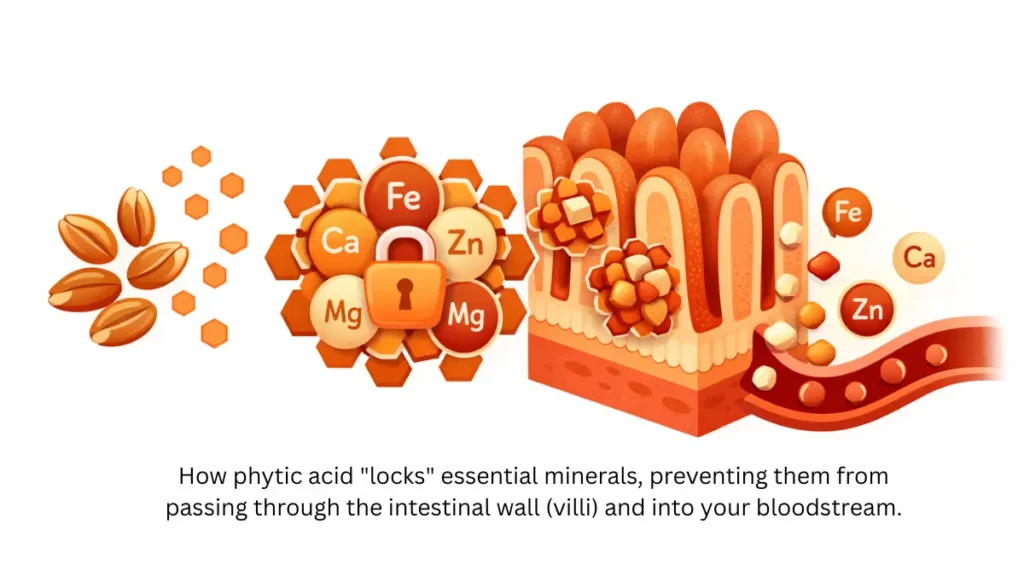
Your digestive system produces very little of the enzyme needed to break phytic acid down. Research from the Weston A. Price Foundation suggests that roughly 80% of the iron and magnesium in whole grains can’t be properly absorbed because of phytic acid binding.
You’re eating healthy bread and not even getting the minerals from it.
Fructans are fermentable carbohydrates found in wheat. They don’t get digested in your small intestine. Instead, they pass through to your colon. Bacteria there ferment them and produce gas.
Multiple studies show that many people who think they’re reacting to gluten are actually reacting to fructans. A 2025 study published in the journal Foods found that FODMAPs, the category fructans belong to, worsen gut symptoms in roughly 40% of the general population.
Lectins are plant defense compounds found in whole grains. They’re linked to gut inflammation, digestive discomfort, and in some people, a leaky gut response.
Commercial bread makes all of this worse. Modern factory baking uses fast-acting yeast with almost no fermentation time. That means fructans and phytic acid stay fully intact when the bread reaches your gut. There’s no time for them to break down before you eat them.
Think about it this way. A supermarket whole grain loaf is made fast, with dough conditioners, and no real fermentation. Every compound that irritates your gut is still sitting there, waiting for your digestive system to deal with it.
This is why swapping to a better bread type, not cutting out grain completely, is the practical fix.
What Sprouted Bread Is and Why It Works
Sprouted bread is made from whole grains that are allowed to germinate, or sprout, before being used to make bread. That one step changes almost everything about how your gut handles it.
Here’s the mechanism. When a grain sprouts, it starts to pre-digest itself. Starches break down. Enzyme levels, especially phytase and amylase, increase inside the grain. So by the time the bread reaches your gut, a lot of the hard work is already done.
Phytic acid drops significantly. A 2025 study confirmed that sprouting reduces antinutrient content, including phytic acid. That means the iron, calcium, and zinc that were previously locked out become actually available to your body.
Fructans are degraded during sprouting. The fermentable carbohydrates that cause gas and bloating are broken down before the bread is even baked. Research cited by Silver Hills Bakery, backed by Monash University FODMAP work, confirms that sprouted grain bread is better tolerated by people with fructan sensitivity.
Lectins are reduced. Less gut inflammation. Less digestive discomfort.
Fiber increases and becomes more useful. Sprouting raises fiber concentration. It also makes fiber easier for your gut lining and microbiome to use.
One important note. Sprouting reduces gluten content but does not eliminate it. If you have celiac disease, sprouted wheat bread is still not safe for you.
In practical terms, your gut is getting pre-processed grain. Not raw, intact grain it has to break down from scratch.
How to Switch to Sprouted Bread: 5 Steps That Actually Work
Here’s exactly what to do, starting this week.
Step 1 — Pick the right product. Look for bread labeled “100% sprouted grain” or “sprouted whole grain.” The word sprouted must appear in the ingredient list, not just the product name on the front of the package.

Reliable brands include Ezekiel 4:9 by Food for Life, Alvarado Street Bakery, and Dave’s Killer Bread Sprouted line. Ezekiel uses no flour at all. Only freshly sprouted certified organic whole grains, slow-baked to preserve fiber and natural bran benefits.
Step 2 — Store it correctly. Sprouted breads like Ezekiel contain no preservatives. They will go bad on the counter fast. Refrigerate or freeze them. Slice off what you need and toast it straight from the freezer.
Step 3 — Start with one slice a day. Don’t switch fully on day one. Your gut bacteria need time to adjust to a new fiber source. Start with one slice. Add more after a week if you feel fine.
Step 4 — Pair it right. Don’t eat bread alone. Pair it with healthy fats, protein, or water-rich foods like cucumber or tomato. Avoid pairing with heavy cheese or fried foods, which slow digestion further. Toasting sprouted bread often makes it even easier on a sensitive gut.

Step 5 — Read the label carefully. If a bread says “made with sprouted grains” but lists regular wheat flour as the first ingredient, it’s mostly conventional bread with a marketing label. Sprouted whole grain flour or intact sprouted grains should be the first ingredient.
Can’t find sprouted bread near you? Sourdough is a solid second option. Real sourdough fermentation breaks down fructans, slows carbohydrate absorption, and partially pre-digests gluten. That makes it one of the most gut-friendly bread options available.

Most people notice a real difference within one to two weeks of making this swap.
What Sprouted Bread Won’t Fix
This switch helps a lot of people. But it’s not a fix for everything. Here’s where it stops working.
- Celiac disease. If you have celiac disease, you still need to avoid all wheat-based bread, including sprouted. See a gastroenterologist.
- SIBO (small intestinal bacterial overgrowth). Even sprouted bread can trigger symptoms if you have SIBO. This isn’t a SIBO treatment.
- Persistent bloating with other causes. If symptoms continue after switching, bread may not be the problem at all. IBS, low stomach acid, and other GI conditions need a proper medical evaluation.
- Constipation from dehydration. Fiber alone won’t fix constipation if you’re not drinking enough water. The National Council on Aging suggests dividing your body weight in pounds by three. That’s roughly how many ounces of fluid you should drink daily to support digestion.
If any of these apply to you, see your doctor before changing your diet.
The Bottom Line
Your gut changes after 50 in real, measurable ways. Fewer digestive enzymes. Slower transit. Less microbiome diversity. Standard whole grain bread, especially the commercial kind, contains phytic acid, fructans, and lectins that get harder to process as those changes add up.
Sprouted grain bread addresses all three. It pre-digests the compounds that cause problems, raises the nutrients your body can actually absorb, and gives your aging gut a much easier job.
Next time you’re at the grocery store, pick up one loaf of 100% sprouted grain bread. Try it for two weeks. Start with one or two slices a day.
Most people who make this switch stop blaming bread entirely. They just needed better bread.
Digesting whole grain bread after 50 doesn’t have to mean giving up grain. It means choosing grain that’s already done part of the work for you.
⚠️MEDICAL DISCLAIMER
This content is for informational and educational purposes only and does not constitute medical advice, diagnosis, or treatment. The information provided about digestive changes, dietary adjustments, and bread alternatives is intended for general wellness awareness and not as a substitute for professional medical guidance. If you are experiencing persistent bloating, gas, constipation, or other digestive symptoms, consult a qualified healthcare provider before making changes to your diet. Individuals with diagnosed conditions such as celiac disease, SIBO, IBS, or diverticulosis should seek personalized advice from a gastroenterologist or registered dietitian.