

It’s 6:42 in the morning and you already know, before you’ve opened your eyes. The moment you try to turn your head toward the alarm, a wall of resistance stops you between your right shoulder and the base of your skull. You bought the cervical pillow six months ago. It’s still not working.
The problem is that most adults over 50 who have already tried the pillow are solving a bedding problem when the real issue is happening inside the cervical spine itself. Morning neck stiffness after 50 has three biological causes. Not one of them is fixed by what’s under your head.
This article explains what those causes are, and what actually addresses them.
| # | Section | What you’ll find |
|---|---|---|
| 1 | What Happens to Your Cervical Spine While You Sleep | The biological reason stiffness builds while you lie still |
| 2 | Why Everything Changes After 50 | The three structural shifts that turn a normal process painful |
| 3 | The Inflammation Signal Most People Miss | A whole-body factor that sets the stage before bedtime |
| 4 | What Your Pillow Actually Does (and Doesn’t Do) | What a pillow can and can’t fix, and the one thing it can’t touch |
| 5 | The Three-Part Morning Sequence | A sequence built around the actual causes, not the symptoms |
| 6 | When Morning Stiffness Is a Signal, Not a Nuisance | Duration, red flags, and when stretching is the wrong first move |
What Happens to Your Cervical Spine While You Sleep
You lie still for seven or eight hours. That stillness is the problem. Your neck has two systems that depend on movement to stay lubricated, and both of them shut down the moment you stop moving.
The first system involves your cervical facet joints [the small sliding joints on either side of each vertebra in your neck]. These joints rely on movement to push hyaluronan [a thick, gel-like fluid that coats and lubricates joint surfaces] back into the joint space.
Animal research (Knight et al., Journal of Physiology, 2007) found that cyclic joint movement stimulates hyaluronan secretion and that overnight stillness depletes it.¹ The joint surfaces wake up drier than they were at midnight.
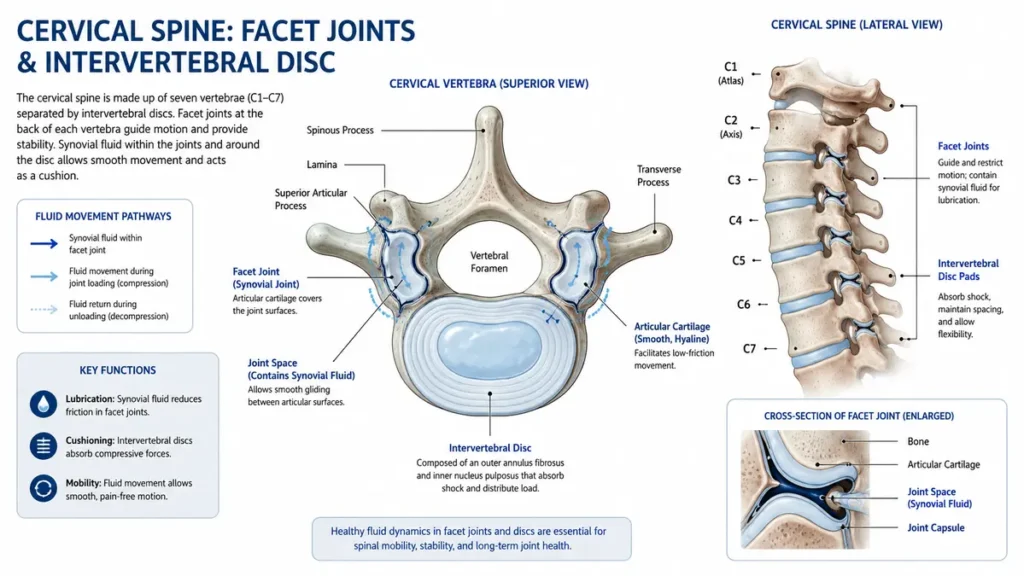
The second system involves your intervertebral discs [the shock-absorbing pads between each vertebra in your spine]. These discs partially rehydrate overnight as the load is taken off your spine during sleep.² They swell slightly with fluid. By morning they’re stiffer than they were at bedtime.
A 2017 study confirmed this rehydration happens in the cervical and thoracic spine, not just the lower back.²
Both of these things are completely normal at 35. After 50, the same overnight process produces something quite different.
Why Everything Changes After 50
After 50, the cervical disc loses two things faster than it can replace them: water and a structural protein called proteoglycan [a molecule that holds water inside the disc and keeps it flexible].
At birth, the inner part of an intervertebral disc is roughly 90% water. By age 60, that figure is closer to 70%.³ The disc becomes denser. It handles the nightly rehydration-and-reload cycle less well. When a stiffer disc swells overnight and then gets loaded again in the morning, the result is resistance, not smooth movement.³

Disc height narrows at the same time. A large MRI analysis (Yamamoto et al., World Neurosurgery, 2021) confirmed that cervical disc height narrowing progresses with age and tracks directly with disc degeneration.⁴
Here’s a number that matters. Modern MRI systematic reviews of asymptomatic populations show that cervical disc degeneration is common even in people without neck pain and increases sharply with age. Pooled imaging studies suggest that degenerative changes are present in a substantial proportion of younger adults and become widespread in older populations, affecting the majority of individuals over 60.⁵
Most people with morning neck stiffness have structural changes on their MRI. They just haven’t seen the image.
The surprising part is that those structural changes were probably well underway before you ever noticed the stiffness at all.
The Inflammation Signal Most People Miss
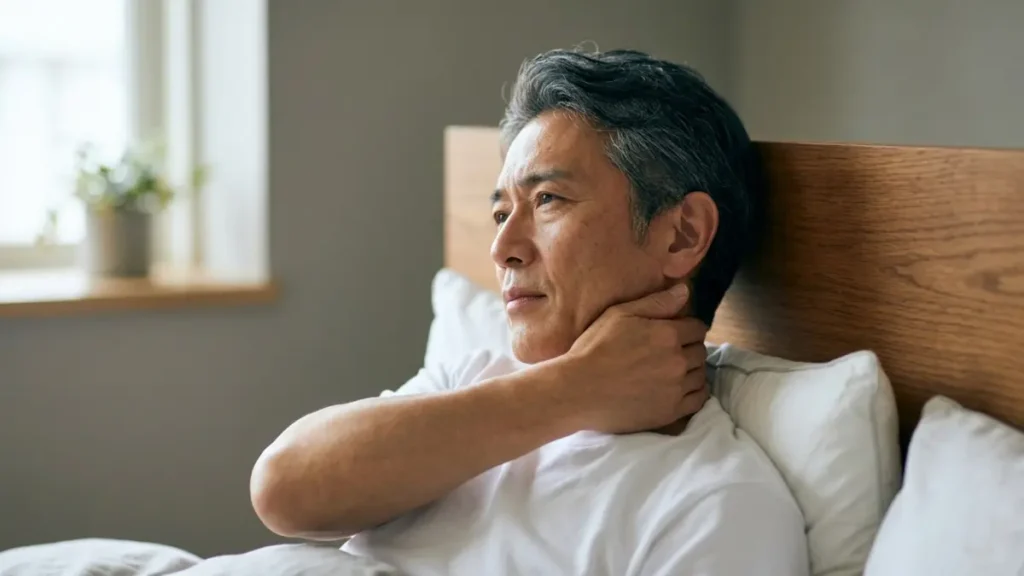
Here’s the piece that almost no article on this topic names. Morning neck stiffness after 50 may have a third contributing factor, and it has nothing to do with how you slept.
Some people with chronic neck pain show signs of a low-level inflammatory state that can be measured in the bloodstream.
A 2020 meta-analysis (Farrell et al.) found raised systemic levels of IL-1 beta [an inflammatory protein your immune system releases, which increases pain sensitivity] and TNF-alpha [another immune protein that drives inflammation in joints and discs] in people with non-specific neck pain.⁶
A study of 111 cervical disc samples (Zhou et al., Orthopaedic Surgery, 2024) found elevated inflammatory markers directly inside degenerated cervical discs.⁷
A 2024 study of 675 older adults (Feller et al., BACE study) found that morning stiffness severity correlated with both disc degeneration and elevated CRP [C-reactive protein, a marker your liver produces when inflammation is present in the body].⁸
This inflammation doesn’t start at bedtime. Sleep exposes it by removing movement and mechanical load, the two things that temporarily reduce it during the day.
Your pillow has never touched your disc, and it never will.
That inflammatory environment is something you can directly influence. Start working on it the evening before.
What Your Pillow Actually Does (and Doesn’t Do)
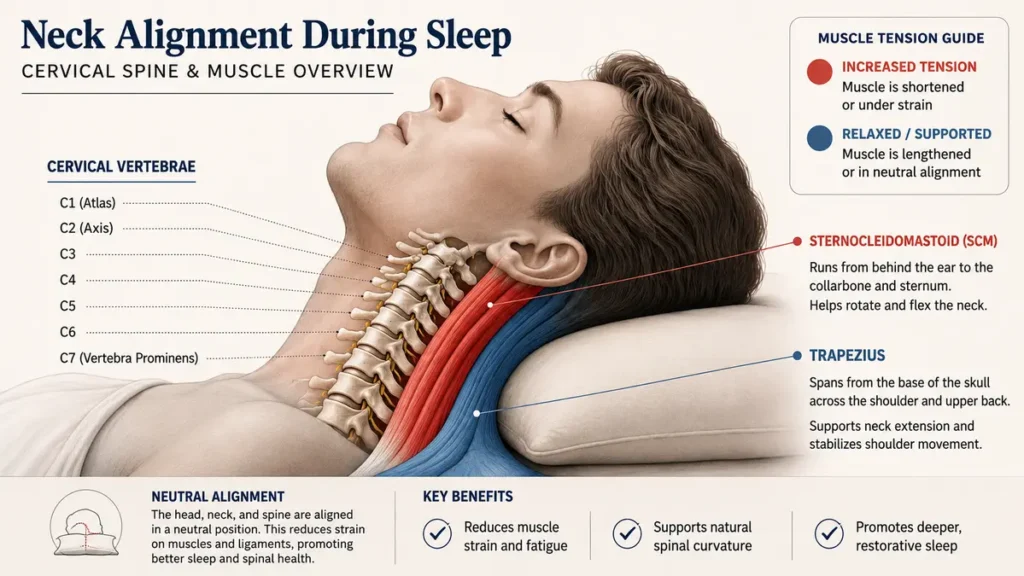
A pillow does one real thing: it controls the angle of your cervical spine [the seven vertebrae that make up your neck] while you sleep.
That matters. A poorly fitted pillow forces the sternocleidomastoid [the long muscle running from behind your ear down to your collarbone] and trapezius [the large muscle across the upper back and neck] to contract through the night instead of resting.⁹ A better pillow can reduce that strain. It’s a real improvement.
Here’s where most people stop. A pillow can’t restore disc water content. It can’t increase synovial fluid [the lubricating fluid inside your joints] viscosity. It can’t lower CRP.
Dr. Kenneth Mautner, a sports medicine physician at Emory Healthcare’s Orthopaedics and Spine Center, describes what happens as you age: your body produces less synovial fluid, and what it does make often becomes thinner and less effective.¹⁰ No pillow reverses that.
The reason the pillow keeps getting blamed is logical. A bad pillow makes everything worse, so a better one produces partial relief. That relief gets misread as proof the problem was the pillow. The stiffness returns because its actual causes were never addressed.
A better pillow reduces the mechanical insult. It can’t touch the disc, the joint fluid, or the inflammation. It will never fully solve the problem.
The Three-Part Morning Sequence
Before trying this sequence, a note on safety: talk to your doctor first if you have been diagnosed with cervical stenosis, a herniated disc, or any condition that limits neck movement. Stop any step that causes sharp pain or numbness down your arm.
This sequence targets all three actual causes. Do all three steps before you leave the bedroom. Under five minutes total.
MORNING SEQUENCE
Step 1: Supine Release (lying flat) Chin to chest, then gently back. Five times. Rotate left and right, five times each. Don’t sit up first.
Step 2: Seated Cervical Rotation (bed edge) Level your chin. Rotate left to end range, hold three seconds. Return. Rotate right, hold three seconds. Five times each side. (Demonstrated at
[00:00:25])Step 3: Neck Glide and Shoulder Roll Push your head straight back. Hold two seconds. Return. Repeat 10 times. Follow with 10 backward shoulder rolls. (Demonstrated at
[00:01:12]and[00:04:54])
If this sequence consistently takes more than 30 minutes to clear your stiffness, the next section explains exactly what that means. Animal research supports that cyclic joint movement restores the hyaluronan lost overnight.¹
A 2024 study (Chen et al., Scientific Reports) found cervical self-mobilization improved rotation range of motion and reduced neck disability.¹¹
When Morning Stiffness Is a Signal, Not a Nuisance
If morning neck stiffness consistently lasts longer than 45 minutes, that duration matters clinically.

The National Institutes of Health (NIH) states that polymyalgia rheumatica [PMR, an inflammatory condition causing pain and stiffness in the neck, shoulders, and hips, almost exclusively in people over 50] produces stiffness that is worst upon waking and typically lasts an hour or more.¹² PMR is not caused by sleeping position. It requires a physician diagnosis and specific treatment.
A clinical scoring system published in American Family Physician (2006) uses morning stiffness duration in minutes as one of five measured disease variables.¹³ Duration is data.
Watch for these red flags alongside your stiffness. Each one needs urgent medical evaluation, not a morning stretch:
- New headaches, especially around the temples or back of the head
- Jaw pain when eating or talking
- Scalp tenderness when touching your head
- Any changes in vision, including temporary blurring or double vision

These symptoms may point to giant cell arteritis [GCA, a condition that inflames the arteries supplying blood to the head, which can cause permanent vision loss if untreated]. The NIH reports about 10% of people with PMR also have GCA.¹²
Start the three-part morning sequence tomorrow and track your stiffness window for 14 days. If it still runs past 45 minutes each morning, bring that log to your doctor.
Conclusion
Morning neck stiffness after 50 is a disc, joint, and inflammation problem. Sleep exposes it every night. The pillow doesn’t cause it and can’t cure it.
Start the three-part morning sequence tomorrow and track your stiffness window for 14 days. If it still runs past 45 minutes each morning, bring that log to your doctor.
Fourteen days of tracking is real data: it confirms something mechanical and addressable, or gives your physician something concrete to act on.
⚠️DISCLAIMER:
This article is for informational purposes only and does not constitute medical advice, diagnosis, or treatment. The content addresses causes and management of morning neck stiffness after 50 and is intended for general educational purposes only. Health conditions vary significantly between individuals, always consult a licensed physician or qualified healthcare provider before making any decisions about your health or medical care.
References
- Knight, M.M., et al. Cyclic movement stimulates hyaluronan secretion into the synovial cavity of rabbit joints. Journal of Physiology. 2007. https://pmc.ncbi.nlm.nih.gov/articles/PMC2375686/ [Animal study. Disclosed in article body at point of citation.]
- Vo, N., et al. Cervical and thoracic intervertebral disc hydration increases with recumbency. The Spine Journal. 2017. https://www.sciencedirect.com/science/article/abs/pii/S1529943017302681
- Schroeder, G.D., et al. Cervical Degenerative Disc Disease. StatPearls / PubMed. 2020. https://pubmed.ncbi.nlm.nih.gov/32809607/
- Yamamoto, K., et al. Normative Magnetic Resonance Imaging Data of Age-Related Degenerative Changes in Cervical Disc Morphology. World Neurosurgery. 2021. https://www.sciencedirect.com/science/article/abs/pii/S1878875021008184
- Brinjikji, W., et al. Systematic literature review of imaging features of spinal degeneration in asymptomatic populations. American Journal of Neuroradiology (AJNR), 2015;36(4):811–816. https://www.ajnr.org/content/36/4/811
- Farrell, S.F., et al. Systemic inflammatory markers in neck pain: A systematic review with meta-analysis. Journal of Pain Research. 2020. https://pubmed.ncbi.nlm.nih.gov/32621397/
- Zhou, Y., et al. Increased Expression of Inflammatory Cytokines and Discogenic Neck Pain. Orthopaedic Surgery. 2024. https://pmc.ncbi.nlm.nih.gov/articles/PMC10782267/
- Feller, D., et al. The association of spinal morning stiffness with lumbar disc degeneration and C-reactive protein: The BACE study. Osteoarthritis and Cartilage Open. 2024. https://www.ncbi.nlm.nih.gov/pmc/articles/PMC11566339/
- Neck Stiffness in the Morning: How Sleep Posture Causes Overnight Pain. Putnams. Available at: https://putnams.co.uk/blogs/news/neck-stiffness-in-the-morning-how-sleep-posture-causes-overnight-pain.
- Mautner, K. Quote on synovial fluid thinning with age. AARP / Emory Healthcare Orthopaedics and Spine Center. January 2026. https://www.aarp.org/health/healthy-living/how-to-lubricate-joints-naturally/
- Chen, X., et al. Effects of exercise combined with cervicothoracic spine self-mobilization on chronic non-specific neck pain. Scientific Reports. 2024. https://www.nature.com/articles/s41598-024-55181-8
- National Institute of Arthritis and Musculoskeletal and Skin Diseases (NIAMS). Polymyalgia Rheumatica and Giant Cell Arteritis. National Institutes of Health. Updated June 2025. https://www.niams.nih.gov/health-topics/polymyalgia-rheumatica-giant-cell-arteritis
- Salvarani, C., et al. Polymyalgia Rheumatica and Giant Cell Arteritis. American Family Physician. 2006. https://www.aafp.org/pubs/afp/issues/2006/1101/p1547.html