

You’ve been doing what you’re supposed to do. Lights low, body still, phone down, waiting for sleep to arrive. And yet here you are, wide awake, with the kind of tired that doesn’t actually lead anywhere restful.
Here’s what sleep articles rarely say plainly: after 50, your nervous system doesn’t wind down just because your body stops moving. It needs a signal. Lying still isn’t that signal. For adults over 50 who already believe they have a wind-down routine, that single fact changes everything.
The nervous system wind-down your body is waiting for isn’t passive. It’s biological, specific, and short. This article explains why stillness falls short and what to do instead, tonight.
This article is for informational purposes only and does not replace professional medical advice. Sleep difficulties after 50 can have underlying causes that need clinical evaluation. Talk to your doctor before making changes to your sleep routine, especially if you are managing a chronic condition or taking medication.
Your Nervous System After 50 Doesn’t Rest the Way You Think
You lie down and your brain keeps going. That’s not a willpower problem.
Your nervous system has two branches. One is your body’s alert system. It handles stress, keeps you sharp, and runs your heart faster when it needs to. The other is your body’s calm signal. It does the opposite. It slows the heart, quiets the gut, and helps you drift toward sleep.
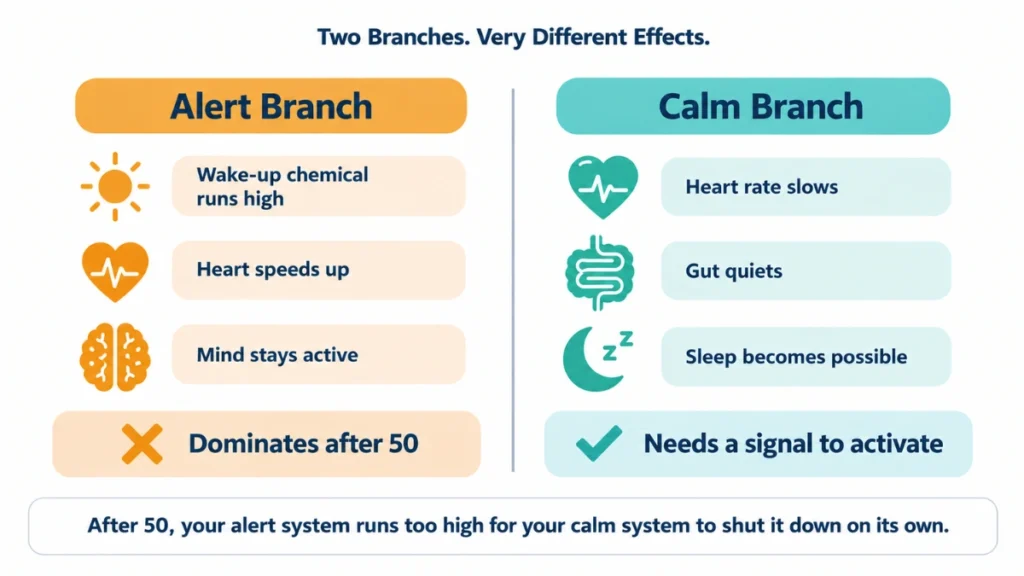
After 50, something measurable shifts. The autonomic balance changes: alert chemistry runs higher around the clock, and overall autonomic regulation weakens. This isn’t a mood or a habit. It’s a biological change in how your autonomic nervous system balances itself.
Research tracking 1,743 community-based adults aged 40 to 100 found that a key marker of this balance, called global autonomic regulation, declined in a straight line with age in both men and women.⁴
That marker is a measure of how smoothly your nervous system shifts gears.
When it declines, the shift from alert to calm doesn’t happen automatically. Your body needs something more than the absence of noise to make that shift happen.
Horizontal stillness removes stimulation. It doesn’t replace it with the right signal. And without the right signal, your nervous system wind-down never fully starts.
What’s Actually Happening When You Lie Still Before Sleep
You know the feeling. Your body is flat. The room is quiet. And your mind is running a list of everything you didn’t finish today.
That’s not anxiety. That’s chemistry.
Older adults carry more of their brain’s wake-up chemical at night than younger adults do. This chemical is called norepinephrine. It’s the same substance that rises when you’re startled or stressed. In older adults, it runs higher during sleep hours, even during normal nights with no obvious stress.
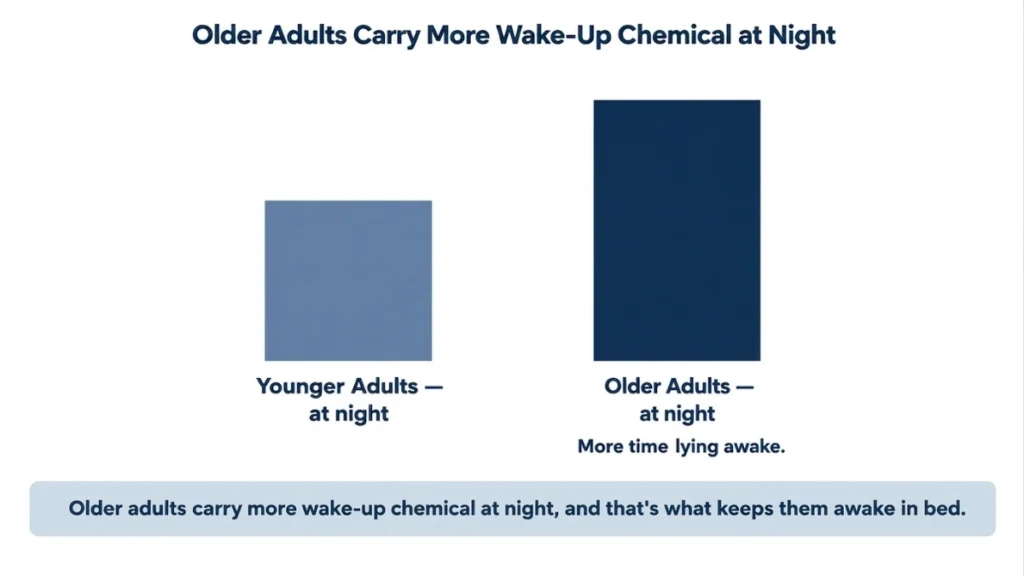
A controlled study tracked norepinephrine levels in older and younger men across a full 24-hour period. The older group had consistently higher levels while lying in bed, and those higher levels directly tracked with more time awake at night.⁵
Lying awake in bed isn’t a sign that you’re not tired. It’s a sign that your body’s wake-up chemical hasn’t been given a reason to quiet down.
Passive stillness doesn’t lower norepinephrine. It doesn’t activate the calm branch of your nervous system. Scrolling makes it worse by adding light and thought. But even lying quietly, doing nothing, doesn’t send the signal your body needs.
The alert system stays active until something actively turns it down. The alert system stays active until something actively turns it down. No standard wind-down routine addresses that directly.
The Nervous System Signal Your Body Is Waiting For
Your body’s calm signal is still there after 50. It’s quieter, but it still responds.
There’s a direct line between how you breathe and how your nervous system balances itself. Each exhale restores vagal outflow. The vagus nerve is the main cable of your body’s calm signal. When it fires, your heart rate drops slightly, and your brain starts to shift toward sleep.
The key is the ratio. When your exhale is longer than your inhale, that restoration increases. A four-second inhale followed by a six-second exhale is enough to move the balance.
One study tested this in both younger adults and adults over 60. Both groups showed a measurable increase in parasympathetic activity, meaning their calm signal strengthened, after five minutes of slow deep breathing with a longer exhale.¹ The calm-signal increase was larger in older adults than in younger ones, and that gap was statistically meaningful.
The nervous system wind-down reflex is preserved. It’s just waiting for the right invitation.
Most standard advice tells you to relax. It doesn’t tell you how to send the signal that makes relaxation physiologically possible. That’s the gap. And it’s why the advice keeps failing.
Why the Relaxation Techniques You’ve Already Tried May Have Let You Down
If you’ve tried progressive muscle relaxation and wondered why it didn’t seem to help, you’re not imagining it.
Progressive muscle relaxation is one of the most widely studied non-drug sleep interventions. It involves tensing and releasing muscle groups in sequence to reduce physical tension. For adults under 55, pooled research supports its use clearly.
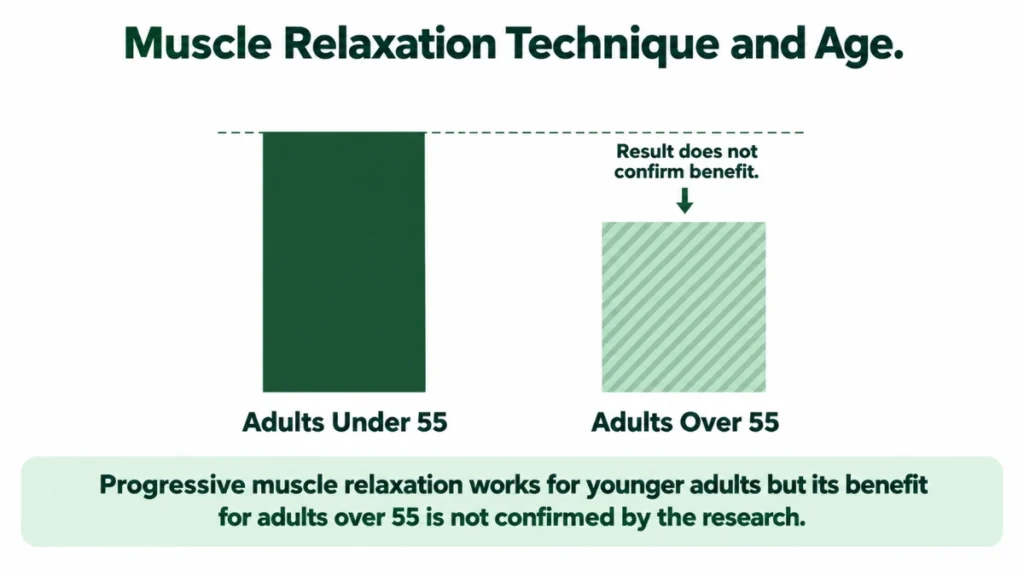
For adults over 55, the picture is different.
A 2026 systematic review analyzed 14 randomized controlled trials covering 957 participants.² The pooled effect for the age 55-and-older group produced a result that crossed zero in its confidence interval.²
A confidence interval that crosses zero means the result wasn’t strong enough to confirm a real benefit.
The authors of that review stated plainly: the effects of progressive muscle relaxation on subjective sleep quality in adults aged 55 and older remain uncertain.²

This is not proof that progressive muscle relaxation does nothing. It’s evidence that a technique built for general adult populations may not match the biology of the aging nervous system. The problem wasn’t your effort. The technique wasn’t designed around a nervous system that has already shifted its baseline toward alert.
What the aging nervous system needs isn’t general relaxation. It needs a specific physiological trigger. That distinction is what the next section delivers.
The Five-Step Protocol That Sends the Right Signal
Before starting this protocol: if you have poor circulation, neuropathy, or reduced feeling in your feet, test any warm water temperature carefully with your elbow or wrist before soaking. Water that feels comfortable to healthy skin can cause burns if sensation is reduced.
The steps below take ten to fifteen minutes. They work by sending specific physiological signals, not by asking you to relax harder.
The Pre-Sleep Nervous System Protocol
- Leave the bed 20 minutes earlier than usual. Sit upright in a chair, not lying down. Horizontal stillness before the nervous system has shifted keeps your alert system active.
- Dim all lights for 10 minutes. Overhead lights, phone brightness, and screens. Bright light delays your brain’s chemical shift toward sleep.
- Breathe four counts in, six counts out. Repeat for five minutes. This is the core step. Every long exhale restores vagal outflow, your body’s main calm-signal line. Research confirms this produces real parasympathetic activation in older adults in one session.¹
- Warm your hands or feet for five minutes. A warm cloth, a brief soak in warm water, or socks work. The aim is comfort and a settled body before bed, not a temperature target.
- Get into bed only when you feel drowsy. Not just tired. Drowsy. Eyelids heavy. Thoughts quieting. That’s the shift. If you lie down before it happens, you’re back to waiting.
Research in adults aged 55 and older has looked at pre-sleep body temperature. A lower core temperature paired with higher hand and foot temperature before sleep is associated with shorter sleep latency and better sleep quality.³
As the body’s blood vessels widen at the periphery, heat moves out from the core, core temperature falls, and that fall accompanies sleep onset.³ That describes what the body does on its own. When a warm footbath was tested before bed in this age group, foot temperature rose as intended but core temperature rose too, and sleep did not change.³ Step 4 is there for comfort, not to force that shift.
What Changes When You Make the Switch
Most people expect sleep to improve gradually. With this protocol, the shift often shows up faster than that.
The breathing step in particular produces measurable change in a single session. The calm-system response shown in older adults after five minutes of slow breathing isn’t a cumulative benefit that builds over weeks. It showed up in the first session, on day one.¹
The alert system and the calm system are constantly trading control. When you give the calm system a real signal, it responds.
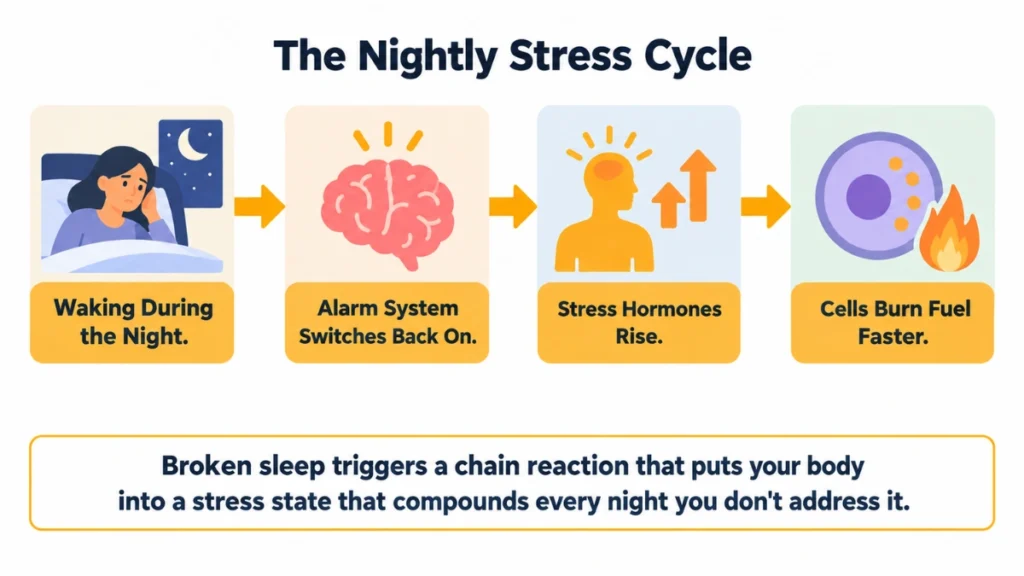
What you’re also stopping is the compounding effect of doing nothing. Sleep fragmentation, meaning waking during the night without knowing why, activates your body’s alert system all over again. This sets off a chain reaction. Your stress hormones rise to meet the demand. Your cells burn energy faster to keep up.
A 2021 review links sustained sleep fragmentation to increased glucocorticoid activity and direct impacts on how your cells produce energy.⁶
Broken sleep doesn’t just leave you tired. It puts your body into a low-level stress state, night after night. That state gets harder to exit the longer it runs.

You won’t feel the difference in one night from lying in bed longer. You will feel it in the first few nights from giving your nervous system the actual signal it needs.
Give Your Nervous System the Right Signal
When you stop mistaking stillness for recovery, your nervous system gets the cue it’s been waiting for, and sleep follows. Replace at least one nightly lie-in-bed session with a structured 10-to-15-minute pre-sleep wind-down protocol drawn from the physiological interventions described in this article. Your body knows how to sleep. It just needs the right invitation.
References
- Magnon V, Dutheil F, Vallet GT. Benefits from one session of deep and slow breathing on vagal tone and anxiety in young and older adults. Scientific Reports. 2021;11:19267. https://www.nature.com/articles/s41598-021-98736-9
- Li K, Chen S, Liu Y, Yu N. The effects of progressive muscle relaxation on sleep quality in adults: a systematic review and meta-analysis of randomized controlled trials. Frontiers in Public Health. 2026;14:1906525. https://www.frontiersin.org/journals/public-health/articles/10.3389/fpubh.2026.1906525/full
- Liao WC, Wang L, Kuo CP, Lo C, Chiu MJ, Ting H. Effect of a warm footbath before bedtime on body temperature and sleep in older adults with good and poor sleep: an experimental crossover trial. International Journal of Nursing Studies. 2013;50(12):1607-16. https://pubmed.ncbi.nlm.nih.gov/23669188/
- Almeida-Santos MA, Barreto-Filho JA, Oliveira JLM, Reis FP, da Cunha Oliveira CC, Sousa ACS. Aging, heart rate variability and patterns of autonomic regulation of the heart. Archives of Gerontology and Geriatrics. 2016;63:1-8. https://pubmed.ncbi.nlm.nih.gov/26791165/
- Prinz PN, Vitiello MV, Smallwood RG, Schoene RB, Halter JB. Plasma norepinephrine in normal young and aged men: relationship with sleep. Journal of Gerontology. 1984;39(5):561-7. https://pubmed.ncbi.nlm.nih.gov/6470445/
- Carroll JE, Prather AA. Sleep and biological aging: a short review. Current Opinion in Endocrine and Metabolic Research. 2021;18:159-164. https://pmc.ncbi.nlm.nih.gov/articles/PMC8658028/