

You wake up stiff. Your back aches. The alarm goes off, and the idea of driving to the gym for an hour sounds impossible before 7 a.m. So you skip it. Again. And then the guilt kicks in. You’re caught in an all-or-nothing trap. You think it’s either a full gym session or nothing at all.
That thinking is what’s keeping you stuck. 5-minute morning activation actually does for your body after 50. It will also show you why gym sessions still matter.
Why Read This
- One thinking pattern is quietly keeping most people over 50 stuck. It has nothing to do with motivation.
- Morning stiffness is biology, not laziness. What five minutes before coffee can do that an hour at the gym cannot will surprise you.
- One half of your fitness routine is doing almost nothing for your long-term health after 50. The other half you cannot afford to skip.
This article is for informational purposes only and does not replace professional medical advice. Talk to your doctor before making changes to your exercise routine, especially if you are managing a chronic condition, taking medication, or recovering from injury.
What Happens to Your Body After 50 (And Why It Changes Everything)
Your body after 50 is not just a slower version of your body at 35. The rules have changed. Starting around age 30, you lose roughly 3–5% of your muscle mass every decade.¹
But after 50, that loss speeds up. Strength can drop 1.5–5% per year past age 50.² That’s not a small number. That adds up fast.
At the same time, your hormones shift. Testosterone, estrogen, and growth hormone all drop.² These are the hormones that help your body rebuild muscle after a tough workout.
Fewer of them means slower recovery. Your joints feel it too. Overnight, the fluid that cushions your joints thins out.
That’s why morning stiffness is not in your head. It’s biology. The same workout that took your body a day to recover from at 35 may now take two to three times as long. Ignoring that reality is what leads to burnout and injury.
The Case for the 5-Minute Morning Activation
A 5-minute morning activation is not a workout. It is not about burning calories. It is about telling your body that today, it is going to move.
60 seconds of glute bridges. 60 seconds of modified push-ups. 60 seconds of a plank hold. 60 seconds of hip circles. 60 seconds of floor-to-stand.
That’s it. Five minutes. No gym. No equipment.
Why does this work? Glute bridges target muscles that commonly weaken with age. Weak glutes cause lower back pain and knee problems.³ Hip circles lubricate the joints that stiffen overnight.
Floor-to-stand movements build the kind of functional strength physical therapists assess through tests like the get-up-and-go test.⁴
The habit science backs this up, too. ACE Fitness (March 2025) confirms that doing a behavior at the same time every day, in the same place, is one of the most reliable ways to make it automatic.⁵
A 5-minute routine has almost no barrier to entry. You can do it before coffee. In your pajamas. Beside your bed.
What the 5-Minute Routine Cannot Do
Here’s the honest part. A 5-minute morning activation is powerful for building daily movement habits and keeping your joints fluid. But it will not build lean muscle. It will not prevent bone loss. And it will not hit the cardio targets your heart needs.
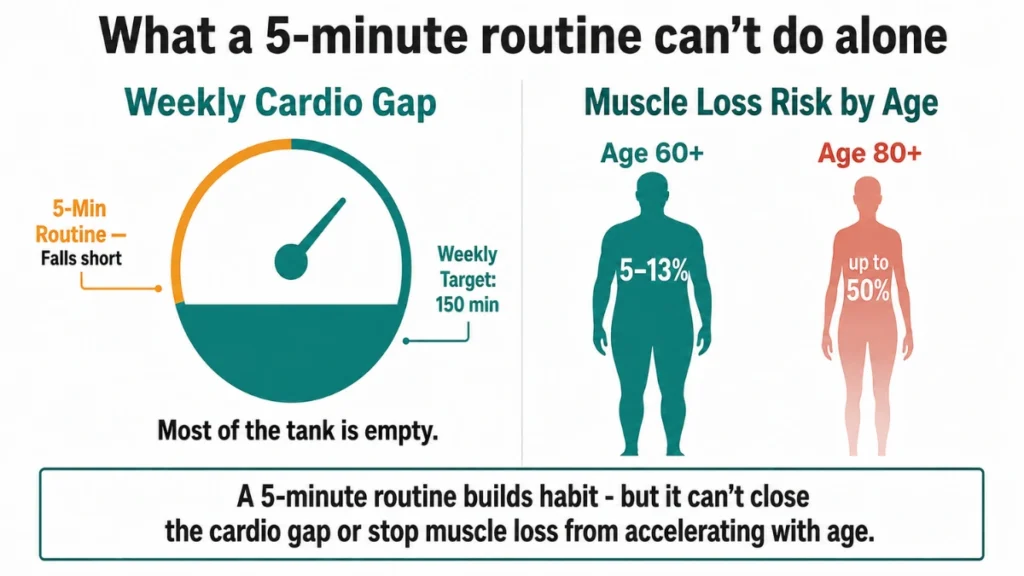
Adults need 150 minutes of moderate-intensity cardio per week.⁶ A 5-minute bodyweight routine does not cover that.
After 50, muscle loss is a real medical condition. In 2016, the ICD-10 officially classified sarcopenia, age-related muscle loss, as a disease.⁷
It affects 5–13% of adults over 60 and up to 50% of those over 80.⁴ The best-established way to slow it down is progressive resistance training.⁸ Short morning routines build the habit. But they can’t do the job alone.
The Case for the Hour at the Gym

Going to the gym is where the real biological change happens. Resistance training, including weights, machines, and resistance bands, is the closest thing to a proven anti-aging tool we have.
Only gym training can do these three things:
Build lean muscle: Progressive overload, gradually increasing weight or reps, signals the body to build new muscle. Bodyweight movements alone rarely provide enough stimulus after a few weeks.
Protect your bones: Weight-bearing exercises slow bone density loss. This directly reduces the risk of osteoporosis [weakening of the bones that makes fractures more likely] and fractures. No pill or supplement does this as reliably as lifting weights.
Hit your cardio targets: 20–30 minutes of brisk walking or moderate cycling meets the weekly cardio requirement. That’s hard to get from a morning routine at home.
Cleveland Clinic exercise physiologist Christopher Travers explains it this way: “As we age, we start losing lean muscle mass, which means our metabolism starts to slow down… The stronger your muscles are, the better joint health you can have. That allows you to be more mobile as you age.”⁹ Slowing that loss is the whole point of resistance training. The gym isn’t optional.
Why Most People Over 50 Quit the Gym (The Real Reason)?
It’s not laziness. It’s the time barrier. A 2024 Dymatize/Talker Research survey of 2,000 exercising adults found that the average gym workout takes 47 minutes.¹⁰
But the full routine, getting ready, driving, warming up, and cooling down, takes close to four hours total.¹⁰

That is a real time cost when you have a job, family, and a body that needs more recovery time than it used to. When a single gym day wipes you out, you skip the next one. Then the guilt builds. Then you stop entirely.
The people who push hardest in every session are often the ones who stop first.
Too much intensity without enough recovery leads to overuse injuries, exhaustion, and giving up. The problem was never the gym. The problem was treating it as the only option and going all-in when your body needed a smarter plan.
The Simple Comparison: Which One Wins What
Before getting to the plan, here’s a straight answer on what each approach does best.
| What You Want | 5-Min Morning | Gym Sessions |
|---|---|---|
| Daily consistency | Strong | Hard to maintain |
| Build lean muscle | Limited | Strong |
| Joint mobility relief | Strong | Not the focus |
| Cardiovascular health | Not enough | Strong |
| Cortisol/hormonal bal. | Low-stress | Depends on intensity |
| Long-term adherence | Easy | Requires planning |
The answer is clear: neither approach wins alone. They cover different needs. That’s exactly why combining them works so well.
A simple week looks like this. Five minutes of morning activation every day, no exceptions. Two gym sessions per week, 45 to 60 minutes each, focused on resistance training. One dedicated cardio session, 20 to 30 minutes, on a non-gym day. That is four days of intentional movement, three days of natural recovery, and every target your body needs after 50 covered.
Start Small, Cover Everything After 50
The 5-minute morning activation wins for daily habit and joint health. The gym wins for muscle, bone, and cardio. Together, they cover everything your body needs after 50.
Start tomorrow. Set your alarm 10 minutes earlier. Do five minutes before your coffee gets cold. Whether you add gym sessions this week or next month matters less than starting the five minutes tomorrow. That one small decision, made every day, is where it all begins.
References
- Volpi E, Nazemi R, Fujita S. Muscle tissue changes with aging. Curr Opin Clin Nutr Metab Care. 2004;7(4):405-410. https://pmc.ncbi.nlm.nih.gov/articles/PMC2804956/
- Keller K, Engelhardt M. Strength and muscle mass loss with aging process. Muscles Ligaments Tendons J. 2014;3(4):346-350. https://pmc.ncbi.nlm.nih.gov/articles/PMC3940510/
- West Coast Kinesiology. Why Weak Glutes Cause Hip and Knee Pain and How to Strengthen Them. West Coast Kinesiology Blog, n.d. https://www.westcoastkinesiology.com/blog/why-weak-glutes-cause-hip-and-knee-painand-how-to-strengthen-them
- von Haehling S, Morley JE, Anker SD. An overview of sarcopenia: facts and numbers on prevalence and clinical impact. J Cachexia Sarcopenia Muscle. 2010;1(2):129-133. https://pmc.ncbi.nlm.nih.gov/articles/PMC3060646/
- ACE Fitness. The Science of Habit Formation: A Guide for Health and Exercise Professionals. March 2025. https://www.acefitness.org/continuing-education/certified/march-2025/8825/the-science-of-habit-formation-a-guide-for-health-and-exercise-professionals/
- Cleveland Clinic. What Does ‘Moderate-Intensity Exercise’ Mean Anyway? January 17, 2024. https://health.clevelandclinic.org/what-does-moderate-exercise-mean-anyway
- Nowakowska-Lipiec K, Zadon H, Michnik R, Nawrat-Szoltysik A. Progressive Loss of Muscle Strength: The Effects of Ageing and Sarcopenia on Muscle Function in Older Females. J Clin Med. 2025;14(20):7276. https://doi.org/10.3390/jcm14207276
- Dunkin MA, Painter K. Sarcopenia With Aging. WebMD, reviewed July 9, 2024. https://www.webmd.com/healthy-aging/sarcopenia-with-aging
- Cleveland Clinic. Weightlifting 101. September 22, 2025. https://health.clevelandclinic.org/weightlifting
- Talker Research (commissioned by Dymatize). Here’s what the average gym-goer’s fitness routine looks like. December 17, 2024. https://talkerresearch.com/heres-what-the-average-gym-goers-fitness-routine-looks-like/