
You slept seven and a half hours, but your watch gave you a 61. Now you feel exhausted. Coincidence? Probably not. Most people with wearables have quietly handed their mood forecast to an algorithm. They wake up, check a number, and feel exactly what the app tells them to feel.
That’s not imagination. It’s a documented psychological phenomenon with a name, measurable consequences, and peer-reviewed research behind it. Why sleep tracker accuracy has real technical limits.
What subjective sleep quality means and why it predicts your day better.
What orthosomnia is and whether you have it.
How to use your tracker as a trend tool, not a daily report card.
How Consumer Sleep Trackers Actually Work And Where They Fall Short
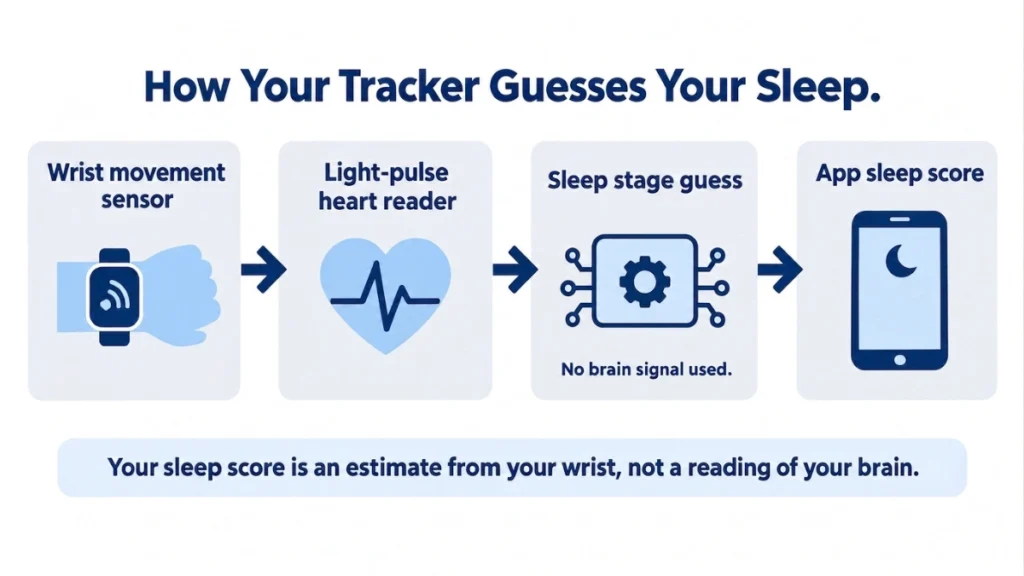
Your wearable does not read your brain. It reads your wrist. Consumer sleep trackers use accelerometry [motion sensing that detects how much and how often you move], movement detection, and optical heart rate sensors.
All of that is used to guess which sleep stage you’re in. That’s a meaningful difference from what actually measures sleep.
Polysomnography [a clinical test that reads your brain waves directly to measure sleep stages precisely]. A 2025 validation study tested six popular devices against polysomnography: Fitbit Charge 5, Fitbit Sense, Withings Scanwatch, Garmin Vivosmart 4, Whoop 4.0, and Apple Watch Series 8.¹
The results showed meaningful discrepancies in sleep stage classification across every device tested.¹
A separate 2025 meta-analysis drawing from 24 studies found significant differences between total sleep time reported by wrist trackers and polysomnography results.²
A 2024 study testing five consumer devices against polysomnography found sleep stage estimates unreliable across the board, with agreement rated poor for light and deep sleep on every device.³
So when your tracker says you got 12 minutes of deep sleep, that number may be a measurement error, not your biology.
The Signal Your Tracker Can’t Measure: Subjective Sleep Perception
Subjective sleep quality is simply how rested you believe you feel when you wake up. Researchers treat it as a completely separate variable from what a device records, and it turns out to be the more important one. Multiple studies show that better subjective sleep quality predicts higher levels of positive emotion the following day.⁴
The same finding has been reported repeatedly by separate research teams, and a 2024 systematic review of 121 studies found the association held consistently across healthy adults, shift workers and people with affective disorders.⁴
Research published in the Journal of Sleep Research in 2025 found that subjective sleep quality, but not objective sleep measures, mediated the link between pre-sleep worrying and next-day emotional well-being.⁵
In plain language, what the wearable actually recorded didn’t predict how people felt the next day. Their own perception did. That subjective sense shapes your energy and mood through the day in a way a sleep score cannot capture.

The Nocebo Effect: How a Bad Score Becomes Real
The nocebo effect [when a negative expectation alone produces a real negative physical outcome]. Your brain doesn’t distinguish between I slept badly and the app says I slept badly.
When you see a poor sleep score. Your brain accepts the algorithmic verdict as a biological fact even when your body has completed adequate sleep cycles. After seeing a poor score, performance on cognitive tasks can suffer.⁶ Not because of poor sleep. Because of a belief triggered by a screen.
In one experiment, people were randomly told they had slept well or slept poorly, regardless of how they had really slept.
What they were told predicted how they performed on cognitive tests; what they themselves reported about their sleep did not.⁶
This is measurable. A two-digit number can alter your morning before you’ve eaten breakfast or taken a step outside. The takeaway is simple but important.
Orthosomnia: When the Tracker Becomes the Problem
Orthosomnia [when a sleep tracker starts causing the exact problem it’s supposed to solve]. The term was coined in 2017 to describe tracker-induced anxiety that disrupts sleep quality.⁷
A 2024 cross-sectional study surveying 523 adults found orthosomnia prevalence ranging from 3% to 14%, depending on the diagnostic threshold. Of those surveyed, 35.8% regularly used a sleep-tracking wearable.⁸
The study is a snapshot and cannot show which came first, but for the people it identified, the device had stopped being a neutral instrument.
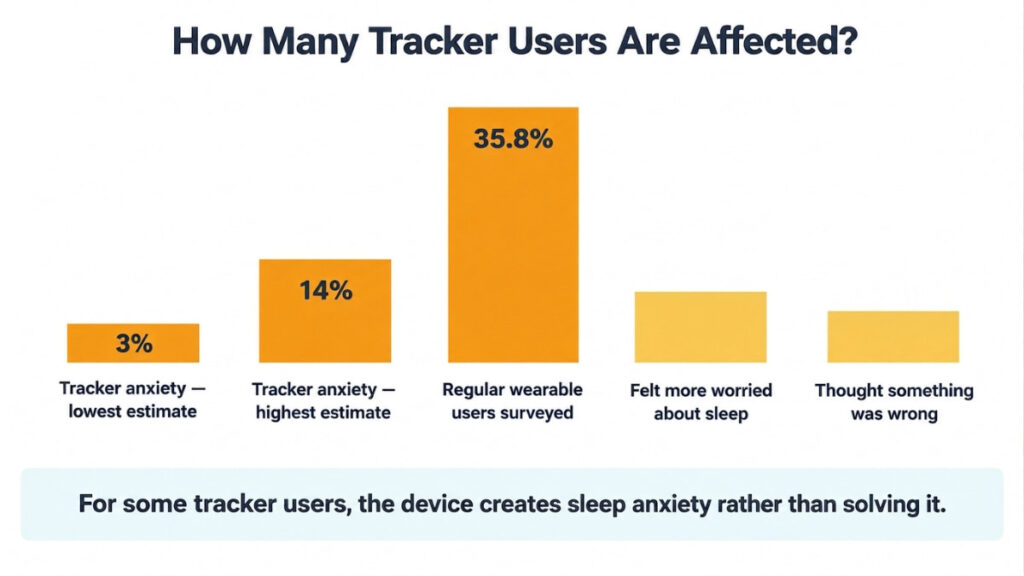
A separate survey of sleep app users found that roughly one in six said the app made them more worried about their sleep, and about one in seven said it made them think something was wrong with their sleep.⁹
Ask yourself honestly: Do you check your score before getting out of bed? Does the number set your mood for the day? Have you ever lain awake trying to earn a better score? Do you feel anxious at bedtime because you’re on the clock? If any of those are yes, the tracker may be working against you.
How to Use Your Tracker Without Letting It Use You: A Practical Framework
Rule 1: Check your body before your phone. Before looking at your score, take 30 seconds and honestly rate how you feel on a scale of 1 to 10. Write it down. Over time, compare it to your tracker data. You’ll likely find your own rating predicts your day better.
Rule 2: Use scores for trends, not verdicts. Your tracker is genuinely useful for showing that late caffeine, alcohol, or an inconsistent bedtime hurts your sleep over a week. It is not a reliable nightly diagnosis.
Rule 3: If you wake up clear-headed and steady through the day, that is the strongest signal you have, whatever the app reports.
Rule 4: Consider tracker-free nights. If checking your score causes stress, don’t check it. Or remove the wearable for a week and journal how you feel each morning. A 2023 AASM survey found 77% of those who have tried a tracker or sleep app found them helpful and 68% changed behavior based on the data.¹⁰ But if you’re in the minority for whom it causes anxiety, stepping back is reasonable.
Rule 5: Drop the optimization mindset. Sleep doesn’t need to be optimized every night like a workout. Consistency of schedule and subjective sense of rest are stronger, more sustainable targets.

Free tools worth using: The Pittsburgh Sleep Quality Index (PSQI) is a validated self-report questionnaire used in clinical practice and research,¹¹ available free online.
A simple morning journal (date, energy 1,10, mood 1,10, one lifestyle note) will tell you more about your patterns than any algorithm.
Your Real Data Point Is How You Feel
Your tracker is a useful trend tool and a poor daily oracle. Your subjective sense of how well you slept predicts your mood, energy, and focus more reliably than any score. Sleep tracker accuracy matters for long-term patterns, but for today, your own sense of rest is the signal that counts. Tomorrow morning, pause before reaching for your phone. Ask yourself: how do I actually feel? That’s your real data point.
References
- Schyvens AM, Peters B, Van Oost NC, Aerts JM, Masci F, Neven A, Dirix H, Wets G, Ross V, Verbraecken J. A performance validation of six commercial wrist-worn wearable sleep-tracking devices for sleep stage scoring compared to polysomnography. Sleep Advances. 2025; 6(2): zpaf021. https://pmc.ncbi.nlm.nih.gov/articles/PMC12038347/
- Lee YJ, Lee JY, Cho JH, Kang YJ, Choi JH. Performance of consumer wrist-worn sleep tracking devices compared to polysomnography: a meta-analysis. Journal of Clinical Sleep Medicine. 2025; 21(3): 573-582. https://pmc.ncbi.nlm.nih.gov/articles/PMC11874098/
- Kainec KA, Caccavaro J, Barnes M, Hoff C, Berlin A, Spencer RMC. Evaluating accuracy in five commercial sleep-tracking devices compared to research-grade actigraphy and polysomnography. Sensors. 2024; 24(2): 635. https://pmc.ncbi.nlm.nih.gov/articles/PMC10820351/
- Hickman R, D’Oliveira TC, Davies A, Shergill S. Monitoring daily sleep, mood, and affect using digital technologies and wearables: a systematic review. Sensors. 2024; 24(14): 4701. https://pubmed.ncbi.nlm.nih.gov/39066098/
- Werner A, Hachenberger J, Spiegelhalder K, Rueth JE, Schlarb AA, Lohaus A, Lemola S. Subjective sleep quality, but not objective sleep measures, mediates the relationship between pre-sleep worrying and affective wellbeing. Journal of Sleep Research. 2025; 34(6): e14467. https://pmc.ncbi.nlm.nih.gov/articles/PMC12592825/
- Draganich C, Erdal K. Placebo sleep affects cognitive functioning. American Psychological Association. 2014. doi:10.1037/a0035546. https://pubmed.ncbi.nlm.nih.gov/24417326/
- Baron KG, Abbott S, Jao N, Manalo N, Mullen R. Orthosomnia: are some patients taking the quantified self too far? Journal of Clinical Sleep Medicine. American Academy of Sleep Medicine. 2017; 13(2): 351-354. https://jcsm.aasm.org/doi/10.5664/jcsm.6472
- Jahrami H, Trabelsi K, Husain W, Ammar A, BaHammam AS, Pandi-Perumal SR, Saif Z, Vitiello MV. Prevalence of orthosomnia in a general population sample: a cross-sectional study. Brain Sciences. MDPI. 2024; 14(11): 1123. https://pmc.ncbi.nlm.nih.gov/articles/PMC11592250/
- Berge HL, Lundekvam KE, Waage S, Bjorvatn B, Pallesen S, Saxvig IW. Sleep in the age of technology: the use of sleep apps and perceived impact on sleep and sleep habits. Frontiers in Psychology. Frontiers Media. 2026; volume 17. https://www.frontiersin.org/journals/psychology/articles/10.3389/fpsyg.2026.1726473/full
- American Academy of Sleep Medicine. One in three Americans have used electronic sleep trackers, leading to changed behavior for many. American Academy of Sleep Medicine. 2023. https://aasm.org/one-in-three-americans-have-used-electronic-sleep-trackers-leading-to-changed-behavior-for-many/ [Press release reporting the 2023 AASM Sleep Prioritization Survey.]
- Buysse DJ, Reynolds CF 3rd, Monk TH, Berman SR, Kupfer DJ. The Pittsburgh Sleep Quality Index: a new instrument for psychiatric practice and research. Psychiatry Research. 1989; 28(2): 193-213. doi:10.1016/0165-1781(89)90047-4. https://pubmed.ncbi.nlm.nih.gov/2748771/