
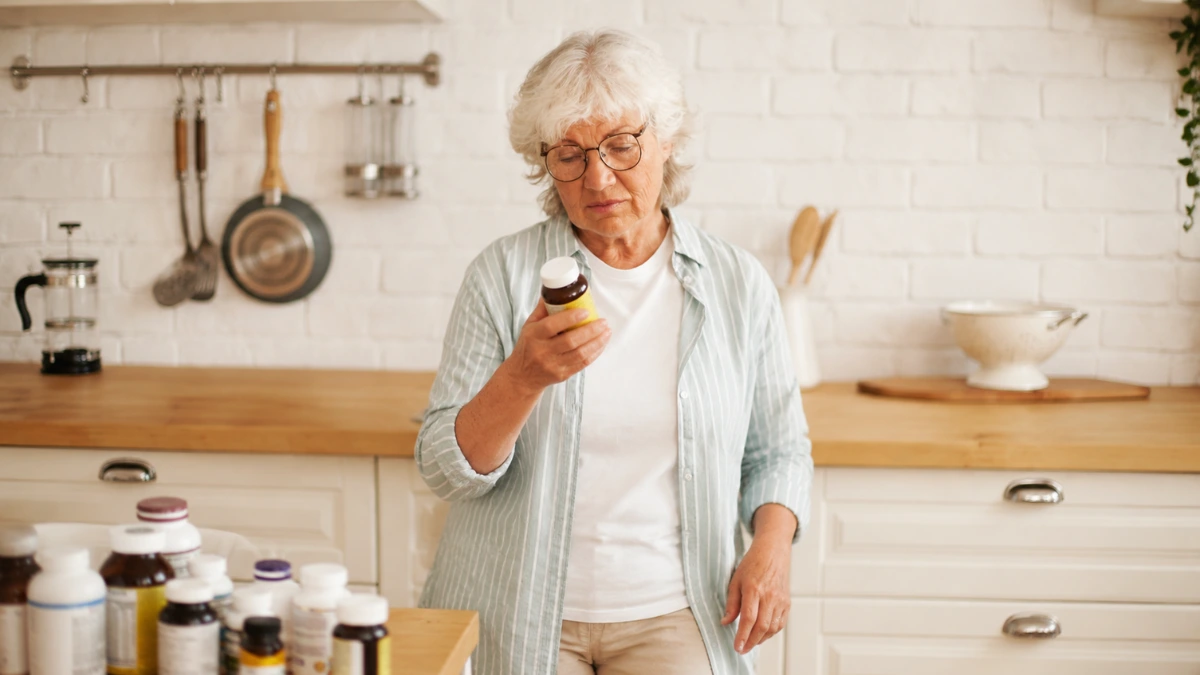
You picked up the vitamin C. Maybe the vitamin E. You’ve been consistent about it, because everything you’ve read says that oxidative stress rises after 50 and antioxidants fight it. The logic seems airtight.
But for adults over 50 who take antioxidant supplements to protect their health, there is a problem hiding inside that logic: your body already runs a defense network of its own, and the supplements you’re taking may be making it quieter, not stronger.
The science of antioxidants after 50 is more complicated than the label on the bottle suggests. This article explains how that happens and what to do about it.
Why this is worth reading through:
- Find out why your body’s most powerful internal defense system, the one that tells your cells to make their own protection, loses its responsiveness every decade after 50
- Learn why the form your antioxidants come in changes whether they protect your cells or merely substitute for protection your body stopped building
- See the specific dose and timing pattern from human trials most consistently tied to blunted muscle and mitochondrial gains, and why it matters more after 50 than before
Your body already runs its own antioxidant factory
You are never relying only on what you eat or swallow to protect your cells from damage. Your body builds these compounds continuously, using raw materials from food.
These internally made compounds include glutathione [a three-part molecule your cells assemble to neutralize reactive oxygen species], catalase, and superoxide dismutase.
These are not the same as vitamin C in a capsule. They work inside the cell, at the site of the problem.

Vitamin C in a supplement circulates in the bloodstream and meets oxidative stress from the outside. These internal compounds are manufactured on demand, right where the damage is happening.¹
The key word is demand. Your body only cranks up production when it detects a stress signal.
When your cells notice that reactive oxygen is building up, a protein called Nrf2 [a master switch inside your cells that turns on genes for making antioxidants and protective enzymes] becomes active and orders the factory to run faster.¹
This means your body’s defense system is not a fixed reservoir. It is a responsive one. The signal drives the output. This difference is more important than almost anything else in this article, and it is exactly what gets disrupted when the supplement story gets complicated.
After 50, that factory starts losing its ability to respond
You might expect that because oxidative stress rises with age, the Nrf2 system would work harder to keep up. That is a reasonable assumption, and it is wrong in an important way.
Researchers studying human cells from adults aged 60 to 69 found something unexpected.² The baseline level of Nrf2-regulated antioxidant genes was actually higher in older adults than in younger ones.²
But when a stress signal arrived and the system was supposed to kick into high gear, the response was significantly weaker in older adults.²
The suppressors of Nrf2, proteins called Bach1 and c-Myc, were also more active in the older cells, working against the defense response.²
This is the detail almost no competing article mentions about antioxidants and aging. The Nrf2 pathway aging problem is not that your baseline drops. Surge capacity weakens.
A factory running at 40% all the time but unable to ramp to 90% when attacked is more vulnerable than one running at 20% that can hit 100% on demand.
A review of multiple aging models confirmed the pattern: the capacity for Nrf2 activation triggered by oxidative stress steadily declines with age, even as the underlying stress load increases.³
The antioxidants in a pill and the antioxidants in a plate of broccoli work through completely different systems in your body, and only one of them tells your cells to make more of their own protection.¹,²
So what happens when you send a flood of the outside kind while the inside kind is already struggling?
High-dose supplements can quiet the signals that keep the factory running
You may have heard that oxidative damage accelerates aging, and that is true. But there is a piece your supplement label does not include.
A controlled rise in reactive oxygen species [unstable molecules your cells produce during normal activity and in response to stress, which also serve as chemical signals] is not just damage to be stopped.
It is the signal that tells your Nrf2 system to turn on.⁴
When you exercise, your muscles produce reactive oxygen species. That temporary rise is the alarm bell. It sets off a cascade that builds new mitochondria, repairs muscle tissue, and strengthens your endogenous antioxidant system.⁴

High-dose vitamins C and E taken close to exercise sessions are the pattern most consistently associated with blunting this signal in humans.⁵
Chronic supplementation with these vitamins has been linked to reduced activation of the redox-sensitive pathways that drive mitochondrial and muscle adaptation after training.⁵
Some people reading this will push back: I take these supplements because my doctor told me oxidative damage is real. It is real.
The evidence for that is solid. But the evidence also shows that not all oxidative stress is damage. Some of it is information your cells need.
There is a genuine limitation here worth naming. Most human trials on this topic have studied younger or middle-aged adults doing structured exercise, not sedentary older adults.⁵

The degree to which high-dose supplementation affects the Nrf2 response in older, less active adults has not been directly tested at scale. The signal-disruption data is real, but its exact magnitude in your situation is not yet resolved.
What is resolved: suppressing reactive oxygen species indiscriminately does not give your body a cleaner environment. It takes away part of its ability to read what is happening and respond.
The gap between a pill and a plate of broccoli is bigger than it looks
When people ask about vitamin C and E supplement risks for older adults, the answer depends on something most discussions skip: where the antioxidant activity is coming from and how it gets into your cells.
Vitamin C and E in supplement form scavenge free radicals in circulation. That helps, sometimes.
Compounds like sulforaphane, found in broccoli and other cruciferous vegetables, do something structurally different. They do not scavenge reactive oxygen species at all.
Instead, they bind to Keap1 [a regulatory protein that normally keeps Nrf2 locked and inactive in the cell], which frees Nrf2 to travel to the cell’s nucleus and switch on dozens of antioxidant genes at once.⁶
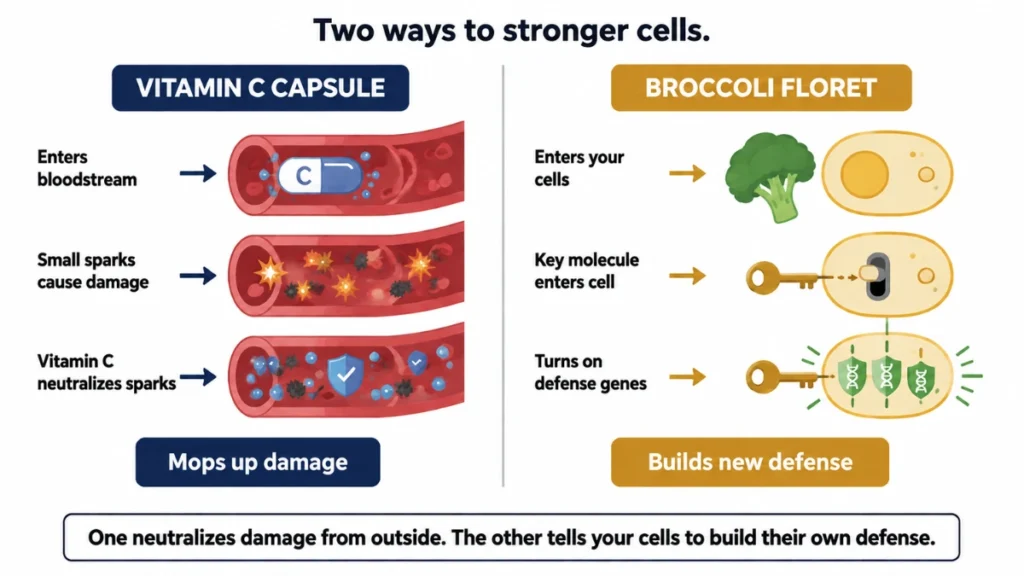
The result is that broccoli is not just delivering protective compounds to your cells. It is instructing your cells to build their own.⁶
A review of large randomized controlled trials found that antioxidant supplements in pill form, including beta-carotene, vitamin A, and vitamin E, did not prevent cancer or cardiovascular disease. Some appeared to increase mortality.⁷ That finding held specifically for well-nourished populations, the group most people over 50 belong to.⁷
That is the real issue with the supplement model: it treats protection as a thing to be delivered from outside, when the body’s most powerful version of it is something it builds from signals it receives.
When you are already well-nourished, adding more of these compounds above your actual deficiency level is not the same as reinforcing a defense. It is filling a tank that is not empty while the engine idles.
When antioxidant supplements actually help after 50
Not every supplement is wrong. The question is whether your body actually has a deficiency in the underlying building blocks, or whether you are adding to a supply that is already adequate.
Older adults often have lower glutathione levels than younger adults, not because they lack vitamin C, but because the amino acids needed to synthesize glutathione inside the cell, specifically glycine and cysteine, tend to decline with age.⁸
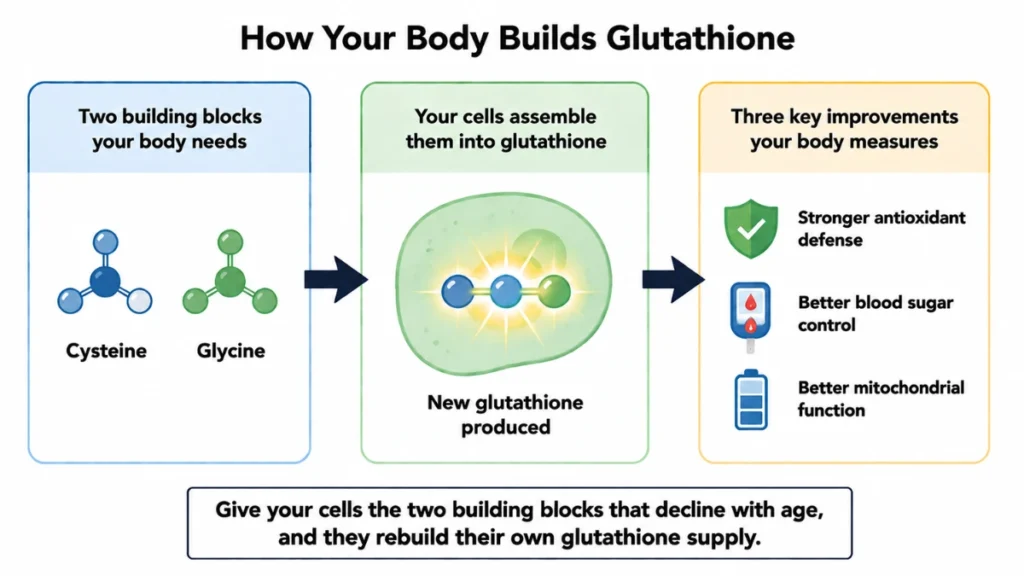
A pilot clinical trial at Baylor College of Medicine found that supplementing these two precursors together, rather than adding generic supplements, was associated with improvements in glutathione levels, mitochondrial function, and insulin resistance in older adults.⁸
This is the distinction the best research supports: targeted replenishment of what the body needs to make its own defense works differently from blanketing the system with compounds it never asked for.
Talk to your doctor before changing your supplement routine if you are pregnant, on medication, or managing a chronic condition.
Foods and patterns that nudge your Nrf2 system:
- Broccoli and broccoli sprouts: sulforaphane activates Nrf2 by binding to and releasing Keap1, freeing the switch to turn on your defense genes.⁶
- Onions and capers: rich in quercetin, a polyphenol linked to Nrf2 signaling support.
- Green tea: contains epigallocatechin gallate, which interacts with Nrf2-related pathways.
- Regular moderate exercise: the temporary rise in reactive oxygen species from physical activity is a natural Nrf2 activator available to you.⁴
- Caloric balance: avoiding chronic overeating is thought to support healthy Nrf2 signaling, though direct human evidence for this specific link is still limited.
What to do with your supplement cabinet today
If you want to support your body’s antioxidant defense system after 50, the most evidence-backed moves do not start with a pill bottle.
A 2025 systematic review of 39 randomized controlled trials in adults aged 55 and older found that combining antioxidant support with exercise produced more consistent improvements in muscle strength and physical function than either alone.⁹
The signal that triggers your Nrf2 system is not replaced by what you swallow.
Start by looking at what you actually eat in a week. If cruciferous vegetables like broccoli, cabbage, and bok choy are rarely on the plate, that gap matters more than the dose on your vitamin C bottle.
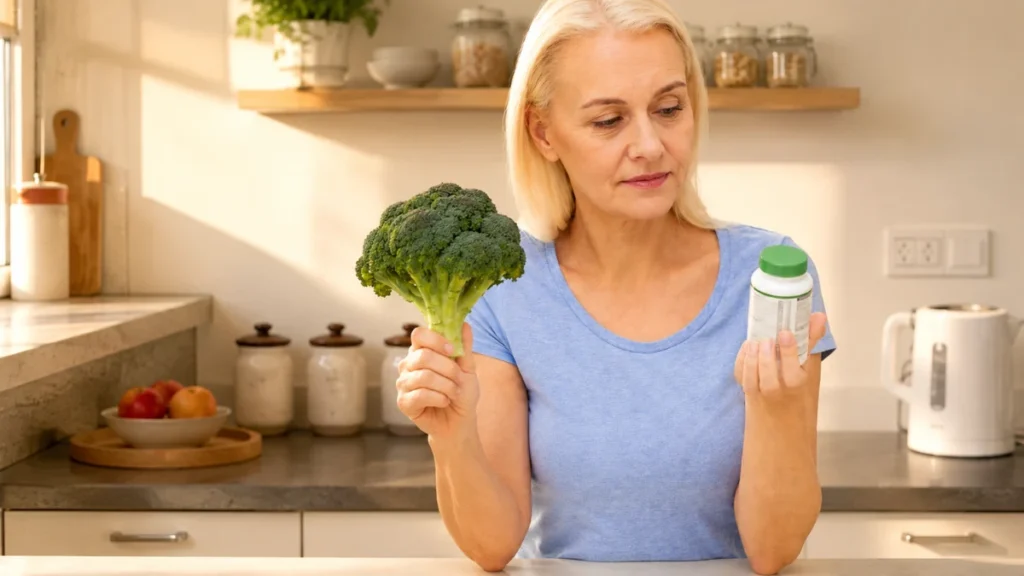
If you do use antioxidant supplements, timing matters. A lot. The research most consistently showing blunted adaptation involves taking high-dose vitamins C or E immediately before or after exercise.⁵
Taking them at a separate time of day, and at lower doses, reduces the likelihood of interfering with the exercise-induced signals your cells rely on.
There is no blanket answer on whether to stop your current supplement. Some people have genuine deficiencies, specific conditions, or medication interactions that make supplementation the right call. That question belongs in a conversation with your doctor, not in a general article.
The question to ask before you refill
The story of antioxidants after 50 is not that supplements are always wrong. Food compounds tell your cells to build protection; isolated supplements often just deliver it externally. One builds. The other substitutes.
Before you open your next bottle of antioxidant supplements, talk to your doctor about whether your current dose may be working against the defense system your body already builds on its own.
What dose tips a supplement from neutral to disruptive remains an open question.
⚠️DISCLIAMER
This article is for informational purposes only and is not a substitute for professional medical advice, diagnosis, or treatment. Always consult your doctor before starting, stopping, or changing any antioxidant or supplement routine, particularly if you are pregnant, nursing, on medication, or managing a chronic condition. Individual responses to supplementation vary, and some of the research discussed is still evolving. Nothing in this article should be used to diagnose or treat any health condition.
References
- Kubo E, Chhunchha B, Singh P, Sasaki H, Singh DP. Sulforaphane reactivates cellular antioxidant defense by inducing Nrf2/ARE/Prdx6 activity during aging and oxidative stress. Scientific Reports. 2017. https://www.ncbi.nlm.nih.gov/pmc/articles/PMC5658327/
- Zhou L, Zhang H, Davies KJA, Forman HJ. Aging-related decline in the induction of Nrf2-regulated antioxidant genes in human bronchial epithelial cells. Redox Biology. 2018. https://pubmed.ncbi.nlm.nih.gov/28863281/
- Shilovsky GA. Lability of the Nrf2/Keap/ARE Cell Defense System in Different Models of Cell Aging and Age-Related Pathologies. Biochemistry (Moscow). 2022. https://pubmed.ncbi.nlm.nih.gov/35491021/
- Merry TL, Ristow M. Do antioxidant supplements interfere with skeletal muscle adaptation to exercise training? Journal of Physiology. 2016. https://pubmed.ncbi.nlm.nih.gov/26638792/
- Mănescu DC, Tudor A, Mănescu AM, Mărgărit IR, Mănescu CO, Prisăcaru C, Păun L, Tudor V. Antioxidants and Exercise: A Redox-Informed Framework for Training Adaptation, Performance, and Recovery. Antioxidants (Basel). 2026. https://pmc.ncbi.nlm.nih.gov/articles/PMC13113188/
- Houghton CA, Fassett RG, Coombes JS. Sulforaphane and Other Nutrigenomic Nrf2 Activators: Can the Clinician’s Expectation Be Matched by the Reality? Oxidative Medicine and Cellular Longevity. 2016. https://pubmed.ncbi.nlm.nih.gov/26881038/
- Bjelakovic G, Nikolova D, Gluud C. Antioxidant supplements and mortality. Current Opinion in Clinical Nutrition and Metabolic Care. 2014. https://pubmed.ncbi.nlm.nih.gov/24241129/
- Kumar P, Liu C, Hsu JW, Chacko S, Minard C, Jahoor F, Sekhar RV. Glycine and N-acetylcysteine (GlyNAC) supplementation in older adults improves glutathione deficiency, oxidative stress, mitochondrial dysfunction, inflammation, insulin resistance, endothelial dysfunction, genotoxicity, muscle strength, and cognition: Results of a pilot clinical trial. Clinical and Translational Medicine. 2021. https://www.ncbi.nlm.nih.gov/pmc/articles/PMC8002905/
- Wang Y, He Z, Long C, Li Y, Yuan Y, Huang T. Systematic review and meta-analysis of antioxidants with or without exercise training improving muscle condition in older adults. Scientific Reports. 2025. https://www.nature.com/articles/s41598-025-16917-2