

You bought the supplement. You take it every day. And you still wake up with leg cramps, still sleep poorly, still feel more tired than you should. That’s a frustrating place to be, and it’s more common than most people realize among adults over 50.
Most people over 50 taking a magnesium supplement are absorbing very little of it, without knowing why. The pill, the dose, even the timing can work against you.
This isn’t about effort; it’s about a set of biological realities that pile up after 50 in ways nobody warned you about. By the end of this article, you’ll know exactly what those realities are and what to do about them.
| # | Section | What You’ll Find |
|---|---|---|
| 1 | The body’s built-in barriers | Why does more of it go to waste as you age? |
| 2 | The label’s hidden problem | Is the milligram number on the front actually what you absorb? |
| 3 | The silent medication thief | Which common prescriptions quietly drain your levels? |
| 4 | The blood test gap | Can a “normal” result still mean you’re low? |
| 5 | The form-by-form guide | Which type actually makes it into your bloodstream? |
| 6 | Making the most of what you take | What small habits change how much you actually absorb? |
Why Magnesium Gets Harder to Absorb After 50
If you take magnesium and feel little difference, your age may be working against you more than your supplement choice. That’s not discouraging news; it’s useful, because it points directly at what to fix.
Two problems at once. The gut absorbs less magnesium as the body ages, while the kidneys simultaneously excrete more of it.¹ This double drain means the gap between what goes in and what stays in widens quietly every decade. Adults over 50 are already less likely than younger adults to consume enough magnesium through food.¹
A supplement is supposed to bridge that gap. But if absorption is already compromised, the bridge is shorter than you think.
Stomach acid plays a bigger role here than most people expect.
As you age, a gradual decline in stomach acid production, a condition called hypochlorhydria [low stomach acid, which means the stomach can no longer break down minerals as effectively], makes it harder to ionize minerals before they can be absorbed.² Magnesium salts, including the ones in supplements, need an acidic environment to dissolve properly. When that environment weakens, so does absorption.²
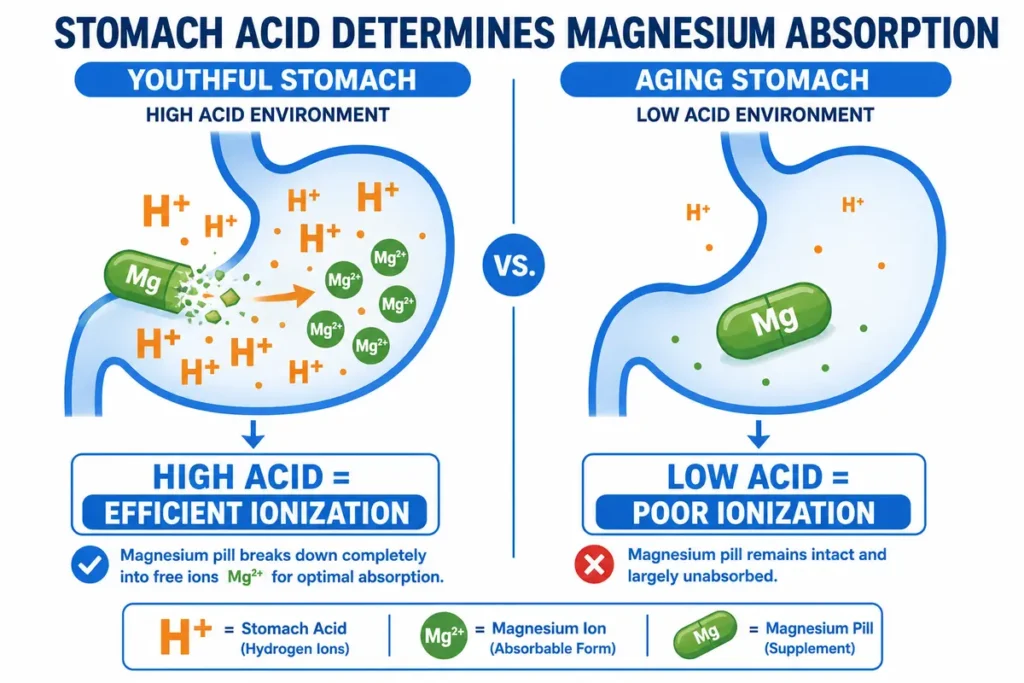
The result is that a magnesium pill may not be absorbing the way the label implies. The body takes in what it can.
No single study has tested all the factors that make this worse after 50. What follows is what the separate pieces each show, based on the best available evidence for each variable.
The Form on the Label Is the First Problem
You’ve probably looked at the back of a supplement bottle and seen “magnesium 400 mg” in large type. That number doesn’t tell you what your body will actually use.
The form determines what absorbs. Magnesium oxide is the most commonly used form in standard supplement formulations.¹ It’s cheap to produce, carries a high percentage of elemental magnesium by weight, and is available everywhere. It’s also among the least bioavailable forms available.
Clinical research on randomized controlled trials in healthy adults found that magnesium citrate and magnesium chloride showed good bioavailability, while magnesium oxide was poorly bioavailable, partly because of its low solubility in water.³
Forms that dissolve well in liquid, including aspartate, citrate, lactate, and chloride, tend to absorb better than magnesium oxide and magnesium sulfate, according to the NIH Office of Dietary Supplements.¹
For someone buying supplements, a magnesium pill labeled “500 mg” that contains magnesium oxide delivers far less usable mineral than one labeled “200 mg” that contains glycinate or citrate.
On the front of the bottle, that number is total magnesium by weight. What reaches your blood depends entirely on the form.
Most people never check the form. They compare milligrams, not molecules. That’s the first mistake, and it’s the most common one on the shelf.

Your Other Medications May Be Blocking What Gets Through
Even if you’re taking a well-absorbed form of magnesium, certain medications common in adults over 50 can significantly reduce how much you actually hold on to.⁴’⁵
Proton pump inhibitors [PPIs, a class of acid-reducing medications used for heartburn and reflux, including omeprazole, pantoprazole, and esomeprazole] are among the most widely prescribed drugs in older adults.
A 2022 observational study of patients aged 65 and older admitted to a geriatric ward found that PPI users had a hypomagnesemia [abnormally low magnesium levels in the blood] prevalence of 21.9%, compared with 15.8% in non-PPI users, with overall PPI use associated with hypomagnesemia after adjusting for other factors.⁴
A separate clinical review summarized a large body of observational data linking chronic PPI use to lower magnesium, most likely through decreased intestinal absorption.⁵
The mechanism appears to run through specific transport proteins in the gut wall that PPIs may impair, disrupting the active uptake pathway that moves magnesium across the intestinal lining.⁶

Loop and thiazide diuretics, often prescribed for blood pressure or fluid retention, cause a different problem. These medications increase urinary excretion of magnesium.⁷
A study of elderly patients found that those taking thiazide diuretics had significantly reduced serum magnesium levels and impaired magnesium-conserving ability compared to non-diuretic users.⁷
You can have a normal blood test result and still be seriously low in magnesium, because the body borrows from bone and muscle to keep the number in your blood looking fine.⁸’⁹
The depletion from these medications tends to develop slowly. It often produces no obvious daily symptoms until levels drop enough to be associated with muscle cramps, disrupted sleep, or irregular heartbeat.¹ You may be taking your magnesium correctly and still losing the race.
If you take a PPI or a loop or thiazide diuretic, ask your doctor specifically about monitoring magnesium levels.
The Blood Test Your Doctor Orders Probably Missed Your Deficiency
This is where most people find out that the system they trusted has a significant blind spot. Getting a blood test to check your magnesium sounds like the right move. For many people, that test gives false reassurance.
Less than 1% of total body magnesium circulates in the blood.⁸ The rest lives in bone (roughly 50 to 60%), muscle, and soft tissues.⁸ The standard serum magnesium test, the one routinely ordered in most clinical settings, measures only the fraction floating in blood plasma.⁸
A published review in Nutrients states that serum magnesium does not reflect the total magnesium content in tissues or organs, and is also a poor indicator of intracellular magnesium content.⁸
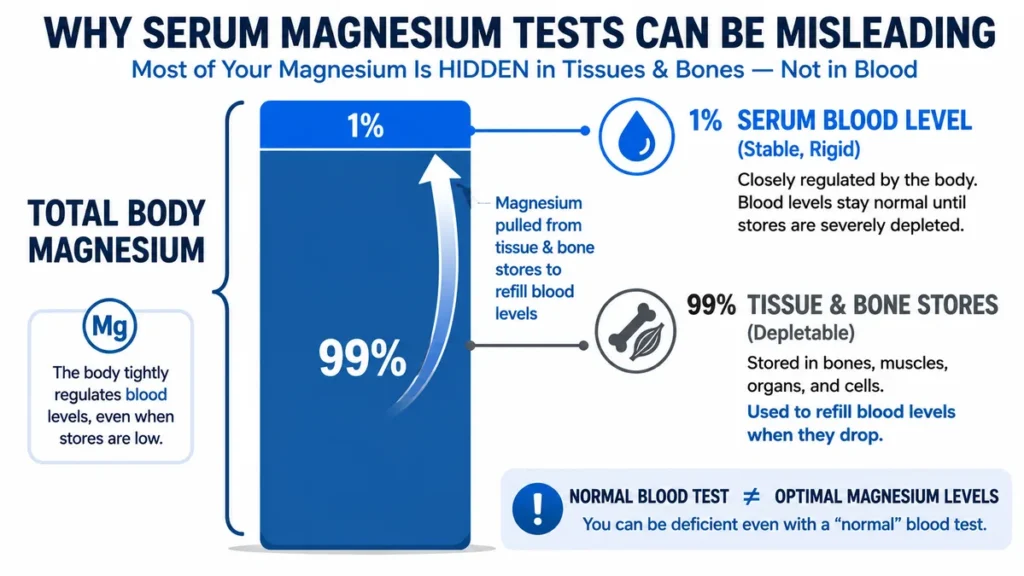
Your body actively defends that number. When tissue stores begin to run low, it pulls magnesium from bone and muscle to keep blood levels within the reference range.⁹
A published clinical workup guide notes that a person may be intracellularly magnesium-depleted and show signs of deficiency yet have normal serum levels, because the body recruits intracellular stores to maintain the reading.⁹
In real life, this plays out plainly. You feel the textbook signs of low magnesium: leg cramps at night, restless sleep, fatigue that doesn’t fit your activity level. Your doctor runs a test. It comes back normal.
Both can be true.
RBC magnesium testing [red blood cell magnesium, which measures the mineral stored inside the cell rather than floating in plasma] gives a more accurate picture of functional magnesium status because it reflects longer-term stores rather than a single snapshot of blood plasma.⁸ It is not universally offered, and standardized reference ranges vary across labs, which is a real limitation.
Ask your doctor whether this test is available, and mention any symptoms you’re experiencing alongside the request.
A normal serum magnesium result is not wrong. It is just measuring something different from what most people assume it is.
Which Form Should You Actually Choose?
Talk to your doctor before changing your supplement routine if you’re on medication, managing a kidney condition, or have been prescribed a specific magnesium form.
With multiple forms on the shelf and genuine differences in absorption, there is a clear hierarchy based on the research available.
Magnesium glycinate (also sold as bisglycinate) is the strongest general-purpose choice for adults over 50 looking to correct low levels. It has good absorption, is gentle on the stomach,¹⁰ and has been studied specifically for sleep.
A 2025 randomized, double-blind, placebo-controlled trial of 155 adults with self-reported poor sleep found that 250 mg of elemental magnesium bisglycinate significantly reduced insomnia severity compared to placebo at four weeks, with the largest benefit seen in those with lower baseline dietary magnesium intake.¹⁰
A meta-analysis on oral magnesium supplementation for insomnia in older adults found an association with reduced time to fall asleep of about 17 minutes compared to placebo, though the authors noted the quality of evidence remains low to very low and more well-designed trials are needed.¹¹
Magnesium citrate absorbs well, is widely available, and is a reasonable alternative if occasional constipation is also a concern. It can have a mild laxative effect at higher doses. Research consistently places it above oxide in bioavailability.³
If cognitive support is your main goal, magnesium L-threonate was developed to cross the blood-brain barrier more effectively than other forms. The foundational work used rat models that showed increased brain magnesium levels with this compound.¹²
Animal research shows biological plausibility, but human application has not been confirmed to the same degree. It is not the right magnesium pill if your primary goal is correcting whole-body deficiency.
Cardiovascular claims appear most often for magnesium taurate, which combines magnesium with taurine. Both individually have some evidence supporting heart function.¹
The published literature does not yet include large randomized controlled trials testing magnesium taurate specifically as a cardiovascular intervention. Mechanistic rationale exists; direct human confirmation does not yet match the marketing.
For constipation specifically, magnesium oxide has its place because of its osmotic laxative effect.¹ As a magnesium pill for correcting a systemic deficiency, it has the lowest bioavailability of all the forms discussed here.

For most adults over 50 who are simply trying to absorb more magnesium, glycinate is the evidence-backed starting point.
How to Get More From Your Magnesium Pill
Choosing the right form matters. So does what you do with it.
Separate magnesium from calcium. If you take very high doses of both (over 500mg of each at once), consider spacing them out. For standard supplement doses, this isn’t a major concern.¹
Watch your zinc intake. One study cited by the NIH Office of Dietary Supplements found that zinc supplementation at 142 mg per day, well above the tolerable upper intake level, significantly decreased magnesium absorption and disrupted magnesium balance in healthy adult males.¹ Most people aren’t taking doses that high. But if you’re combining a zinc supplement with magnesium, check the label.
Consider splitting your dose. The gut absorbs magnesium more efficiently in smaller amounts.¹ A single large dose may saturate the uptake pathway and increase the likelihood of a laxative effect, particularly with citrate forms.¹ Splitting a daily target across two meals is a practical way to increase how much gets through.

Time it right. Glycinate taken in the evening aligns with its sleep-supporting properties. Citrate is flexible and works at any meal. Taking either with food reduces digestive side effects.¹
Finally, if you’re taking a PPI or a diuretic, address that with your doctor. No timing strategy or form switch fully compensates for a medication that is actively blocking absorption or increasing excretion.
What to Do Before Your Next Bottle
The form of magnesium is the variable most under your control, and it’s the one most people ignore.
Before buying your next magnesium pill, check the label for the form. If it says magnesium oxide, consider switching to magnesium glycinate or magnesium citrate, which absorb significantly better. Separate it from calcium by two hours and take it with food. If you’re on a PPI or diuretic, bring this up with your doctor. Your pills can only do what your body lets them do.
⚠️DISCLAIMER:
This article is for informational purposes only and does not constitute medical advice or a recommendation to use any supplement. The content addresses magnesium supplement absorption and form selection for adults over 50 and is intended for general educational purposes only. Supplements can interact with medications and may not be appropriate for everyone, always consult a licensed healthcare provider before starting, changing, or stopping any supplement regimen.
References
- NIH Office of Dietary Supplements. Magnesium: Fact Sheet for Health Professionals. National Institutes of Health. Current. https://ods.od.nih.gov/factsheets/Magnesium-HealthProfessional/
- Grober U, Schmidt J, Kisters K. Magnesium and Drugs. International Journal of Molecular Sciences. 2019;20(9):2094. https://pmc.ncbi.nlm.nih.gov/articles/PMC6539869/
- Rylander R, Remer T, Berkemeyer S, Vormann J. Bioavailability of Magnesium and Potassium Salts Used as Potential Substitutes for Sodium Chloride in Human Nutrition: A Review. Nutrients. 2025. https://www.ncbi.nlm.nih.gov/pmc/articles/PMC12643194/
- Wiersema N, et al. Proton Pump Inhibitors and Hypomagnesemia in Older Inpatients: An Observational Study. Pharmacotherapy. 2022. https://pubmed.ncbi.nlm.nih.gov/36461136/
- Cheungpasitporn W, et al. Magnesium Deficiency and Proton-Pump Inhibitor Use: A Clinical Review. Nephrology. 2015. https://pubmed.ncbi.nlm.nih.gov/26582556/
- Danziger J, et al. Proton pump inhibitors and hypomagnesemia: a rare but serious complication. Kidney International. 2013. https://pubmed.ncbi.nlm.nih.gov/23538697/
- Leary WP, Reyes AJ. Diuretic-associated hypomagnesemia in the elderly. Southern Medical Journal. 1987. https://pubmed.ncbi.nlm.nih.gov/3662705/
- Workinger JL, Doyle RP, Bortz J. Challenges in the Diagnosis of Magnesium Status. Nutrients. 2018. https://pmc.ncbi.nlm.nih.gov/articles/PMC6316205/
- Hypomagnesemia Workup. Medscape/StatPearls. 2024. https://emedicine.medscape.com/article/2038394-workup
- Schuster J, Cycelskij I, Lopresti A, Hahn A. Magnesium Bisglycinate Supplementation in Healthy Adults Reporting Poor Sleep: A Randomized, Placebo-Controlled Trial. Nature and Science of Sleep. 2025;17:2027-2040. https://pmc.ncbi.nlm.nih.gov/articles/PMC12412596/
- Arab A, Rafie N, Amani R, Shirani F. Oral Magnesium Supplementation for Insomnia in Older Adults: A Systematic Review and Meta-Analysis. BMC Complementary Medicine and Therapies. 2021. https://pubmed.ncbi.nlm.nih.gov/33865376/
- Mohammed Akhtar N, et al. Neuroprotective effects of magnesium: implications for neuroinflammation and cognitive decline. Frontiers in Endocrinology. 2024. https://www.frontiersin.org/journals/endocrinology/articles/10.3389/fendo.2024.1406455/full