

You download an app. You do 10 minutes of memory puzzles before bed. You feel like you did something good for your brain.
For adults over 50 who want to protect their memory and thinking, the uncomfortable truth is that what most likely helps is not on any app store.
Most people over 50 are spending time on brain games when the strongest available evidence points to something far simpler and more powerful. A real conversation, unscripted and back-and-forth with another person, demands more from your brain than any game ever designed.
The question is why, and whether the way you spend your social time already counts.
Why this article is worth your time:
- Why your brain works harder during a 20-minute phone call than during an hour of puzzles
- The specific cognitive demand that brain apps can never replicate
- What a clinical trial found when it gave isolated older adults regular, structured conversations
- How much social interaction the evidence actually points to, and the number is more specific than you’d expect
- The one distinction between types of social connection that determines which conversations actually count for your brain
What your brain is actually doing while you talk to someone
You probably think of talking as easy, something you do on autopilot while driving or cooking. That instinct is wrong, and it turns out to be an important mistake.
When you hold a real conversation, your brain is doing several hard things simultaneously: listening to what the other person said, tracking the thread of a topic, choosing words to respond, suppressing the thought you were about to say, and monitoring whether the other person understood you.
Neuroimaging research shows that extended speech production is associated with activation in a left-sided network covering regions involved in semantic knowledge, plus prefrontal cortex [the front part of the brain responsible for planning, working memory, and executive control] areas tied to cognitive planning.¹
That is not just language. That is working memory and executive function running in parallel, in real time.
Every sentence you produce requires a decision. Every sentence you receive requires you to update your mental model of what the other person thinks, wants, and expects from you next. A puzzle has a fixed answer. A conversation has none.
The unpredictability matters. A poorly designed game can be solved by pattern recognition.
A conversation cannot.
The person on the other end might say something unexpected, change the subject, or contradict what you thought you understood. Your brain has to adapt, not just execute.
The quality of your social exchanges tracks with brain health in measurable ways.
A 2024 study of adults aged 70 and older found that poor-quality daily social encounters were linked to higher rates of subjective cognitive decline through their effect on daily stress.²
The finding cuts both ways: connection that challenges you and goes well is the cognitive version of resistance training. It hurts a little. It builds something.

That is not a metaphor. The same neural circuits that govern planning and memory fire every time someone searches for the right word mid-sentence and finds it.
Why social isolation hits your brain harder than most risks on the list
You probably already know that staying social is good for you. What you may not know is how much ground you lose when you stop, and why social isolation cognitive decline research has been harder to take seriously than it deserves.
The 2020 Lancet Commission on Dementia Prevention identified 12 modifiable risk factors for dementia. Social isolation appeared on the list alongside smoking, diabetes, and physical inactivity.³
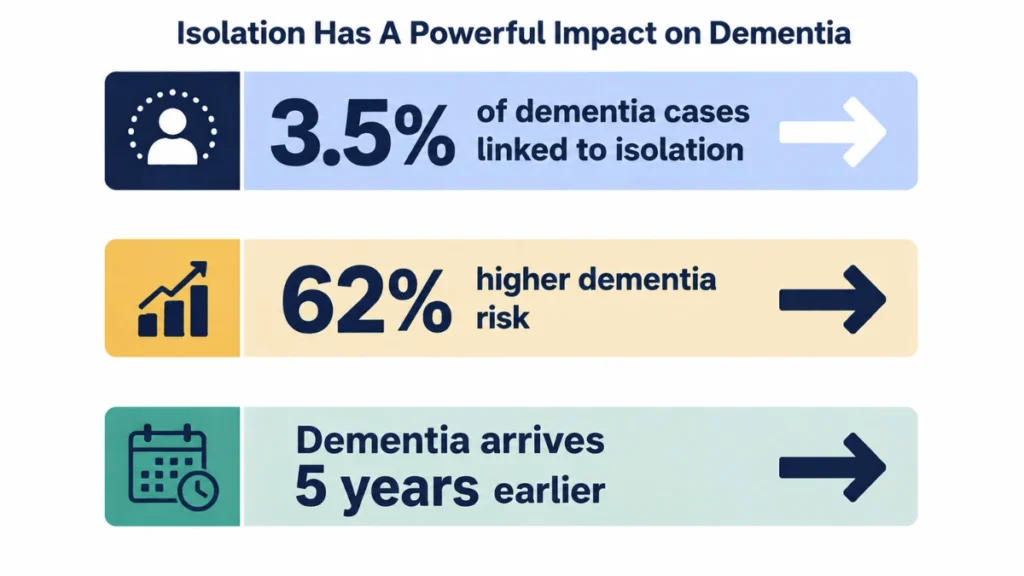
Reducing isolation was estimated to prevent 3.5% of dementia cases worldwide, a larger share than eliminating physical inactivity or diabetes could claim.³
A UK Biobank cohort study following over 155,000 people for an average of nearly nine years found that socially isolated individuals carried a 62% higher risk of being diagnosed with dementia compared to those who were not isolated.⁴
That figure survived adjustment for age, health status, and genetic risk level.⁴
Then in 2025, a Rush University study of 1,923 dementia-free older adults found that the least socially active participants developed dementia an average of five years before the most socially active.⁵
Five years.
That is not a rounding error.
But here is the insight that almost no popular article captures. Not all social connection is the same, and the difference matters more than the quantity.
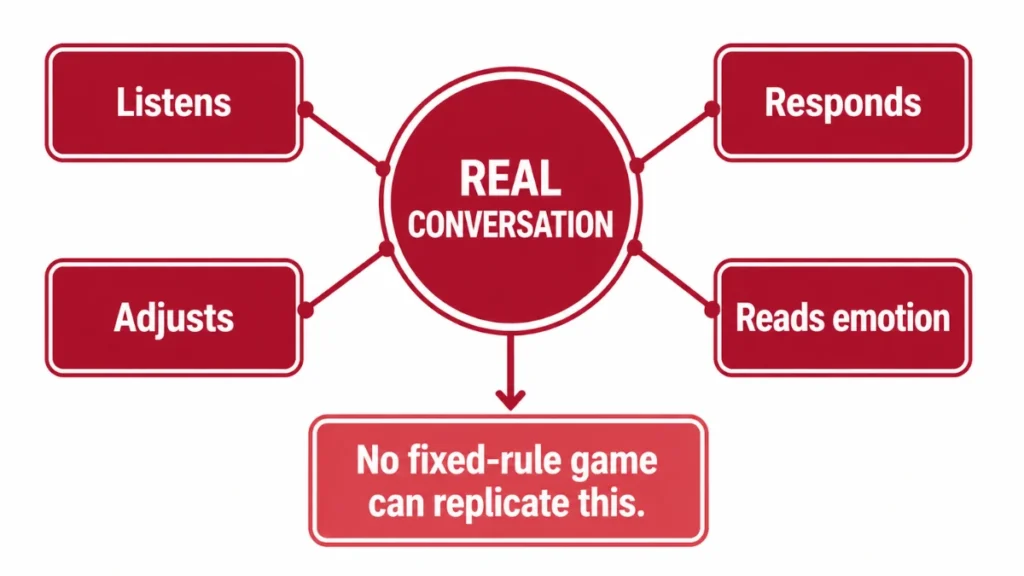
Brain games make you better at brain games; a real conversation forces you to listen, respond, adapt, and remember all at once, which is exactly the kind of complex, unpredictable demand that keeps aging neural circuits sharp.
Researchers studying social networks and cognitive aging have proposed two distinct pathways.⁶
Social bridging [connecting with a wider, more varied set of people outside your close circle] appears to provide cognitive enrichment by exposing the brain to novel contexts and unpredictable exchanges.
Social bonding [deep connection with close family or intimate partners] may buffer biological stress through neuroendocrine pathways. Both matter, but they seem to work differently: bridging appears to help offset structural brain changes, while bonding appears to buffer the effects of stress.⁶
A close call with your sister every Sunday is valuable. When was the last time you talked at length with someone outside your usual circle?
The real problem with brain games and cognitive apps
You have probably heard that doing puzzles keeps your brain sharp. It is one of the most repeated pieces of advice in healthy aging, and most of the people who pass it along believe it sincerely.
The evidence does not support it, at least not in the way the claim is usually made.
A 2021 systematic review and meta-analysis of randomized controlled trials found no significant improvement in standardized cognitive tests from game-based brain training in older adults with existing cognitive impairment, compared to control groups, though the researchers noted the studies varied too much in quality and design to rule out a benefit entirely.⁷

That is the population most often told to do brain games. On the measures that matter most, the games didn’t show a clear win.
Studies in healthy older adults show a more mixed picture. But the problem starts even before transfer comes into play. One seven-week trial found that the games didn’t improve the exact skills they were designed to train.⁸
It rarely transfers to the broader cognitive functions people use in daily life: following a complex conversation, remembering a list of errands, adapting quickly when plans change.
The transfer gap is the central weakness. A game has fixed rules, a fixed format, and a predictable response structure. Your brain can learn to perform well on it without building the flexible, adaptive capacity that protects cognitive function long-term.
Now compare that to the Rush University study showing that socially active older adults developed dementia five years later than the least active.⁵
No single study has placed conversation and brain games in direct competition with dementia prevention as the primary outcome. The case here is assembled from different bodies of evidence pointing in the same direction.
Social activity involves the unpredictable, multi-system demands that games do not: listening, responding, adjusting, remembering context from earlier in the conversation, and reading the emotional state of another person simultaneously.
The brain games industry is worth billions. The research case for them is not.
What makes a conversation a better workout than a puzzle
Think about what actually happens when a conversation goes well. You remember what the other person said three turns ago, connect it to something new they just said, and formulate a response that fits the tone.
All of that happens while you watch their face for signs that they followed you. None of it has a reset button.
A puzzle resets every time. A conversation never does.
Does conversation help memory directly? The clearest test of that came from the I-CONECT (Internet-Based Conversational Engagement Clinical Trial), an NIH-funded randomized controlled trial that assigned socially isolated adults aged 75 and older to regular semi-structured video chat sessions with trained conversationalists.⁹
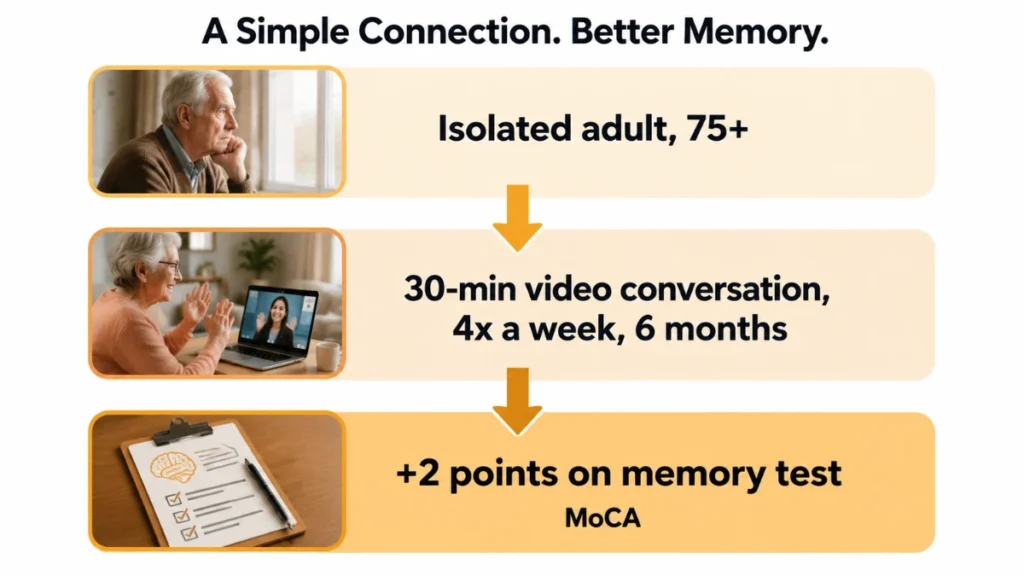
The sessions ran for 30 minutes, four times per week, for six months.
In the group with mild cognitive impairment [early-stage memory and thinking difficulties that do not yet meet the criteria for dementia], those who received the conversations improved their global cognitive function score by nearly 2 points on the Montreal Cognitive Assessment compared to the control group.⁹
The effect size (Cohen’s d of 0.73) was described by researchers as clinically meaningful.⁹
fMRI [functional magnetic resonance imaging, a brain scan that measures activity by tracking blood flow] data from the same trial showed a trend toward increased connectivity in the dorsal attention network in the conversation group.⁹
Here is what that means concretely. The sessions were not therapy, not tutoring, and not reminiscence exercises. They were conversations, guided by picture prompts and structured to keep participants engaged and speaking. The brain responded.
Conversation is not a nice supplement to cognitive health strategies. It is the strategy, and if you are over 50, that means who you talk to and how often matters in a way the brain games industry does not want you to think about.
How much conversation the evidence actually points to
If you have read this far, you are probably wondering what the evidence actually recommends in terms of frequency and duration. The honest answer is that the research is more specific than most advice you will encounter, but it does not translate into a universal prescription.
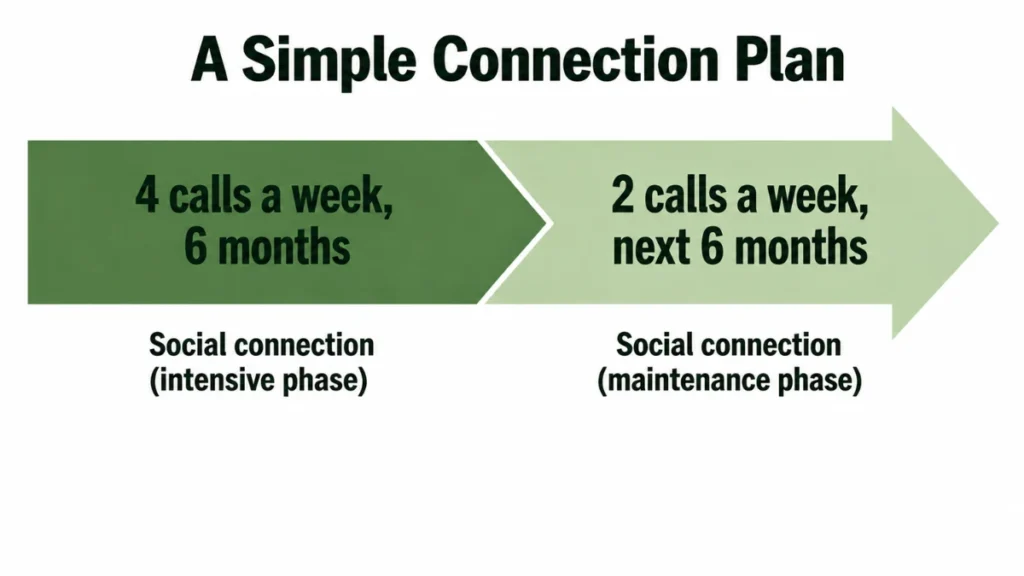
The I-CONECT trial used a structured protocol: four 30-minute video conversations per week for the first six months, then two per week for another six months.⁹
Participants who responded best (the top 30% of responders in subsequent analysis) showed delays in cognitive decline of six months or more in global cognitive function.¹⁰
The Rush Memory and Aging Project found that each step up in social activity frequency was associated with a 47% lower rate of cognitive decline over an average follow-up of more than five years, in a sample of 1,138 older adults without dementia at baseline.¹¹
The assembled evidence: No single study directly tests conversation against brain apps in the same population with dementia prevention as the primary outcome.
The case here is built from a social activity longitudinal study, isolation-and-dementia epidemiology, and the I-CONECT RCT: three distinct bodies of evidence converging on the same direction, not one unified causal proof.
Read the numbers with that in mind. What the evidence supports is a clear direction and a general threshold, not a precise formula. More frequent, more varied, and more cognitively demanding conversation appears to be better than less.
A 45-minute call with a new contact about a topic you disagree on is a harder workout than a five-minute check-in with someone who always agrees with you.
The I-CONECT protocol gives a reasonable upper anchor. Weekly calls with a rotating cast of contacts gives a realistic lower bound for someone with an active life.
Simple ways to build more real conversation into your week
You do not need a clinical trial protocol to start. What the research suggests is a direction: more frequent, more varied, less scripted contact with other people. The practical goal is to make conversation a deliberate part of your week rather than something that happens by accident.
If you are managing a chronic health condition or have had a recent change in cognition, talk to your doctor before making significant changes to your routine, especially if adding social commitments requires adjusting other medical or physical activity plans.
A few things the evidence points toward:
- Phone or video over text. The I-CONECT trial’s benefits came from the video conversations, not the short weekly phone check-ins both groups got.⁹ Video gives you facial expressions and eye contact that text just can’t.

- Aim for at least 20 minutes. If you can manage it. That’s our own rough floor, not the study’s. The actual I-CONECT sessions that showed a real benefit ran a full 30 minutes.⁹
- Vary who you talk to. The bridging research suggests that widening your social circle provides cognitive demands that repeat contact with the same people does not.⁶ A weekly call with a different person each time does more than seven calls with the same person.
- Choose conversation over passive exposure. Listening to a podcast or watching a documentary uses language processing, but it requires no response, no adaptation, no uncertainty. Those are the elements that make conversation a workout.
- Use a prompt if you need one. The I-CONECT protocol used picture prompts to keep conversations going.⁹ A shared article, a news story, or a question about the other person’s week serves the same purpose.
The NIA has published a plain-language summary of the I-CONECT findings, including what the sessions looked like in practice, at nia.nih.gov, which is a useful starting point if you want to understand the protocol before adapting it.¹²
You already know how to talk to people. The question is whether you are doing it often enough, with enough variety, to give your brain what it needs.
The Simplest Protection Your Brain Has
The most important thing this research says is also the most available one. Protecting how you think and remember as you age does not require a subscription, a device, or a daily training schedule. It requires other people.
Pick one person you haven’t spoken to in a while and call them this week, not text, call, and aim for a conversation that lasts at least 20 minutes.
The evidence on how much frequency and variety matter continues to develop. What it already shows is enough to act on.
⚠️DISCLAIMER
This article is for informational purposes only and does not constitute medical advice, diagnosis, or treatment. The studies referenced reflect population-level findings, and individual results can vary. Readers managing a chronic health condition or a recent change in memory or cognition should consult a qualified healthcare provider before adjusting their routine.
References
- Hoffman P. Reductions in prefrontal activation predict off-topic utterances during speech production. Nature Communications. 2019. https://pmc.ncbi.nlm.nih.gov/articles/PMC6355898/
- Jang H, Hill NL, Turner JR, Bratlee-Whitaker E, Jeong M, Mogle J. Poor-Quality Daily Social Encounters, Daily Stress, and Subjective Cognitive Decline Among Older Adults. Innovation in Aging. 2024 (year unverified from provided material). https://academic.oup.com/innovateage/article/8/6/igae038/7666927
- Livingston G, Huntley J, Sommerlad A, et al. Dementia prevention, intervention, and care: 2020 report of the Lancet Commission. The Lancet. 2020. https://www.thelancet.com/journals/lancet/article/PIIS0140-6736(20)30367-6/fulltext
- Elovainio M, Lahti J, Pirinen M, Pulkki-Råback L, Malmberg A, Lipsanen J, Virtanen M, Kivimäki M, Hakulinen C. Association of social isolation, loneliness and genetic risk with incidence of dementia: UK Biobank Cohort Study. BMJ Open. 2022. https://pmc.ncbi.nlm.nih.gov/articles/PMC8867309/
- Chen Y, Grodstein F, Capuano AW, Wang T, Bennett DA, James BD. Late-life social activity and subsequent risk of dementia and mild cognitive impairment. Alzheimer’s & Dementia. 2024. https://alz-journals.onlinelibrary.wiley.com/doi/10.1002/alz.14316
- Perry BL, McConnell WR, Coleman ME, Roth AR, Peng S, Apostolova LG. Why the cognitive “fountain of youth” may be upstream: Pathways to dementia risk and resilience through social connectedness. Alzheimer’s & Dementia. https://alz-journals.onlinelibrary.wiley.com/doi/abs/10.1002/alz.12443
- Kletzel SL, Sood P, Negm A, et al. Effectiveness of Brain Gaming in Older Adults With Cognitive Impairments: A Systematic Review and Meta-Analysis. 2021. https://pubmed.ncbi.nlm.nih.gov/34146517/
- van Muijden J, Band GPH, Hommel B. Online games training aging brains: limited transfer to cognitive control functions. Frontiers in Human Neuroscience. 2012. https://www.ncbi.nlm.nih.gov/pmc/articles/PMC3421963/
- Dodge HH, Yu K, Wu CY, et al. Internet-Based Conversational Engagement Randomized Controlled Clinical Trial (I-CONECT) Among Socially Isolated Adults 75+ Years Old With Normal Cognition or Mild Cognitive Impairment: Topline Results. The Gerontologist. 2023. https://academic.oup.com/gerontologist/article/64/4/gnad147/7342399
- Dodge H, Wu CY, Chen L, Yu K. Targeting Socially Isolated Older Adults: The Internet-Based Conversational Engagement Trial (I-CONECT). 2024. https://www.ncbi.nlm.nih.gov/pmc/articles/PMC11692696/
- James BD, Wilson RS, Barnes LL, Bennett DA. Late-life social activity and cognitive decline in old age. Journal of the International Neuropsychological Society. 2011. https://pubmed.ncbi.nlm.nih.gov/22040898/
- National Institute on Aging. Online conversations show potential cognitive benefit for socially isolated older adults. NIA. 2024. https://www.nia.nih.gov/news/online-conversations-show-potential-cognitive-benefit-socially-isolated-older-adults