

You eat the walnuts. You sprinkle the flaxseed. You feel good about it. But something nobody tells you about omega-3 after 50 is that the plant form, ALA [alpha-linolenic acid, the short-chain omega-3 found in walnuts, flaxseed, and chia seeds], has to be converted by your body into the forms your brain and heart actually use.
That conversion process is already limited in everyone, and for women, it drops further after menopause, when the hormonal boost that helped it along disappears.
This article is for adults over 50 who eat reasonably well but may not be getting the omega-3s their body can actually use. The problem is not what you are eating. It is what your body can no longer do with it.¹
What your body does with plant-based omega-3s
You have probably assumed that eating enough walnuts, flaxseed, or chia seeds was covering your omega-3 needs. That assumption was already shaky at any age, since conversion is inefficient across the board.¹
For a postmenopausal woman, it’s on even shakier ground: the estrogen that once helped her body do this job more efficiently is gone.⁴
Your body runs on two forms of omega-3 it can use directly: EPA [eicosapentaenoic acid, the omega-3 tied to reducing inflammation throughout the body] and DHA [docosahexaenoic acid, the omega-3 that makes up a large portion of brain tissue and the retina].¹
ALA, the kind in walnuts and flaxseed, is neither of these. It is a building block your liver has to convert through a chain of chemical steps using specific enzymes.¹
Your liver handles the conversion, but only up to a point. The rate-limiting step is an enzyme called delta-6 desaturase [the gatekeeper enzyme that starts the ALA-to-EPA-to-DHA chain].² Even in a healthy young adult eating a good diet, only a small fraction of ALA makes it through.
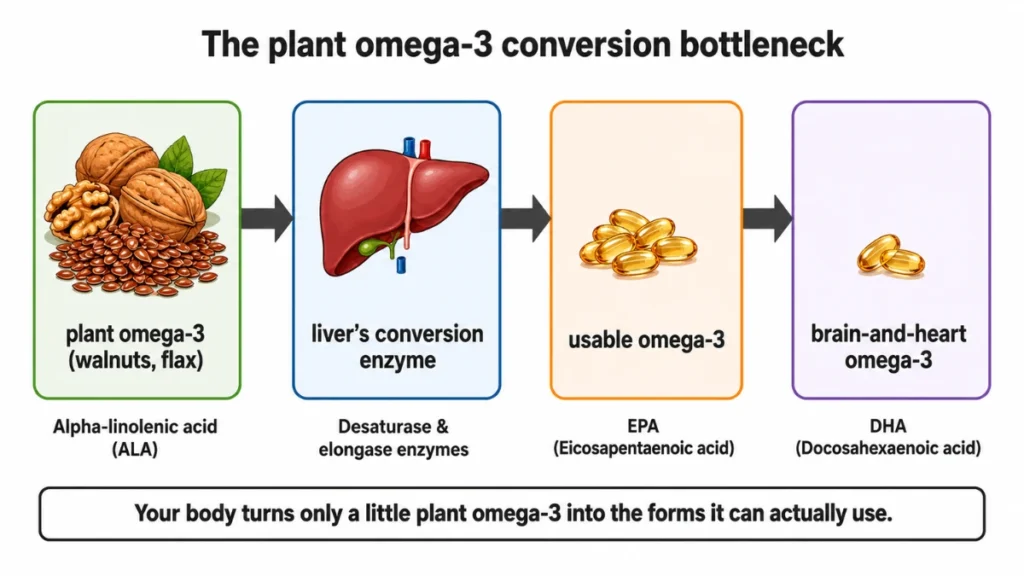
Very little DHA survives the process and for women, that gap widens sharply once menopause hits.¹
Why the conversion engine slows after 50
If you have noticed that eating more flaxseed never seems to make much difference, one enzyme may explain it.
The slowdown is partly age-related, independent of how well you eat.
Animal research from the 1980s found that delta-6 desaturase activity declines with age in rats, more markedly in the testes than in the liver.³
Though that research focused on a related enzyme pathway (omega-6 fats and prostaglandins) rather than omega-3 conversion specifically. Whether the same age-related decline applies to omega-3 conversion in humans hasn’t been directly tested.
What human conversion data shows is that ALA conversion is already very limited, even when the enzyme functions normally. Direct measurements in aging humans are harder to obtain, but the numbers from adult populations reveal the ceiling.²
Your starting point depends on your biology.
Men convert ALA to EPA at roughly 0.2–6%, and to DHA at under 0.1%.⁴
In women before menopause, the numbers are better: roughly 21% of ALA converts to EPA and about 9% to DHA, because estrogen boosts the liver enzymes responsible for conversion.⁴
After menopause, that estrogen-driven advantage disappears. Women lose the hormonal upregulation of FADS2 [the gene-encoded enzyme in the liver responsible for the rate-limiting step in ALA-to-DHA synthesis], and their conversion capacity drops closer to the male range.⁴
No single study directly tests the full chain from reduced conversion capacity to measurable health outcomes in adults over 50. The picture here is assembled from separate research streams that each test one piece.
If you are a woman past menopause, your situation is different from what most omega-3 guides assume. A postmenopausal woman eating only flaxseed and walnuts is in a very different position than a younger woman eating the same foods.⁴
The question is not whether to eat more ALA. Conversion is limited for everyone, and drops further after menopause. The good news is you can bypass the pathway entirely with three foods most people already recognize.
Eating more flaxseed will not fix this. The pathway itself is inefficient, more so after menopause. Your body needs a route around it, and that route does exist.
Three food categories that deliver DHA and EPA ready-made
You can skip the conversion entirely if you eat from one of three food categories. Each delivers DHA and EPA already formed, and your body absorbs and uses them directly.
Before adding any new omega-3 supplement to your routine, check with your doctor or pharmacist, especially if you take blood thinners, have heart disease, or are managing a chronic condition, since omega-3s can affect how these work.
The three categories are:
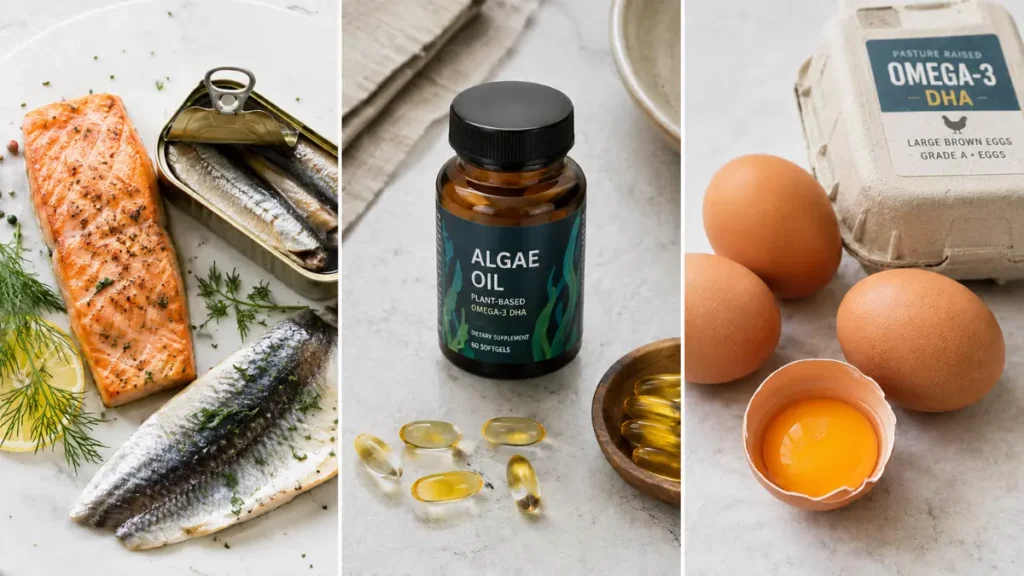
- Fatty fish: Salmon, sardines, herring, and mackerel deliver the highest preformed DHA and EPA per serving. A 3-ounce serving of herring provides roughly 0.94 grams of DHA and 0.77 grams of EPA.¹ Sardines canned in tomato sauce deliver about 0.74 grams of DHA and 0.45 grams of EPA per 3-ounce serving.¹ Two servings a week covers what most major health organizations recommend for adults.⁵
- Algae oil: Algae is where fish get their DHA. Algae oil supplements deliver preformed DHA and EPA that reaches the blood at rates matching fish oil. A randomized controlled trial of 74 adults with elevated triglycerides found plasma DHA and EPA bioavailability from algae oil was statistically non-inferior to fish oil after 6 and 14 weeks.⁶ A sound choice for people who avoid fish or prefer a non-animal source.
- Omega-3-fortified eggs: Some eggs are produced by hens fed an omega-3-enriched diet and contain more preformed DHA than standard eggs.¹ They are not as concentrated as fish, but they add a consistent small contribution for people who eat eggs daily.
Once you are eating preformed EPA and DHA, your liver’s declining conversion capacity no longer stands in the way. The pathway problem, at least, is solved.

How a high omega-6 diet blocks what little conversion remains
Even if your delta-6 desaturase enzyme is still working, there is a second obstacle most people over 50 have never been told about.
If you cook with vegetable oil or eat packaged foods regularly, you are consuming large amounts of omega-6 linoleic acid [the most common fat in cooking oils, processed snacks, and packaged foods], which competes with ALA for the same enzyme.⁷
Your liver uses delta-6 desaturase to process both omega-6 and omega-3 fats, and both families compete for the same active site. The enzyme actually prefers omega-3, but when omega-6 vastly outnumbers it in a typical diet, sheer volume crowds out ALA processing anyway.⁷ ALA conversion to DHA takes a back seat.
Your liver enzymes evolved for a diet with far less omega-6 than most people eat today. The evolutionary ratio was roughly 1:1 to 4:1; the modern Western diet runs at about 16:1.⁷ That shift happened in less than a century.
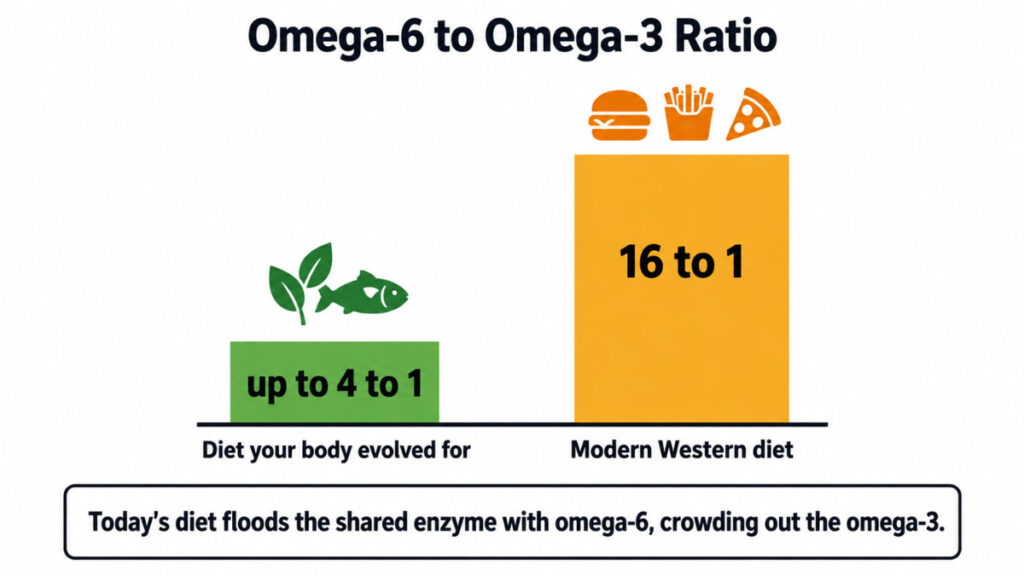
If you are over 50 and eating a standard Western diet, you face a double blockage.
After 50, the conversion enzyme is already slower and it actually prefers omega-3, but with omega-6 vastly more abundant in vegetable oils and packaged food, sheer volume crowds out ALA processing from walnuts or flaxseed anyway.
You have probably been told to eat more omega-3s. That framing misses the second half of the problem: eating more omega-6s may reduce the conversion of the omega-3s you are already eating.⁷
You can give your remaining conversion capacity more room to work by cooking with olive oil instead of corn or sunflower oil, and cutting back on packaged foods.⁷ Does it make more sense to fix the ratio, or to skip the conversion pathway altogether?
What the evidence says about DHA, EPA, and brain and heart health after 50
If you want to understand why DHA matters to cognitive aging, start with the wiring it supports.
In one small study of 40 health-conscious seniors (non-smokers, largely vegetarian, an unusually clean-living group), higher blood levels of EPA and the omega-3 index correlated with better delayed memory recall, faster processing speed, and more volume in brain regions tied to memory, including the entorhinal cortex and white matter.⁸

You may have seen headlines claiming omega-3 protects your brain. The evidence behind those headlines is real but narrower than it sounds.
Taking omega-3 supplements was linked to modest improvements in global cognitive function in pooled data from 14 randomized trials covering 26,881 adults aged 40 and older.⁹
The effect was measurable but modest: 0.16 on a standard cognitive screening scale (the MMSE).⁹
How reliable is this evidence? The nine reviews behind this analysis varied widely in quality: three were rated high quality, three moderate, and three low or very low, using a standard tool for grading systematic reviews.⁹
Before dismissing that number, consider what it measures. Effect size 0.16 might not appear on a brain scan, but it is large enough to be detected on a standard global cognition screening test over time
Your heart may have more to gain from EPA and DHA than your brain does, based on current trial data.
A meta-analysis of 38 randomized controlled trials found EPA and DHA supplementation was associated with a meaningful reduction in cardiovascular mortality and non-fatal heart attacks and since the trial population had, overall, low baseline cardiovascular risk, the benefit for someone with higher personal risk could plausibly be even larger.¹⁰

If you are weighing EPA versus an EPA-plus-DHA formula, the cardiac trial data favors EPA monotherapy in consistency.¹⁰
Across decades of cardiovascular trials, the pattern is consistent: preformed EPA and DHA show real cardioprotective effects, particularly EPA alone.¹⁰
The brain data is more complicated. Most brain-health trials recruited people already experiencing mild cognitive impairment, not healthy adults in their 50s looking to preserve function. Whether preformed DHA and EPA from food produces the same results as a purified supplement is genuinely unknown.
Eating fatty fish twice a week is not the same intervention as 2,000 mg per day of purified DHA, and the trial data cannot be cleanly applied from one to the other.
What you have is evidence that is improving but has not yet answered the specific question most people over 50 are actually asking.
A simple weekly eating pattern that closes the gap
The gap between what your body needs and what a typical Western diet provides is real, but it is not large in practical terms. You do not need a complete diet overhaul. You need three specific changes made consistently.
Nearly all US adults (about 98%) fall short of the optimal omega-3 index, and just over half of the total US population age 6 and up falls into the lowest, ‘undesirable’ category, based on blood measurements from a 2021–2023 national survey.¹¹
The foods you already buy can close that gap if you make one or two deliberate swaps per week.
Here is what the week can look like:
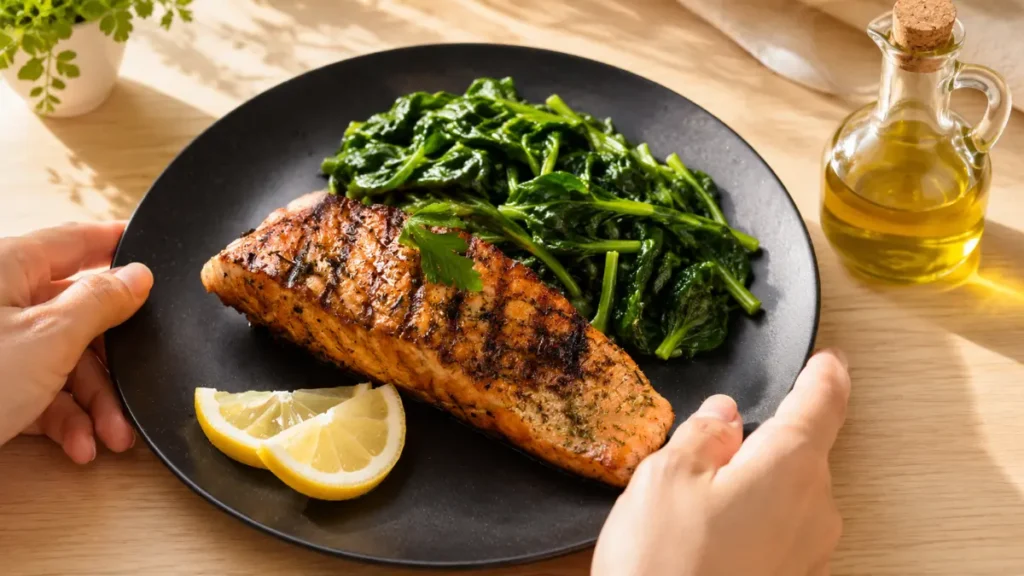
- Two servings of fatty fish per week: Sardines, herring, salmon, or mackerel, canned or fresh. One serving at Tuesday dinner and one at Saturday lunch requires no cooking change beyond what you already do. Each 3-ounce serving delivers the DHA and EPA your body can use directly.¹
- Swap your cooking oil: Replace corn, sunflower, or soybean oil with olive oil. This alone reduces the omega-6 load competing with your remaining conversion capacity, without adding a new food.⁷
- Add algae oil if you skip fish: A daily algae oil supplement closes the gap for people who avoid seafood. Algae oil capsules deliver preformed DHA in amounts that vary by product, without requiring any conversion.
How much applies to your situation depends on your diet, any existing deficiency, and whether you use other supplements.
These three changes do what eating more walnuts and flaxseed cannot: they deliver DHA and EPA in the form your body can use after 50, without relying on a conversion pathway that has slowed.
If you follow these three changes for 30 days and track how you feel, noting sleep, afternoon focus, and energy, you will have personal data that no study of 26,000 people can give you. That data is yours alone.
What to eat instead of converting
Swap a cooking oil, add two fish meals a week, or start algae oil daily. You have bypassed the conversion problem that arrives after 50.
Check the label on your next meal: if it contains only ALA-rich foods like walnuts or flaxseed with no fatty fish or algae oil, add one preformed DHA and EPA source this week and track how you feel after 30 days.
Brain research on omega-3 and cognitive function is still catching up. The heart evidence is not. NIH ODS omega-3 fact sheet: ods.od.nih.gov.¹
⚠️DISCLAIMER
This article is for informational purposes only and does not constitute medical advice. Omega-3 needs vary by individual health status, medications, and existing conditions. Before adding any supplement such as algae oil or fish oil, consult your doctor or pharmacist, particularly if you take blood thinners or manage a chronic condition.
References
- National Institutes of Health, Office of Dietary Supplements. Omega-3 Fatty Acids Fact Sheet for Health Professionals. 2025. https://ods.od.nih.gov/factsheets/Omega3FattyAcids-HealthProfessional/
- Childs CE, Kew S, Finnegan YE, Minihane AM, Leigh-Firbank EC, Williams CM, Calder PC. Increased dietary α-linolenic acid has sex-specific effects upon eicosapentaenoic acid status in humans: re-examination of data from a randomised, placebo-controlled, parallel study. Nutr J. 2014 Dec 11;13:113. doi: 10.1186/1475-2891-13-113. https://www.ncbi.nlm.nih.gov/pmc/articles/PMC4274685/
- Horrobin DF. Loss of delta-6-desaturase activity as a key factor in aging. Medical Hypotheses. 1981;7(9):1211-1220. https://pubmed.ncbi.nlm.nih.gov/6270521/
- Minihane AM. Omega-3 fatty acids, brain health and the menopause. Post Reproductive Health. 2025;31(2):97-104. https://pmc.ncbi.nlm.nih.gov/articles/PMC12209554/
- National Center for Complementary and Integrative Health. Omega-3 Supplements: What You Need to Know. 2024. https://www.nccih.nih.gov/health/omega3-supplements-what-you-need-to-know
- Bailey E, et al. Comparative Bioavailability of DHA and EPA from Microalgal and Fish Oil in Adults. International Journal of Molecular Sciences. 2025;26(19):9343. https://www.ncbi.nlm.nih.gov/pmc/articles/PMC12524788/
- Simopoulos AP. The omega-6/omega-3 fatty acid ratio: health implications. OCL. 2010;17(5):267-275. https://www.ocl-journal.org/articles/ocl/full_html/2010/05/ocl2010175p267/ocl2010175p267.html
- Loong S, et al. Omega-3 Fatty Acids, Cognition, and Brain Volume in Older Adults. Brain Sciences. 2023;13(9):1278. https://www.ncbi.nlm.nih.gov/pmc/articles/PMC10526215/
- Barros MI, et al. Omega-3 Polyunsaturated Fatty Acids and Cognitive Decline in Adults with Non-Dementia or Mild Cognitive Impairment: An Overview of Systematic Reviews. Nutrients. 2025;17(18):3002. https://pmc.ncbi.nlm.nih.gov/articles/PMC12472900/
- Khan SU, et al. Effect of omega-3 fatty acids on cardiovascular outcomes: A systematic review and meta-analysis. eClinicalMedicine. 2021;38:100997. https://www.ncbi.nlm.nih.gov/pmc/articles/PMC8413259/
- Powers CD, et al. Over Half of the United States Population Had an Undesirably Low Omega-3 Index Based on Erythrocyte Membrane Measurements: Results From the Cross-Sectional NHANES From August 2021 to August 2023. Current Developments in Nutrition. 2026;10(6):107715. https://www.sciencedirect.com/science/article/pii/S2475299126000806