

You got the results. Everything came back normal. And yet, two weeks later, you are still losing words mid-sentence, still reading the same paragraph twice, still feeling that familiar dull weight behind your eyes by early afternoon.
That disconnect, between a clean test and a brain that does not feel clean, is exactly what this article is about.
For adults over 50 who have seen normal blood work but still feel mentally slow, a standard panel is often the beginning of the brain fog investigation, not the end of it.
It does not measure everything. And what it misses can matter.
What you will find here:
- Why a “normal” thyroid result may not mean your brain is getting enough thyroid hormone
- The sleep condition that leaves no trace in blood but quietly erodes your memory
- A nutrient whose brain deficiency hides behind normal lab values
- A specific list of tests to bring to your next appointment
Why “Normal” Results Do Not Mean Normal for Your Brain
You already know something is off. You have been foggy for months, your doctor ran the tests, and the numbers all came back fine. The problem is not the tests. The problem is what those tests were built to find.
A standard blood panel is designed to catch disease. It looks for thyroid hormones out of range, vitamin levels below a clinical threshold, blood sugar high enough to meet a diagnostic cutoff.
It was never designed to find the narrower gap between “technically fine” and “functioning well.” Those are two different targets, and routine lab work only aims at one.
According to 2023 Behavioral Risk Factor Surveillance System data, roughly 1 in 6 adults aged 45 and older in the United States report worsening confusion or memory loss.¹
Most of them are not diagnosed with any disease. They live in the space a blood panel cannot see.
This article draws on research from separate fields: thyroid physiology, sleep medicine, nutritional neuroscience, and inflammation biology.
No single study directly tests the full claim that a standard panel misses the leading causes of brain fog in people over 50.
Each piece of evidence covers one part of that picture, and this matters to how you read what follows.
Standard panels measure what you have. They do not measure how well your body is using it.

A thyroid hormone level is measured in blood, not in brain tissue. A magnesium result reflects what is circulating, not what has reached your neurons.
A sleep quality reading does not exist on any standard panel because there is no blood marker for a disrupted sleep cycle.
The test tells you the ingredient is present. It cannot tell you whether the brain received it.
The Thyroid Marker Your Panel Almost Certainly Skipped
Your blood test result came back normal, but normal on a standard panel and normal for your brain are not the same thing.
Most routine thyroid tests measure TSH [a pituitary signal that tells the thyroid gland how hard to work]. TSH is a useful screen. But it’s only one piece of the picture.
A 2024 prospective observational study following 218 adults aged 60 and older with existing thyroid disease found that lower TSH and higher free thyroxine (T4) [the storage form of thyroid hormone] levels were significantly linked to cognitive decline over a two-year period.²
That study didn’t find the same link for free T3, the active form of thyroid hormone. It’s a reminder that even within one hormone system, different markers can tell different stories.
The distinction matters more after 50. Several factors, including genetics, gut health, and chronic stress, can affect how well the body handles thyroid hormone as we age, which is part of why two people with identical TSH numbers can have very different symptoms.

The American Thyroid Association has noted that severe thyroid dysfunction is associated with cognitive symptoms including brain fog and memory loss, and that these often improve when thyroid function is restored.³
These findings come from people already diagnosed with thyroid disease. What’s less well understood is whether milder, harder-to-catch versions of the same problem affect people whose panels look normal.
If you have thyroid symptoms but clean results, the test may simply not have looked past TSH. Free T4 and free T3 aren’t included in routine panels at most clinics, and require a separate order.
How this connects to what follows is worth naming: the thyroid gap is one of two causes where the test exists but is not routinely ordered. The next cause leaves no blood trace at all.
When Your Blood Has No Record of What Your Sleep Is Doing to Your Mind
You might sleep eight hours and still feel like you barely closed your eyes. That is not always about sleep quantity. It can be about what happens while you sleep, or what stops happening.

Obstructive sleep apnea (OSA) [a condition where the airway partly or fully collapses during sleep, cutting off breathing repeatedly through the night] is one of the most common and most underdiagnosed contributors to daytime cognitive problems in adults over 50.
A 2025 systematic review and meta-analysis of 23 studies involving 33,226 adults found that the pooled prevalence of cognitive impairment among people diagnosed with OSA was approximately 37%.⁴
Estimates varied depending on the country and testing method used, but the overall picture was consistent: cognitive impairment is common in OSA, not rare.
That is more than one in three.
A condition affecting this many people, with this much cognitive impact, belongs on every brain fog checklist. It is not there because blood work cannot see it.
Blood work has no way to catch sleep apnea. It’s diagnosed by watching what happens while you sleep, not by anything circulating in your bloodstream, so a person with frequent breathing interruptions overnight can still walk into a lab the next morning with results that look clean.
The cognitive effects are real. Each time breathing stops, oxygen to the brain drops briefly. Over time, repeated oxygen loss and sleep fragmentation are thought to contribute to impairment in focus, memory, and executive function.⁴
Sleep apnea is the blank space in your blood work that a blood test cannot fill.
The only way to detect it is a sleep study. A polysomnography [a supervised overnight test that tracks brain waves, oxygen levels, and breathing patterns] or a home sleep test can confirm or rule it out in a single night.
If you snore, wake up feeling like you never slept, or have been told you stop breathing at night, you’re a reasonable candidate to ask about testing.
The Magnesium Problem Hiding in Your Results
Your magnesium result came back normal. That is not the same as your brain having enough magnesium.
Standard lab tests measure magnesium in the blood. But less than 1% of the body’s total magnesium is in blood serum; the rest is stored in bone and other soft tissue.⁵
Blood levels can appear normal even when the brain is running short.
That gap between circulating levels and brain availability makes intake, not just serum levels, the number that matters for cognition.
A 2023 study using data from 6,001 cognitively healthy participants in the UK Biobank, aged 40 to 73, found that people consuming more than 550 milligrams of magnesium daily had brain volumes approximately one year younger by age 55 compared with those consuming around 350 milligrams per day.⁶
This is an observational finding, not a controlled trial, so it shows an association rather than proof that magnesium intake directly preserves brain size and it comes from a single study of a UK population, so how well it generalizes elsewhere isn’t yet known.
But brain volume is closely tied to cognitive reserve: the brain’s built-in buffer against memory slips and slower processing that erodes with age.
The gap between the two intake levels is not a pharmacological dose. It is the difference between an average diet and a magnesium-rich one.
Magnesium plays a role in nerve and muscle function, and low levels have been linked to poorer sleep quality in some research.
Magnesium deficiency is more common in adults over 50, in part because magnesium absorption from food naturally decreases with age.⁵
If you take a proton pump inhibitor [a medication that reduces stomach acid, often prescribed for acid reflux], your magnesium levels may be affected.⁵ The same is true of certain diuretics, and magnesium loss is also common with diabetes itself.
A normal serum magnesium level under these conditions may understate what is actually available to the brain.
Talk to your doctor before adding magnesium supplements if you are on medication for kidneys, blood pressure, or any chronic condition, since magnesium interacts with several common drugs.

The Slow Burn Your Standard Panel Rarely Catches
You might feel rundown and foggy for months without a clear reason, and your blood work still looks fine. One possible explanation does not always make it onto a standard panel: chronic low-grade inflammation.
Inflammation [the immune system’s response to injury or threat] is well understood in its acute form: a swollen ankle, a fever. The chronic, low-level version is harder to see and rarely produces obvious symptoms. It does not spike your white blood cell count.
It does not show up on a basic metabolic panel. Detecting it requires a specific test: hsCRP [high-sensitivity C-reactive protein, a blood protein that rises when inflammation is present throughout the body].
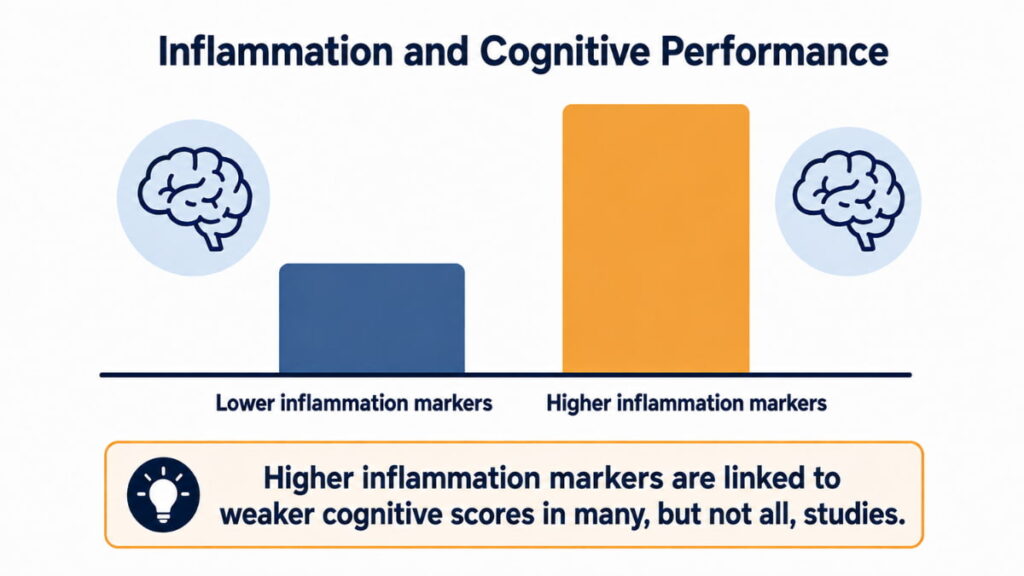
A large study of 3,270 older adults free from dementia found that elevated levels of certain immune proteins, particularly TNF-alpha [tumor necrosis factor-alpha, a protein the immune system releases during inflammatory responses], were associated with poorer performance on cognitive assessments.⁷
The strongest effects at the outset were seen for visual-spatial tasks, tied to TNF-alpha levels. When the researchers followed a subset of participants for several more years, a different marker (the balance between two other immune signals, IL-6 and IL-10) predicted who went on to decline.⁷
The evidence here is genuinely mixed. Not all studies of chronic inflammation and cognition find the same pattern, and some have found no predictive relationship at all.
What the better-powered studies do consistently show is an association between elevated inflammatory markers and domain-specific cognitive decline over time, particularly in older women.⁷
Researchers are still working out which markers matter most and for whom.
What makes this worth knowing: hsCRP is inexpensive and widely available, yet it is rarely ordered as part of a standard brain fog workup. If your results look clean but your symptoms persist, asking specifically for an hsCRP test is a reasonable next step.
What to Ask for at Your Next Appointment
Most doctors will not order these tests unless you ask. That is not negligence. It is how medicine is set up.
A standard physical screens for disease. What you are describing is a gap between your test results and how you actually function, and that gap requires you to name it directly.

Here is the script. Say it in these words or close to them:
“My routine labs came back normal, but I have been having ongoing brain fog and I want to rule out a few specific things. Can we look beyond TSH at my full thyroid panel, check my hsCRP for inflammation, and discuss whether a sleep study makes sense given my symptoms?”
That single request covers the three most commonly missed pieces. Looking past TSH addresses the thyroid gap. hsCRP gives you a window into low-grade inflammation.
A sleep study rules out obstructive sleep apnea. Together they complete the picture that a standard panel leaves open.
Before your appointment, write down:
- How long the brain fog has been present
- Whether it is worse at a specific time of day
- Any medications you take regularly, including over-the-counter drugs and supplements
- Whether you snore, wake unrefreshed, or have been told you stop breathing in your sleep
A list like this does two things. It makes the appointment faster, and it makes your symptoms harder to dismiss.
Cognitive complaints in adults over 50 are sometimes attributed to normal aging when the real cause is something fixable.
According to Alzheimer’s Association data drawn from BRFSS surveys, 54.8% of adults aged 45 and older who experience cognitive decline have never discussed their concerns with a doctor.⁸ The conversation itself is the first step.
Start With the Tests You Have Not Taken
Brain fog that outlasts a normal blood test is not a dead end. It is a gap in what was measured. The tests in this article are not experimental. They are widely available, inexpensive, and simply not routine.
Ask your doctor to run a full thyroid panel beyond TSH, a magnesium test, and a sleep study if you snore or wake unrefreshed. Those three are the most commonly missed pieces of the brain fog puzzle.
Not every case resolves once the right tests are run. But a question you never asked your doctor cannot be answered.
⚠️DISCLAIMER
This article is for informational purposes only and does not constitute medical advice, diagnosis, or treatment. Always consult a licensed healthcare provider before pursuing additional testing or making changes to your medications or supplements. Research cited reflects individual study findings and should not replace professional clinical evaluation.
References
- Eugene DY, Kilmer G, Ali AR, Claxton JS, Woodruff R, Coronado F, Strahan AE. Subjective Cognitive Decline Among Adults Aged 45 and Older — United States, 2023. Journal of Public Health Management and Practice. 2026. https://pubmed.ncbi.nlm.nih.gov/41650298/
- Muhammad A, Ul Haq I, Khan MA, Hassan HSA, Aman B, Arshad MM. Thyroid Functions and Cognitive Decline in the Elderly. Cureus. 2024;16(11):e74484. https://www.ncbi.nlm.nih.gov/pmc/articles/PMC11670265/
- American Thyroid Association. Thyroid and the Brain. Clinical Thyroidology for the Public. 2018;11(1):3-4. https://www.thyroid.org/patient-thyroid-information/ct-for-patients/january-2018/vol-11-issue-1-p-3-4/
- Su K, Feng Z, Wang L, Zhao G, Li J. Prevalence of cognitive impairment among adults with obstructive sleep apnea: a systematic review and meta-analysis. Sleep and Breathing. 2025;29(6):323. https://pmc.ncbi.nlm.nih.gov/articles/PMC12537604/
- National Institutes of Health Office of Dietary Supplements. Magnesium: Fact Sheet for Health Professionals. NIH ODS. https://ods.od.nih.gov/factsheets/Magnesium-HealthProfessional/
- Alateeq K, Walsh EI, Cherbuin N. Dietary magnesium intake is related to larger brain volumes and lower white matter lesions with notable sex differences. European Journal of Nutrition. 2023;62(5):2039-2051. https://pmc.ncbi.nlm.nih.gov/articles/PMC10349698
- Dyer AH, McNulty H, Caffrey A, Gordon S, Laird E, Hoey L, Hughes CF, Ward M, Strain JJ, O’Kane M, Tracey F, Molloy AM, Cunningham C, McCarroll K. Low-grade systemic inflammation is associated with domain-specific cognitive performance and cognitive decline in older adults: Data from the TUDA study. Neurobiology of Aging. 2023;134. https://www.sciencedirect.com/science/article/abs/pii/S0197458023002701
- Alzheimer’s Association. Subjective Cognitive Decline Data and Analysis. https://www.alz.org/professionals/public-health/public-health-topics/data-assessment-analysis