

You’ve been doing the right things. You eat well, you move, you put your phone down before bed. And you’re still waking up at 3 a.m., still dragging by noon, still wondering what you’re missing.
The light in your room right now may be the problem. The ordinary lamps and overhead lights in your home are quietly disrupting the cellular signals that control sleep, hormone production, and tissue repair. After 50, your biology has far less margin to absorb that disruption.
Adults over 50 who are already doing the right things are often blindsided by this one. Not because it’s hard to fix, but because no one frames the room itself as a health variable.
The evening light at home you barely notice is altering the cellular signals that govern your sleep, hormone balance, and long-term health.
This article is for informational purposes only and does not constitute medical advice. The research cited reflects findings on light exposure and circadian biology, and individual responses may vary. If you have a sleep disorder or chronic health condition, consult your doctor before making changes.
Why Evening Light at Home Hits Differently After 50
You probably know melatonin [a hormone your brain releases at night to trigger sleep and repair] helps you sleep. What most people don’t know is what it also does while you sleep. Melatonin is an antioxidant [a compound that neutralizes cell damage before it builds up].
It helps your cells neutralize damage that builds up during the day. It signals your body’s repair systems to start working. It’s not just a sleep switch. It’s a maintenance signal.
After 50, your body makes less of it. One cross-sectional study of 144 people aged 30 to 110 found that nighttime melatonin levels dropped starting around age 60, reaching much lower levels in people in their 70s and beyond.¹
That means the repair signal your body depends on is already weaker than it was at 35.
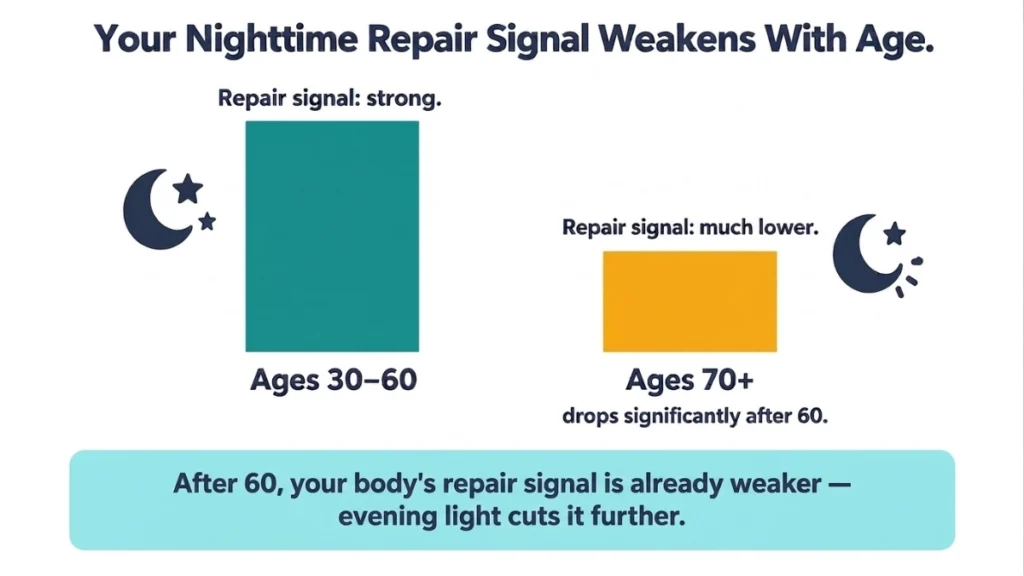
When evening light cuts that signal further, you’re not just losing sleep. You’re losing recovery time.
Your body’s circadian system [the internal 24-hour timing mechanism that controls when your body sleeps, repairs, and resets] also governs when repair genes turn on. The CLOCK protein [a molecule inside your cells that drives that 24-hour timing cycle], which is central to this system, controls gene activity linked to tissue maintenance, cellular aging, and DNA repair.²
Disruption of this system is linked to accelerated aging and age-related disease.
That disruption doesn’t feel like anything. It accumulates quietly. And after 50, with melatonin reserves already lower, there’s less buffer when the evening light in your home keeps the signal suppressed night after night.

The Room Is the Problem, Not the Screen
You put your phone down. Good. The overhead light is still on.
The lamp on your ceiling runs for four or five hours every evening. It covers your whole room. And depending on the bulb inside it, it may be suppressing your melatonin just as effectively as the device you just set on the nightstand.
A 2026 study measured 52 home lamps across three technologies: LEDs, compact fluorescent lights, and incandescent bulbs. Researchers calculated the melatonin suppression value for each type. Cool white LED bulbs produced a median suppression value of 12.3%. That figure is comparable to smartphone screens.³
Warm white LEDs produced just 3.6%. Traditional incandescent bulbs came in at 1.5%.
The difference between a cool white LED and a warm white LED is not how bright the light looks to you. It’s the wavelength. Cool white bulbs carry more short-wavelength (blue) light, which is exactly what triggers your brain’s melatonin-suppression pathway. Warm white bulbs carry less of it.
You can’t feel the difference when you walk in the room. Your melatonin can.
The number on the bulb package tells you which one you have. That number is the bulb’s color temperature, measured in kelvin: cool white bulbs carry the higher numbers, warm white the lower ones. Most people have never looked at that number. It’s worth looking at tonight.
What Your Cells Are Actually Doing Between 8 and 11 p.m.
Your body runs a maintenance shift every night. A repair process starts at roughly the same time each evening, triggered by the same signal. That signal is your circadian system, and light is what tells it when to start.
Between roughly 8 and 11 p.m., your pineal gland [a small structure deep in the brain that releases melatonin in response to darkness] begins releasing melatonin. When the light signal says it’s night, melatonin flows and tells the rest of the body to shift into repair mode.
Part of what gets repaired is DNA. Your cells accumulate small amounts of DNA damage throughout the day from sun exposure, metabolism, and normal cellular activity. The circadian system coordinates when the repair machinery runs.
Disrupting that timing doesn’t just affect sleep. It affects the integrity of your genetic material.
Research shows that circadian rhythms, which evolved over 2.5 billion years as a defense against oxidative stress [a buildup of unstable molecules that damage cells when the body cannot clear them fast enough], are essential for maintaining genomic stability by regulating DNA repair pathways, oxidative stress responses, and cell cycle regulation.
Disruption through artificial light, irregular sleep schedules, and shift work is linked to increased oxidative damage and genomic instability.⁴
Genomic stability means the ability of your cells to keep their DNA intact. When it breaks down, the blueprint for healthy cell function degrades.
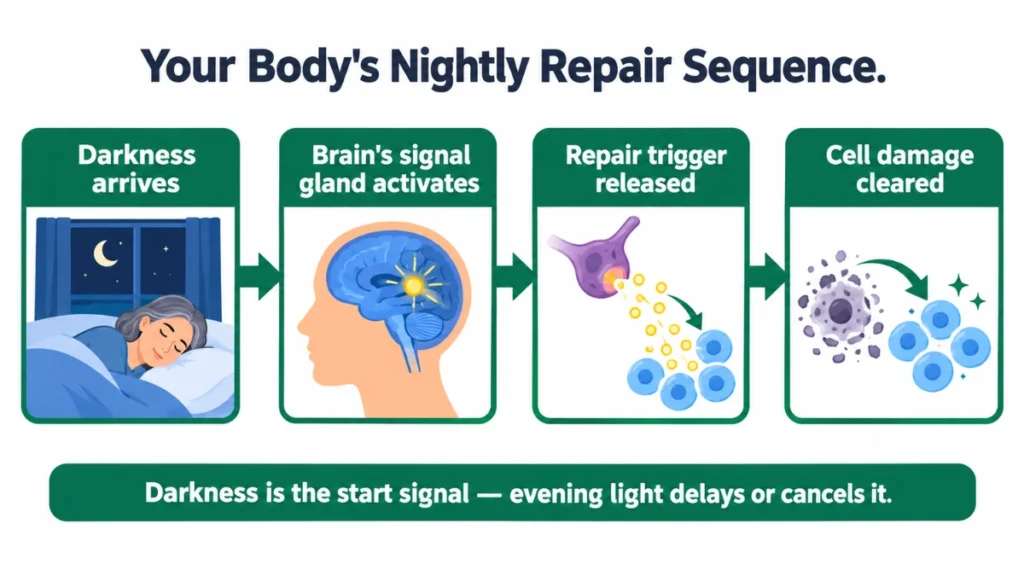
If the evening light at home keeps sending the wrong signal, the repair process never gets its start signal. The damage from the day carries forward into the next one.
The Worst Offenders Already On in Your Home Tonight
Walk through your home at 9 p.m. and look at what’s on.
The living room overhead is probably the biggest problem. It covers the most space, burns the longest hours, and in most modern homes it holds a cool white LED. That’s the highest-impact fixture in the building.
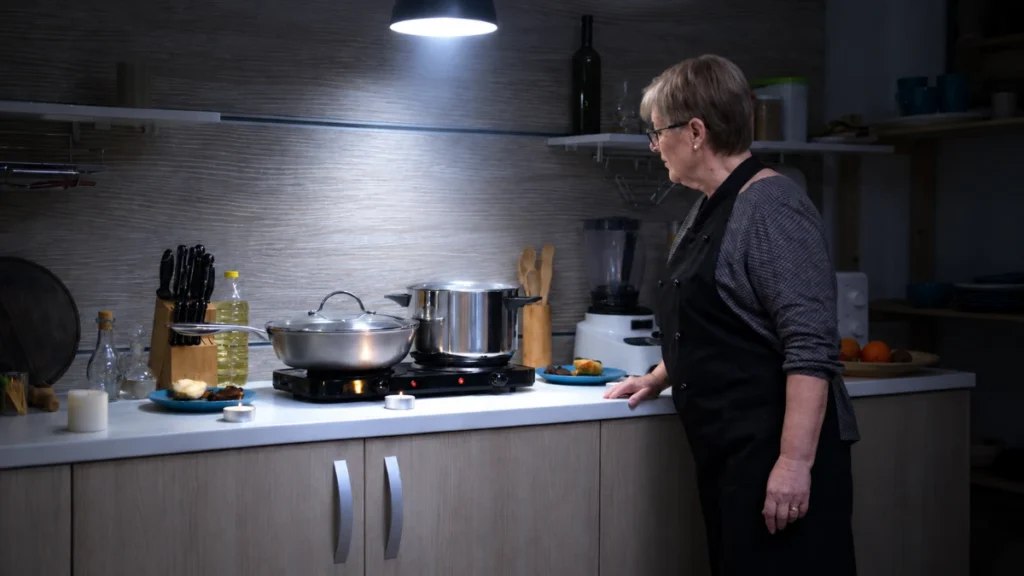
The kitchen is next. Bright overhead lighting in a kitchen typically runs at the cool white end of the range. If you’re in the kitchen at 8 or 9 p.m. making tea or cleaning up, you’re standing under the most powerful circadian disruptor in the house.
The bathroom is the one most people miss. Ten minutes under a cool white bathroom overhead right before bed is enough to matter.
Research from Brigham and Women’s Hospital found that exposure to room light before bedtime delayed melatonin onset in 99% of subjects, reduced pre-sleep melatonin concentration by 71.4%, and during normal sleep hours, room light suppressed melatonin by more than 50% in 85% of trials.⁵
Researcher Joshua J. Gooley and his co-authors at Brigham and Women’s Hospital, including Dr. Charles A. Czeisler, concluded: “Our results demonstrate that the melatonin profile is truncated by exposure to room light before bedtime.”⁵
The fixture that did the most damage tonight probably wasn’t the one you were worried about.
What Happens to Long-Term Cellular Health When This Goes Uncorrected
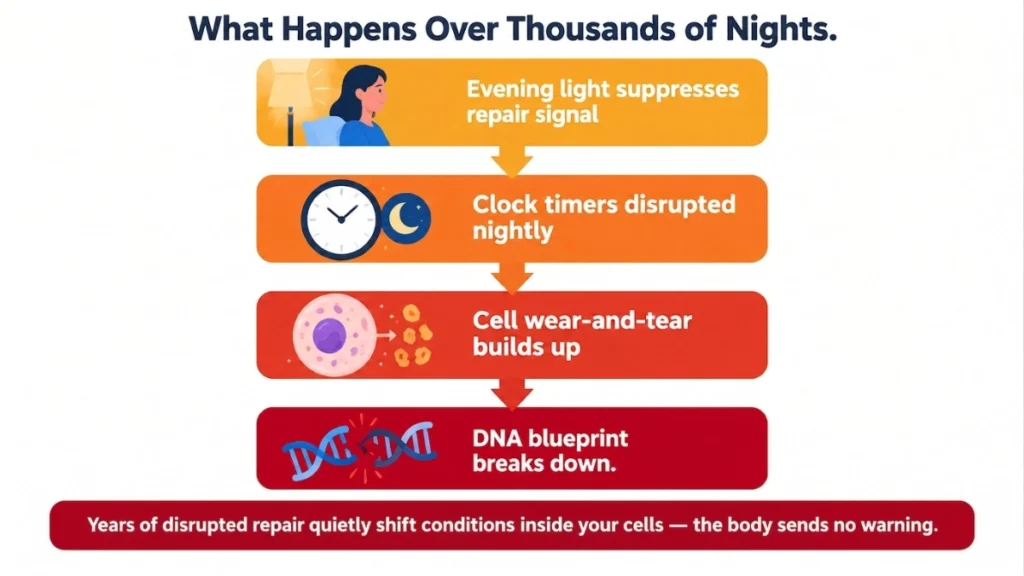
One night of bright evening lighting won’t hurt you in any lasting way. Three thousand nights is a different story.
That’s roughly ten years. And if you’re 50, 60, or 70, the next ten years are exactly when cellular maintenance matters most.
Artificial light at night disrupts endogenous biological clocks [internal timing systems built into your cells that keep their own rhythm but are set by light]. The research links this disruption to sleep disorders, endocrine diseases, cardiovascular disease, cancer risk, immune impairment, depression, anxiety, and cognitive decline.⁶
Some readers will ask: if this were serious, wouldn’t doctors be talking about it? The honest answer is that cumulative, invisible harm from everyday environments rarely triggers a clinical conversation until the downstream disease is already present.
The light in your room leaves no acute symptom. There’s no moment where you feel it working.
Studies on aged rats found that a 30-minute light pulse late at night abolished the circadian rhythm of Per2 [a clock gene that regulates how cells respond to oxidative stress and influences cancer development].⁷
This was animal research, not human data.
The research shows the link in a living system, but the same effect in humans has not been directly established. Still, Per2 operates the same way in human cells. The basic biology is shared.
What happens after years of suppressed melatonin and disrupted clock genes isn’t a single event. It’s a slow shift in the conditions inside your cells. The body doesn’t send a warning label. The evidence accumulates long before any symptom appears.
The Evening Light Audit: What to Change, Zone by Zone
Here is the audit. Walk through your home tonight with this in mind.
A systematic review of light’s effects on the human circadian system found that melatonin secretion and suppression both decline with age, and that even light levels as low as 5 to 10 lux can trigger a circadian response during sleep.⁸
Lux is a measure of light brightness. A single nightlight sits at the low end of that range. A living room produces roughly 200 to 400 lux.⁹ The gap between those numbers is why the room matters more than you think.

This audit is about changing the room. It requires no new habit and no new routine.
The living room. Replace any overhead LED bulb rated above 3000K with a warm white bulb rated 2700K or lower. If the fixture has a dimmer, use it. Drop brightness to 50% or lower after 7 p.m.
The kitchen. If you’re in the kitchen in the evening, switch to a warm white bulb and dim it. Avoid standing under a full-brightness cool white overhead after 7 p.m.
The bathroom. This is the most overlooked zone. Install a warm amber bulb in your bathroom fixture. If you use the bathroom 30 to 60 minutes before bed, that bulb is now the last light your eyes see before sleep.
Tunable smart bulbs. The same 2026 study that measured lamp suppression values tested tunable LED lamps across color temperature settings.
At their coolest setting (5700K), suppression was estimated at 10%. At their warmest (2100K), it dropped to 0.1%.³ That’s a reduction of nearly 100 times, from one setting change on an app.
THE EVENING LIGHT AUDIT
Three changes, one evening, no new habits required.
- Living room: Swap bulbs to 2700K or lower. Dim to 50% after 7 p.m.
- Kitchen: Replace overhead with warm white. Avoid full brightness after 7 p.m.
- Bathroom: Install a warm amber or red bulb. Use it for your last 30 minutes before bed.
- Optional upgrade: Replace any fixture with a tunable smart bulb. Set it to 2100K from 7 p.m. onward.
Target: All main living areas at 2700K or lower and dimmed by 8 p.m.
Your Cells Are Waiting for the Right Signal
After 50, taking back control of your evening light at home gives your cells the repair window they’ve been missing. Audit and adjust the artificial light sources in your home’s evening environment before 9 p.m. The fix doesn’t require willpower. It requires a different bulb.
References
- Zhao ZY, Xie Y, Fu YR, Bogdan A, Touitou Y. Aging and the circadian rhythm of melatonin: a cross-sectional study of Chinese subjects 30-110 yr of age. Chronobiology International. 2002; 19(6):1171-1182. https://pubmed.ncbi.nlm.nih.gov/12511033/
- Yuan Z, Nepovimova E, Wu Q, Kuca K. Role of circadian CLOCK signaling in cellular senescence. Biogerontology. 2025; 26: article 177. https://link.springer.com/article/10.1007/s10522-025-10319-7
- Terán E, Yee-Rendón CM, Sosa-Arámbula HJ, De La Herrán-Arita AK, Woods RL. Home lighting, blue-light filtering, and their effects on melatonin suppression. Scientific Reports. 2026; 16: article 2850. https://www.nature.com/articles/s41598-025-29882-7
- Ganesh JM, Singh P, Murali R, Chandramoorthy HC, Perumalsamy LR, Gandhirajan RK. Clocking the damage: circadian rhythm, redox homeostasis and genome integrity in cancer. Molecular and Cellular Biochemistry. 2026; 481(3):1135-1153. https://pubmed.ncbi.nlm.nih.gov/41364289/
- Gooley JJ, Chamberlain K, Smith KA, Khalsa SBS, Rajaratnam SMW, Van Reen E, Zeitzer JM, Czeisler CA, Lockley SW. Exposure to Room Light before Bedtime Suppresses Melatonin Onset and Shortens Melatonin Duration in Humans. The Journal of Clinical Endocrinology & Metabolism. 2011; 96(3):E463-E472. https://pmc.ncbi.nlm.nih.gov/articles/PMC3047226/
- Lei T, Hua H, Du H, Xia J, Xu D, Liu W, Wang Y, Yang T. Molecular mechanisms of artificial light at night affecting circadian rhythm disturbance. Archives of Toxicology. 2024; 98(2):395-408. https://pubmed.ncbi.nlm.nih.gov/38103071/
- El-Hennamy RE, Elmasry HA. Alterations in Per2, Bcl2 gene expression, and oxidative status in aged rats liver after light pulse at night. Sleep and Biological Rhythms. 2024; 22(2):181-190. https://pmc.ncbi.nlm.nih.gov/articles/PMC10959914/
- Tähkämö L, Partonen T, Pesonen AK. Systematic review of light exposure impact on human circadian rhythm. Chronobiology International. 2019; 36(2):151-170. https://www.tandfonline.com/doi/full/10.1080/07420528.2018.1527773
- Dautovich ND, Schreiber DR, Imel JL, Tighe CA, Shoji KD, Cyrus J, Bryant N, Lisech A, O’Brien C, Dzierzewski JM. A systematic review of the amount and timing of light in association with objective and subjective sleep outcomes in community-dwelling adults. Sleep Health. 2019; 5(1):31-48. https://pmc.ncbi.nlm.nih.gov/articles/PMC6814154/