
You’ve noticed something shifted, and you’re not imagining it. After 50, most people spend money on skincare products while ignoring the daily habits that actually slow skin aging from the inside out.
If you’re an adult over 50 who wants to look younger without expensive treatments, that gap is worth closing. This article explains what is actually changing in your skin after 50, why most products can’t fix it, and what a specific 11-minute morning habit can do that no bottle on your bathroom shelf ever will.
The answer lives one layer deeper than any cream can go.
Why Read This
- What changes in your skin after 50 that no cream has ever been designed to fix.
- What a small pilot study found when women did four minutes of targeted face movements every morning.
- Why drinking more water affects your skin differently at 50 than it did at 30.
- Which single topical product earns a place in this routine, and which ones don’t.
- What starts tonight that costs nothing and takes less time than making coffee.
What Actually Changes in Skin After 50
You look in the mirror one morning and something is different. It’s not gradual. That reaction is picking up on a real, measurable change happening below the surface.
Daily habits for younger-looking skin after 50 work because they target what is actually changing, not just what is visible.
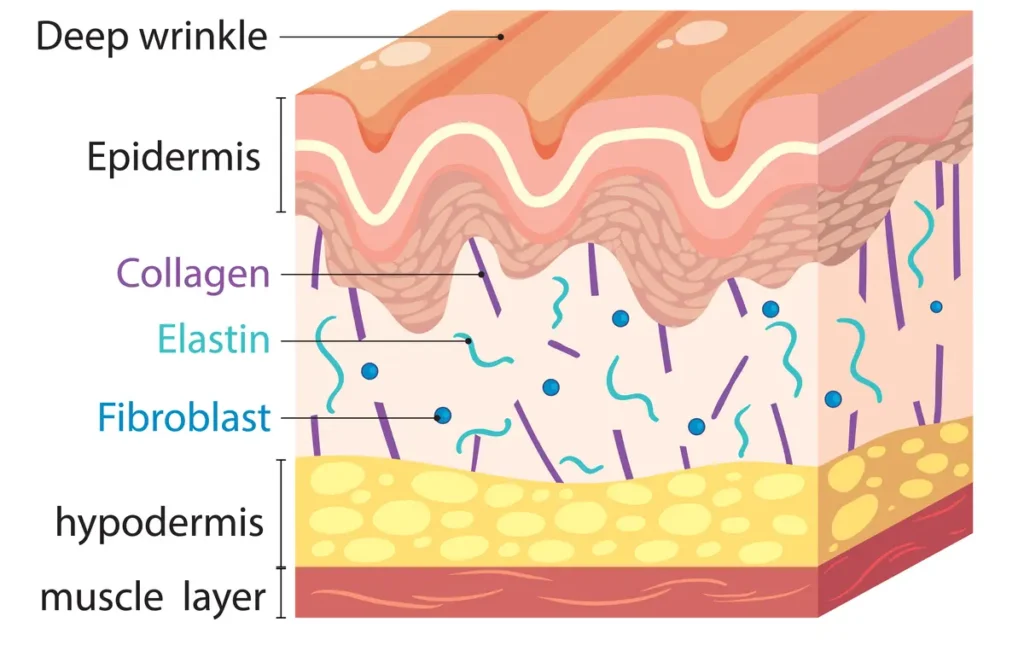
Your skin has two layers that matter here. The outer layer is the epidermis [the thin, visible surface of skin that you can feel and that products touch]. Below it sits the dermis [the thicker inner layer where collagen and elastin fibers give skin its structure, firmness, and spring]. Most skincare products never reach the dermis.
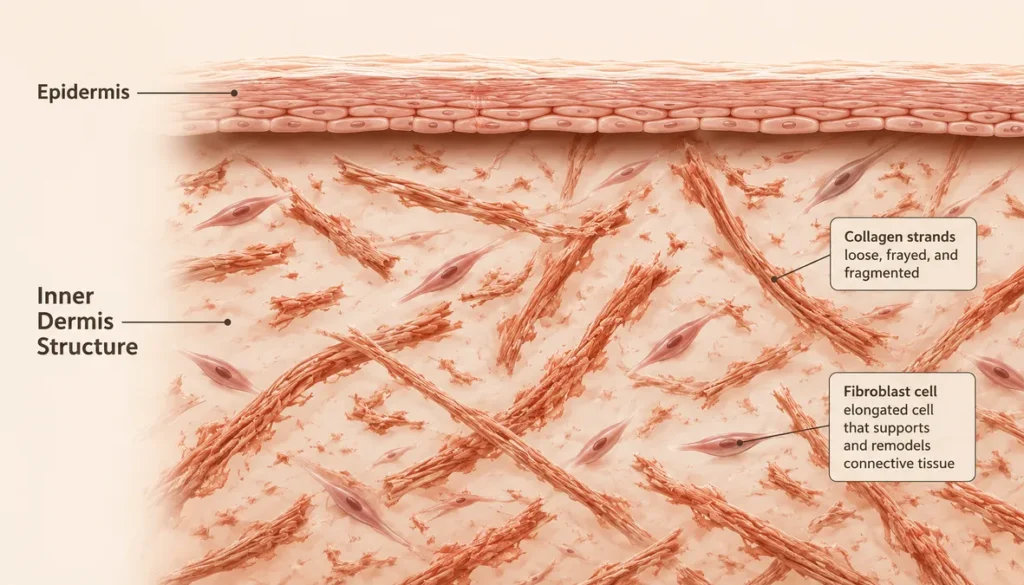
After 50, the dermis changes in specific ways. The cells that build and maintain it are called fibroblasts [specialized cells in the dermis responsible for producing collagen and repairing the skin’s structural scaffold]. They become less productive with age.
A 2006 study in the American Journal of Pathology found that fibroblasts from older adults produced measurably less collagen than those from younger adults.¹ Loss of structural contact between those cells and collagen fibers made the problem compound over time.¹
No single study has followed the same people from age 20 to 80 measuring every variable. What the separate pieces show is consistent.
The dermis thins, collagen fragments, and skin after 50 loses structural support in ways no surface application can reverse.
That’s not pessimism. It’s the starting point for every habit in this article.
Why the Creams in Your Bathroom Aren’t Reaching the Problem
Most people assume better products mean better skin. That assumption deserves a direct answer.
The cream you apply lives in the epidermis, but the wrinkles that bother you are forming one layer deeper, in the dermis, where no topical product has ever been. That’s not a failure of any particular brand. It’s physics.
The epidermis is designed as a barrier. It keeps things out, including most ingredients applied to it. Topical penetration [how far an ingredient travels through the skin’s surface before stopping] is limited by skin biology.
Moisturizers hydrate the epidermis and reduce water loss from the surface.
Retinoids, the most evidence-backed topical active ingredient, show some signaling effects on the dermis. They have a ceiling.
They don’t rebuild the structural layer where aging in skin after 50 actually happens.
The dermis responds primarily to what happens inside the body. It responds to mechanical load, collagen production rate, and how quickly existing collagen is being broken down.
A 2023 study in PLOS One measured the physical properties of dermal collagen in young skin versus aged skin. The collagen in aged skin was rougher, stiffer, and more fragmented.²
This article is not anti-skincare. One topical skincare product earns its place in section six. Seeing what products can’t do is the only way to see what actually can.
The Facial Habit That Works Where Creams Cannot
Most anti-aging content reaches this point and recommends a serum. This one doesn’t.
Here is what most skincare content skips entirely: it isn’t only the skin that changes on the face as you age. It’s the muscle underneath it.
Facial muscle volume [the mass and density of the underlying muscles that give the face its three-dimensional shape] is the structural base. The skin is the covering.
When the muscle loses volume, the skin above sags. Hydration level makes no difference. This is why cheeks flatten and jowls appear. The skin didn’t fail. The scaffolding shrank.
A pilot study published in JAMA Dermatology in 2018 tested what happened when 27 women aged 40 to 65 did structured facial muscle resistance exercises for 20 weeks.³ Independent dermatologists rated them as appearing approximately three years younger. Upper and lower cheek fullness improved significantly.³
That finding deserves honest context: the study was small, and what happens across a larger population is still being studied.
Even with those limits, the mechanism is real. Mechanical loading [the physical stress placed on muscle and connective tissue during movement] activates fibroblasts and may promote collagen synthesis.
A 2025 clinical trial with women averaging nearly 50 years old found that eight weeks of intensive face yoga increased muscle elasticity across all measured facial muscle groups.⁴
Talk to your doctor before starting any new exercise routine if you’re managing a health condition or recovering from facial surgery.
Four minutes of facial exercises costs nothing. What they reach, no cream touches.
What the Sun Costs the Dermis Every Day After 50
You probably already know sun protection matters. What most people don’t know is exactly what photoaging costs the dermis, and why that cost gets higher after 50.
UV radiation triggers the release of matrix metalloproteinases [enzymes released by skin cells in response to UV exposure that break down existing collagen in the dermis]. Every unprotected minute adds to the total damage.
For skin after 50, with collagen production already slowed, protecting what remains matters more than at any earlier point.

This isn’t hypothetical.
A randomized controlled trial of 903 middle-aged adults found that daily sunscreen users showed no detectable increase in skin aging over 4.5 years.⁵ The discretionary-use group showed measurable aging progression over the same period.⁵
After 50, daily sunscreen is a structural preservation decision, not a cosmetic one.
The study population was adults under 55. Direct evidence in adults specifically over 50 is limited.
But photoaging operates the same way in older skin. The stakes only rise with age.
Apply SPF 30 or higher to your face and neck every morning. That means cloud days, indoor days, every short errand. Windows transmit UV.
The habits that preserve the dermis aren’t all about what you put on your skin. The next one is about what you put in your body.
How Dehydration Affects the Skin You Can See After 50
You can feel when your skin is dry. What’s harder to notice is what’s happening underneath when hydration is consistently low.
Older skin loses water faster than younger skin. This is because of transepidermal water loss [water that evaporates from the skin’s surface to the outside air, a process that increases with age and with skin barrier damage].
After 50, the skin’s capacity to retain internal moisture declines. Water needs to come in more consistently from the inside.

A 2015 study in Skin Research and Technology asked 34 healthy women to add two liters of water per day for one month.⁶ Both surface and deep skin hydration increased measurably in those who had previously been drinking lower amounts.⁶
That study’s participants had a mean age of 24.5. Direct evidence on water intake and skin hydration in adults over 50 specifically is limited.
The underlying physiology is well documented. The exact benefit at older ages hasn’t been confirmed in a dedicated trial.
Topical moisturizers and drinking water do different jobs. A moisturizer slows evaporation from the surface. Drinking water supports water content in the dermis from below.
One doesn’t substitute for the other.
The last section puts all of this into a sequence that costs nothing and takes less time than making coffee.
Start Your 11 Minutes Here
The habits in this article add up to 11 minutes in the morning. That’s the realistic ceiling for something a person will actually do every day without thinking about it.

Here’s the sequence:
Your 11-Minute Morning Skin Habit
— Two minutes: Drink one full glass of water before coffee, before your phone, before anything else. Your body loses water overnight. Skin gets it last.
— Four minutes: Do three targeted facial resistance movements. The Cheek Lifter (form an O with your mouth, smile to lift cheek muscles, repeat 10 times) was among the exercises used in the JAMA Dermatology study. Add one exercise targeting the jaw and one targeting the brow.
— Two minutes: Apply SPF 30 or higher to your face and neck. Every day. Not just beach days.
— Three minutes: Apply a basic moisturizer to your face and neck to reduce transepidermal water loss. This is the one topical product that earns consistent use alongside the habits above.
Sleep isn’t in these 11 minutes because it happens the night before. A 2015 study found that women who were poor sleepers had higher skin aging scores and significantly reduced skin barrier recovery compared to good sleepers.⁷
The dermis rebuilds collagen during deep sleep. For anyone working on skin after 50, losing that window is not a small cost.
What This Means for You Tonight
The most important thing to remember: your skin after 50 is aging in a layer products don’t reach, and the habits that slow that process are mostly free.
Start with one habit tonight: wash your face, drink a full glass of water, and go to bed 30 minutes earlier than usual. Pick just one to hold for the next seven days. One consistent daily habit for skin after 50 outperforms an expensive routine you can’t sustain.
⚠️DISCLAIMER:
This article is for informational purposes only and does not constitute medical advice or an endorsement of any longevity intervention. The content addresses daily habits for slowing skin aging after 50 and is intended for general educational purposes only. Individual health, genetics, and medical history significantly affect outcomes, consult a qualified physician before adopting any protocol discussed in this article.
References
- Fisher GJ, Quan T, Purohit T, Shao Y, Cho MK, He T, et al. Decreased collagen production in chronologically aged skin: roles of age-dependent alteration in fibroblast function and defective mechanical stimulation. American Journal of Pathology. 2006. https://ajp.amjpathol.org/article/S0002-9440(10)62205-5/fulltext
- He T, Fisher GJ, Kim AJ, Quan T. Age-related changes in dermal collagen physical properties in human skin. PLOS One. 2023. https://journals.plos.org/plosone/article?id=10.1371%2Fjournal.pone.0292791
- Alam M, Walter AJ, Geisler A, Roongpisuthipong W, Sikorski G, Tung R, Poon E. Association of facial exercise with the appearance of aging. JAMA Dermatology. 2018. https://pmc.ncbi.nlm.nih.gov/articles/PMC5885810/
- Intensive face yoga clinical trial. Effect of intensive face yoga on facial muscles tonus, stiffness, and elasticity in middle-aged women: a pre-experimental clinical trial. Medicina. 2025. https://pmc.ncbi.nlm.nih.gov/articles/PMC12112979/
- Green AC, Williams GM, Logan V, Strutton GM. Sunscreen and prevention of skin aging: a randomized trial. Annals of Internal Medicine. 2013. https://www.acpjournals.org/doi/10.7326/0003-4819-158-11-201306040-00002
- Palma ML, Tavares L, Fluhr JW, Bujan MJ, Rodrigues LM. Positive impact of dietary water on in vivo epidermal water physiology. Skin Research and Technology. 2015. https://onlinelibrary.wiley.com/doi/10.1111/srt.12208
- Oyetakin-White P, Suggs A, Koo B, Matsui MS, Yarosh D, Cooper KD, Baron ED. Does poor sleep quality affect skin ageing? Clinical and Experimental Dermatology. 2015. https://pubmed.ncbi.nlm.nih.gov/25266053/