

You’re skipping breakfast. You’re sticking to your window. You’re doing everything right, and nothing is moving. That’s one of the most frustrating places to be. You’ve heard that intermittent fasting works. Maybe it even worked for you before. But after 50, your body is playing by a completely different set of rules.
This article explains the three real reasons intermittent fasting stops working after 50. Then it shows you a specific 5-day method, the Fasting Mimicking Diet, backed by clinical research. You’ll get a clear protocol, a sample meal plan, and practical tips you can start using this week.
Why Read This
• Why your fasting window may be working against your biology after 50: and what your body actually needs instead.
• The one macronutrient ratio that keeps your body in fat-burning mode while you are still eating real food every day.
• Why protecting muscle on your normal eating days matters more than what you do on fasting days.
• The hidden reason stress and poor sleep can cancel out your fasting results entirely.
This article is for informational purposes only and does not constitute medical advice. The dietary approaches described, including the Fasting Mimicking Diet and 5:2 method, may not be suitable for everyone. Talk to your doctor before making changes to your eating pattern, especially if you are pregnant, on medication, managing a chronic condition, or have a history of disordered eating. Individual results will vary.
Why Intermittent Fasting Stops Working After 50?
You’re not doing it wrong. Your body has simply changed. After 50, three things happen that work against standard fasting.
Your metabolism may slow gradually with age. You lose muscle mass, which burns more calories than fat does. And your cells stop responding to insulin as efficiently as they once did.
This matters because intermittent fasting relies on a calorie deficit. But if your metabolism is slower and your muscle mass is lower, that deficit becomes much harder to create even when you’re eating less.
For women, there’s another layer. The average age of menopause is 51.⁷ When estrogen drops, your body shifts fat storage toward the belly. This visceral fat [deep belly fat that wraps around your organs] is the stubborn kind. It’s also the kind most connected to insulin resistance [when your cells stop responding properly to insulin].
Research suggests that when estrogen declines, fat may migrate to the abdomen, worsening insulin resistance.¹ This makes your body hold onto fat even harder. A standard 16:8 fasting window isn’t deep enough to break this cycle. Your body needs a different kind of reset.
What Is the Fasting Mimicking Diet: And Why It Works?
The Fasting Mimicking Diet FMD was created by Dr. Valter Longo, Director of the Longevity Institute at the University of Southern California. It’s not a trend.
It came out of decades of aging research. Here’s how it works: for 5 consecutive days, you eat a specific combination of foods high in healthy fats, low in protein, low in sugar, and carbs. This ratio keeps your body in a fasted state on a biological level, even though you’re eating real food every day.
A 2024 study published in Nature Communications looked at two clinical trials and found that three cycles of the FMD reduced insulin resistance, lowered liver fat, improved immune markers, and cut biological age by 2.5 years.² Not just weight. Actual biological age.
Dr. Longo said it plainly at DOC 2025: This is the first food-based intervention shown to make people biologically younger without requiring permanent lifestyle changes.³
The reason this works better than daily fasting after 50 is that it may trigger autophagy [your body’s natural process of clearing out old damaged cells].
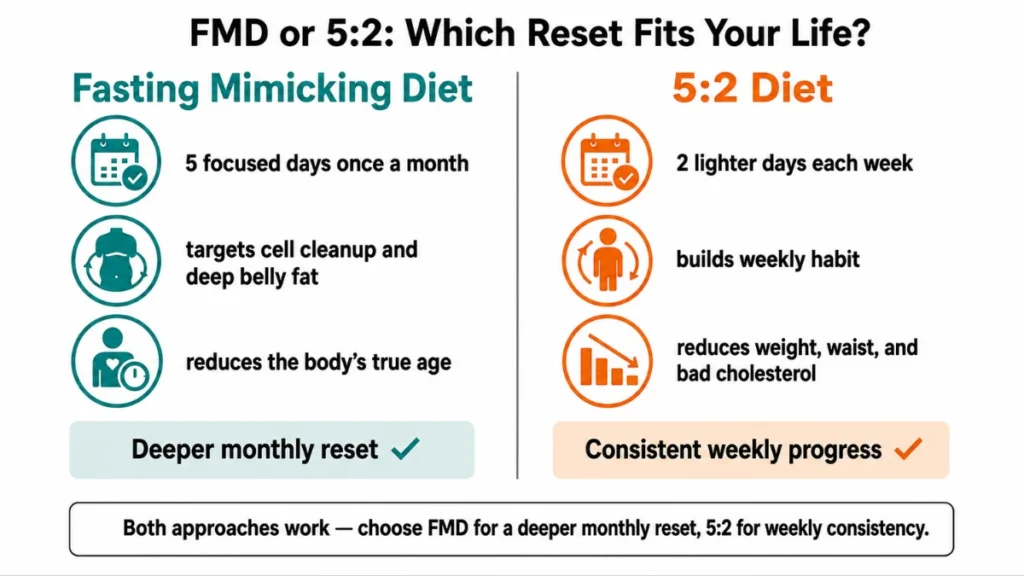
The Two Approaches: FMD vs. 5:2: Which One Is Right for You
You have two options. Both are backed by research. Pick the one that fits your life.
Option 1: Monthly FMD
Five consecutive restricted days, once per month. The rest of the month, you eat normally. This is the deeper reset: better for autophagy, biological age, and visceral fat reduction.
Option 2: Weekly 5:2
Eat normally for 5 days. Restrict to 500-600 calories on 2 non-consecutive days each week, Monday and Thursday is a popular structure. This builds consistent weekly momentum.
A 2025 meta-analysis reviewed 20 studies with 1,393 participants and found the 5:2 diet reduced body weight, BMI, waist circumference, body fat, LDL cholesterol, and insulin resistance.⁴
Those are real results across a large pool of real people. Neither approach requires supplements, kits, or special foods. Both work with simple, whole-food ingredients you already buy.
If you’re new to restricted eating, start with the 5:2. If you want the deeper metabolic benefit and can commit to 5 focused days per month, try the FMD.
What to Eat on Restricted Days?
This is where most people go wrong. They eat too little on restricted days and too randomly on normal days. Both mistakes slow your results. On restricted days, your goal is 500-700 calories. Day 1 of FMD can go up to 1,000. Focus on foods that are high in healthy fat, low in protein, and free from sugar and refined carbs.
These aren’t random rules; this specific macronutrient ratio is what keeps your body in the fasted-state biology that makes FMD work.

A sample restricted day looks like this:
- Morning: Vegetable broth + black coffee or herbal tea
- Midday: Small handful of mixed nuts + sliced cucumber
- Evening: Half an avocado with lemon juice over leafy greens, drizzled with 1 teaspoon olive oil
Total: approximately 500-550 calories. High fat, low protein, low sugar.
Avoid on restricted days:
Talk to your doctor before changing your diet or exercise routine if you are on medication, managing a chronic condition, or have any underlying health concerns.
- Protein shakes (they may raise IGF-1 and break the fasted state)
- Fruit juice or refined carbs
- Alcohol
- Heavy exercise on fasting days
You don’t need a kit. You don’t need to buy anything special. You need the right foods, portioned simply.
What to Eat on Feeding Days (This Matters More Than You Think)?
You may not realize it, but what you eat on your normal days determines whether you lose fat or lose muscle. After 50, your body starts losing muscle at roughly 1–2% per year.⁶
Fasting speeds up that process if you’re not eating enough protein on feeding days. A 2025 randomized controlled trial published in Nutrients found that alternate-day fasting cut body fat but also reduced muscle when fasting-day protein was too low.⁵
So on your normal eating days, protein is the priority. Aim for 20-40 grams of protein per meal.⁸ Good sources include eggs, fish, Greek yogurt, legumes, and lean poultry. Spread it across the day, not just in one meal.

Beyond protein, think Mediterranean-style eating: vegetables, olive oil, whole grains, legumes, and fatty fish, which is well studied and may suit the 50+ metabolic profile.
And stop breaking your fast with a large, heavy meal. Start small: a bowl of broth, one boiled egg, or a small protein-rich snack. This may help prevent a blood sugar spike that undoes the metabolic work from your restricted day.
3 Practical Tips That Determine Your Results After 50
Getting the protocol right is only part of it. These three habits are where people either succeed or stall.
Track restricted days: don’t guess
Use MyFitnessPal or Cronometer to log calories on fasting days. You need to stay between 500-700 calories, not 300 too low, which may cause muscle loss, and not 900: not enough restriction for metabolic shift. Guessing usually puts you in the wrong zone.
Add resistance training on feeding days
Even two or three sessions of bodyweight exercises per week signal your body to preserve muscle during the fasting cycle. Squats, push-ups, and resistance bands all count. This is not optional after 50; it’s what separates fat loss from total weight loss.
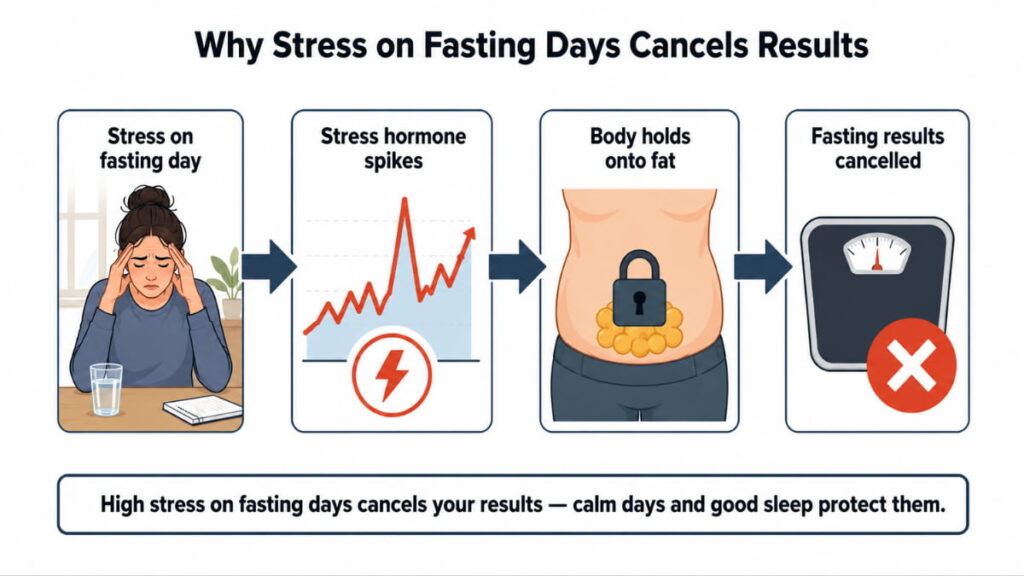
Manage stress on restricted days
High cortisol from hard workouts, poor sleep, or a stressful schedule may signal your body to store fat. Choose your restricted days carefully. Pick calmer days. Prioritize sleep on restricted days. Even a few minutes of slow breathing before bed may help lower stress levels. Your fasting only works if your stress hormones cooperate.
Pick One. Start This Week.
Intermittent fasting after 50 can work; it just needs a smarter structure. Your body isn’t broken. It’s different. The 5-day FMD or structured 5:2 gives it the metabolic reset it actually needs. Pick one approach, commit to two full cycles, protect your protein on feeding days, and see what changes.
References
- De Paoli M, Zakharia A, Werstuck GH. The Role of Estrogen in Insulin Resistance: A Review of Clinical and Preclinical Data. American Journal of Pathology. 2021. https://ajp.amjpathol.org/article/S0002-9440(21)00245-5/fulltext
- Brandhorst S, Levine ME, Wei M, Shelehchi M, Morgan TE, Nayak KS, Dorff T, Hong K, Crimmins EM, Cohen P, Longo VD. Fasting-mimicking diet causes hepatic and blood markers changes indicating reduced biological age and disease risk. Nature Communications. 2024. https://www.nature.com/articles/s41467-024-45260-9
- University of Southern California. Fasting-like diet lowers risk factors for disease, reduces biological age in humans. ScienceDaily. 2024. https://www.sciencedaily.com/releases/2024/02/240220144536.htm
- Wu C, Chen B, Yu J, Zhang Q, Piao C. Effect of the 5:2 Diet on Weight Loss and Cardiovascular Disease Risk Factors in Overweight and/or Obesity: A Systematic Review and Meta-Analysis. International Journal of Endocrinology. 2025. https://www.ncbi.nlm.nih.gov/pmc/articles/PMC11876533/
- Pang BWJ, Yang Y, Rashiqah N, Huang CB, Sim DW. Effects of Four Weeks of Alternate-Day Fasting with or Without Protein Supplementation: A Randomized Controlled Trial. Nutrients. 2025. https://www.mdpi.com/2072-6643/17/23/3691
- von Haehling S, Morley JE, Anker SD. From muscle wasting to sarcopenia and myopenia: update 2012. Journal of Cachexia, Sarcopenia and Muscle. 2012. https://pmc.ncbi.nlm.nih.gov/articles/PMC3505577/
- Carlson K, Vadakekut ES. Menopause. StatPearls [Internet]. StatPearls Publishing. 2026. https://www.ncbi.nlm.nih.gov/books/NBK507826/
- Rizzo N. Do You Know Protein Math? A Visual Guide to the Number of Grams in the 7 Healthiest Sources. TODAY. 2026. https://www.today.com/health/diet-fitness/protein-math-guide-rcna253217