

You’re mid-sentence in a meeting when the words disappear.
Not forgotten, vanished. You can see your colleague’s face waiting, but your brain has gone offline. By the time you recover, everyone’s moved on.
This isn’t your memory failing. It’s a hormone crash happening at the exact same time every afternoon, and most doctors miss it because they’re looking at your morning blood work.
The fog you feel at 2:00 PM isn’t random. It’s your body running a cortisol rhythm designed for a hormone profile you no longer have.
Your 2 PM Slump: The Hormone Crash Women Over 50 Miss
In women over 50, afternoon brain fog is primarily caused by a cortisol crash occurring alongside fluctuating estrogen levels. While cortisol [the body’s main stress and alertness hormone] should stay steady until evening, hormonal shifts after menopause often cause it to drop prematurely around 2:00 PM to 4:00 PM, leading to sudden mental fatigue.
You likely feel this right after lunch. The room feels slightly dimmer. You read the same email three times but the words won’t stick. Most women blame their sandwich or a bad night’s sleep.
One patient described it as “trying to read underwater.” The words were there, but reaching them required effort her brain couldn’t muster. She assumed early dementia. Her labs showed perfect estrogen, because her doctor tested at 8:00 AM, not 2:00 PM.

But the timing is too consistent for it to be just a “heavy lunch.” This is a physiological timing error. Your brain expects a certain level of chemical fuel to keep its gears turning.
When you were younger, estrogen helped keep your stress hormones in a predictable rhythm. Now, that rhythm is broken. Your brain is essentially running out of “alertness juice” four hours too early.
This drop doesn’t just make you tired; it changes how your brain processes information. You aren’t losing your memory. You’re losing the chemical signal that tells your brain to pay attention.
But this sudden dip in cortisol isn’t happening in a vacuum, it’s actually being triggered by a specific “missing handshake” in your endocrine system.
How Estrogen Regulates Your Cortisol Rhythm
Your brain relies on a delicate balance called the estrogen-cortisol handshake. Estrogen [the primary female sex hormone] acts like a regulator for your stress response. It keeps your cortisol [the body’s main alertness chemical] from spiking too high or crashing too low.
When estrogen levels drop after 50, that regulator disappears. Without it, your daily cortisol rhythm becomes jagged. Instead of a smooth slide toward bedtime, your levels “fall off a cliff” in the mid-afternoon.
Think of it like a thermostat that lost its sensor. The heat stays on all morning, but then shuts off entirely while it’s still cold outside.
Your brain is left without the chemical fuel it needs to stay sharp.
This explains why you feel “wired but tired” at 3:00 PM. You have enough adrenaline [the emergency “gas” pedal] to stay awake, but not enough cortisol to actually focus. Your brain is idling at a high speed with no way to shift into gear.
What this means for you: This brain fog isn’t a sign of permanent decline; it’s a timing error in your internal clock. Your neurons [brain’s signaling cells] are perfectly healthy, they just aren’t getting the “wake up” signal at the right time.
Research from the North American Menopause Society confirms that estrogen withdrawal disrupts the hypothalamic-pituitary-adrenal axis, the system that regulates your cortisol rhythm throughout the day.
But this hormone crash isn’t the only thing clouding your mind, your afternoon snack might be turning a small dip into a total blackout.
Why Your Lunch Triggers Insulin Spikes and Brain Fog
Many women over 50 try to fight the slump with a salad or a piece of fruit. But after menopause, your body becomes less efficient at handling glucose [blood sugar]. This is called insulin resistance [when cells ignore the signal to take in sugar], and it peaks in the afternoon.
When you eat, your blood sugar rises. To compensate, your pancreas pumps out insulin [the key that lets sugar into cells]. If those cells are resistant, your body overreacts and pumps out too much.
This creates a “hypoglycemic dip” [a sudden drop in blood sugar] about two hours after you eat, and your brain suddenly loses its primary power source.

What this means for you: That 3:00 PM “brain fade” is often your brain literally starving for fuel because your insulin spiked too high at noon. You aren’t “crashing” from the food itself, but from your body’s exaggerated reaction to it.
The frustration compounds because you can’t predict it. Some days a turkey sandwich causes zero fog. Other days, the exact same meal knocks you offline for two hours. The difference isn’t the food, it’s where you are in your monthly cortisol pattern, which no longer follows predictable rules after menopause.
Unlike a typical food coma, this hormonal dip feels like a physical weight behind your eyes. You might even feel a slight internal shakiness or a sudden craving for something sweet.
But don’t reach for the chocolate just yet. The real danger isn’t just the sugar, it’s a specific “leaky” transition happening in your brain’s protective shield.
How Your Brain’s Protective Barrier Weakens After 50
Your brain is protected by a highly selective filter called the blood-brain barrier [a cellular wall that keeps toxins out]. Think of it as a microscopic security guard that only lets in the “good” fuel while blocking out “trash” molecules.
As estrogen levels decline, this barrier becomes slightly more permeable [leaky]. This is the second mechanism at play. Because the “wall” is less tight, metabolic byproducts that usually stay in your blood can slip into your brain tissue.
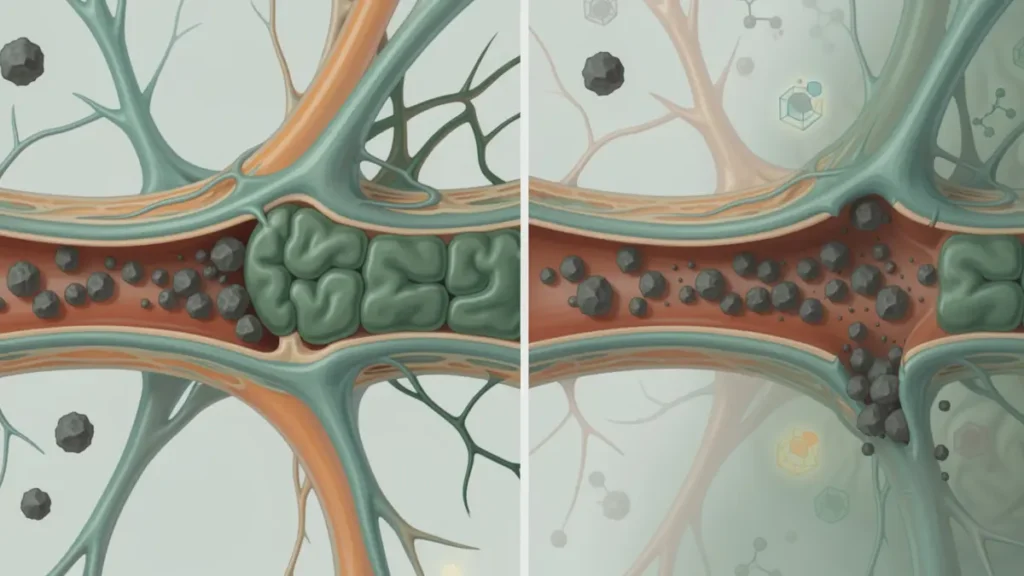
This creates a low-level inflammatory response [the body’s protective swelling] that slows down your neurotransmitters [chemical messengers] like dopamine and serotonin.
What this means for you: Your brain is essentially dealing with “static” on the line. The 2:00 PM fog is the moment your brain’s cleaning system falls behind the influx of these molecules.
This permeability shift also explains why brain fog feels different from regular tiredness. You’re not sleepy. Your eyes aren’t heavy. You just can’t think clearly, as if someone turned down the brightness on your internal screen. That’s the inflammatory molecules creating “noise” in your neural pathways, not damage, just interference.
Many women mistake this for early-onset memory loss. But the “forgetfulness” is actually just your brain’s processing speed slowing down because it’s busy filtering out microscopic debris.
But this isn’t a permanent state of “leaky brain”, you can actually tighten that filter and reset your cortisol in under ten minutes.
Your 10-Minute Afternoon Reset Protocol
You don’t have to wait for your hormones to “fix themselves.” You can manually override the cortisol crash by using a specific 10-minute protocol designed to signal safety and alertness to your brain. This sequence targets the vagus nerve [the main highway of the parasympathetic nervous system] and stabilizes blood sugar.
Start with 2:4 Breathwork for 90 seconds. Inhale through your nose for a count of 2, then exhale through pursed lips for a count of 4. This elongated exhale tells your brain the “stress” is over and stops the cortisol freefall. Repeat this 10 times.
Next, use Cold Water Shock for 1 minute. Splash ice-cold water on your face or run it over your wrists. This triggers a mild “diving reflex” [a natural slowing of the heart rate].
The shock immediately increases blood flow to the brain and tightens the blood-brain barrier.
Follow with a Protein Pivot for 2 minutes. Eat 15–20g of protein immediately. A hard-boiled egg or a small palmful of walnuts works best. This prevents the “insulin dip” from getting worse and provides amino acids [the building blocks of neurotransmitters] for focus.
Finish with Light Exposure for 5 minutes. Step outside or sit by a bright window. Natural light hits the retina and signals the suprachiasmatic nucleus [your brain’s master clock] to stop producing melatonin and keep alertness high.

If the basic reset isn’t enough, consider adding Magnesium Glycinate [mineral bonded to an amino acid]. Taking 200-300mg in the mid-afternoon, separate from your evening dose, can help smooth out the jagged cortisol spikes that lead to the crash. Always discuss new supplements with your provider, especially if you take blood pressure medication.
For women seeking a definitive answer, a Dutch Test [comprehensive dried urine hormone test] can map your exact cortisol slope throughout the day. This moves you from guessing to knowing exactly when your “cliff” occurs so you can time your protein and light exposure to the minute.
By stacking these four quick steps, you aren’t just “powering through.” You are physically resetting the chemical environment of your brain.
But even the best protocol can be undone by one common mistake many women make with their morning caffeine.
Why Morning Coffee Causes Your 2 PM Crash
Most women over 50 reach for a second cup of coffee when the afternoon fog rolls in. But this creates a “caffeine-cortisol feedback loop” [a cycle where stimulants mask a deeper hormonal crash]. If you drink caffeine within the first 60 minutes of waking up, you blunt your body’s natural Cortisol Awakening Response [the morning surge that clears sleep fog].

When you skip that natural surge, your body tries to compensate later in the day. By the time 2:00 PM hits, the caffeine from your morning cup has worn off, and your body has no “natural” cortisol left to take its place. This is why the afternoon crash feels so much more aggressive after age 50.
What this means for you: Your morning coffee isn’t giving you energy; it’s just “borrowing” it from your afternoon. By delaying your first cup until 10:00 AM, you allow your hormones to do their job first.
This simple shift in timing can be the difference between a productive afternoon and a total mental blackout. But even with perfect timing, there are a few common questions that always come up when women start tracking their “fog” patterns.
Your Questions Answered
Why am I getting brain fog in the afternoon?
After 50, declining estrogen stops regulating your stress response, causing cortisol to “crash” prematurely between 2:00 PM and 4:00 PM. This is often worsened by insulin resistance, which starves the brain of glucose exactly when your hormonal alertness is dipping.
What are the four warning signs of brain fog?
The primary signs include “word-finding” difficulty [forgetting simple nouns], a sensation of physical pressure behind the eyes, reading the same sentence multiple times without comprehension, and a sudden, intense craving for sugar or caffeine.
How to clear brain fog in 10 minutes?
Use the “10-Minute Reset” by combining 90 seconds of 2:4 breathwork, a cold-water splash to the face, eating 15g of protein, and getting 5 minutes of direct natural sunlight. This sequence manually overrides the cortisol drop and stabilizes blood sugar.
What hormone crashes in the afternoon?
Cortisol is the primary hormone that crashes. It only does so because estrogen, which normally acts as a stabilizer, is no longer present in high enough levels to maintain a smooth daily rhythm.
Is brain fog dangerous?
On its own, hormonal brain fog is a functional timing issue rather than a structural brain disease. However, it can be a “canary in the coal mine” for underlying insulin resistance or chronic inflammation, which should be monitored by a healthcare provider.
Conclusion
Afternoon brain fog after 50 isn’t an inevitable part of aging or a sign of permanent decline. It is a biological “timing error” caused by a cortisol crash that your body no longer has the estrogen to prevent. By understanding the insulin and blood-brain barrier mechanisms at play, you can stop “powering through” and start using biology to your advantage.
The most important thing to remember is that your brain is still capable of high-level focus; it just needs a different set of signals than it did a decade ago. Start by delaying your morning caffeine and keep a high-protein snack ready for the 2:00 PM window.
Your Afternoon Focus Protocol:
- Delay caffeine until 10:00 AM.
- Eat 15g of protein with lunch (no naked carbs).
- Reset at 2:00 PM with the 10-minute breath and light sequence.
⚠️MEDICAL DISCLAIMER
This content is for informational and educational purposes only and does not constitute medical advice, diagnosis, or treatment. Before making changes to your diet, exercise routine, or supplement regimen, consult a qualified healthcare provider. If you experience sudden confusion, severe headaches, or difficulty speaking, seek emergency medical care immediately.