

You’ve been on your feet all day with no problem. Then you lie down at night, and there it is. That buzzing. That burning. That crawling, pins-and-needles feeling in your feet. Many doctors call it just aging. It’s not. For women over 50, nighttime foot tingling is often a direct signal from your nervous system that it’s running low on specific B vitamins, especially B12.
This article will show you exactly why this happens at night, which B vitamins are responsible, why women over 50 are hit hardest, and what four blood tests to ask your doctor for. No vague advice. Just clear steps you can take starting this week.
Why Do Your Feet Tingle Specifically at Night?
Your nervous system doesn’t get louder at night; your distractions just go quiet. During the day, you’re moving, talking, working. Your brain is busy processing dozens of signals at once. Mild nerve irritation gets drowned out. But the moment you lie down, all that noise disappears.
And those damaged nerve signals, the ones your body was hiding from you all day, become the only thing you can feel.
There’s also a blood flow issue. When you lie flat, circulation to your feet changes. If your nerves are already struggling due to poor nutrition or minor vessel narrowing, lying down makes it worse. The nerves in your feet get less oxygen. They fire incorrectly.
You feel tingling, burning, or that crawling sensation. Your body temperature also drops slightly at night. Cold extremities conduct sensations differently. That’s why mild tingling during the day can feel sharp and urgent at bedtime.
The medical word for this is paresthesia, abnormal sensations caused by irritated or damaged peripheral nerves.
According to the NHS NICE 2025 clinical guidance, tingling and burning in the toes are among the most common documented symptoms in people over 50. Your body isn’t broken. It’s sending a signal.
The B-Vitamin Gap: What’s Actually Happening to Your Nerves
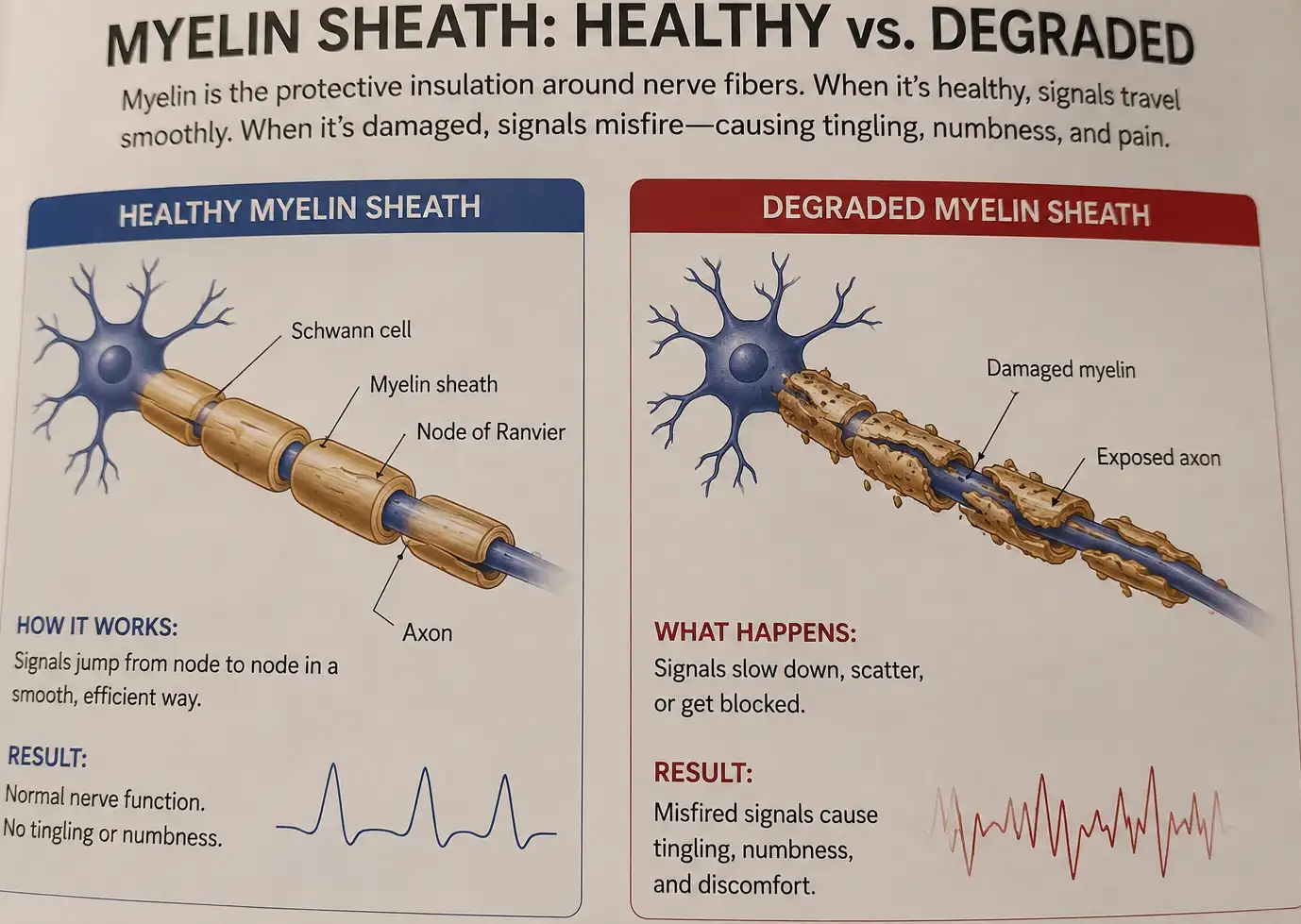
Think of each nerve fiber like an electrical wire. B12 is the rubber coating around it. Without enough B12, that protective coating called the myelin sheath starts to break down.
When it breaks down, nerve signals don’t travel cleanly. They misfire, leak, or stop altogether. The result is tingling, burning, numbness, or that dead foot feeling when you wake up.
Here’s what each B vitamin does for your nerves:
- Vitamin B12 builds and maintains the myelin sheath. Deficiency is the most common nutritional cause of nerve tingling in older adults.
- Vitamin B6 helps your nerves send signals correctly. But here’s the catch: too little B6 causes tingling, and too much B6 from unmonitored supplements can also damage nerves. Australia’s Therapeutic Goods Administration has confirmed this risk.
- Vitamin B3 (Niacinamide) supports energy production inside nerve cells and helps keep blood flowing to the extremities.
Research from 2024 shows B12 deficiency affects just 6% of adults under 60, but that number jumps to 20% in adults over 60 (TouchEndocrinology, 2024).
Among postmenopausal women specifically, some studies show rates as high as 50% depending on diet and where they live (PMC, 2025).
And here’s the part that surprises most women: your blood test might already say normal, and you could still be deficient. More on that in Section 5.
3 Hidden Reasons Women Over 50 Are Most at Risk
This isn’t random. Three specific things stack against women after 50.
1. Your stomach acid has dropped. Your body needs strong stomach acid to pull B12 out of food before it can absorb it. After menopause, many women experience a natural drop in stomach acid, a condition called hypochlorhydria.

You can eat salmon and eggs every day and still not absorb enough B12. Most women don’t know their stomach acid has dropped because it causes few obvious symptoms.
2. Your medications may be draining your B12. Two very common drug types silently deplete B12:
- Proton pump inhibitors (PPIs: omeprazole, lansoprazole are used for acid reflux or GERD. Millions of women over 50 take these daily. They reduce stomach acid further, blocking B12 absorption.
- Metformin: Used for type 2 diabetes or prediabetes, interferes with B12 absorption in the small intestine. A 2025 NIH study found long-term Metformin users had a 67% higher likelihood of B12 deficiency than non-users. The risk grows 3% for every year of use.
3. Your diet has quietly shifted. B12 is found almost only in animal products, such as meat, fish, eggs, and dairy. As appetite decreases with age, or as women reduce red meat for heart health, B12 intake drops. Plant-based eaters without fortified foods or supplements are especially at risk.

Any one of these alone might not cause symptoms. But when two or three happen at the same time, deficiency can build fast and silently.
Other Causes to Rule Out First
B vitamins are often the reason, but not always. Rule these out before assuming. Four other conditions can cause the same nighttime foot tingling:

1. High or uncontrolled blood sugar. Diabetic peripheral neuropathy looks identical to B12-deficiency neuropathy. The two can also happen at the same time. A 2025 study (Cureus) found that 54.7% of patients aged 46,60 with diabetic nerve damage also had B12 deficiency.
2. A pinched nerve. Sciatica, a slipped disc, or spinal stenosis can send burning sensations all the way down into your feet. This is structural, not nutritional, and needs different treatment.
3. Poor circulation. Peripheral artery disease (PAD) restricts blood flow to the legs and feet. Lying flat can make this worse, causing numbness and tingling at night, mimicking B12 deficiency exactly.
4. Restless Legs Syndrome (RLS). This feels like a crawling or tingling urge to move your legs, especially at night. It can co-exist with a B-vitamin deficiency but has a different treatment path.
The good news: a single blood panel can sort through most of these causes at once. Here’s exactly what to ask for.
The 4 Blood Tests to Request by Name
Don’t wait for your doctor to offer these. Ask for them directly. Most standard checkups don’t include these tests. But they’re simple, fast, and covered by most insurance with a doctor’s order.

1. Serum B12: The basic starting point. But know this: up to 50% of people with metabolic B12 deficiency still test in the normal range on this test alone (multiple peer-reviewed sources, 2025). It’s necessary, but not enough on its own.
2. Methylmalonic Acid (MMA): This is the more accurate test. MMA measures whether B12 is actually working at the cellular level. If MMA is elevated, your nerves are being starved of B12 even if your serum result looks fine. Ask for this by name.
3. Homocysteine: Elevated homocysteine is another sign that B12, B6, or folate levels are too low to meet your body’s needs. It also flags cardiovascular risk, so many doctors are happy to include it.
4. HbA1c fasting blood sugar: Rules out diabetes or prediabetes as the cause of your nerve symptoms. This is standard, but worth confirming it’s on your panel.
What to say at your appointment: “I’d like to check my Serum B12, Methylmalonic Acid, Homocysteine, and HbA1c. My symptoms suggest a possible B-vitamin gap or blood sugar issue.”
Testing takes less than 10 minutes. It can prevent years of progressive nerve damage.
Conclusion
Nighttime foot tingling is a real signal, and in women over 50, a B-vitamin gap is one of the most common and fixable causes. Ask your doctor for the four tests above. Act on what you find. The buzzing doesn’t have to be permanent. The FDA has warned that B12 deficiency left untreated for more than 3 months can cause permanent nerve damage.
That’s not meant to scare you; it’s meant to motivate you. You now know what to ask for, what to test, and what to do next. Most women who catch this early see real improvement within a few months of correcting their levels. Book the appointment. Ask for the tests by name. Your feet have been patient long enough.
⚠️MEDICAL DISCLAIMER
This article is for informational purposes only. It does not replace medical advice, diagnosis, or treatment. The information covers nighttime foot tingling, B-vitamin deficiencies, vitamin B12, vitamin B6, vitamin B3, paresthesia, hypochlorhydria, medication side effects, diabetic peripheral neuropathy, pinched nerves, poor circulation, Restless Legs Syndrome, serum B12 tests, Methylmalonic Acid tests, Homocysteine tests, and HbA1c tests.
Individual results vary based on age, health status, and fitness level. Before changing your exercise routine, diet, or supplement use, talk to your doctor or a qualified health professional first. If you experience chest pain, dizziness, severe joint pain, or any sudden symptom during or after exercise, stop immediately and seek medical care.