You grip the arms of the chair, preparing to stand, and for a split second, you hesitate. Isometric exercises for strength after 50 might be the missing piece. It isn’t that you cannot get up. It’s the mental calculation of the dull ache in your knees and the effort it now takes to find your center of gravity. Your mind feels thirty, but your muscles are speaking a different, heavier language.
Staying still might be the secret to moving better. A 2023 landmark study published in the British Journal of Sports Medicine revealed that isometric wall sits were nearly twice as effective at lowering blood pressure as traditional aerobic exercise, while simultaneously triggering significant myofibrillar protein synthesis in older adults (Edwards et al., British Journal of Sports Medicine, 2023)
If you think you’re too old to gain new strength, here’s why this is different. Most fitness programs fail because they ignore the reality of aging joints. You don’t need explosive movement to create power. You just need tension. The “creaky” feeling in your lower back isn’t a sign of permanent decay. It’s a signal that your support system is offline.
Margot knows this hesitation well. She often eyes her low-set sofa with suspicion, wondering if her knees will “trust” her enough to stand up smoothly on the first try.
Every situation responds differently. Use this as a starting point, not a prescription.
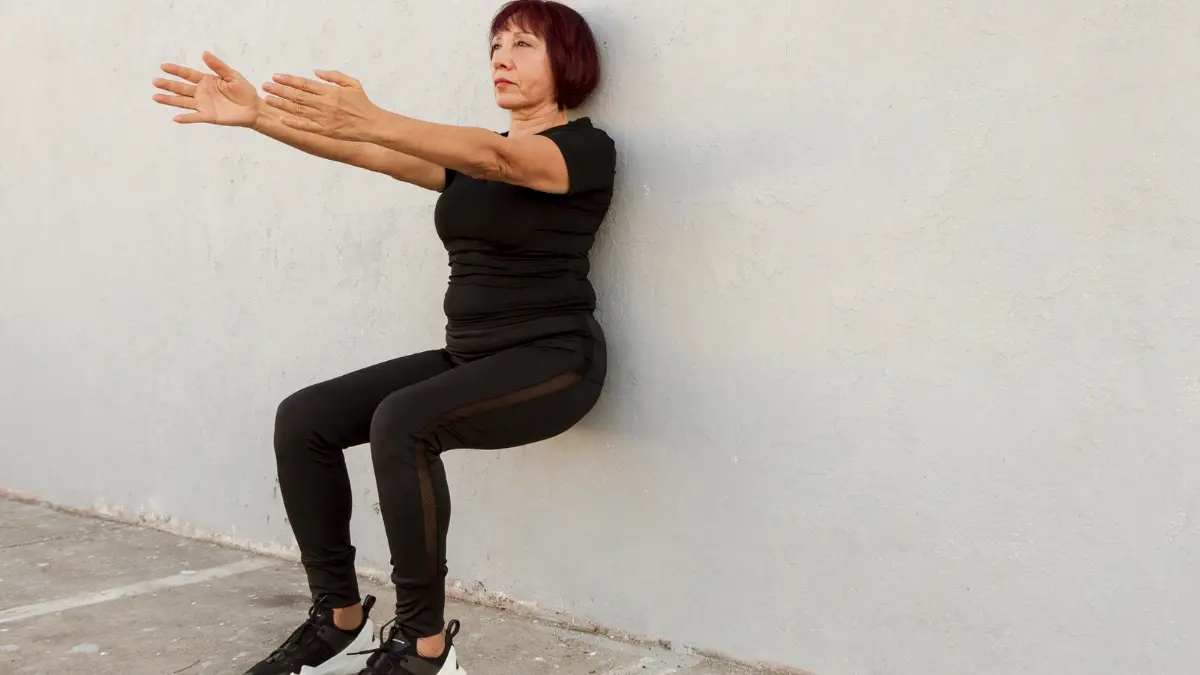
Stand up and find a clear patch of wall. Lean your back against it and slide down until your knees are bent at a comfortable angle. Keep your weight in your heels and your back flat against the surface. Hold this position for just 20 seconds.
You’ll likely feel a distinct warmth or “burn” in your thighs. That sensation is your nervous system waking up dormant fibers. You just completed your first isometric exercise. It took less than a minute.
Why Strength “Leaks” After 50 (and Why Gravity Isn’t the Enemy)
Isometric exercises for strength after 50 provide a solution to a biological hurdle called sarcopenia. This muscle loss typically claims 3% to 5% of your muscle mass every decade once you cross thirty. This isn’t a personal failure or a lack of willpower. It’s a biological shift where your body becomes less efficient at maintaining the tissue that keeps you upright, as Johns Hopkins Medicine confirms.

Joint pain often disguises itself as weakness. When your knees or hips ache, your brain naturally throttles the power sent to your muscles to protect the joint. This creates a cycle where you move less, lose more muscle, and feel even more pain. You’re not “wearing out”; your joints are simply starving for tension.
The Science of Stillness: How Isometrics Rebuild Muscle Without Movement
Strength isn’t about moving weights; it’s about neurological tension. In a dynamic lift, your muscles only work at maximum capacity for a tiny fraction of the movement. Isometric exercises for strength after 50 change the math. They keep the muscle under maximum tension for the entire duration of the hold.
This process relies on Motor Unit Recruitment. Think of a dim hallway where isometrics finally flip the “high-beam” switch. Because the muscle isn’t shortening or lengthening, your brain is forced to recruit every available fiber just to maintain the position. This “wakes up” deep fibers that light lifting often misses.
Static holds also address the integrity of your body through tendon stiffness. Think of it like tightening the strings on a guitar to improve the tone. As we age, connective tissues can become lax. Steady tension encourages these tissues to reorganize. This provides a more stable “sleeve” around your joints.
Margot noticed this change during a routine trip to the store. She found she could hold a heavy grocery bag steady at her side without the usual forearm fatigue.
Your 6-Minute No-Equipment Protocol
This protocol uses five Tier 0 movements. Total time: six minutes. Zero equipment. Zero impact.
How to Perform the Full 6-Minute Protocol
- Wall Sit (90 Seconds): Lean against a wall and slide down until thighs are parallel to the floor. Press your heels down. If knees hurt, slide up a few inches.
- Plank Hold (60 Seconds): Place forearms on the floor, elbows directly under your shoulders. Extend both legs behind you until your body forms a straight line. You’ll feel your core, shoulders, and thighs all working at once to hold the position. Don’t let your hips rise or sag. If the floor position is too difficult, place forearms on a low coffee table instead.
- Glute Bridge Hold (60 Seconds): Lie on your back, knees bent, feet flat on the floor. Press through your heels and lift your hips until your shoulders, hips, and knees form a straight line. You’ll feel deep tension across your hips and lower back. If your hips sag, drop an inch and reset. Floor too difficult? Use a firm couch instead.
- Static Lunge Hold (45 Seconds per side): Take a long step forward and drop your back knee slightly. Hold the hover. Use a chair for balance if needed.
- Overhead Hold (60 Seconds): Stand with feet shoulder-width apart and raise both arms directly overhead, palms facing inward. Press actively toward the ceiling. Imagine the ceiling is pushing back. You’ll feel your shoulders, upper back, and core all engage to hold the position. Don’t let your lower back arch. If shoulders ache, lower arms to goalpost position at shoulder height instead.”
The hardest workout you’ll ever do involves staying perfectly still. When you master the hold, you master your own physical response to stress. This is the foundation of functional independence.
3 Biggest Mistakes That Stall Progress
Success isn’t just about how hard you squeeze. It’s about avoiding errors that turn a productive session into a painful one. This is the part most guides skip: because these movements feel simple, it’s easy to overlook what’s actually going wrong.
How to Avoid Progress Killers
- Ignoring “Zing” Pain: Never push into sharp pain. Muscular “burn” is good; joint “stabbing” is a signal to stop.
- Inconsistency: Many treat isometrics like heavy lifting that requires days of rest. Because there’s no “lowering” phase, muscle damage is minimal. You can do these daily.
- The Pressure Trap: Derek’s face often turns a deep shade of red during his plank holds. He’s instinctively “bearing down” against a closed airway. This can cause a dangerous spike in blood pressure.
Focusing on his breath helped Derek stay in the hold longer without feeling a “pounding” sensation in his temples. He learned to keep his jaw relaxed while his core did the work

Every situation responds differently. Use this as a starting point, not a prescription.
Beyond the Hold: Your Long-Term Strength Action Plan
Once the 6-minute protocol becomes a habit, you can begin to layer in more challenge. You’re the primary investigator of your own body, and your goal is to move from “holding a position” to “actively fighting against it.”
How to Progress Your Strength
- Tier 1 (Resistance): Wrap a loop band around your thighs during wall sits. The external pull forces stabilizers to work twice as hard.
- Tier 2 (Duration): Gradually push your holds toward 60 seconds. Once you maintain perfect form for a full minute, you have reached a new baseline.
- Tier 3 (Fueling): Aim for 30g of high-quality protein after your session. Focus on leucine-rich sources like Greek yogurt, salmon, or eggs to trigger growth.

The Towel Resistance Hack
You don’t need a gym for a stronger upper body. Take a bath towel, roll it up, and hold it in front of your chest. Attempt to pull the towel apart as hard as you can for 30 seconds. Think of this as your upper body finisher after the protocol. Derek performs this while his morning coffee brews. He eventually found his posture felt more upright during the day without extra effort.
Your Questions Answered
Can isometrics replace weightlifting entirely?
They’re an incredible foundation for building static strength and protecting joints. For total mobility, they’re best used as a precursor to functional movement.
Are isometric exercises safe for people with high blood pressure?
Yes, if you don’t hold your breath. The Overhead Hold in particular raises internal pressure quickly. Keep breathing steadily throughout every hold. Studies indicate they may lower resting blood pressure, but always consult your doctor first.
How soon will I feel stronger using this 6-minute method?
Strength is a neurological gain first. You’ll likely feel more stable on your feet and “sturdier” within the first few days of consistent practice.
Conclusion
Reclaiming your strength doesn’t require a radical lifestyle shift. It starts with the decision to stay still. Isometric exercises for strength after 50 let you bypass joint pain and speak directly to your nervous system.
That heavy laundry basket? Margot doesn’t even think about it anymore. She just carries it upstairs without stopping for a breather. That is the goal. It’s not a number on a scale; It’s freedom from the mental calculation of whether your body can handle the day. You have everything you need to rebuild, right where you are.
Your Strength Protocol:
- The Hold: Perform 4-5 isometric holds for 30-60 seconds each.
- The Breath: Use a 3-count inhale and 3-count exhale throughout every hold; never hold your breath.
- The Fuel: Consume 30g of protein (Greek yogurt, eggs, or salmon) following your session.
⚠️MEDICAL DISCLAIMER :
This content is for informational and educational purposes only and doesn’t constitute medical advice. Sarcopenia and joint health are complex; always consult a qualified healthcare provider before beginning a new tension-based exercise program, especially if you have a history of hypertension or heart disease. If you experience chest pain, dizziness, or sudden sharp joint pain, seek emergency medical care immediately.