

That flat, gray feeling at week nine, the one you hoped would be gone by now, sitting in the exact spot it sat in on day one. You checked the calendar.
You took the pill every morning. For adults over 50 whose antidepressant does not seem to be working, a doctor using the word failure is easy to believe.
Almost nobody says this part out loud: the pill and your depression might be getting along just fine. What might actually be failing is the number on the prescription, the one written as if your liver still moved at 30.
Why Read This
Before you assume it is time to switch medications, a few things are worth knowing.
- Why your body may be processing the same pill differently than it did years ago
- The dosing detail buried in prescribing information that rarely comes up in an appointment
- What genetic testing for antidepressants can actually promise, and where it falls short
- The exact question to bring to your next appointment instead of “should we try something else”
Why “It’s Not Working” Often Means Something Else
You have watched the calendar for weeks, checking whether the low mood, the flat mornings, or the racing nights are any different. When nothing changes, the default conclusion feels obvious: this drug is not for you.
But an antidepressant over 50 that seems to not be working hides at least two very different problems, and they call for opposite fixes. One is that the drug and your depression are a bad match.
The other is that the dose reaching your bloodstream is wrong for your body, not for your diagnosis. Close to half of older adults do not respond to their first antidepressant², and clinicians have long treated that number as evidence about the drug or the diagnosis.
Almost nobody asks whether the dose itself was built for a different body.

That different body is usually a younger adult. Most antidepressant dosing comes from trials run on healthy younger adults¹, and extrapolating those results to an older adult with a slower liver and different kidney function may not hold up as well. A drug that failed at the dose your doctor would give a 30 year old can succeed at the dose your body actually needs at 60⁴.
The response rate question is genuinely unsettled in the research.
Some large studies find no meaningful difference in response between older and younger adults², while others find effectiveness narrowing specifically in the oldest patients³.
That disagreement matters here, because it means age-related dosing problems are not the whole explanation for every case of “it’s not working,” even though they explain more of it than most people are told. No single study tracks a person from mismatched dose to mistaken diagnosis of failure.
What follows connects separate pieces of evidence, on aging biology, drug labeling, and patient outcomes, that were tested independently rather than as one chain.
How Your Body Changes the Way It Processes Medication After 50
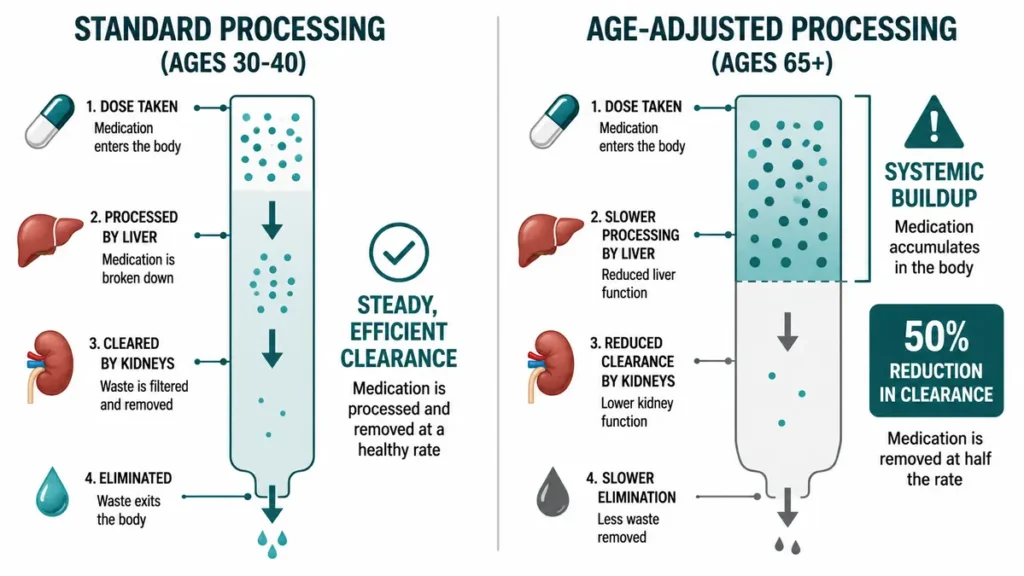
Your liver and kidneys have been working for you for decades, and somewhere past 50 they start doing that work more slowly. That slowdown changes how long a drug stays active in your system and how much of it builds up.
Aging reduces the blood flow through the liver and the activity of several liver enzymes that break down antidepressants, while kidney function typically declines to about half of a younger adult’s level by later life⁴.
The result is a drug that lingers longer and reaches higher concentrations than the same dose would in someone younger.
Drug clearance [how fast your body removes a medication from your bloodstream] is the concept that ties this together. When clearance drops, the same daily dose behaves like a larger one⁴.
You are not imagining that side effects feel stronger too⁴.
Total body water and lean muscle tend to decrease with age, while body fat increases. And that shift changes how a drug spreads through your body depending on whether it dissolves in water or fat⁴. A water-soluble drug ends up more concentrated in less water.
A fat-soluble drug gets stored longer in more fat⁴.
Neither situation is dangerous by itself, but both change what a “normal” dose actually does once it is inside you.
The Dosing Mismatch Almost Nobody Explains
Your prescriber likely started you on the same dose the label recommends for a much younger adult. For one common antidepressant, that starting number was never the problem, what happens after it is.⁵
From age alone.
The FDA’s own prescribing information for escitalopram, one of the most commonly prescribed antidepressants, states that in adults 65 and older, drug exposure and half-life increase by about 50 percent compared to younger adults, which is why the label caps how high the dose should climb rather than lowering where it starts.⁵
That detail rarely comes up in a ten-minute appointment, even though it is printed on the drug’s own label, based on actual pharmacokinetic testing in older adults.
The label already knew. The appointment never caught up to it.
Yet the same age-related decline shows up unevenly across the broader category.
A review comparing scientific literature to official prescribing information found that about half of commonly used antidepressants had documented evidence of age-related decline in clearance, but far fewer package inserts stated it clearly⁶.
That gap between what the science shows and what the label says is exactly where a dosing mismatch can slip through unnoticed, for drugs where the label offers less guidance than escitalopram’s does.
This is where the standard failure story falls apart. If your dose was never adjusted for a slower clearance rate, and your symptoms have not improved, you and your doctor have no reliable way to tell whether the drug failed or the dose did.
Not unless someone raises the possibility out loud.
What Genetic Testing Can and Cannot Tell You
You may have heard about genetic testing that promises to match you to the right antidepressant, and it is reasonable to wonder whether that is the fix you have been missing.
The science behind it is real: two liver enzymes, CYP2D6 and CYP2C19, break down most common antidepressants, and genetic variation in these enzymes changes how fast people clear the drug⁷.
People with a slow-metabolizing version of these enzymes can build up higher drug levels at a standard dose⁸, and clinical dosing guidelines already exist for adjusting several SSRIs based on these gene variants⁷.

Where the evidence gets thinner is proving that testing for these genes actually eases the specific problem you came here with.
A randomized trial of patients starting a tricyclic antidepressant for major depression found that genotype-guided dosing got people to an effective blood level faster and with fewer side effects, but did not produce a measurably bigger drop in depressive symptoms than standard dosing did⁹.
That does not mean the biology is wrong. It means faster, safer dosing and faster symptom relief turned out to be two different outcomes in that trial, and only the first one was clearly proven.
If you are considering genetic testing, ask what outcome it is actually expected to improve for you: getting to the right dose sooner, avoiding side effects, or lifting your mood faster, since the evidence supports those three differently⁹.
The Conversation Worth Having With Your Prescriber
You do not need a genetics lab or a pharmacology degree to raise this with your doctor. You need one specific question and the patience to let the answer play out over weeks, not days.
Full therapeutic benefit from an antidepressant typically takes up to four weeks to appear, while side effects can show up within hours to days of starting¹⁰, which is exactly the kind of mismatched timeline that makes people quit before the real answer arrives.
That four to six week gap between starting a change and knowing whether it helped is long enough that many people give up on a dose adjustment before it has had a fair chance to work.
Talk with your prescriber before changing your dose or stopping any antidepressant on your own, since adjusting these medications without medical guidance can cause withdrawal symptoms.

- Ask whether your current dose was set with your age and other medications in mind
- Ask whether a lower starting dose with a slower increase might suit your body better
- Ask what specific symptom or measurement you are both watching for over the next month
- Ask what the plan is if this adjustment does not help within that window
What a Realistic Timeline for Getting This Right Looks Like
You may have already thought about quitting, or you may have already stopped.
Nearly 30 percent of patients stop taking an antidepressant during the first month, and more than 40 percent have stopped by the third month¹⁰.
Most of those early exits happen before a fair trial of the medication, let alone a dose adjustment, has run its course. Response to antidepressants often takes longer in older adults.
And some research finds better outcomes in studies that ran for ten to twelve weeks rather than the standard four to eight¹¹. A dose change started in week one of treatment may not show its real effect until week ten or twelve, not week four¹¹.
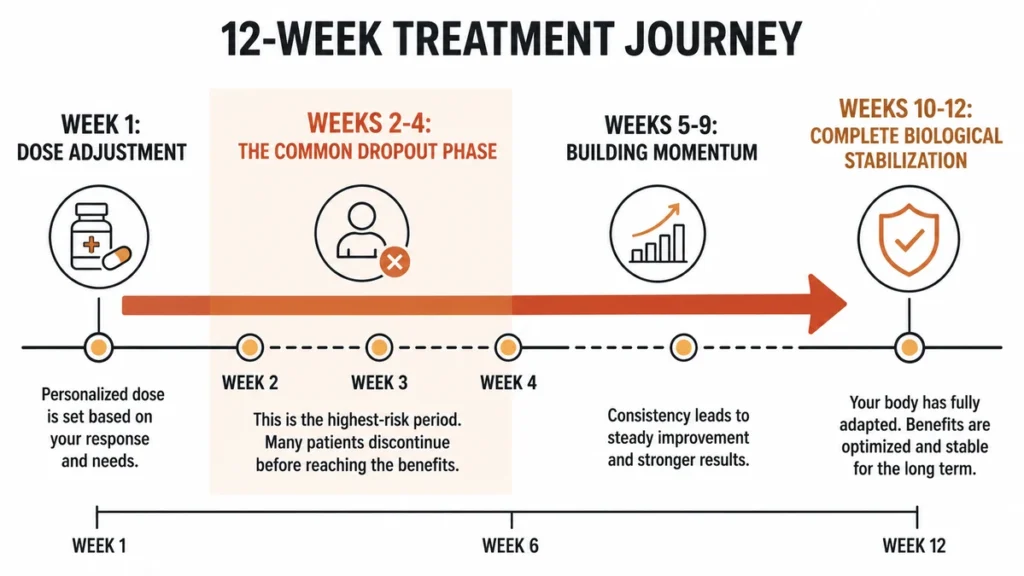
That timeline is not a flaw in your patience. It is how the biology actually works, and everyone in this system, from prescribing guidelines to appointment scheduling, moves faster than that biology does.
A visit within the first two weeks of starting or changing a dose gives you and your prescriber an early checkpoint rather than a two month guess.
Reframing the Wait
The most important thing to remember about an antidepressant over 50 that seems to have stopped helping: “not working” and “wrong for you” are not the same conclusion.
Bring this specific question to your prescriber at your next appointment: “Could my dose or drug choice need adjusting for my age, not because the medication is wrong for me, but because my body handles it differently now?”
The NIH National Institute on Aging offers a free guide to medications and aging (nia.nih.gov/health/medicines-and-medication-management/taking-medicines-safely-you-age).
This will not tell you which explanation fits you. That comes from watching your own body.
⚠️DISCLAIMER:
This article is for informational purposes only and does not constitute medical advice, diagnosis, or treatment. The content addresses antidepressant dosing and metabolism changes in adults over 50 and is intended for general educational purposes only. Health conditions vary significantly between individuals, always consult a licensed physician or qualified healthcare provider before making any decisions about your health or medical care.
References
- Lotrich FE, Pollock BG. Aging and clinical pharmacology: implications for antidepressants. Journal of Clinical Pharmacology. 2005. https://pubmed.ncbi.nlm.nih.gov/16172176/
- Gutsmiedl K, Krause M, Bighelli I, et al. How well do elderly patients with major depressive disorder respond to antidepressants: a systematic review and single-group meta-analysis. BMC Psychiatry. 2020;20:102.https://pmc.ncbi.nlm.nih.gov/articles/PMC7057600/
- Hvidberg MF. Are antidepressants effective in the treatment of depression in the elderly? A critical umbrella review on reviews, methods, and future perspectives. Mental Health Science. 2023. https://onlinelibrary.wiley.com/doi/full/10.1002/mhs2.14
- Parikh C. Antidepressants in the elderly: challenges for study design and their interpretation. Br J Clin Pharmacol. 2000;49(6):539-547.https://pmc.ncbi.nlm.nih.gov/articles/PMC2015038/
- U.S. Food and Drug Administration. Highlights of Prescribing Information: Lexapro® (escitalopram oxalate) Tablets/Oral Solution. Revised January 2017. (Access via FDA label, but the year should be 2017 based on this document).https://www.fda.gov/media/135185/download
- Boyce RD, Handler SM, Karp JF, Hanlon JT. Age-Related Changes in Antidepressant Pharmacokinetics and Potential Drug-Drug Interactions: A Comparison of Evidence-Based Literature and Package Insert Information. Am J Geriatr Pharmacother. 2012;10(2):139-150.https://www.sciencedirect.com/science/article/abs/pii/S1543594612000025
- Hicks JK, Bishop JR, Sangkuhl K, et al. Clinical Pharmacogenetics Implementation Consortium (CPIC) Guideline for CYP2D6 and CYP2C19 Genotypes and Dosing of Selective Serotonin Reuptake Inhibitors. Clinical Pharmacology and Therapeutics. 2015. https://pmc.ncbi.nlm.nih.gov/articles/PMC4512908/
- Berm EJJ, Hak E, Postma M, et al. Effects and cost-effectiveness of pharmacogenetic screening for CYP2D6 among older adults starting therapy with nortriptyline or venlafaxine: study protocol for the CYSCE trial. Trials. 2015. https://www.ncbi.nlm.nih.gov/pmc/articles/PMC4328880/
- Vos CF, ter Hark SE, Schellekens AFA, et al. Effectiveness of Genotype-Specific Tricyclic Antidepressant Dosing in Patients With Major Depressive Disorder: A Randomized Clinical Trial. JAMA Network Open. 2023. https://www.ncbi.nlm.nih.gov/pmc/articles/PMC10167565/
- Rudoler D, Lane N, Grudniewicz A, et al. The relationship between relational continuity and family physician follow-up after an antidepressant prescription in older adults: a retrospective cohort study. BMC Primary Care. 2024. https://www.ncbi.nlm.nih.gov/pmc/articles/PMC11034035/
- Romdhani A, Lehmann S, Schlatter J. Discontinuation of Antidepressants in Older Adults: A Literature Review. Ther Clin Risk Manag. 2023;19:291-299. https://pmc.ncbi.nlm.nih.gov/articles/PMC10066696/