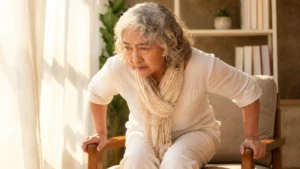
The first few steps out of bed shouldn’t feel like walking on broken glass. But for millions of adults over 50, that’s exactly how every morning starts. Your knees grind. Your hips ache. Your lower back feels like it was welded shut while you slept.
Here’s what most articles skip: this isn’t just wear and tear. It’s a biology problem. And it has a biology fix.
This guide is for adults over 50 who are done accepting morning stiffness as normal. It breaks down a 3-part morning stretch protocol, done before your feet even hit the floor, that targets the exact reason your joints lock up overnight. Under 10 minutes. No equipment needed.
Why Read This
- Why your joints feel worst in the first ten minutes after waking, and why moving more slowly is the fix
- The one part of your back that stiffens most after 50, and why almost no stretch guide targets it
- Why the order of these three parts matters more than how long you stretch
- One stiffness pattern that signals a doctor visit, not a stretch session
Why Your Joints Feel Stiff Every Morning (It’s Not Just Age)?
If your joints hurt most in those first ten steps of the day, two things are happening at once inside your joints.
First, synovial fluid [a gel-like liquid that fills the space between your bones and prevents them from grinding together] decreases.⁴ After 50, your body makes less of it.³ The fluid also becomes more watery and less effective.⁴ Less lubrication means more friction. More friction means more pain and stiffness, especially after hours of not moving.
Second, cartilage gets thinner: Cartilage is the cushioning on the ends of your bones. With age, a key molecule called hyaluronic acid [a substance that gives cartilage its springiness and helps synovial fluid maintain its thickness] in your joints breaks down.²,⁵,⁴ When that happens, your cartilage loses its springiness.²,⁵ Your joints absorb impact less well.
Put these two things together, thinner cartilage and less synovial fluid, and you get joint stiffness after 50 that feels worst right after waking up.
32.5 million US adults have osteoarthritis [the most common joint disease, caused by cartilage breakdown over time].⁴ A 2024 systematic review found that static stretching reduced passive muscle stiffness in older adults across all 6 analyzed studies.¹
1. In-Bed Mobility — Joint Lubrication
5 minutes · Still in bed · No equipment
Most stretch guides tell you to get up first. This one doesn’t. The difference is in what happens to your joints before you stand.
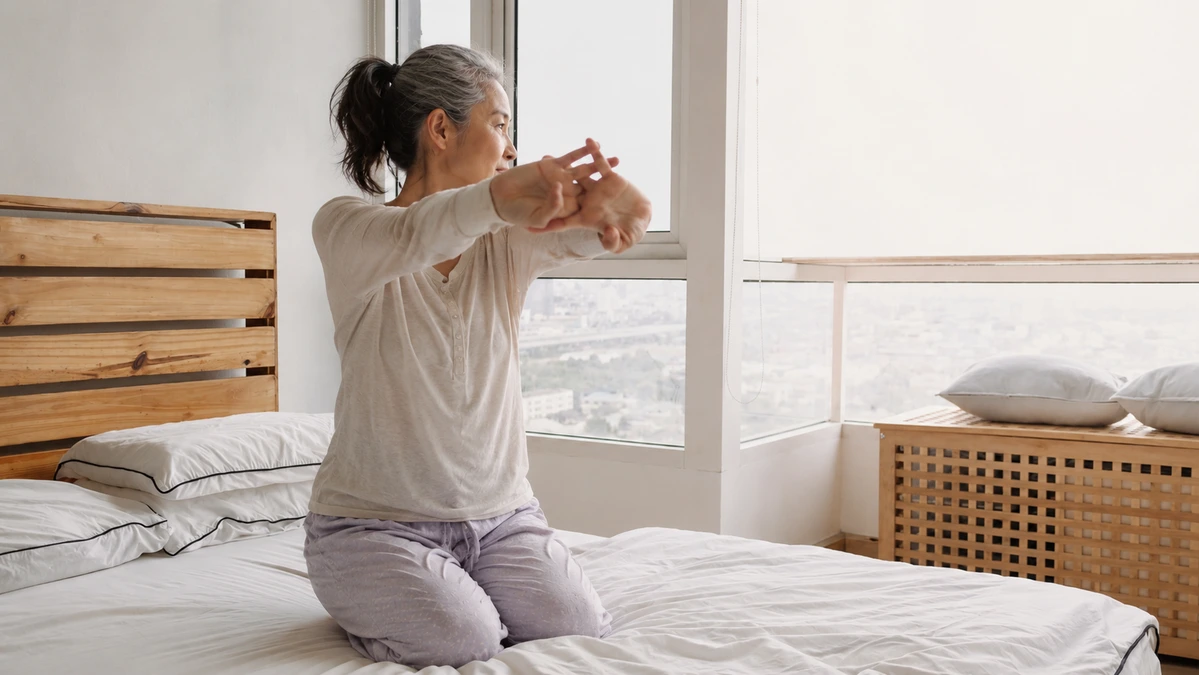
Doing these three moves before you stand up slowly pumps synovial fluid back through your knees, hips, and ankles. By the time your feet hit the floor, your joints are warmer, looser, and ready.
Talk to your doctor before starting this stretch routine if you are pregnant, on medication, or managing a chronic condition such as arthritis or osteoporosis.
Exercise 1 of 3: Heel Slides
- Lie flat on your back. You can keep the duvet on.
- Slowly slide your right heel toward your backside, bending your knee.
- Slide it back out to straight. That’s one rep.
- Do 10 reps on each leg. Go slow. No rushing.
Targets: Hips and knees. This move works through the hips and knees, where stiffness tends to settle overnight.
Exercise 2 of 3: Ankle Pumps & Circles
In the video, they demonstrate seated, but you can do this lying flat in bed, which is exactly how we recommend it.
- Stay on your back. Legs straight.
- Point your toes away from you, then flex them back toward your face. Repeat 10 times.
- Now rotate your ankles slowly 10 circles clockwise, then 10 counter-clockwise.
Targets: Ankles and feet. This also helps circulate blood back up from your legs, which can pool during sleep.⁹
Exercise 3 of 3: Knee Hugs
- Still on your back. Bring one knee gently toward your chest.
- Hold it with both hands, or clasp your hands behind the knee if that’s easier.
- Hold for 15,30 seconds. Breathe. Then switch legs.
- Do both sides twice.
Targets: Lower back, glutes, and hip flexors. This is a reliable in-bed stretch for lower back stiffness.
2. Thoracic & Spinal Mobility — Back & Chest
3 minutes · Bed edge or floor · No equipment
Most people over 50 focus on their knees and hips and completely ignore the mid-back. That’s a mistake. Your thoracic spine [the middle section of your back, running behind your chest] has 12 vertebrae. When it gets stiff, it doesn’t move the way it should.
So your lower back and neck have to pick up the slack. That is often where upper-body pain starts, as a stiff mid-back can shift extra load onto the areas above and below it.
Exercise 1 of 2: Book Opener (Thoracic Rotation)
The video uses shorter holds with more reps; either way works. We recommend the 20 to 30 second hold for a deeper, gentler stretch.
- Lie on your side with knees bent and stacked on top of each other.
- Stretch both arms straight out in front of you, palms together.
- Without moving your legs, slowly rotate your top arm back like you’re opening a book. Let your chest open and follow the arm.
- Hold for 20 to 30 seconds. Then bring the arm back. Do 3 reps on each side.
Targets: Mid-back rotation and chest opening. Helps ease the tension that builds in the upper back after 50.
Exercise 2 of 2: Cat-Cow
The video uses short holds; in our version, let your breath lead the movement. Inhale as you arch, exhale as you round. Slow and steady.
- Get on your hands and knees. Wrists under shoulders, knees under hips.
- Inhale: let your belly drop, arch your back, look up gently.
- Exhale: round your spine up toward the ceiling, tuck your chin to your chest.
- Repeat slowly for 8 to 10 breaths.
Targets: Full spinal flexibility from neck to tailbone. Moving through both positions also works every joint along your spine.
3. Standing Activation — Posture & Hips
3 minutes · Standing · Chair or wall for balance
By now, your joints are warmer. Your spine is looser. Your body has been gently woken up, not shocked into action. Part 3 prepares you for the movement most people do all day without thinking until it starts to hurt. Getting out of a chair. Walking down stairs. Reaching back to buckle a seatbelt.
These three moves also help with balance, and for good reason. Reduced mobility and joint stiffness are established risk factors for losing balance in adults over 50. Use a chair or wall for balance. Don’t skip that step.
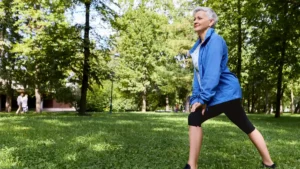
Exercise 1 of 3: Hip Flexor Stretch (Chair-Assisted)
- Stand next to a chair and hold the back of it for support.
- Step your right foot back about 18 inches. Keep your back heel on the floor.
- Gently push your hips forward until you feel a stretch at the front of your right hip and thigh.
- Hold 20 to 30 seconds. Switch sides.
Targets: Hip flexors, the muscles at the front of the hip. These get shortened from sitting. Tight hip flexors are associated with lower back pain and can negatively affect movement patterns.¹⁰
Use a chair against a wall so it doesn’t slide.
Exercise 2 of 3: Standing Calf Stretch
- Face a wall. Place both hands flat on the wall.
- Step one foot back about 18 inches. Keep that back heel pressed flat to the floor.
- Lean gently forward until you feel the stretch in your calf. Hold 20 to 30 seconds.
- Switch legs.
Targets: Calves and ankles. This also helps with foot stiffness and plantar fasciitis [inflammation along the bottom of the foot that causes sharp heel pain, especially in the morning], which is very common after 50.
Exercise 3 of 3: Chest Opener
- Stand tall. Roll your shoulders back and down.
- Clasp your hands together behind your back.
- Gently lift your arms upward just a few inches. You’ll feel your chest open.
- Hold for 15 to 20 seconds. Take 3 slow, deep breaths here.
Targets: Chest, shoulders, and upper spine. Opens the chest and shoulders, which tend to tighten from the postures held during sleep.
5 Rules That Make This Protocol Actually Work
Doing these stretches once will feel nice. Doing them every day will change how your mornings feel. These five rules are the difference between trying something once and building a habit that lasts.
1. Start before you get up: Part 1 works specifically because you do it before standing. Most people leap out of bed and wonder why they’re stiff. You’ll do the opposite. Lie there, do the moves, then stand. This is the single biggest thing that makes this protocol different.
2. Daily beats intense: Ten minutes every morning beats one long stretch session on Sundays. Your joints need regular, gentle movement, not occasional hard workouts. Aim for 5 days a week at a minimum. The other two days, even 5 minutes is fine.
3. Never force a stretch: Mild discomfort is normal. Pain is a stop sign. If discomfort lasts more than 2 hours after stretching, ease back.⁸ You’re stretching too hard or too long. Pull back, don’t push through.
4. Use heat: A warm shower before or after helps your muscles relax and loosens synovial fluid to reduce joint stiffness.⁷ If you can’t shower first thing, try a warm cloth on your knees for a few minutes. Even that small amount of heat helps.
5. Know when stiffness is a bigger signal: If your morning stiffness gets better within 30 minutes of moving, that’s typical osteoarthritis behavior.⁶ But if it regularly lasts longer than 45 minutes and doesn’t improve much with movement, talk to your doctor. It may indicate inflammatory arthritis [a condition where the immune system attacks joint tissue, causing prolonged stiffness and swelling], which needs a different approach.⁶
Do This Tomorrow Morning
The single most important step: do Part 1 before your feet hit the floor. Not after your shower. Not after coffee. Before you stand.
Try it tomorrow morning. Not someday. Tomorrow. Keep this article open tonight. Many people notice a real change within the first two weeks. This morning stretch protocol for stiff joints after 50 costs nothing but ten minutes.
One honest limit: if your stiffness consistently lasts longer than 45 minutes after moving, stretching alone won’t fix it. See a doctor.
⚠️DISCLAIMER
This article is for informational purposes only and does not constitute medical or professional fitness advice. The content addresses morning stretch protocol for joint stiffness after 50 and is intended for general educational purposes only. Exercise carries inherent risk, consult a qualified healthcare or fitness professional before beginning or modifying any training program, particularly if you have an existing injury or medical condition.
References
- Nakamura M, Takeuchi K, Fukaya T, Nakao G, Konrad A, Mizuno T. Acute effects of static stretching on passive stiffness in older adults: a systematic review and meta-analysis. Archives of Gerontology and Geriatrics. 2024;117:105256. https://www.sciencedirect.com/science/article/abs/pii/S0167494323003345
- Gul R, Nazir I, Amirzada MI, Jahan F, Naseer F, Baig TA. Aging and Synovial Joint Function: Changes in Structure and Implications for Mobility. IntechOpen. 2024. DOI:10.5772/intechopen.1003866. https://www.intechopen.com/chapters/1167539
- Fernández-Torres J, Ilizaliturri-Sánchez V, Martínez-Flores K, Lozada-Pérez CA, Espinosa-Morales R, Zamudio-Cuevas Y. An update on the study of synovial fluid in the geriatric patient. Reumatología Clínica. 2024. DOI:10.1016/j.reuma.2023.12.006. Available from: https://www.sciencedirect.com/science/article/abs/pii/S1699258X23002899
- Collins DP, Elsouri KN, Demory Beckler M. Osteoarthritis: Can We Do Better? Cureus. 2022;14(11):e31505. DOI:10.7759/cureus.31505.https://pmc.ncbi.nlm.nih.gov/articles/PMC9750799/#sec3
- Temple-Wong MM, Ren S, Quach P, Hansen BC, Chen AC, Hasegawa A, D’Lima DD, Koziol J, Masuda K, Lotz MK, Sah RL. Hyaluronan concentration and size distribution in human knee synovial fluid: variations with age and cartilage degeneration. PMC. 2016. https://pmc.ncbi.nlm.nih.gov/articles/PMC4721052/
- Kalunian KC. Osteoarthritis: Current Concepts in Diagnosis and Management. American Family Physician. 2000;61(6):1795. https://aafp.org/afp/2000/0315/p1795.html
- Kambach B. When and Why to Apply Heat to an Arthritic Joint. Arthritis-Health. 2015. https://www.arthritis-health.com/treatment/alternative-treatments/when-and-why-apply-heat-arthritic-joint
- Harvard Health Publishing. Stretching to help arthritis pain. Harvard Health. 2024. https://www.health.harvard.edu/pain/stretching-to-help-arthritis-pain
- Li Y, Guan XH, Wang R, Li B, Ning B, Su W, Sun T, Li HY. Active ankle movements prevent formation of lower-extremity deep venous thrombosis after orthopedic surgery. Medical Science Monitor. 2016;22:3169-3176. https://pmc.ncbi.nlm.nih.gov/articles/PMC5024560/
- Konrad A, Močnik R, Titze S, Nakamura M, Tilp M. The Influence of Stretching the Hip Flexor Muscles on Performance Parameters. A Systematic Review with Meta-Analysis. International Journal of Environmental Research and Public Health. 2021. https://www.ncbi.nlm.nih.gov/pmc/articles/PMC7922112/