

You’re mid-sentence and the word just vanishes. You stare at the other person, and your face gives away the thing you haven’t said out loud: something is quietly going wrong.
You’ve been wondering if this is the beginning of something you can’t stop. At this age, every mental slip carries the weight of a story you’ve heard too many times.
Adults over 50 lose some brain volume with age, but research links three correctable daily habits to measurable shrinkage on top of it.
The three inputs driving that extra loss are ones you chose this morning. They aren’t invisible forces. They are sleep consistency, daily hydration, and how you distribute movement through the day. Knowing which one is most degraded in your life is where to start.
This article is for general information only and is not medical advice. The studies it describes link sleep, hydration and sitting time to brain volume; they do not diagnose or treat any condition. If your memory changes suddenly, keeps getting worse or affects daily life, see your doctor rather than relying on lifestyle changes alone.
Your Brain Is Losing Volume, and Lifestyle Factors Are Setting the Rate
You made three choices this morning before you sat down. How much you drank. How well you slept last night. How long you’ve been sitting since. Those three inputs are setting your brain’s shrinkage rate more than your age is.
Brain losing volume is not a disease. Some annual loss happens in healthy people with no diagnosis at all. The question isn’t whether it’s happening. The question is how fast, and what is driving the speed.
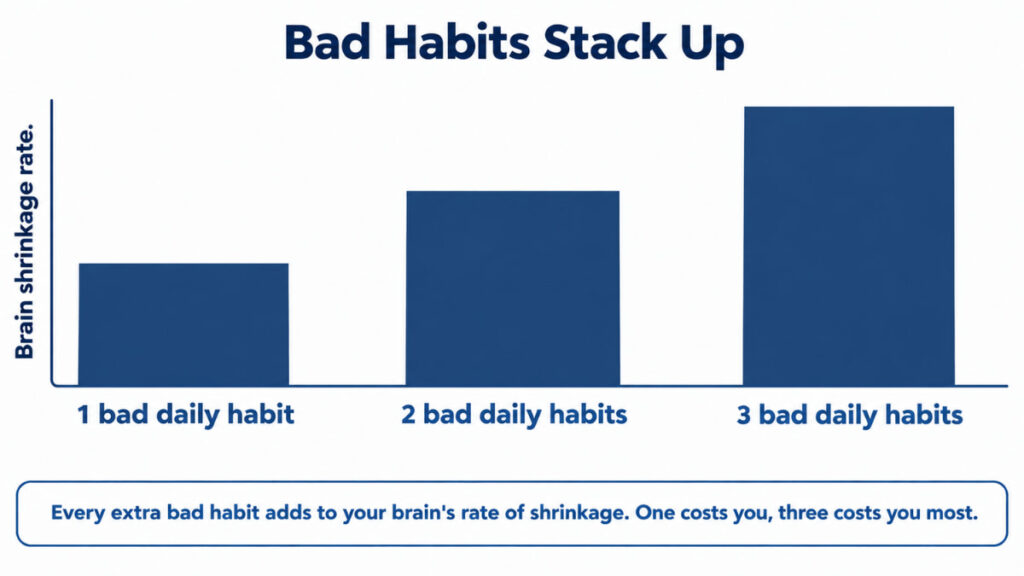
Data from 3,838 adults across eight European cohorts found that having multiple unhealthy lifestyle factors is associated with a linear reduction in overall brain volume.¹
That word “linear” means the effects stack. One degraded input costs you something. Two costs you more. Three costs you the most.
The stacking is what makes this problem hard to address. Age gets the blame because age is the variable no one can change. But the three lifestyle inputs above are the variables you can change. And right now, they’re doing more of the work.
Think about how many people over 50 actually live. They sleep on shifting schedules, staying up late some nights and crashing early others. They drink coffee in the morning and little water for the rest of the day.
They sit for hours, do one workout, then sit again. Each of those habits is a lever pulling brain volume lower than it has to go.
None of those habits feel dangerous. The brain doesn’t send a warning signal when lifestyle inputs degrade. It just changes, quietly, over time.

The good news is that none of this requires a doctor’s visit or a prescription. The inputs that are affecting your brain volume are the same ones you’ll audit at the end of this article.
The three inputs are sleep consistency, hydration, and movement through the day. All three are measurable today. All three can change this week.
Dehydration Shrinks Your Brain, and You’re Probably Already Doing It
You don’t feel it happening. That’s the problem. Mild dehydration is easy to miss while it is happening.
When your brain loses fluid, its cells shrink. The outer layer of your brain gets thinner. White matter [the network of fibers that connects different brain regions] loses volume. These changes show up on MRI scans after just 12 hours without enough fluids.
Fifteen healthy adults had their brain volume measured before and after 12 hours of fluid restriction.
Scans showed measurable decreases in whole-brain volume, the outer brain layer, and the white matter connecting different brain regions.² The brain had physically changed after a single night of not drinking enough.
Mean whole-brain volume fell by 0.36 percent. White matter volume fell by 0.59 percent.²
Whole-brain volume recovered within about an hour of drinking water, and white matter regained part of what it lost.² One hour of drinking began to undo what a night of drying out had done.
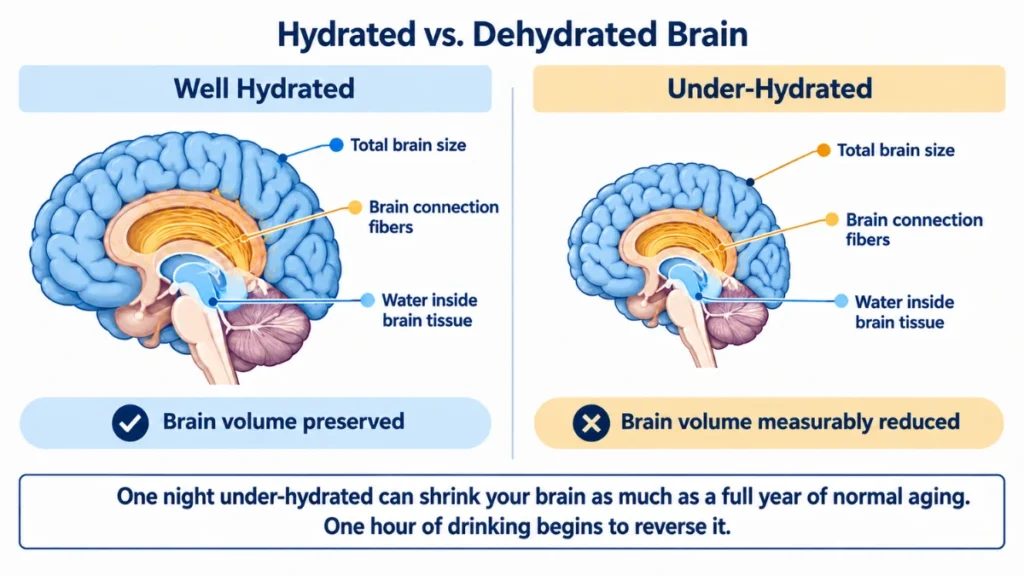
That comparison should stop you. The annual brain volume loss from normal aging runs around 0.2 percent.² One night of going to bed under-hydrated can match or exceed a full year of typical aging loss.
Brain tissue fluid dropped by 1.63 percent on average after 12 hours without fluids.² The water in your brain tissue fell by more than one and a half percent after a single overnight stretch without enough to drink.
Many people over 50 drink less than they need. The sense of thirst tends to weaken with age. You feel fine. The scan would say otherwise.
If you’re on medication, managing a kidney condition, or have been told to limit fluids by a doctor, check with your physician before significantly changing how much you drink each day.
Signs You May Be Chronically Under-Hydrated
- Your urine is dark yellow before noon (target: pale yellow)
- You drink coffee or tea but little plain water before noon
- You rarely feel thirsty (a declining thirst sense is a warning, not reassurance)
- You get mild headaches or afternoon fatigue most days
- You’re older (the body’s water-holding tends to decline with age)

Going to bed slightly under-hydrated tonight means this whole process runs again while you sleep. The brain that wakes up tomorrow starts smaller than the one that went to bed.
Inconsistent Sleep Shrinks the Memory Center Faster Than Short Sleep Does
You already know you should sleep more. What gets less attention is that unpredictable sleep may be doing more damage than short sleep is.
The hippocampus [the brain’s memory center, which stores new information, retrieves names, and builds the pathways you use for recall] is also among the first brain structures to show measurable shrinkage from lifestyle inputs.
Your memory center may be measurably smaller if your sleep schedule shifts by an hour or more each night.
Adults whose nightly sleep duration varied by 60 minutes or more showed a reduction of 280 cubic millimeters in left hippocampal volume and 252 cubic millimeters in right hippocampal volume, compared to adults who kept a steady schedule.³
Those are MRI-confirmed differences in the physical size of the memory center.
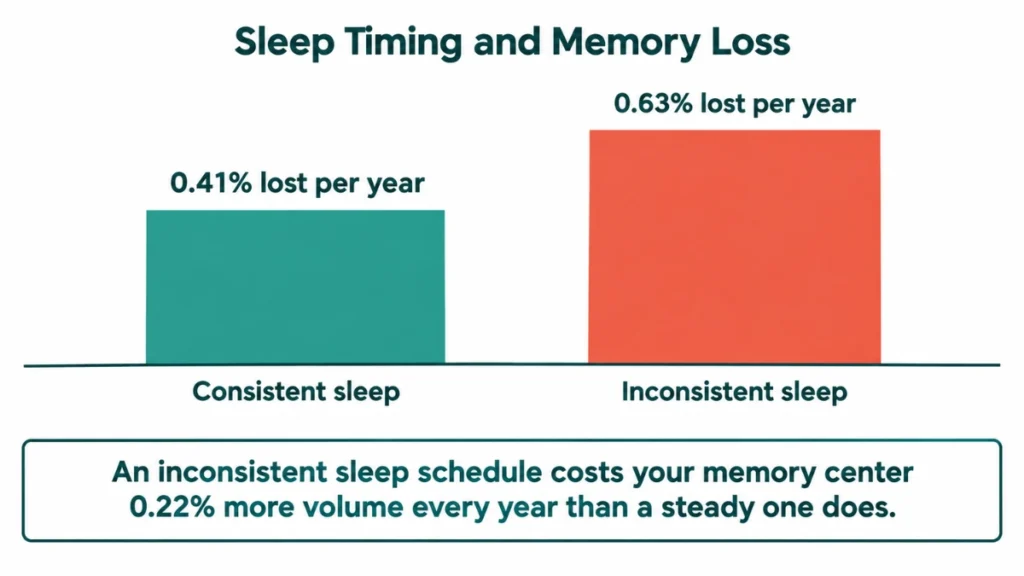
The damage wasn’t from sleeping less. It was from sleeping unpredictably.
Adults with worse sleep quality scores lost hippocampal volume at an annualized rate of 0.63 percent, compared to 0.41 percent for those with better sleep.⁴ That is about 0.22 percentage points more volume lost every year.
The research shows the link clearly but hasn’t fully settled the cause.
What the data consistently points to is that circadian disruption [a mismatch between your body’s internal clock and your actual sleep timing, caused by shifting bedtimes night to night] appears especially damaging to the hippocampus.
Sleep supports the brain’s overnight memory work, and the hippocampus plays a special role in it.
Sitting All Day Shrinks the Brain Even If You Exercise
You go to the gym. You do your walk. You’ve done your part. That assumption is the one this section has to break.
A group of 404 adults aged 50 and older wore wrist devices for a week to track daily movement, then had their brain scans and cognitive scores followed for seven years.
Adults with greater sedentary time showed a smaller Alzheimer’s disease neuroimaging signature and worse episodic memory [the ability to recall specific personal events and experiences] in cross-sectional models.⁵ A smaller neuroimaging signature means thinner cortex in brain regions vulnerable to Alzheimer’s disease.
Participants who spent more time sedentary showed faster shrinkage of the hippocampus and faster declines in naming and processing speed, regardless of how much they exercised.⁵ The workout did not cancel out the chair, and the memory center kept shrinking regardless.

Marissa Gogniat, assistant professor of neurology at the University of Pittsburgh and lead author of the study, stated: “Minimizing the time spent sitting, even if you exercise daily, reduces the likelihood of developing Alzheimer’s disease.”⁶
The research doesn’t prove a direct cause, but the association held across seven years and more than 400 people. Movement needs to be spread across the day, not banked in a single session.
If exercise isn’t enough on its own, what does enough actually look like?
The Evidence That the Brain Can Grow Back
The hippocampus shrinks 1 to 2 percent every year in cognitively healthy older adults.⁷ That loss raises the risk for cognitive impairment [a noticeable decline in memory, thinking, or judgment that goes beyond normal aging]. It sounds fixed.
Brain losing volume at this rate doesn’t have to continue on that schedule.
In a randomized controlled trial with 120 older adults, one group walked at moderate intensity three days per week for one year. The other group did stretching and toning exercises.
The walking group increased left hippocampal volume by 2.12 percent and right hippocampal volume by 1.97 percent. The stretching group lost 1.40 percent and 1.43 percent respectively.⁷
One year of walking, three days per week, was enough to reverse what would otherwise be one to two years of normal aging loss.
Stretching kept people moving, but the hippocampus didn’t grow. It kept shrinking.
The benefit came from sustained moderate-intensity aerobic movement. The kind that raises your heart rate and holds it there.
Sustained aerobic movement appears to trigger growth factors in the brain that support cell health in the hippocampus. The research shows this link clearly, though the exact steps in the body are still being studied.
The person who walks at a pace that challenges their breathing and the person sitting on a couch are both getting older at the same rate. They are not losing memory-center volume at the same rate.
Whether the movement you’re doing right now creates that gap is the question this section leaves open.
The Three-Input Audit to Run This Week
You now know that brain losing volume is not set by your age. It’s being set right now by three inputs you can check before the day ends.
The Lifebrain data showed a linear relationship between lifestyle inputs and brain volume loss.¹
Fix one input and the brain benefits. Fix two and the benefit grows. Fix all three and you’re working against the full stacking effect. Here is how to check each one.
Check your urine color before noon. Pale yellow means you’re ahead. Dark yellow means you’re running low on fluids.
The fix is plain water, consistently, not just at meals. Make it the first thing you reach for in the morning, before coffee or anything else.
Track your actual bedtime and wake time for one week, not just your total hours, but your consistency. If the total varies by more than 60 minutes night to night, your hippocampus is carrying that cost.
The fix isn’t always sleeping more. It’s sleeping on a predictable schedule, even on days off.

Notice the longest stretch you sit without standing. If it runs past 60 minutes regularly, the brain is registering that as sedentary time, even if you exercised this morning.
The fix is distribution. Short breaks through the day, not a compensating workout at the end of it.
None of these require equipment, medication, or a diagnosis. They require noticing what you’re already doing and adjusting one part of it this week.
Research links each of these inputs to brain volume, and each one is within your control. The schedule you’re on right now is the one you set this morning. That changes today, or it doesn’t.
Three Inputs. One Week. Your Move.
When you correct the three inputs driving brain losing volume, you take control of the variable that actually matters most. Audit your sleep, hydration, and movement this week.
Your brain volume depends on what you do next. Age set the clock. You set the pace.
References
- Binnewies J, Nawijn L, Brandmaier AM, et al., Penninx BWJH. Lifestyle-related risk factors and their cumulative associations with hippocampal and total grey matter volume across the adult lifespan: A pooled analysis in the European Lifebrain consortium. Brain Research Bulletin. 2023; 200:110692. https://www.sciencedirect.com/science/article/pii/S036192302300117X
- Biller A, Reuter M, Patenaude B, Homola GA, Breuer F, Bendszus M, Bartsch AJ. Responses of the Human Brain to Mild Dehydration and Rehydration Explored In Vivo by 1H-MR Imaging and Spectroscopy. American Journal of Neuroradiology. 2015; 36(12):2277-2284. doi:10.3174/ajnr.A4508. https://www.ajnr.org/content/36/12/2277
- Diaz J, Almeida D. Intraindividual Variability in Sleep Duration Is Associated With Hippocampal Volume in Mid Life. Innovation in Aging. 2023; 7(Supplement_1):553. Conference abstract. https://doi.org/10.1093/geroni/igad104.1814
- Fjell AM, Sørensen Ø, Amlien IK, et al. Self-reported sleep relates to hippocampal atrophy across the adult lifespan: results from the Lifebrain consortium. Sleep. 2020; 43(5):zsz280. https://academic.oup.com/sleep/article/43/5/zsz280/5628807
- Gogniat MA, Khan OA, Li J, et al. Increased sedentary behavior is associated with neurodegeneration and worse cognition in older adults over a 7-year period despite high levels of physical activity. Alzheimer’s & Dementia. 2025. doi:10.1002/alz.70157. https://alz-journals.onlinelibrary.wiley.com/doi/10.1002/alz.70157
- University of Pittsburgh School of Medicine. Sedentary Behavior is an Independent Risk Factor for Alzheimer’s Disease, New Study Reveals. News release. https://www.medschool.pitt.edu/news/sedentary-behavior-independent-risk-factor-alzheimer-s-disease-new-study-reveals
- Erickson KI, Voss MW, Prakash RS, et al., Kramer AF. Exercise training increases size of hippocampus and improves memory. Proceedings of the National Academy of Sciences. 2011; 108(7):3017-3022. https://www.pnas.org/doi/10.1073/pnas.1015950108