

You’re not imagining it. Something shifted after 50, and the protein on your plate stopped doing what it once did automatically.
For adults over 50 who eat well, stay active, and still feel their strength quietly slipping, this article is written for you. The problem isn’t effort. It’s anabolic resistance (a condition where your muscles stop responding normally to protein), a biological change that makes your muscles far less responsive to the protein you eat. Eating the right amount isn’t enough anymore. Eating it the right way is what separates muscle preservation from muscle loss.
By the end, you’ll know the per-meal protein target, the leucine threshold proposed for older adults, and the eating pattern your body actually responds to after 50.
This article is for informational purposes only and is not a substitute for medical advice. Protein needs, supplement use, and exercise programs vary based on individual health status, medications, and existing conditions. Consult your doctor or a registered dietitian before making changes to your diet or starting a new training routine.
Why You’re Losing Muscle After 50 (Even If You’re Active)?
Here’s something most people don’t know. Muscle loss doesn’t start at 60 or 70. It starts in your 40s and keeps adding up year after year.¹,²
Researchers call it sarcopenia (the gradual loss of muscle mass that comes with age). On average, adults lose roughly 0.5–1.2% of muscle mass every year after 50.¹ That sounds small. But strength drops even faster, about 3% per year.¹ That’s the part you actually feel.
And it’s not just about looks. Weaker muscles mean:
- A higher risk of falls and fractures
- A slower metabolism
- Less energy for everyday tasks
- Greater risk of losing your independence as you age

So why does this happen, even to people who eat well and stay active? The answer is something called anabolic resistance.
Your Body’s Muscle-Building Signal Gets Harder to Hear
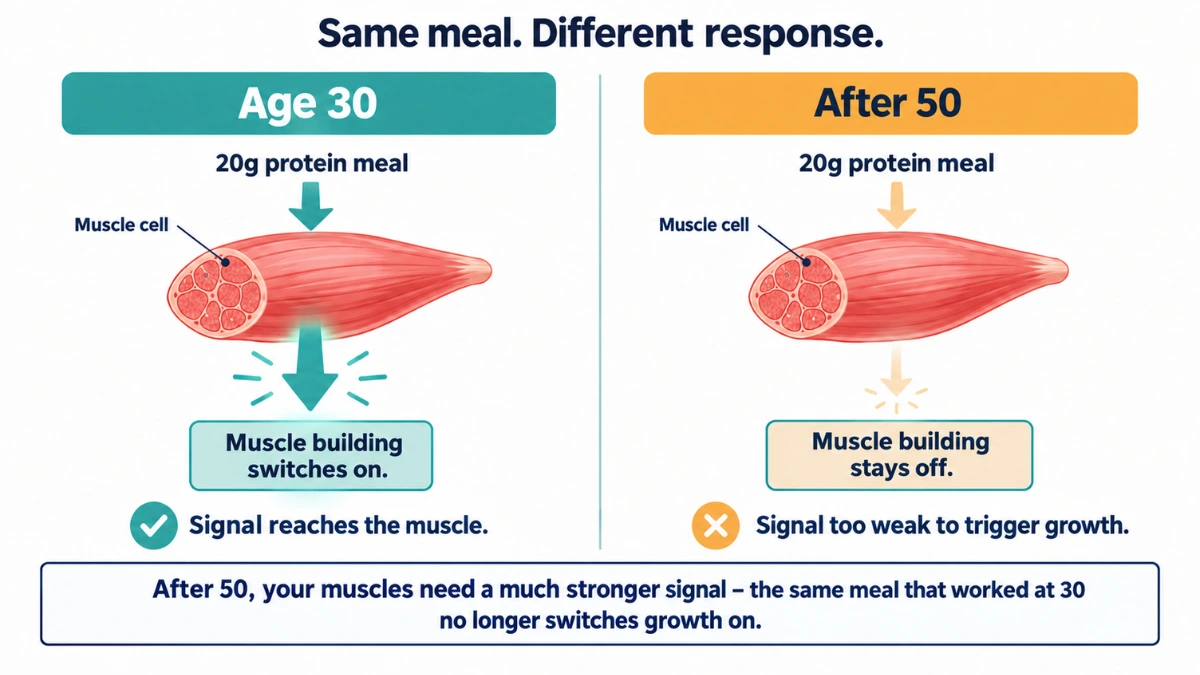
In your 30s, eating a 20g protein meal sends a clear signal to your muscles: grow and repair. After 50, that same signal gets weaker. Your muscles need a much stronger input, more protein, more leucine (an amino acid that switches on muscle building), and more physical stimulus just to get the same response.
Aging muscle is less sensitive to lower doses of amino acids. It needs more to trigger the same muscle-building process. This is not a character flaw. It’s just how the body changes.
There’s another piece to this. Sarcopenia hits fast-twitch muscle fibres (the fibres that power quick, explosive movements like catching yourself from a fall) hardest.¹⁴
Losing them is part of why older adults become more prone to falls. Short periods of inactivity, a week in bed after illness, a month off from exercise, cause a steep drop in strength.¹⁵
And older adults find it harder than younger people to recover fully from those setbacks.¹
So staying consistent matters more than ever after 50.
How Much Protein Do You Actually Need After 50?
Most adults have heard of the protein RDA (Recommended Dietary Allowance): 0.8 grams per kilogram of body weight per day. That number was set to prevent protein deficiency in the average adult.
Some recommendations point to a higher target for older adults: 1.2 to 1.6 grams of protein per kilogram of body weight, per day.²,³ For a 154-pound (70 kg) person, that works out to roughly 84 to 112 grams of protein per day.
That’s a big jump from what the average diet delivers. And the daily total is only half the picture.

It’s Not Just How Much: It’s When You Eat It
Researchers have found that older adults have a higher per-meal protein threshold. That means you need to hit a minimum amount at each meal to actually trigger muscle repair and growth.
Eating 10g at breakfast, 15g at lunch, and 70g at dinner? That doesn’t work. The big dinner doesn’t make up for the small earlier meals.
For older adults, about 30–35 grams of protein per meal has been suggested, with about 3 grams of the amino acid leucine as the proposed threshold.⁴,⁵
Younger adults can build muscle with smaller amounts spread differently. Older adults need to hit this threshold at each meal, not just once a day. Spread your protein. Don’t back-load it.
Quick-Reference Table
| Goal | What to Aim For |
|---|---|
| Daily protein total | 1.2–1.6g per kg of body weight |
| Protein per meal | 30–35g |
| Leucine per meal | About 3g |
| Meals per day | 3–4 |
The Leucine Factor: Why Protein Quality Matters as Much as Quantity
All proteins are not the same. And after 50, this gap matters a lot.
Leucine is a specific amino acid. It acts like the on switch for muscle building. When your body gets enough leucine at a meal, it activates a cellular process called the mTOR pathway (a signalling switch inside muscle cells that turns on muscle growth).¹³
Without enough leucine? That switch stays off no matter how much total protein you eat.
Younger adults get this response from less leucine per meal. Older adults need more: about 3 grams per meal has been proposed.⁵ Here’s why this matters for how you plan your meals.
Three Threshold Meals Beat Six Small Ones
This is the part most people get wrong about protein after 50.
If you eat three meals a day, each with enough leucine, you get three muscle-building signals. But if you spread the same total protein across six small meals each below the threshold, you get zero strong signals.
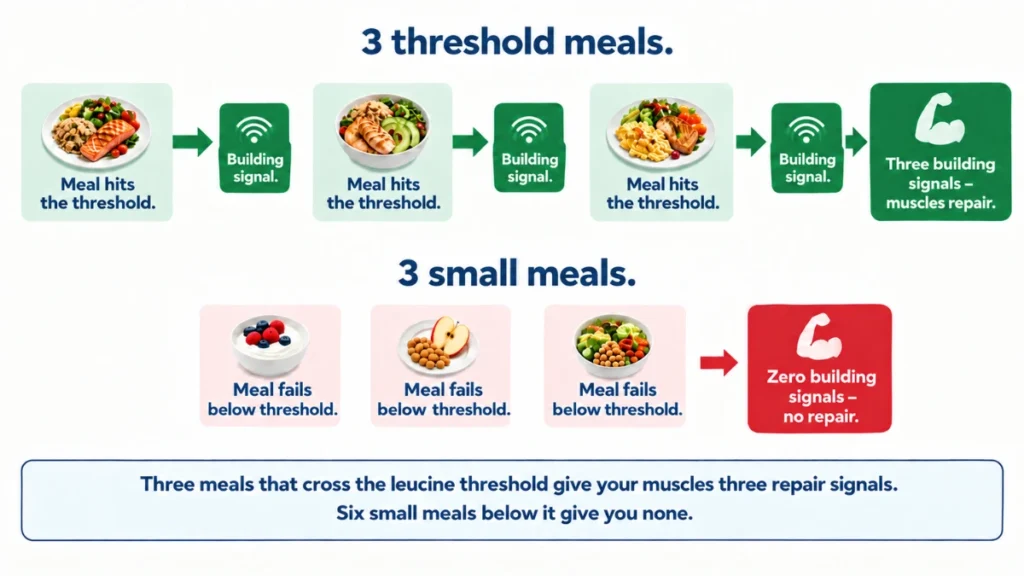
More meals don’t mean better results. Hitting the threshold is what counts.
Best Protein Sources for Adults Over 50
These foods are high in leucine and work well for reaching the 30–35g per meal target:
- Whey protein: The highest leucine content per gram of any protein source
- Egg: Soft, easy to cook, highly digestible
- Chicken breast: about 2.3g of leucine per 100g (cooked)⁶
- Beef: Leucine-rich and filling
- Salmon and tuna: Leucine-rich, with omega-3s too
- Greek yogurt: High protein, easy to add to any meal
- Cottage cheese: Underrated and worth adding
- Soy: The best plant option for leucine content

Resistance Training: The Part That Makes Protein Actually Work
Protein alone won’t save your muscle.
Your muscles need a reason to stay. That reason is physical stress, specifically, the kind that comes from resistance training. Structured resistance training is the strongest tool available to slow sarcopenia.
That holds whether you train at a gym or at home.

How Often Do You Need to Train?
Aim for 2 to 3 resistance training sessions per week as a starting point. The CDC recommends muscle-strengthening activities on at least two days a week for adults 65 and older to prevent age-related decline.⁷
Two solid sessions are better than zero. Three are better than two. Beyond that, recovery becomes the limiting factor, especially after 50.
Jump to each exercise in the video:
- Chair sit-to-stand and goblet squat form: 1:00
- Romanian deadlift form (hip hinge for spine safety): 4:16
- Step-up progression for single-leg balance: 6:36
- Single-arm dumbbell row form: 8:30
- Full-body overhead drive: 10:18
Beginner-Friendly Exercises (No Gym Required)
Focus on large muscle groups. These exercises hit them effectively:
- Squats: Bodyweight or with light dumbbells
- Push-ups: On knees if needed to start
- Resistance band rows
- Deadlifts: Bodyweight Romanian deadlifts are a good start
- Farmer’s Carry: Hold a heavy bag or dumbbell and walk
Aim for 3 sets of 8–12 reps per exercise. When those feel easy, add resistance. Progression, getting slightly harder over time, is what keeps your muscles adapting.
Talk to your doctor before starting a new supplement or exercise routine if you’re on medication, pregnant, or managing a chronic condition.
A Simple 3-Day Weekly Template
| Day | Focus |
|---|---|
| Monday | Full body (squat, push-up, row) |
| Wednesday | Full body (deadlift, shoulder press, carry) |
| Friday | Full body (repeat Monday or mix in new moves) |
Supporting Nutrients That May Help
Protein and resistance training are the foundation. Three other nutrients can support that work.
Vitamin D

Vitamin D deficiency is common in adults over 50. And low vitamin D is linked to weaker muscles, poor balance, and slower recovery.
Evidence supports supplementing with 800 to 1,000 IU (International Units, the standard measure for vitamin D dosing) of vitamin D per day for adults 60 and over, especially if your levels are low.¹¹ Get them tested; it’s a simple blood test.
Food sources include fatty fish, egg yolks, and fortified dairy. But food alone is rarely enough to correct a deficiency.
Omega-3 Fatty Acids
Omega-3s reduce inflammation, and chronic, low-grade inflammation is part of what accelerates muscle loss after 50. A 2025 systematic review found that adding omega-3 to resistance training did not build more muscle or strength in older adults than training alone, though one test of function (rising from a chair) improved.⁸,⁹,¹⁰

Trials in older adults have often used around 3 grams of omega-3 per day.⁸ If you take omega-3, fish oil capsules are the easiest source. Fatty fish like salmon, mackerel, and sardines also help.
Creatine
Creatine is one of the most studied supplements in sports nutrition. For older adults, it helps maintain strength, supports energy during training, and may even benefit brain function.
It’s safe, inexpensive, and works well when combined with resistance training. 3–5 grams per day is the standard dose, with no loading phase needed.¹²
Your Actionable Weekly Plan: Start This Monday
Here’s what the full plan looks like for a normal week. No guesswork. Just a structure to follow.
| Day | Activity |
|---|---|
| Monday | 30–45 min resistance training |
| Tuesday | Rest or light walk |
| Wednesday | 30–45 min resistance training |
| Thursday | Rest or light walk |
| Friday | 30–45 min resistance training |
| Saturday | Active rest (walk, stretch, swim) |
| Sunday | Full rest |
Start Here: One Change This Week
Muscle loss after 50 is real. It’s driven by a biological shift in how your body handles protein, anabolic resistance. And it quietly gets worse every year you don’t address it. But it’s not a given.
The research is detailed: eat more high-quality protein, spread it across 3–4 meals, hit 30–35g per meal, prioritize leucine-rich foods, and combine it with resistance training at least twice a week.
That’s the full strategy. Not a magic supplement. Not a complicated diet. Just a smarter approach to protein and movement, built on solid science. Pick one thing to change this week. Add a high-protein breakfast. Schedule two training sessions. Calculate your actual daily protein target using your body weight.
References
- Bell KE, von Allmen MT, Devries MC, Phillips SM. Muscle Disuse as a Pivotal Problem in Sarcopenia-related Muscle Loss and Dysfunction. Journal of Frailty and Aging. 2016;5(1):33-41. https://doi.org/10.14283/jfa.2016.78
- Campbell WW, Deutz NEP, Volpi E, Apovian CM. Nutritional Interventions: Dietary Protein Needs and Influences on Skeletal Muscle of Older Adults. The Journals of Gerontology: Series A. 2023;78(Supplement 1):67-72. https://doi.org/10.1093/gerona/glad038
- Nunes EA, Colenso-Semple L, McKellar SR, et al., Phillips SM. Systematic review and meta-analysis of protein intake to support muscle mass and function in healthy adults. Journal of Cachexia, Sarcopenia and Muscle. 2022;13(2):795-810. https://doi.org/10.1002/jcsm.12922
- Verreijen AM, van den Helder J, Streppel MT, et al., Weijs PJM. A higher protein intake at breakfast and lunch is associated with a higher total daily protein intake in older adults: a post-hoc cross-sectional analysis of four randomised controlled trials. Journal of Human Nutrition and Dietetics. 2021;34(2):384-394. https://doi.org/10.1111/jhn.12838
- Zaromskyte G, Prokopidis K, Ioannidis T, Tipton KD, Witard OC. Evaluating the Leucine Trigger Hypothesis to Explain the Post-prandial Regulation of Muscle Protein Synthesis in Young and Older Adults: A Systematic Review. Frontiers in Nutrition. 2021;8:685165. https://doi.org/10.3389/fnut.2021.685165
- U.S. Department of Agriculture, Agricultural Research Service. FoodData Central, SR Legacy, Chicken, broilers or fryers, breast, meat only, cooked, roasted (FDC ID 171477). 2019. https://fdc.nal.usda.gov/food-details/171477/nutrients
- Centers for Disease Control and Prevention. What Counts as Physical Activity for Older Adults. 2025. https://www.cdc.gov/physical-activity-basics/adding-older-adults/what-counts.html
- Dam DL, Christensen JA, Olsen PØ, Wilson JJ, Tully MA, Buhl SF, Caserotti P. Impact of Omega-3 Fatty Acids Supplementation Combined with Resistance Training on Muscle Mass, Neuromuscular and Physical Function in Older Adults: A Systematic Review and Meta-Analysis of Randomized Clinical Trials. Journal of Ageing and Longevity. 2025;5:4. https://doi.org/10.3390/jal5010004
- Nunes EA, D’Souza AC, Steen JP, Phillips SM. Lack of evidence for Omega-3 fatty acid supplementation in enhancing lean mass, muscle strength, and physical function in healthy adults and clinical populations: An overview of reviews. Clinical Nutrition ESPEN. 2025;67:155-165. https://doi.org/10.1016/j.clnesp.2025.03.012
- Moon GK, Bu SY. Effects of Omega-3 Fatty Acid Supplementation on Skeletal Muscle Mass and Strength in Adults: A Systematic Review. Clinical Nutrition Research. 2023;12(4):304-319. https://doi.org/10.7762/cnr.2023.12.4.304
- International Osteoporosis Foundation. Vitamin D recommendations. Accessed 29 Sep 2026. https://www.osteoporosis.foundation/vitamin-d-recommendations
- Kreider RB, Kalman DS, Antonio J, et al., Lopez HL. International Society of Sports Nutrition position stand: safety and efficacy of creatine supplementation in exercise, sport, and medicine. Journal of the International Society of Sports Nutrition. 2017;14:18. https://doi.org/10.1186/s12970-017-0173-z
- Dodd KM, Tee AR. Leucine and mTORC1: a complex relationship. American Journal of Physiology-Endocrinology and Metabolism. 2012;302(11):E1329-E1342. https://doi.org/10.1152/ajpendo.00525.2011
- Lexell J. Human aging, muscle mass, and fiber type composition. The Journals of Gerontology: Series A. 1995;50 Spec No:11-16. https://doi.org/10.1093/gerona/50a.special_issue.11
- Marusic U, Narici M, Simunic B, Pisot R, Ritzmann R. Nonuniform loss of muscle strength and atrophy during bed rest: a systematic review. Journal of Applied Physiology. 2021;131(1):194-206. https://doi.org/10.1152/japplphysiol.00363.2020