
You did everything right. You went to bed on time, you slept your eight hours, and you woke up just as tired as if you had not slept at all. Adults over 55 who sleep a full night and still wake up drained are not failing at sleep. They are sleeping inside a body whose sleep has quietly changed without warning.
This article will not tell you to go to bed earlier. It will show you why the hours stopped mattering and what is actually missing from your sleep now that you are past 55.
| # | Section | What You’ll Find |
|---|---|---|
| 1 | The Number That Changed | Why 8 hours is no longer the right measurement |
| 2 | What Disappears First | The sleep stage your body needs most is shrinking |
| 3 | The Clock That Shifted | Your body’s internal alarm starts firing too early |
| 4 | The Silent Intruder | Something disrupts deep sleep without fully waking you |
| 5 | Read Your Morning | Three signals your body sends every day to name the cause |
| 6 | Four Specific Actions | Each one is tied to a different reason you wake up exhausted |
The Number That Changed: Why 8 Hours Stopped Working After 55
You wake up after eight hours and feel like you barely slept. The number looks right. The feeling does not. The reason is that waking up tired after 8 hours of sleep after 55 is not about duration. It is about what happens during those hours.
The reason it feels wrong is that sleep is not a flat block of rest. It moves through stages all night. The deepest stage handles the work your body actually needs: tissue repair, immune function, growth hormone release, and the kind of physical reset that makes you feel recovered.¹ The lighter stages do not do that work.
What matters is not how long you were in bed. It is which stages you actually reached.
The numbers behind that feeling are specific. One long-term study tracking sleep across the adult lifespan found that the percentage of time spent in deep, slow-wave sleep [the deepest stage, when the body does most of its physical repair] dropped from 16.6% in adults aged 25 to 34 down to 5.0% in adults aged 55 to 65. Sleep efficiency [the percentage of time in bed actually spent sleeping] also fell, from 93.0% to 81.6% in those same groups.²
That means an adult over 55 sleeping eight hours may spend only about 25 minutes in the stage that handles repair. The same eight hours at 35 delivered roughly 80 minutes of it.
The sleep inside them changed, and the next section shows exactly which part disappeared first.
What Disappears First: The Sleep Stage That Actually Fixes Things
You already know that you are tired. What most people past 55 do not know is which part of sleep is responsible.
After 55, your body can spend eight hours in bed and get almost none of the sleep that actually fixes anything.
That is not an exaggeration. It is a result of what happens to deep sleep [also called slow-wave sleep, the stage tied to physical repair, memory consolidation, and clearing waste products from the brain] as the body ages.
The scale of deep sleep decline after 55 is not subtle. In a study of healthy men followed from early adulthood to midlife, Van Cauter and colleagues found that the average percentage of deep slow-wave sleep fell from 18.9% in men aged 16 to 25 down to just 3.4% in men aged 36 to 50.³
A person who once spent roughly 90 minutes per night in the repair stage now spends closer to 15.
Your brain is doing something else during deep sleep that also matters. The glymphatic system [the brain’s waste-removal process that operates mainly during deep sleep and clears out proteins linked to neurodegeneration] is most active during this stage.⁴
This is why waking up tired after 8 hours of sleep past 55 often comes with a specific feeling: not just sleepy, but heavy, foggy, and physically unrefreshed. The hours were there.
Save this: Deep sleep is not just “deep rest.” It is the stage when growth hormone is released, tissue is repaired, and the brain clears waste. If this stage shrinks, no number of hours in bed replaces it.
The hours were there. The next section explains why the clock itself is now working against the repair.
The Clock That Shifted: How Your Body Pulls You Awake Too Early
You have probably noticed it. You fall asleep at a reasonable time and wake up at five or six in the morning, wide awake, even though it is earlier than you would choose.
That is not insomnia. That is your circadian rhythm [the body’s internal 24-hour clock that controls sleep timing, body temperature, hormone release, and alertness] shifting with age.
The shift starts earlier than most people expect. Research tracking sleep timing in middle-aged and older adults found that people between ages 45 and 64 begin showing a clear phase advance: the internal clock drifts earlier, so the body wants to fall asleep earlier in the evening and wakes earlier in the morning.⁵
The problem is not just the early wake time. It is that the early wake interrupts the final hours of sleep, when the body is cycling through more of its repair stages. The clock sends wake-up signals while the sleep is still unfinished.
Two hormones are part of why this happens. Melatonin [the hormone released by the pineal gland that signals darkness and prepares the body for sleep] may decline in peak overnight concentration with healthy aging.⁶
Meanwhile, cortisol [the hormone that rises in the morning to shift the body into an alert, active state] advances its timing with age, rising earlier in the day in line with the earlier sleep–wake schedule seen in older adults.⁷
The body clock says morning before the sleep is done, and something else may be compounding that problem in the hours before you wake.
The Silent Intruder: The Breathing Problem Most People Over 50 Have Not Been Tested For
You might sleep through the night and still wake up exhausted, with no idea why.
You are not snoring yourself awake. You do not feel like you wake up during the night. But something is breaking your sleep dozens of times every hour.
A common condition called obstructive sleep apnea [a condition where the airway repeatedly collapses during sleep, briefly stopping breathing and pulling the brain out of deep sleep each time] is behind more exhausted mornings in people over 50 than most doctors catch. And most people with it have no idea.

The numbers on how common this is are surprising. A systematic review and meta-analysis that pooled data from 39 studies and more than 33,000 people found that the prevalence of obstructive sleep apnea in older adults is approximately 35.9%.⁸ That is more than one in three. The majority remain undiagnosed.
Sleep apnea over 50 does not always announce itself with loud snoring or gasping. Many people with it sleep through the night without ever remembering a disruption.
The brain rouses just enough to restart breathing, sometimes dozens of times per hour, then drops back into a lighter stage. Deep, restorative sleep never gets a chance to stabilize.
What this means in the morning: you feel like you slept, because you were in bed and mostly unconscious. But the restorative stages were shattered. The tiredness is real. The cause is invisible unless you look for it.
Talk to your doctor before making changes to any sleep or health routine if you are managing a chronic condition or taking prescription medications.
Read Your Morning: Three Signals Your Body Sends to Name the Cause
Most articles tell you what to do before they tell you what is wrong. This section does the opposite.
Your morning has a pattern, and that pattern carries specific information about which of the three problems above is yours.
Here are three distinct signals and what each one points to.
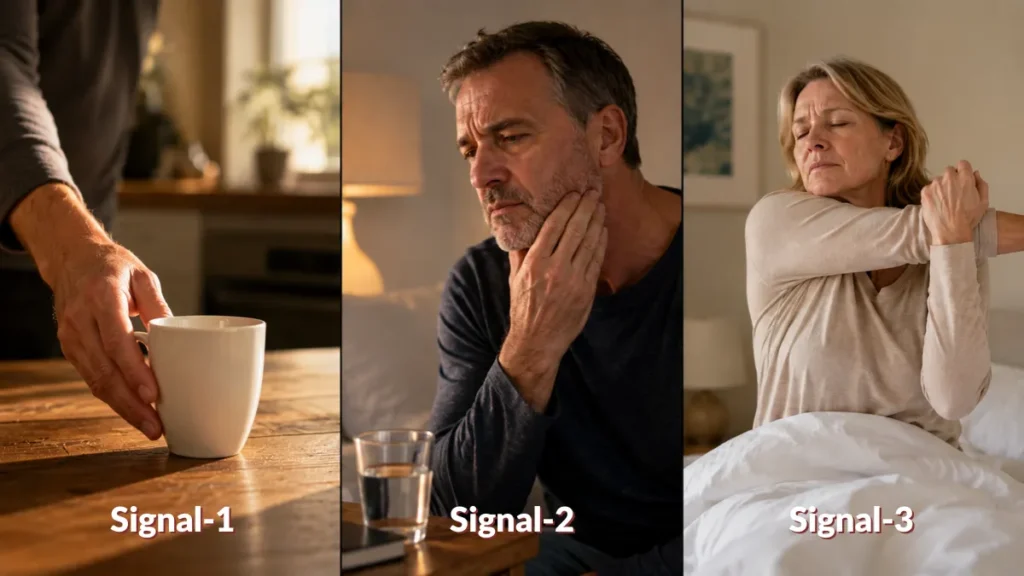
Signal 1: You feel almost okay for 30 to 45 minutes after waking, then crash. This points to circadian phase advance. Your cortisol awakening response [the natural spike in cortisol that occurs in the first 30 to 45 minutes after waking and gives the body its initial energy for the day] fires on schedule, giving you a brief window of alertness. Then it fades before your body has built up enough energy for the day.
The reason Signal 1 happens has to do with a cortisol pattern that shifts with age: research in healthy older adults aged 56 to 75 found that smaller overnight changes in cortisol were linked to lower subjective sleep quality.⁹
Signal 2: You wake up with a dry mouth, a dull headache at the temples, or a sore throat. Or your partner tells you that you snore or hold your breath.
This points toward sleep-disordered breathing. These are the morning signs of a night of repeated airway collapses. If you recognize any of these, ask your doctor about a home sleep study.
Signal 3: You feel physically heavy, stiff, and unrefreshed, but your mind clears within an hour. This points to slow-wave sleep deficit without breathing disruption. The body did not get the tissue repair deep sleep provides.
Most people over 55 dealing with morning fatigue will recognize one of these three more clearly than the others. That recognition is where action starts.
Four Actions Tied to the Specific Cause, Not Generic Advice
Generic sleep advice tells everyone to do the same things. This article does not.
Each action below is tied to one of the three causes named above.
1. Morning light gives your body clock the reset signal it ran on all your life.
Step outside or open a window within 20 minutes of waking to expose your eyes to natural light. Research on light therapy and older adults found that exposure to high light levels during morning hours is the key external stimulus that maintains a consistent 24-hour cycle.¹⁰
This targets the body clock shift described in H2-3 and helps anchor the cortisol awakening response at the right time.

2. A fixed wake time is the single fastest way to stabilize when your body expects to be asleep.
Set a wake time and hold it seven days a week. A meta-analysis of randomized controlled trials found that sleep restriction therapy (SRT), a behavioral treatment that consolidates sleep into a more efficient schedule, produced significant improvements in sleep efficiency and sleep onset latency in adults.¹¹
An inconsistent wake time drifts the body clock further and compounds the phase advance already happening with age.
3. If Signal 2 fits you, ask for a home sleep study this week.
Sleep apnea over 50 is common, treatable, and routinely missed. A home sleep study is non-invasive, done in your own bed, and takes one night.
4. Alcohol in the evening disrupts the second half of your sleep in ways most people do not realize.
Stop alcohol at least four hours before bed. Alcohol at moderate to high doses is linked to significant suppression of REM sleep [the sleep stage associated with memory processing, emotional regulation, and mental recovery] across the full night, along with increased wakefulness in the second half of sleep.¹²

The second half of the night is when REM and lighter restorative cycles dominate. Disrupting that second half compounds the deep-sleep deficit already present after 55.
Conclusion
The most important thing you can do today is get outside within 20 minutes of waking up. Step outside or open a window within 20 minutes of waking to expose your eyes to natural light and give your body clock the reset signal it needs. After that, pick the signal from the morning diagnostic section that matches your mornings and follow the one action tied to it.
Morning fatigue over 55 is not a mystery you are stuck with. Waking up tired after 8 hours of sleep past 55 is a message your body sends every day, and now you know how to read it.
⚠️DISCLAIMER:
This article is for informational purposes only and does not constitute medical advice, diagnosis, or treatment. The content addresses why adults over 55 wake up exhausted after eight hours of sleep and is intended for general educational purposes only. Health conditions vary significantly between individuals, always consult a licensed physician or qualified healthcare provider before making any decisions about your health or medical care.
References
- Sleep and immune function. Pflugers Archiv / European Journal of Physiology. PubMed. 2011. PMID: 22071480. https://pubmed.ncbi.nlm.nih.gov/22071480/
- longitudinal polysomnographic follow-up study of sleep architecture and aging. Sleep and Aging: A Polysomnographic Follow-Up Study. PMC. 2025. https://pmc.ncbi.nlm.nih.gov/articles/PMC12592829/
- Age-related changes in slow wave sleep and REM sleep and relationship with growth hormone and cortisol levels in healthy men. JAMA. 2000. https://pubmed.ncbi.nlm.nih.gov/10938176/
- “Norepinephrine-mediated slow vasomotion drives glymphatic clearance during sleep.” Cell. January 2025. https://www.cell.com/cell/fulltext/S0092-8674(24)01343-6
- Circadian system and aging: phase advance confirmed in middle-aged adults ages 45-64. PMC Frontiers review. 2025. https://pmc.ncbi.nlm.nih.gov/articles/PMC12575272/
- Physiological melatonin levels in healthy older people: A systematic review. PubMed. 2016. https://pubmed.ncbi.nlm.nih.gov/27302542/
- Age-related changes of circadian rhythms and sleep-wake cycles including advanced cortisol acrophase in older adults. Journal of Sleep Research. PubMed. 2002. https://pubmed.ncbi.nlm.nih.gov/12890070/
- Global prevalence of obstructive sleep apnea in older adults: a systematic review and meta-analysis. PubMed. 2023. https://pubmed.ncbi.nlm.nih.gov/37318436/
- Relationship between cortisol changes during the night and subjective and objective sleep quality in healthy older adults aged 56-75. PMC. 2020. https://www.ncbi.nlm.nih.gov/pmc/articles/PMC7068538/
- Light as therapy for sleep disorders and depression in older adults. PMC. 2003. https://pmc.ncbi.nlm.nih.gov/articles/PMC3839957/
- The effect of single-component sleep restriction therapy for insomnia in adults: a meta-analysis of randomised controlled trials. Journal of Sleep Research. 2025. https://onlinelibrary.wiley.com/doi/10.1111/jsr.70200
- Alcohol and sleep I: effects on normal sleep. PubMed. 2013. https://pubmed.ncbi.nlm.nih.gov/23347102/