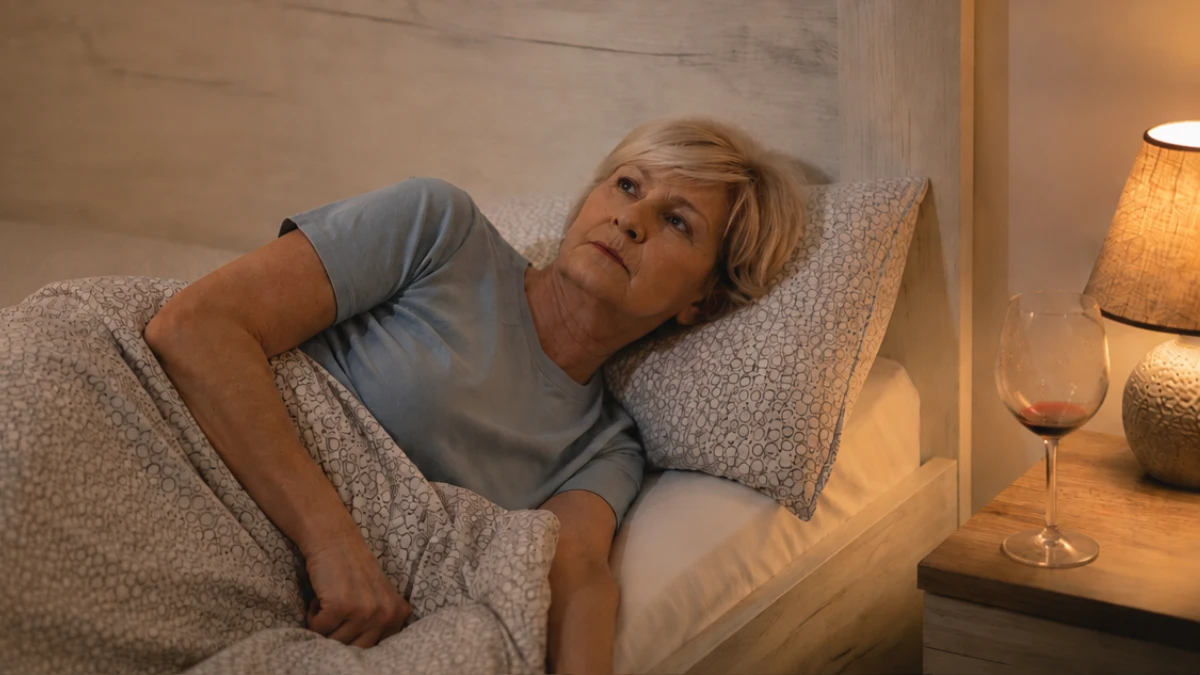
You pour a glass of wine after dinner, feel your shoulders drop, and drift off faster than you have in years. That part works. What happens three hours later does not.
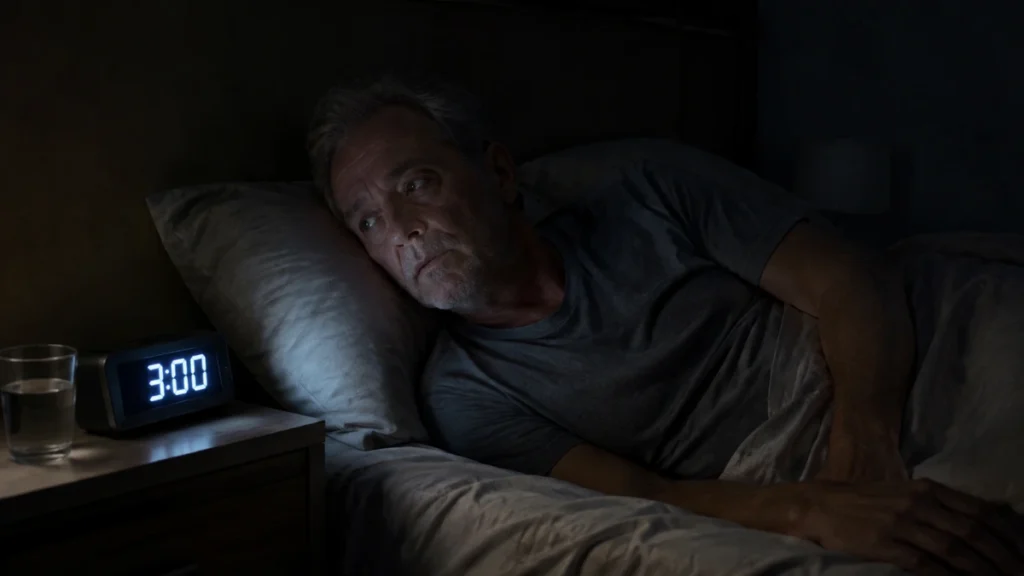
You are awake, staring at the ceiling, heart tapping a little harder than it should. You tell yourself it is the bathroom or the neighbor or just getting older. It is partly the wine, and it is working against sleep your body can no longer afford to lose.
Adults over 60 who drink wine or alcohol in the evening are not just disrupting a good night’s sleep. They are compounding damage to sleep that age has already started.
Why this article goes further than most:
- The evening glass might be doing something to your sleep hormone you have never considered, and the effect kicks in before you fall asleep
- Your body at 60 metabolizes alcohol differently than it did at 40, and the timing of that difference lands exactly when sleep matters most
- The 3am wake-up has a chemical explanation that has nothing to do with your bladder
- One change in timing (not in how much you drink) can show you within a week whether alcohol is your sleep thief
What Your Brain Is Already Losing Before Your First Sip
You probably already sense that sleep has changed. The feeling of waking fully rested, sharp and ready, has become less common over the past decade.
This is not a personal failure, and it is not something sleep hygiene alone can reverse. The brain itself changes how it builds sleep as you age.
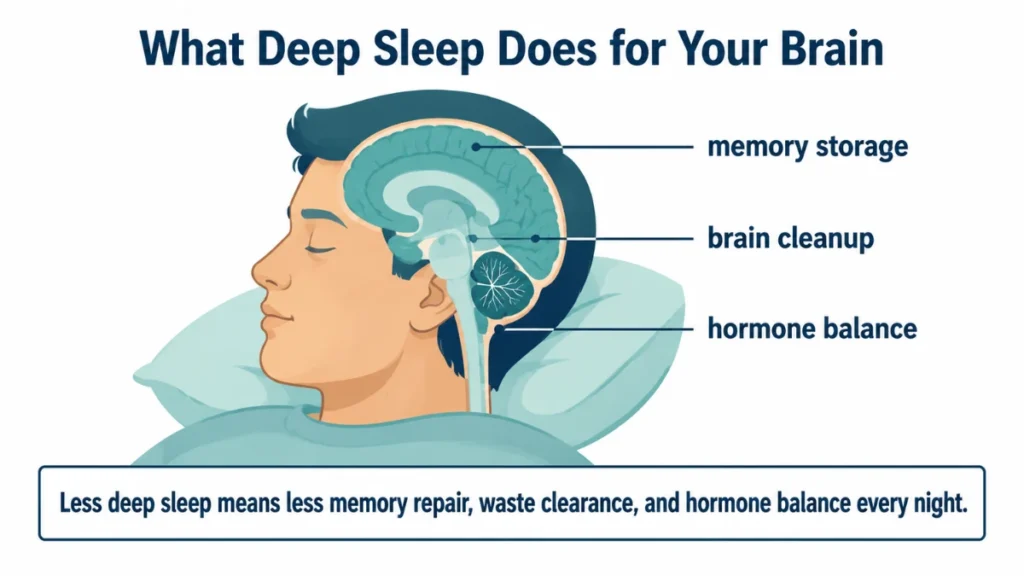
Slow-wave sleep [the deepest stage of sleep, when the brain runs its repair cycle and consolidates what you learned that day] begins declining in middle age and falls sharply after 60.¹
Adults past 60 show longer time to fall asleep, more frequent awakenings, less deep sleep, and shorter sleep cycles overall compared to younger adults.¹ This pattern holds across multiple large reviews.
The part that matters most for this article is what slow-wave sleep actually does. During this stage, the brain moves memories from short-term storage into long-term storage, clears metabolic waste through the glymphatic system, and regulates hormones that govern repair.
Less of it means less of all three.
What is rarely discussed in popular writing about sleep and aging is that adults over 60 start every night with a system already running below capacity. The baseline has shifted.
Any further disruption does not hit a healthy baseline. It hits a reduced one.
This is the setup that makes alcohol’s effect on sleep past 60 a different problem than the same effect at 35. Each part of that claim comes from a separate line of research.
The Starting Point Has Changed: Sleep Past 60 Is Not What It Was
You lie down with the same intention you always had: sleep through the night. But sleep after 60 has a different architecture than sleep at 40 or 30, and that difference is not random. It is structural.
Research on sleep and aging documents at least nine changes that begin accelerating in the fifth decade: earlier bed and wake times, longer time to fall asleep, more wakings, shorter overall duration, and more fragile sleep (more easily broken by noise or light).¹
Less slow-wave sleep, more time in lighter stages, shorter sleep cycles, and more time awake after waking also characterize the older adult pattern.¹ These are not symptoms of poor health. They appear in healthy older adults too.
The wine that sends you to sleep is metabolized into something that wakes your brain up, and your body past 60 clears it far more slowly than it did at 40.
If you have noticed that a single glass hits you harder now than it used to, that is real.²
Alcohol metabolism slows with age because the liver enzymes responsible for breaking it down become less active over time, leading to higher blood alcohol levels from the same dose.² Less of it takes longer to clear.
No single study puts all of this together for adults over 60 specifically. The aging sleep architecture data and the alcohol metabolism data come from separate research streams, each well-supported on its own.
That limitation belongs here, stated plainly: what follows is the best available picture from adjacent evidence, not a single direct proof.
Why the 3am Wake-Up Is Not Random
Alcohol makes you feel sleepy because it floods your brain with adenosine [a chemical that builds up while you are awake and signals that it is time to sleep]. The more adenosine present, the more pressure you feel to sleep.³
This is why a drink or two accelerates sleep onset. It pushes adenosine up fast.
The problem arrives three to five hours later. Once your liver has processed the alcohol, the adenosine signal collapses and the brain’s wake-promoting neurons fire back hard.³
This is why so many people who drink in the evening wake sharply in the early morning hours. Not because something external disturbed them, but because alcohol burned through the sleep pressure that was supposed to carry them through the night.
That mechanism was traced in animal research to adenosine acting on wake-active neurons in the base of the brain.³ Animal models cannot directly confirm this happens identically in humans, but the behavioral pattern (early sleep, mid-night waking, rebound alertness) is consistent across human sleep studies.
The disruption extends to REM sleep [the lighter sleep stage where the brain processes emotion and consolidates memory]. A 2024 meta-analysis of 27 sleep studies found that REM suppression begins at roughly two standard drinks and grows with each additional drink.⁴
Alcohol suppresses REM during the first half of the night, then a rebound follows in the second half: fragmented, vivid, and interrupted.⁴
Alcohol suppresses REM during the first half of the night, and the second half brings disrupted, lighter sleep as alcohol clears and its sedative effect fades.⁴
That disruption is associated with the broken, restless sleep in the early morning hours after drinking.
Past 60, the adenosine clock already runs differently. Age reduces the homeostatic sleep drive [the brain’s built-in pressure system that accumulates during wakefulness and pushes you into sleep]. Scientists still debate whether the drive itself weakens, or the brain just stops sensing it as well.⁵
The alcohol-induced adenosine spike clears on roughly the same schedule as at any age. The older brain simply has less reserve pressure to absorb the crash that follows. That cost is what the next section measures.
What One Glass Actually Takes From Your Night
One glass of wine with dinner seems harmless. It may be, from a liver standpoint. From a sleep standpoint, the damage starts before you fall asleep.
A double-blind crossover study in nine healthy volunteers found that evening alcohol consumption suppressed the body’s nocturnal melatonin [the hormone that signals the brain to shift into sleep mode and governs circadian timing] secretion by 41% at midnight, at doses typical of social drinking.⁶
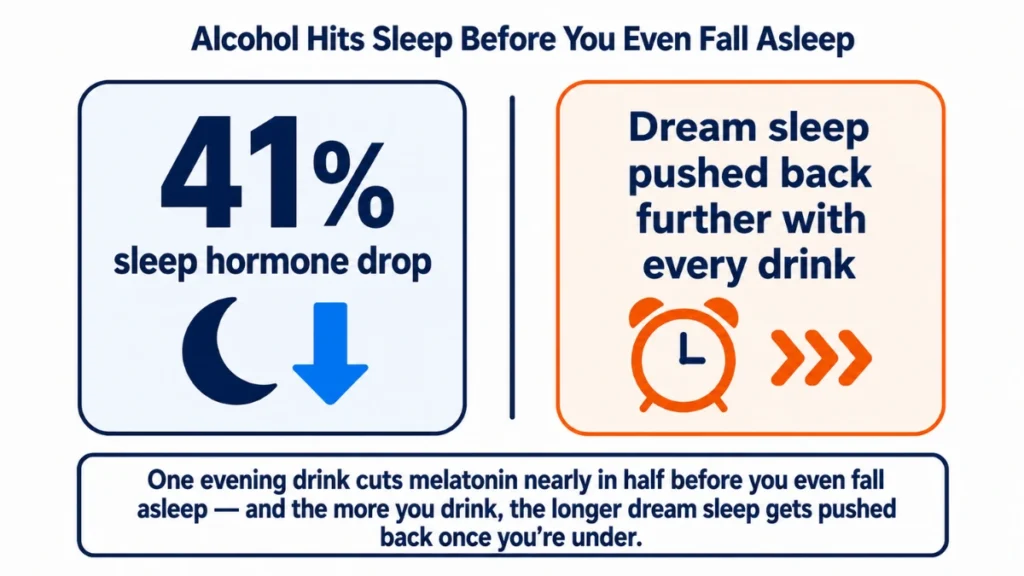
Forty-one percent.
Before you have even fallen asleep, the hormone that regulates when your sleep begins and how deep it goes has been cut nearly in half.
This matters more past 60 because melatonin production already declines with age. Evening alcohol does not suppress a robust melatonin signal. It suppresses one that is already lower than it was at 40.
Across the 27 studies, REM sleep onset latency [the time before the first REM period begins] was delayed by an average of 18 minutes in the alcohol condition, with the delay growing by approximately 30 minutes for every additional gram of alcohol per kilogram of body weight consumed, and REM duration fell significantly.⁴
Those are not rounding errors. They are the difference between a restorative night and one that leaves you foggy the next day.
The problem is not the drink. The problem is what the drink costs at a price nobody reads on the label.
Alcohol displaces the sleep you were about to earn with sleep that looks like rest but isn’t.
One more number worth knowing: the melatonin suppression in that study was dose-dependent.⁶ The second drink adds to the first. So what does this mean for someone with a condition that already puts breathing at risk during sleep?
When Alcohol Also Becomes a Breathing Problem
Something else can go wrong during sleep past 60, and it has nothing to do with brain waves. It happens in the airway.
Obstructive sleep apnea [a condition where the throat muscles relax enough during sleep to block breathing repeatedly throughout the night] becomes more common with age.
A 2018 systematic review and meta-analysis found that alcohol consumption is associated with a higher risk of sleep apnea in adults.⁷
Alcohol relaxes the muscles that keep the airway open, which worsens the condition in people who already have it.
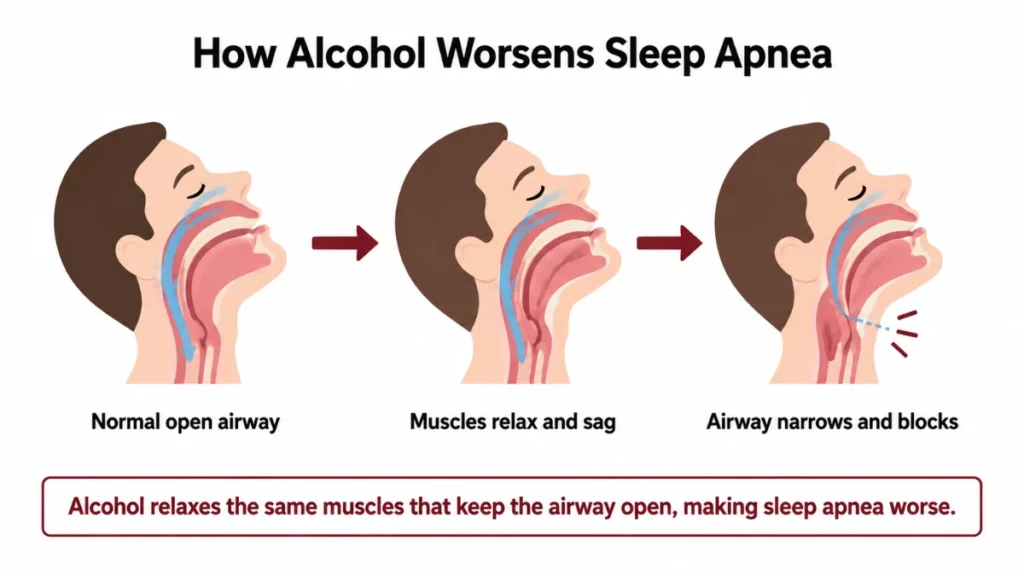
Most of the sleep apnea research on alcohol covers adults broadly rather than adults over 60 specifically. That it worsens apnea is well-documented in the broader population.
How much more severely it affects the already-narrowed airways common in older adults is less precisely quantified. That gap belongs acknowledged here, not in a footnote.
Sleep apnea matters in this article because many older adults have it without knowing it. The condition is associated with fragmented sleep, unrefreshing sleep, and morning fatigue: symptoms that look exactly like the disruption described in earlier sections.
If you regularly wake tired despite a full night in bed, talk to your doctor about whether a breathing disorder warrants investigation before you make changes to your evening routine.
That conversation applies here because alcohol does not just interrupt sleep architecture. For some people, it actively makes breathing during sleep worse.
A One-Week Test That Shows You the Difference
You do not need a sleep tracker to know whether alcohol is disrupting your sleep. You need seven nights and one rule.
The recommendation to finish alcohol at least three to four hours before bedtime is practical harm reduction, not a proven clinical threshold.⁸
It is based on typical alcohol clearance times: at a standard drinking rate, alcohol metabolized in the first four hours of sleep is mostly gone before the rebound waking window.⁸
For adults over 60, whose clearance is slower, four hours is the more conservative and appropriate target.²
If you take blood pressure medication, a sedative, an antihistamine, or a sleep aid, check with your doctor before adjusting your drinking timing.²
Alcohol interacts with a wide range of medications common in later life, and the sleep effects described in this article may be compounded by those interactions.²
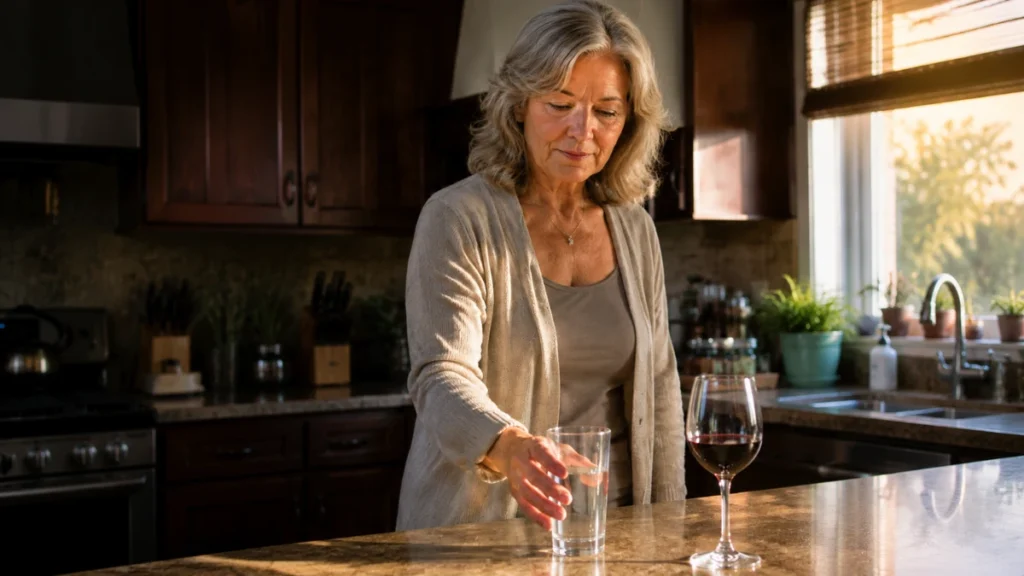
- For seven consecutive nights, stop drinking at least four hours before your usual bedtime.
- Keep everything else the same: same bedtime, same wake time, same dinner, same routine.
- On nights one through three, note how easily you fall asleep (easier, same, harder).
- On nights four through seven, note whether you wake in the early morning hours as often as before.
The point of the test is not abstinence. It is information. Most people who try it report a noticeable shift by day four or five.
If you notice no change by day seven, treat that as information too. Bring it to your doctor as a starting point for finding what is actually in the way.
The Night Starts Earlier Than You Think
Sleep quality after 60 is already running thinner than it did in earlier decades. Alcohol does not create that problem, but it reliably makes it worse. Alcohol clears, the brain rebounds, and the second half of the night pays the price.
Move your last drink to at least three hours before bedtime for one week and track whether you wake less in the night.
The research that directly tests these effects together in adults over 60 is still thin. Better studies on this exact population would change how precisely this advice can be calibrated.
⚠️Disclaimer
This content is for informational and educational purposes only and does not constitute medical advice. Always consult your healthcare provider before making changes to your diet, alcohol intake, or sleep routine, especially if you have underlying conditions or take medications. Individual responses to alcohol vary.
References
- Mander BA, Winer JR, Walker MP. Sleep and Human Aging. Neuron. 2017. https://www.sciencedirect.com/science/article/pii/S0896627317300880
- Meier P, Seitz HK. Age, alcohol metabolism and liver disease. Current Opinion in Clinical Nutrition and Metabolic Care. 2008. https://pubmed.ncbi.nlm.nih.gov/18090653/
- Thakkar MM, Sharma R, Sahota P. Alcohol disrupts sleep homeostasis. Alcohol. 2015. https://pubmed.ncbi.nlm.nih.gov/25499829/
- Gardiner C, Weakley J, Burke LM, Roach GD, Sargent C, Maniar N, Huynh M, Miller DJ, Townshend A, Halson SL. The effect of alcohol on subsequent sleep in healthy adults: a systematic review and meta-analysis. Sleep Medicine Reviews. 2024. https://www.sciencedirect.com/science/article/pii/S1087079224001345
- Taillard J, Gronfier C, Bioulac S, Philip P, Sagaspe P. Sleep in Normal Aging, Homeostatic and Circadian Regulation and Vulnerability to Sleep Deprivation. Brain Sciences. 2021. https://pmc.ncbi.nlm.nih.gov/articles/PMC8392749/
- Ekman AC, Leppäluoto J, Huttunen P, Aranko K, Vakkuri O. Ethanol inhibits melatonin secretion in healthy volunteers in a dose-dependent randomized double blind cross-over study. Journal of Clinical Endocrinology and Metabolism. 1993. https://pubmed.ncbi.nlm.nih.gov/8370699/
- Simou E, Britton J, Leonardi-Bee J. Alcohol and the risk of sleep apnoea: a systematic review and meta-analysis. Sleep Medicine. 2018. https://www.ncbi.nlm.nih.gov/pmc/articles/PMC5840512/
- Bolling C, Cardoni ME, Arnedt JT. Sleep and Substance Use: Exploring Reciprocal Impacts and Therapeutic Approaches. Current Psychiatry Reports. 2025. https://pmc.ncbi.nlm.nih.gov/articles/PMC12942847/