

Somewhere around midday, the wall shows up. You were fine an hour ago, and now your eyelids feel heavy and your focus is gone, even though you slept reasonably well and ate breakfast.
If you’re over 50 and this happens at almost the same time every day, you’ve probably already blamed lunch, blamed your sleep, maybe blamed getting older in general.
The real explanation is more specific than any of those. That predictable midday crash is often a sign of how your cortisol after 50 behaves across the whole day, not just whether you have enough of it.
What’s Actually Behind That Wall
- Your crash hits on a schedule your coffee can’t touch, and the reason has nothing to do with how much you slept
- The morning window that sets your entire day’s energy opens and closes within the first hour after waking
- Why the number of hours you sleep may be the least important part of what happens to your afternoon
- The one thing most articles about cortisol after 50 get completely backwards
The Crash Isn’t What You Think
It feels like running out of gas. One minute you’re working through your to-do list, the next you’re staring at the same paragraph for the third time, wondering if you should just give up and call it a day.
That sensation is real, but the cause usually isn’t an empty tank.
Your body isn’t out of cortisol at noon. It’s that the daily rhythm shaping cortisol after 50 has changed shape as you’ve aged, and a flatter rhythm feels a lot like running on empty even when the levels themselves aren’t low.
The timing is the tell. If your crash hits within the same thirty-minute window almost every day, regardless of how much coffee you drank or how well you slept the night before, that consistency points to a built-in rhythm rather than a random dip.

A crash caused by poor sleep or a heavy lunch tends to vary day to day. A crash caused by your cortisol pattern shows up on schedule, because it’s tracking your internal clock rather than yesterday’s choices.
You’ve probably noticed this without naming it. Maybe you’ve stopped scheduling anything important after 1 p.m. because you already know how that hour will go.
That’s not a coincidence and it’s not a willpower problem. It’s a pattern your body has been running for years, and once you know what’s driving it, you can work with it instead of fighting it blind.
What Actually Happens to Your Cortisol After 50
You’ve probably assumed your hormones are simply running low by midday. With cortisol after 50, that assumption is backward. The hormone doesn’t disappear, the daily rhythm that’s supposed to shape it gets weaker.
Healthy cortisol is supposed to spike hard right after you wake up, then fall steadily for the rest of the day, hitting its lowest point at night. Researchers call this daily decline a slope, and a steep slope is the healthy pattern.¹
One study of 69 older adults found that those with a flatter cortisol slope, independent of age within the group, tended to make riskier decisions than those with a steeper slope.¹
A flatter slope has also been linked to riskier financial decision-making in older adults, which suggests the rhythm itself, not just the hormone level, affects how the mind functions day to day.¹
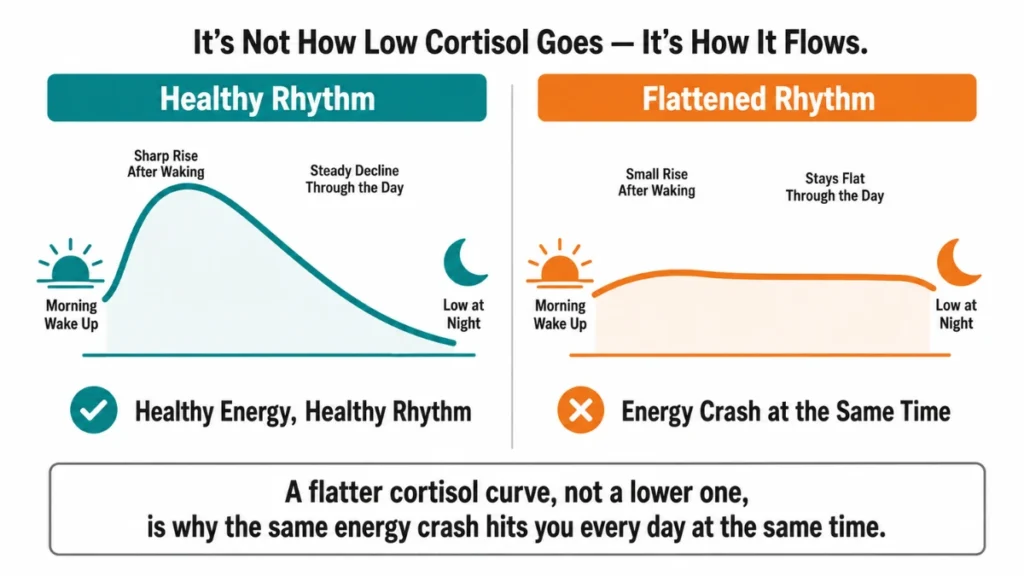
This matters because a flat rhythm doesn’t feel like “too much cortisol.” It feels like a crash, because your body is missing the steep morning peak and clean afternoon drop that’s supposed to organize your energy.
The Cortisol Awakening Response [the sharp rise in cortisol in the first half hour after waking] also tends to decline with older age.²
Without that strong morning push, the whole day’s rhythm starts from a lower, flatter baseline, which leaves less contrast between your most alert hours and your least alert ones.
It’s not about running out of cortisol. It’s about losing the shape of it.
The Midlife Twist Nobody Mentions
You’ve probably read that stress wears you down until your adrenal system gets tired and your cortisol fades. That story is common, but it doesn’t match what shows up in midlife women specifically, and it’s worth pausing on because it changes how you should think about your own crash.
During the menopause transition, cortisol doesn’t reliably fall.³ In one study tracking women through the menopause transition, cortisol levels were highest during the late transition stage compared to earlier stages, running counter to the ‘burnout’ story of steadily declining cortisol.³
Research on hot flashes and daytime cortisol has been mixed, with at least one study finding no consistent link between hot flash frequency and cortisol patterns across the day.⁴
That inconsistency is itself useful. It means the menopause-cortisol connection isn’t as simple as more symptoms equaling more stress hormone.
And the HPA axis [the brain-to-adrenal-gland system that controls cortisol release] involved here is responding to more than one signal at once.
This research speaks directly to women in the menopause transition. The broader pattern it points to, a rhythm that flattens rather than a supply that runs out, is the same one the age-related slope data described earlier applies to people of any sex past 50.
For most people past 50, cortisol isn’t running out by noon, it’s running too high, too flat, all day long, and that flatness is what gets mistaken for an energy crash.
That’s the real finding here: the body isn’t quitting, it’s stuck on.
A fair caveat belongs here too. No single study has directly tracked the connection between this midday crash feeling and cortisol’s daily slope in adults over 50.
This picture is built by combining separate findings, the slope flattening with age, the sleep-cortisol link covered next, and the menopause-related rise, rather than from one study that tested the full chain at once. Each piece is well supported on its own.
The full connection between them is a reasonable read of the evidence, not a settled, single-study fact.
The Morning Window That Sets Your Whole Day
You probably think your energy problem starts at noon. It actually starts hours earlier, in the first sixty to ninety minutes after you open your eyes.
A systematic review of human studies, mostly in younger adults, found that bright light exposure in the early morning is associated with measurable increases in cortisol, especially from light with more blue and green wavelengths.⁵
Dim, low-light mornings, the kind you get from a lamp or overcast daylight through a window, fall well below the brightness levels shown to raise cortisol in that research, which is part of why this window matters more than people assume.⁵
That morning light exposure appears to act as a timing cue for the rest of the day’s cortisol rhythm.⁵
This part is easy to dismiss: it’s not about getting more sleep or eating differently first thing. It’s about whether your eyes get bright, blue-rich light early, whether that’s from stepping outside or a well-lit room, before the rhythm for the day has already been set by the dim light most people wake up into.

If your mornings are spent indoors under regular room lighting until you’re already at your desk, your body may never get the strong wake-up signal that’s supposed to kick off a steep, healthy cortisol slope.
Typical dim home lighting is well below the bright light conditions shown to raise cortisol in that research, which is part of why this window matters more than people assume. ⁵
Dim, low-light mornings, the kind you get from a lamp or overcast daylight through a window, fall well below the brightness levels shown to raise cortisol in that research, which is part of why this window matters more than people assume.⁵
This is one piece of the rhythm you can actually influence directly, starting tomorrow morning.
Why Sleep Fixes the Afternoon, Not Just the Night
You’ve probably been told that bad sleep makes you tired the next day. That’s true, but it undersells what’s actually happening to your cortisol while you’re tossing and turning.
A study of older adults using wrist sensors to track sleep found that more fragmented sleep, meaning more small awakenings through the night, was linked to higher cortisol levels measured during the day.⁶
Longer stretches of being awake after initially falling asleep showed the same pattern.⁶
Total sleep duration alone wasn’t linked to daytime cortisol in this study, which suggests it’s the choppiness of your sleep, not just the hour count, that shapes your rhythm most.⁶
That distinction is worth sitting with. Two people can both get seven hours of sleep, and the one whose sleep was repeatedly interrupted may be carrying a higher, flatter cortisol pattern into the next day than the one who slept straight through.

This connects directly back to your noon crash. A higher daytime cortisol baseline, fed by a restless night, makes the gap between your morning energy and your afternoon dip even less noticeable, because there’s less contrast left to lose.
Building Your Reset Day
None of this means starting over. It means shifting a handful of habits that already sit inside your normal day, aimed at the parts of your rhythm that are actually flexible.
Protein timing is one of them.
A study of older adults found that higher protein intake at breakfast and lunch was associated with higher total daily protein intake overall, a simple way to hit daily protein targets without cutting back later.⁷
Many of the study’s participants were also managing their weight, so results may look somewhat different for other groups.

This is associative evidence, not a controlled trial, so treat it as a reasonable habit shift rather than a guaranteed fix.
A few habits, taken together, target the actual rhythm rather than just the symptom. Talk to your doctor before changing your supplement routine, exercise habits, or daily medication timing if you’re managing a chronic condition or taking prescription medication.
- Get outside for direct light within the first hour of waking, even on a cloudy day, before screens or indoor lighting take over your morning.
- Eat a protein-forward breakfast and lunch instead of saving most of your protein for dinner.
- Protect your sleep continuity, not just your sleep duration, by keeping a consistent wake time and a cool, dark, quiet room.
- Schedule your hardest tasks earlier in the day, while your natural cortisol rhythm still has contrast left to give.
Pick one of these to start with this week. The rhythm responds to consistency more than intensity, so a small habit kept daily will do more than an ambitious one kept occasionally.
Your Rhythm, Not Your Reserves
The real reframe is simple: your noon crash isn’t a sign that you’re running out of cortisol after 50, it’s a sign that the daily rhythm shaping it has gone flat. “More sleep” alone rarely fixes that.
Get outside for direct light within an hour of waking, every day this week, and track whether your noon crash shifts.
Your body is running the same clock it always has, just with a softer signal. The open question is how much of that signal you can recover, and the answer probably depends on how consistently you work with the rhythm rather than around it.
⚠️DISCLAIMER:
This article is for informational purposes only and does not constitute medical advice, diagnosis, or treatment. The content addresses cortisol rhythm changes and energy crashes after age 50 and is intended for general educational purposes only. Health conditions vary significantly between individuals, always consult a licensed physician or qualified healthcare provider before making any decisions about your health or medical care.
References
- Weller JA, Buchanan TW, Shackleford C, Morganstern A, Hartman JJ, Yuska J, Denburg NL. Diurnal Cortisol Rhythm Is Associated With Increased Risky Decision Making in Older Adults. Psychology and Aging. 2014. https://pmc.ncbi.nlm.nih.gov/articles/PMC4219869/
- Stalder T, Oster H, Abelson JL, Huthsteiner K, Klucken T, Clow A. The Cortisol Awakening Response: Regulation and Functional Significance. Endocrine Reviews. 2025. https://academic.oup.com/edrv/article/46/1/43/7739741
- Woods NF, Mitchell ES, Smith-DiJulio K. Cortisol Levels During the Menopausal Transition and Early Postmenopause: Observations From the Seattle Midlife Women’s Health Study. Menopause. 2009. https://pmc.ncbi.nlm.nih.gov/articles/PMC2749064/
- Gerber LM, Sievert LL, Schwartz JE. Hot Flashes and Midlife Symptoms in Relation to Levels of Salivary Cortisol. Maturitas. 2017. https://pmc.ncbi.nlm.nih.gov/articles/PMC5215844/
- Robertson-Dixon I, Murphy MJ, Crewther SG, Riddell N. The Influence of Light Wavelength on Human HPA Axis Rhythms: A Systematic Review. Life (Basel) / PMC. 2023. https://www.ncbi.nlm.nih.gov/pmc/articles/PMC10608196/
- Morgan E, Schumm LP, McClintock M, Waite L, Lauderdale DS. Sleep Characteristics and Daytime Cortisol Levels in Older Adults. SLEEP. 2017. https://academic.oup.com/sleep/article/40/5/zsx043/3064347
- Verreijen AM, van den Helder J, Streppel MT, Rotteveel I, Heman D, van Dronkelaar C, Memelink RG, Engberink MF, Visser M, Tieland M, Weijs PJM. A Higher Protein Intake at Breakfast and Lunch Is Associated With a Higher Total Daily Protein Intake in Older Adults: A Post-Hoc Cross-Sectional Analysis of Four Randomised Controlled Trials. Journal of Human Nutrition and Dietetics. 2021. https://www.ncbi.nlm.nih.gov/pmc/articles/PMC8048646/