
You pick up a product you trust, read “No Added Sugar” on the front, and put it in your cart without a second thought. You’ve been doing everything right, and you still can’t shake the feeling that something in the ingredient list doesn’t add up.
After 50, your metabolism is less forgiving. A hidden sweetener that would barely register at 35 can now push fasting glucose up, stall weight loss, or drive inflammation you can’t explain.
The label is not lying. It’s using a legal gap to hide sugar on labels under nine alternate names, each invisible to anyone who only knows to look for the word “sugar.”
This article names all nine. For adults over 50 managing blood sugar or weight, knowing these names changes how you shop.
This article is for informational purposes only and does not constitute medical or nutritional advice. Individual responses to ingredients vary by age, health status, and medication. If you manage blood sugar or any metabolic condition, consult your doctor before changing your diet.
How the ‘No Added Sugar’ Claim Works, and Where It Breaks Down
Reading sugar on labels starts with knowing what the “No Added Sugar” claim actually means under FDA rules.
The claim is legal when a manufacturer avoids adding any ingredient the FDA formally classifies as an added sugar. That definition includes sucrose, dextrose, syrups, honey, and concentrated fruit or vegetable juices added during processing.¹
Here is where it breaks. A manufacturer can replace a single sweetener called “sugar” with three smaller sweeteners named something else. Each one sits lower on the ingredient list because it weighs less. None of them triggers the formal classification on its own. The front panel stays clean.
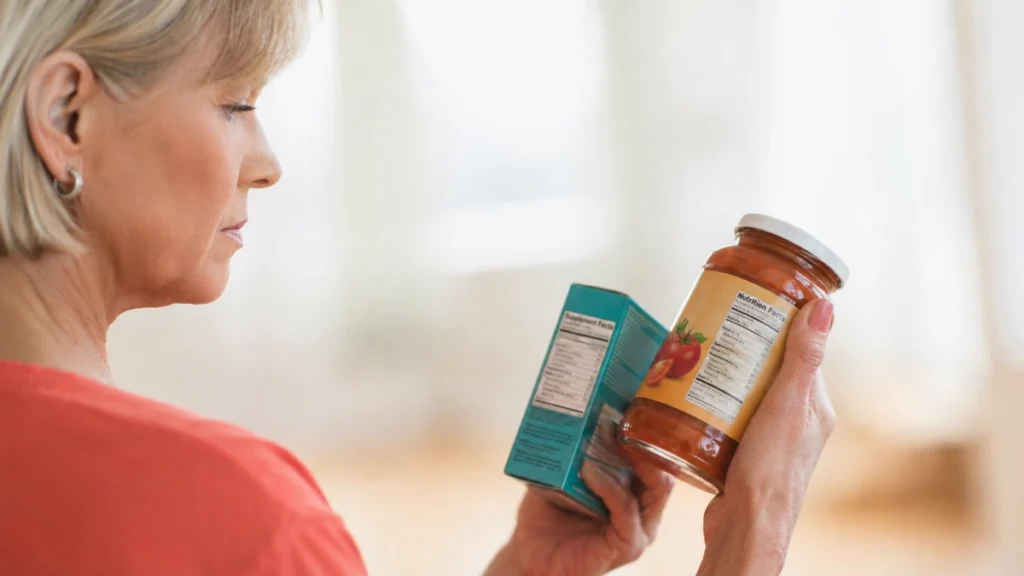
This is how sugar on labels disappears without actually leaving. The ingredient list must name every additive. But there’s no rule that the name has to signal “sweetener” to you.
Your daily budget for added sugar is 50 grams based on a 2,000-calorie diet, about 12 teaspoons.¹ One product using two or three of the names below can take a third of that budget before you open it.
The question isn’t whether this is legal. It is. The question is: how many of these nine names are already in your kitchen?
What “No Added Sugar” Actually Means Under FDA Rules
The front-panel claim is legal if no ingredient classified as an added sugar was added during processing. But classification depends on the name used, not the chemistry.
A sweetener renamed or split into smaller portions under different labels may clear the legal threshold and still end up in your body. Reading the ingredient list is the only way past this.
Name 1: Maltodextrin
Pick up a protein shake, a meal replacement bar, or a powdered “sugar-free” drink mix. Turn it over. Finding sugar on labels this hidden starts with knowing what maltodextrin actually is.
It looks like a preservative. It sounds like a fiber. It’s neither. Maltodextrin is a white powder made from corn, rice, or potato starch.² Manufacturers use it as a filler and thickener, which gives it a non-sugar function and earns it a non-sugar name. That name is what lets it appear on “No Added Sugar” products.
Its glycemic index sits between 85 and 105.² Table sugar scores around 65 on the glycemic index, with published values ranging from the high 50s to around 80.²
Your blood sugar rises faster from maltodextrin than from actual sugar.
It’s classified as a complex carbohydrate, not a sugar. That’s the legal basis for its placement. But when you eat it, your body breaks it down almost instantly. There’s no fiber slowing it. It hits your bloodstream the same way glucose does, and it does it faster.
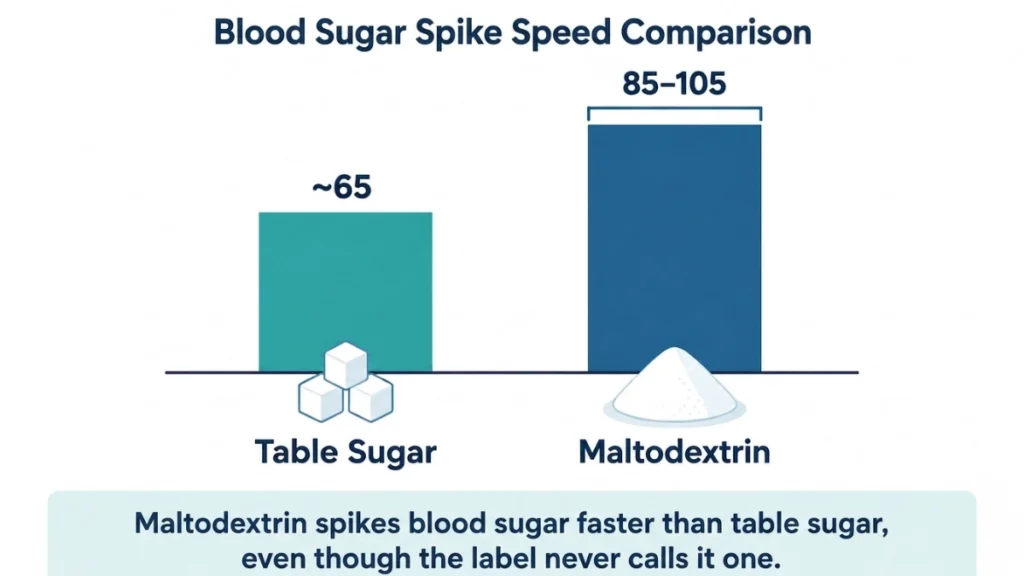
Look for it in protein powders, granola bars labeled “no sugar added,” powdered coffee creamers, and packaged soups. It won’t appear under the word “sweetener.” It appears under its own name, which is exactly the point.
It’s classified as a carbohydrate, not a sugar. Your pancreas doesn’t make that distinction.
Name 2: High-Fructose Corn Syrup
Many people believe high-fructose corn syrup was largely removed from products after consumer backlash. Some brands did remove it. They often replaced it with crystalline fructose, glucose syrup, and corn syrup solids listed separately. The fructose content didn’t leave. The name did.

High-fructose corn syrup is a mix of free fructose and glucose. Glucose enters your bloodstream and your cells use it directly. Fructose goes to your liver.
Your liver converts excess fructose into fat through a process called de novo lipogenesis. In plain terms: when your liver gets more fructose than it can handle, it makes fat instead of fuel.
A controlled study found that consuming HFCS-sweetened beverages for 15 days increased liver fat and reduced insulin sensitivity in adults, with effects scaling as the dose went up.³ At doses providing as little as 10% of daily calories from HFCS, post-meal glucose and lactate rose measurably.³
Your liver responds to the fructose load regardless of what name it arrived under.
If you stopped reading HFCS on labels years ago and assumed the problem was solved, check again.
Look for crystalline fructose, glucose syrup, or corn syrup solids. They often appear together on the same ingredient list, each one too small to flag on its own, all of them adding up to the same liver load from sugar on labels you didn’t recognize.
Name 3: Agave Nectar
You’ll see agave nectar on products near the organic granolas, the “natural” protein bars, and herbal teas with added sweetener. It’s marketed as low-glycemic and diabetes-friendly. That part is technically true. What isn’t mentioned is why it’s low-glycemic, and why the number tells only half the story.
Agave nectar is mostly fructose, more of it than table sugar or most other sweeteners. Its glycemic index is around 10 to 19, depending on the product, because fructose doesn’t enter your bloodstream as glucose.⁴ The glycemic index measures blood glucose response only.
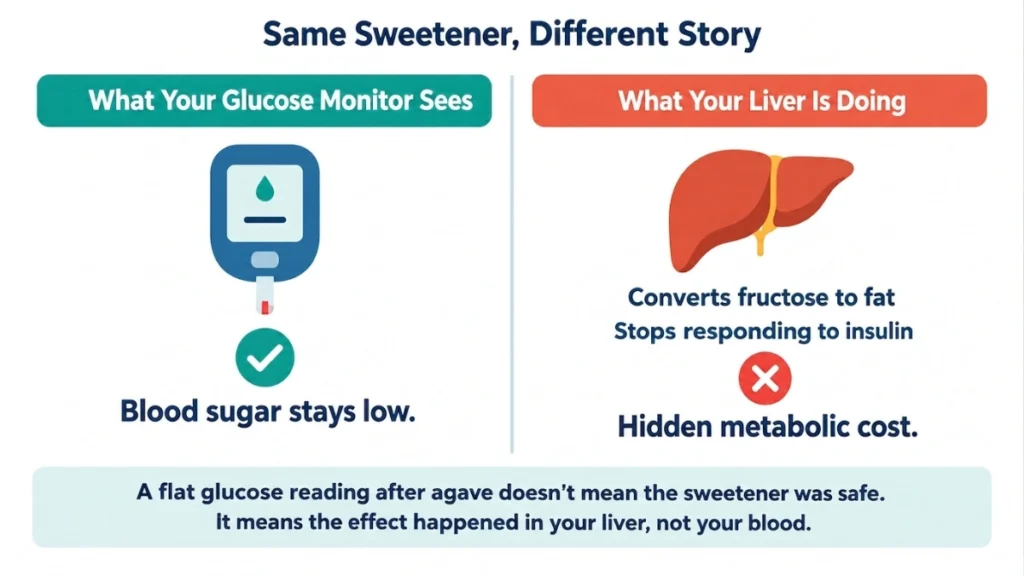
Fructose bypasses your blood sugar and goes straight to your liver.
When you eat agave, your glucose monitor may barely move. That isn’t because the sweetener had no effect. It’s because the effect happened somewhere the monitor can’t see.
In large amounts and as part of a calorie surplus, dietary fructose can cause the liver to resist insulin and increase fat storage.³,⁵ This research includes both animal models and human studies.³,⁵
Manufacturers use agave because it carries a health story that fits the “No Added Sugar” front panel perfectly. Low GI. Natural. Plant-based. All of those things are true. None of them tell you what your liver is doing.
A flat glucose reading after eating agave isn’t a clean bill of health. It’s a sign that the metabolic event happened where your meter doesn’t measure.
Name 4: Fruit Juice Concentrate
Picture a granola bar in the health food aisle. The front says “No Added Sugar, sweetened only with real fruit.” You turn it over. The second ingredient is apple juice concentrate.
Fruit juice concentrate is made by removing the water from fruit juice. The fiber leaves with the water. What stays is a dense mix of fructose and glucose, stripped of everything that would slow absorption in a whole piece of fruit. When used as a sweetener in a processed food, the FDA classifies it as an added sugar.¹
The front panel can still say “No Added Sugar.”
Manufacturers argue the concentrate is a natural ingredient from fruit, not a processing additive. Knowing that distinction requires the consumer to know the rule exists. Most don’t.

If you manage blood sugar, take medication for diabetes, or are working with a doctor on your diet, check with your provider before making changes based on any label information.
Watch for these four on ingredient lists:
- Apple juice concentrate
- Grape juice concentrate
- White grape juice concentrate
- Pear juice concentrate
A bar labeled “sweetened only with fruit” with apple juice concentrate second on its list delivers the same sugar load as one sweetened with cane sugar. The fiber that would slow absorption in the whole fruit is gone.
You bought the bar because it said “real fruit.” The concentrate is real. It just isn’t whole.
Name 5: Evaporated Cane Juice
You’ll find this one on yogurt, protein bars, and crackers that position themselves as cleaner alternatives to mainstream snacks. The name sounds like something pressed from a plant. That impression is the entire strategy.
Evaporated cane juice is sugar. It comes from sugar cane, the water is removed, and what remains is a crystallized sweetener that behaves in your body exactly like the cane sugar in any other product.
The FDA agrees. FDA said in 2016 final guidance that “evaporated cane juice” is false or misleading and does not reveal the ingredient’s basic nature as a sugar.⁶
The FDA told manufacturers to relabel it as “sugar.”
Not every brand complied. Smaller producers and products with older label versions still use the original name. If you see “evaporated cane juice” on an ingredient list, read it as “sugar.” The FDA already does.
This name survives because the word “juice” carries a health association that the word “sugar” does not. That association is the product. The ingredient is the same either way.
If a brand is still using this term in 2026, that’s worth noting. The FDA guidance is ten years old.
Name 6: Coconut Sugar
Coconut sugar is one of the most aggressively marketed sweeteners in the over-50 wellness space. You’ll see it on packaging next to words like “low glycemic,” “mineral-rich,” and “diabetic-friendly.”
Those claims have enough truth in them to sound credible. They don’t have enough truth to make coconut sugar a safe substitute.
A glycemic index of 35 for coconut sap sugar appears in the literature and traces back to Trinidad and colleagues.⁷ That number has not been consistently replicated. More recent independent measurements place coconut sugar’s GI closer to 56, which is similar to regular white sugar.⁷
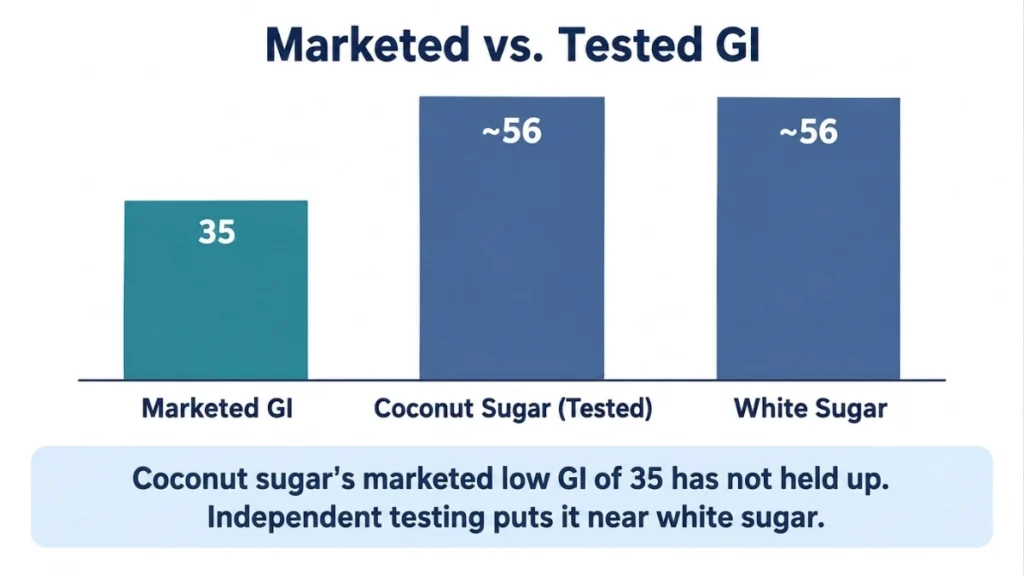
More importantly, a controlled study testing coconut jaggery, a solid sweetener made from the same coconut sap, against cane sugar in adults with type 2 diabetes found no statistically significant difference in peak blood glucose or total blood sugar response.⁷
The authors concluded that coconut jaggery cannot be recommended as a healthier substitute for cane sugar in people with type 2 diabetes.
Coconut sugar is roughly 70 to 80% sucrose.⁸ That’s the same molecule as table sugar.
The minerals it contains, small amounts of iron, zinc, and potassium, are present in quantities too small to make a meaningful nutritional difference at the serving sizes people actually use.
The marketing is real. The health advantage isn’t.
Name 7: Dextrose
Dextrose appears on ingredient lists for everything from packaged bread to cured meats to sports drinks. It sounds medical. It sounds precise. It doesn’t sound like sugar, which is precisely why manufacturers use it.
Dextrose is glucose. It’s the same simple sugar your body runs on, derived from corn starch through a process called hydrolysis.¹⁰ When you eat dextrose, your body processes it identically to any other glucose source. There’s no conversion step. It enters your bloodstream directly and raises blood sugar immediately.
The FDA lists dextrose as an added sugar.¹ A product that replaces “sugar” with “dextrose” on its ingredient list has not reduced its sugar content. It has renamed it.

This is one of the cleaner examples of the tactic this article is built around. The chemistry didn’t change. The label did.
Dextrose appears in products that carry “No Added Sugar” claims when manufacturers argue it was added for a functional purpose, as a preservative or browning agent, rather than as a sweetener. The function is real. The blood glucose effect is the same regardless.
If you see dextrose near the top of an ingredient list, you’re looking at added glucose. The name is the only thing that changed.
Name 8: Brown Rice Syrup
Brown rice syrup gets its good reputation from two words: brown and rice. Both carry health associations. Neither one changes what the sweetener does once you eat it.
Brown rice syrup is made by fermenting cooked brown rice with enzymes that break down its starch into simpler sugars. Brown rice syrup’s main components are maltose and glucose.⁹ Both raise blood sugar. The CDC identifies rice syrup alongside corn syrup and high-fructose corn syrup as a hidden sugar name that people managing blood sugar should watch for on ingredient lists.¹²
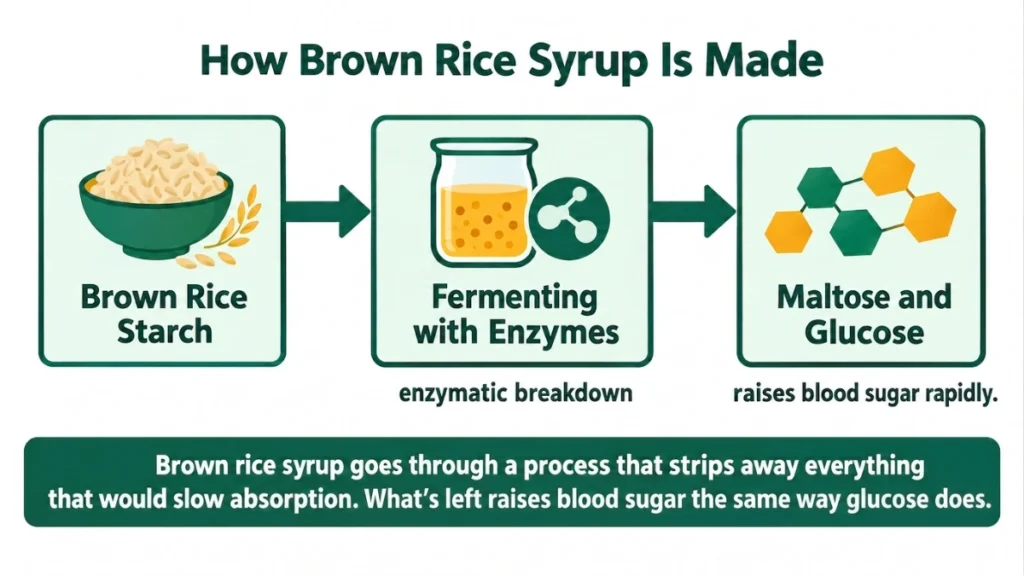
It has a high glycemic load, meaning it raises blood sugar quickly.
You’ll find it in organic cereals, “natural” energy bars, rice cakes with flavoring, and some plant-based protein products. The organic certification on the packaging often draws the eye before the ingredient list does. That’s the strategy.
Brown rice syrup is common in products that have removed HFCS and replaced it with something that sounds better. The glucose load is comparable. The label tells a different story.
The word “brown rice” tells you where it came from. It doesn’t tell you what it does after you swallow it. Those are two different pieces of information, and only one of them is on the label.
Name 9: Maltose
Maltose is the quietest name on this list. It doesn’t appear as often as the others. When it does, it’s usually in a product made from fermented or sprouted grains, a specialty granola, a malt-based cereal, or a “natural” protein bar using germinated ingredients.
Maltose is a disaccharide, meaning two glucose molecules bonded together.¹¹ Your digestive system splits them apart within seconds of consumption. The result is two units of glucose entering your bloodstream in rapid succession. The blood glucose effect is close to eating glucose directly.
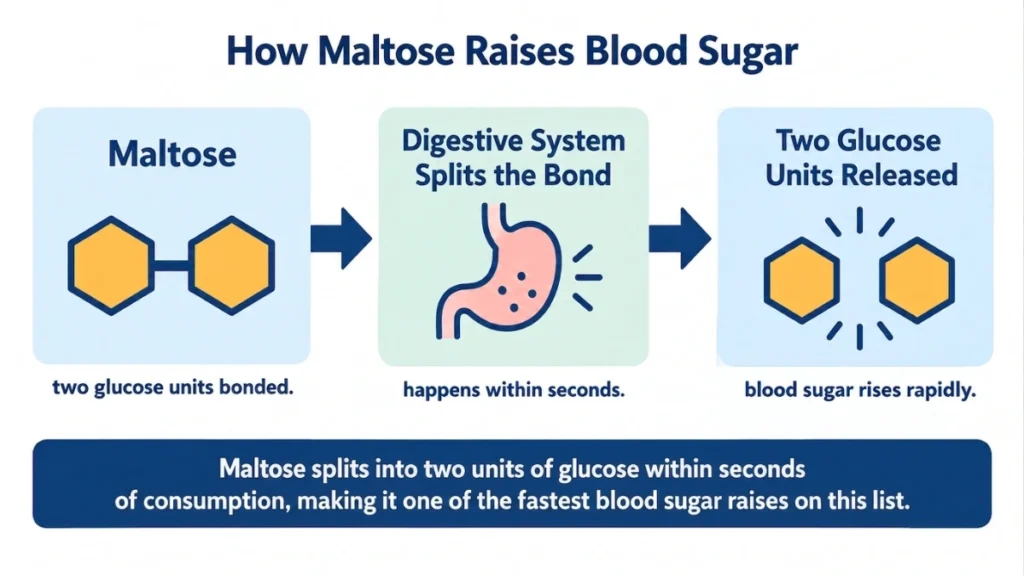
The CDC names maltose in its list of sugar terms people with diabetes and prediabetes should recognize on ingredient lists.¹²
Maltose ends in “-ose.” That suffix is the one pattern worth memorizing from this entire article. Most ingredients ending in “-ose” are sugars. Glucose, fructose, dextrose, sucrose, and maltose all follow this pattern. Cellulose is the main exception. It’s a fiber, not a sugar, despite the suffix.
If you remember nothing else from this list, remember the “-ose” rule. It catches more than half the names above without memorizing a single one.
Of these nine names, how many appeared on something you ate this morning?
Now You Know What to Look For
Knowing the real names behind sugar on labels puts the power back in your hands instead of the front panel. Check three pantry products tonight, and scan the ingredient list for every name on this list. The label follows the law. You follow the science.
References
- U.S. Food and Drug Administration. Added Sugars on the Nutrition Facts Label.
https://www.fda.gov/food/nutrition-facts-label/added-sugars-nutrition-facts-label - Erdile J. A Hidden Carbohydrate’s Impact on Blood Sugar. BetterByDesign Nutrition Ltd., 2025, updated 2026.
https://bbdnutrition.com/2025/11/13/hidden-carbohydrate-impact-blood-sugar/ - Sigala, Hieronimus, Medici, Lee, Nunez, Bremer, Cox, Price, Benyam, Abdelhafez, McGahan, Keim, Goran, Pacini, Tura, Sirlin, Chaudhari, Havel, Stanhope. The Dose-Response Effects of Consuming High Fructose Corn Syrup-Sweetened Beverages on Hepatic Lipid Content and Insulin Sensitivity in Young Adults. Nutrients. 2022;14(8):1648.
https://doi.org/10.3390/nu14081648 - Medical News Today. Is agave syrup the best sweetener for diabetes? Healthline Media.
https://www.medicalnewstoday.com/articles/317167 - Tappy L, Le KA, Tran C, Paquot N. Fructose and Metabolic Diseases: New Findings, New Questions. Nutrition. 2010;26(11-12):1044-1049.
https://doi.org/10.1016/j.nut.2010.02.014 - U.S. Food and Drug Administration. FDA Releases Final Guidance Regarding the Food Labeling Term “Evaporated Cane Juice.” HFP Constituent Update, May 25, 2016.
https://www.fda.gov/food/hfp-constituent-updates/fda-releases-final-guidance-regarding-food-labeling-term-evaporated-cane-juice - Hewa Pathirana HPDT, Wijesekara I, Yalegama LLWC, Garusinghe C, Jayasinghe MA, Waidyarathne KP. Comparison of Blood Glucose Responses by Cane Sugar (Saccharum officinarum) Versus Coconut Jaggery (Cocos nucifera) in Type 2 Diabetes Patients. Journal of Future Foods. 2022;2(3):261-265.
https://www.sciencedirect.com/science/article/pii/S2772566922000477 - Alternative Sugars: Coconut Sugar. British Dental Journal. 2017;223:749, 24 November 2017.
https://www.nature.com/articles/sj.bdj.2017.1011 - Ofoedu CE, Osuji CM, Ojukwu M. Sugar Profile of Syrups from Malted and Unmalted Rice of Different Varieties. Journal of Food Research. 2019;8(1):52.
https://doi.org/10.5539/jfr.v8n1p52 - Serrano-Febles J, Luis-Orozco J, Ramirez HL, Gomez-Brizuela L, Martin C, Garcia-Cruz A. Optimization of Enzymatic Hydrolysis of Corn Starch to Obtain Glucose Syrups by Genetic Algorithm. DYNA. 2025;92(235):83-91. Universidad Nacional de Colombia.
https://doi.org/10.15446/dyna.v92n235.116302 - Crow RR, Kumar S, Varela MF. Maltose Chemistry and Biochemistry. In: Preedy VR, ed. Dietary Sugars: Chemistry, Analysis, Function and Effects. Food and Nutritional Components in Focus No. 3. Royal Society of Chemistry; 2012:101-114.
https://www.researchgate.net/publication/233971788_Maltose_Chemistry_and_Biochemistry - Centers for Disease Control and Prevention. Spotting Hidden Sugars in Everyday Foods. CDC, Diabetes — Healthy Eating. Reviewed February 5, 2026.
https://www.cdc.gov/diabetes/healthy-eating/spotting-hidden-sugars-in-everyday-foods.html