

You eat well. You have for years. Salads, salmon, leafy greens, the whole list. So why do you still feel tired, foggy, or like something is quietly off? Health-conscious adults over 50 are increasingly finding that eating well is not the same thing as being well-nourished.
After 50, the body’s ability to pull nutrition from food quietly declines through multiple overlapping mechanisms, so nutrient absorption after 50 is where the problem lives. The food is not the problem. The extraction system is.
Why keep reading:
- One stomach condition affects a third of older adults, blocks multiple nutrients, and goes completely unnoticed
- Your skin’s ability to make vitamin D has been dropping since your 30s, and sun exposure alone can no longer compensate
- A medication your doctor prescribed for a different problem may be draining a mineral your muscles and heart depend on
- How you cook your vegetables changes how much of them you actually absorb
- Protein from the same chicken breast now does something different in your muscles than it did 15 years ago
Your Stomach Produces Less Acid as You Age, and Acid Is the Key That Opens Many Nutrients
You might eat iron-rich spinach and still end up iron-deficient. You might drink milk every day and still lose bone density. That disconnect between eating and absorbing is where nutrient absorption after 50 begins to break down.
Stomach acid is not just for digestion. Without enough acid, nutrients that would otherwise be released may pass through unabsorbed.
Acid appears to dissolve mineral compounds in a way that allows the gut wall to take them in, and it is understood to activate the enzymes that help free vitamins from their protein bonds.¹
Without enough of it, food moves through the system carrying much of its nutrient content intact but inaccessible.
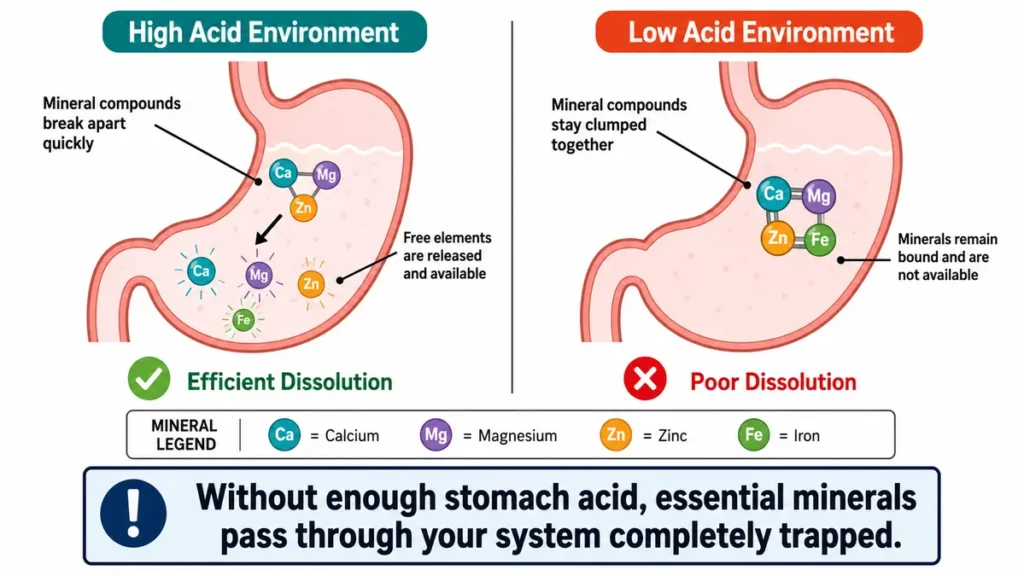
Research examining gastric secretion and aging confirms that reduced acid output is associated with lower absorption of iron, calcium, and vitamin B12.¹
The cause in most older adults is not age itself but atrophic gastritis [a condition where the stomach lining thins and loses its acid-producing cells, often due to a bacterial infection or long-term medication use], which affects approximately one in three older adults in the United States.²
This matters for nutrient absorption after 50 because atrophic gastritis is largely asymptomatic. There is no stomach pain, no heartburn, no signal. Most people who have it do not know they do.² The nutrients that depend most on acid include iron, calcium, vitamin B12, folate, and zinc. That is not a short list.
The evidence assembled here is drawn from multiple studies, each testing a different piece of the absorption problem. No single study has tested every mechanism at once. But the direction is consistent: the gut changes after 50, and those changes affect what you actually get from what you eat.
The Vitamin D Your Skin Makes Has Been Declining Quietly Since Your 30s
You step outside on a sunny afternoon and feel good about it. You should. But the nutritional return on that time outside has been shrinking for years.
The skin makes vitamin D when ultraviolet light hits a compound called 7-dehydrocholesterol [a precursor molecule in the skin that converts to vitamin D3 when exposed to UV radiation].
The concentration of that compound in the skin declines by approximately 50 percent between age 20 and age 80.³ Less raw material means less vitamin D produced, regardless of how long you stand outside.
Skin synthesis falls steadily. Research tracking vitamin D production across the adult lifespan found that for every decade of age, there is roughly a 13 percent decrease in vitamin D3 production from the same sun exposure.⁴ By the seventh decade, production is approximately half what it was at age 20.⁴

That’s the real shift here: the sun did not change, the skin did.
The skin can no longer be your primary vitamin D source after 60. That is not a suggestion. It is what the numbers show.
This decline compounds with the fact that aging also reduces the kidneys’ ability to convert stored vitamin D into the active form the body uses.⁵ So production drops, and conversion efficiency drops separately. Two breaks in the same chain.
Understanding how vitamin D3 is made and then activated helps explain why sun exposure alone may no longer be enough, and why blood testing is a more reliable guide than guessing based on how much time you spend outdoors.
B12 Is Stuck Inside Its Protein Wrapper if You Have Low Stomach Acid
Most people know they need vitamin B12. Far fewer know that getting enough B12 in your food and absorbing it are two completely different problems.
Vitamin B12 in food is always attached to a protein. Before your body can absorb it, stomach acid and an enzyme called pepsin [a digestive enzyme activated by stomach acid that breaks apart proteins] must strip the B12 free from that protein wrapper. If your stomach acid is low, the B12 never gets released.¹
The same stomach that processed your food perfectly at 35 may absorb significantly less vitamin B12 from that food by 65, not because your diet changed but because a stomach condition called atrophic gastritis silently reduced the acid needed to release the vitamin from its protein wrapper.²
Research following more than 3,000 non-institutionalized adults aged 60 and older found that atrophic gastritis was associated with a significantly higher rate of vitamin B12 deficiency, affecting 38 percent of participants with the condition compared to 15 percent of those without it.⁶
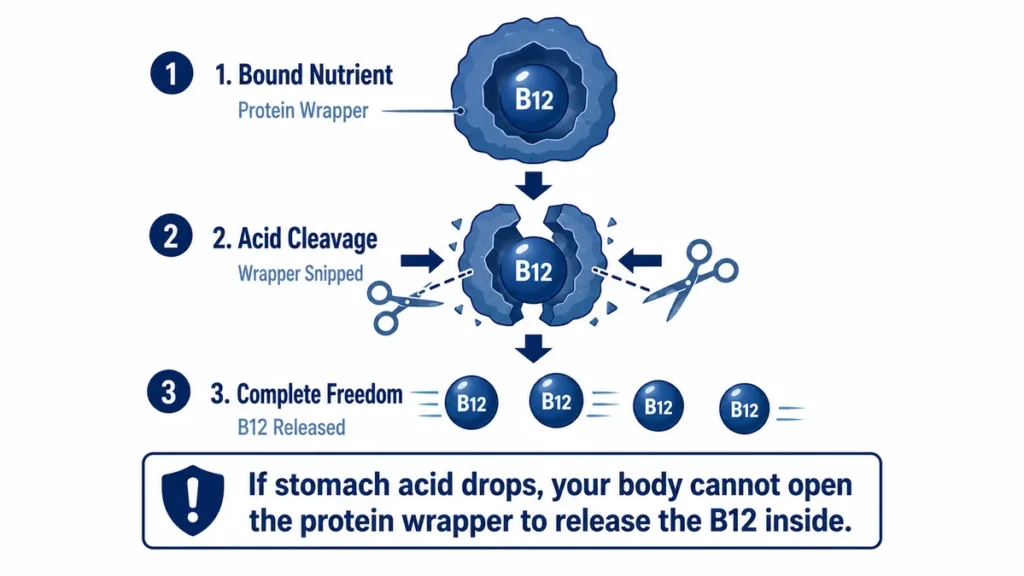
There is a critical distinction that most articles on B12 miss: crystalline vitamin B12 found in fortified cereals and supplements does not require stomach acid for absorption.⁶ This means the form of B12 matters as much as the amount.
Eating B12-rich animal foods is not the same as getting B12 from a fortified source when stomach acid is low. A person can have a diet full of meat, eggs, and dairy and still test deficient.
Not because their diet is poor. Because their stomach chemistry changed.
Several Common Medications Drain Nutrients Your Body Cannot Afford to Lose
If you take a daily medication, this section is about you.
Medications and nutrient absorption interact directly. A review of clinical studies on medicine-induced nutrient deficiencies in older adults identified three nutrients most consistently depleted by commonly prescribed drugs: vitamin B12, sodium, and magnesium.⁷
The medications responsible were not obscure. They included drugs prescribed for heartburn, diabetes, high blood pressure, high cholesterol, and depression.⁷
Talk to your doctor before changing your supplement routine if you’re on medication, managing a chronic condition, or were recently prescribed a new drug.
- Metformin (the most common type 2 diabetes medication) blocks vitamin B12 absorption from food. Studies consistently find lower B12 levels in people taking metformin compared to those not taking it, with the effect growing stronger over time and with higher doses.⁸
- Proton pump inhibitors (heartburn medications such as omeprazole and pantoprazole) suppress stomach acid, which then reduces B12, calcium, and magnesium absorption. A systematic review of long-term PPI use found a 12 to 18 percent reduction in serum vitamin B12 over 12 months of use.⁹
- Thiazide diuretics (blood pressure medications) can deplete key electrolytes through the kidneys.⁷
The drugs treating your chronic conditions may be creating new nutrient problems at the same time. Most prescribing conversations do not include this.
Your Gut Bacteria Have Shifted, and the New Lineup Absorbs Nutrients Differently
Your gut is home to trillions of bacteria, and by your 60s, the community has changed significantly from what it was in your 40s.
The bacteria responsible for producing short-chain fatty acids [small compounds that gut bacteria make from fiber that feed the gut lining and support absorption] appear to decline with normal aging.
Research found that bacteria species such as Dorea, Blautia, and Coprococcus, which produce these protective compounds, decrease with age, while populations of bacteria associated with gut inflammation increase.¹⁰
A diverse microbiome that produces anti-inflammatory compounds has been associated with healthier aging across multiple geographic populations.¹¹ The direction of this research is consistent.
It is worth noting that the gut microbiome literature is still developing, and the causal chain from bacterial shifts to specific nutrient deficiencies in humans has not been fully established. Most evidence is associative, not causal.

What is clear is that the gut lining itself becomes less efficient with age, reducing absorptive surface and slowing transit in ways that affect multiple nutrients. The microbiome change and the structural change appear to work together, though the combined effect has not been tested in a single controlled human trial.
A disrupted gut environment may affect how well fat-soluble vitamins, short-chain fatty acids, and certain minerals are taken up. The shift is gradual. Most people cannot feel it happening.
Protein From That Chicken Breast Does Less Work in Your Muscles Now
You probably eat some protein at dinner. Maybe lunch too. The amount may be fine. The problem is what your muscles do with it.
Muscle protein synthesis [the process by which muscle cells use amino acids from food to build and repair muscle tissue] becomes less responsive to protein intake with age. This is called anabolic resistance [a reduced ability of aging muscle to increase protein-building in response to the same amino acid signal that worked in younger muscle].¹²
Aging has been associated with a reduced muscle protein synthetic response to protein intake, and the level of habitual physical activity appears to be a key factor in whether that responsiveness can be partially maintained.¹²
Leucine matters more now than it used to. Research has established that older adults require a higher amount of leucine, a specific amino acid, to trigger the same muscle-building response that younger adults get from a smaller amount.¹³
The leucine threshold differs between young and older adults, meaning the same serving of protein delivers a weaker anabolic signal to aging muscle than it did a decade ago.¹³

The practical gap is this: older adults may need more protein per meal, distributed differently across the day, and combined with resistance exercise to partially overcome anabolic resistance. Simply continuing to eat the same portions in the same pattern does not compensate for this biological shift.
Calcium Absorption Drops with Age Even When Vitamin D Levels Look Fine
Most people connect calcium to bones and stop there. But the absorption part of the calcium story is where things get complicated after 50.
Calcium absorption falls with age.¹⁴ A study measuring absorption across 262 healthy postmenopausal women aged 40 to 87 found that absorption was 28 percent lower in women over 75 than in younger postmenopausal women.¹⁴
The calcium-vitamin D connection is real, but it does not fully explain the absorption decline. The same study found that even after accounting for vitamin D levels, calcium absorption continued to fall in older women, suggesting a separate age-related mechanism is also at work.¹⁴
Aging also reduces the kidneys’ production of calcitriol [the active hormonal form of vitamin D that directly controls how much calcium the intestine absorbs], with production falling roughly 50 percent due to declining kidney function.⁵
Less calcitriol means the gut absorbs less calcium even when dietary intake looks adequate and vitamin D on a blood test looks normal.⁵
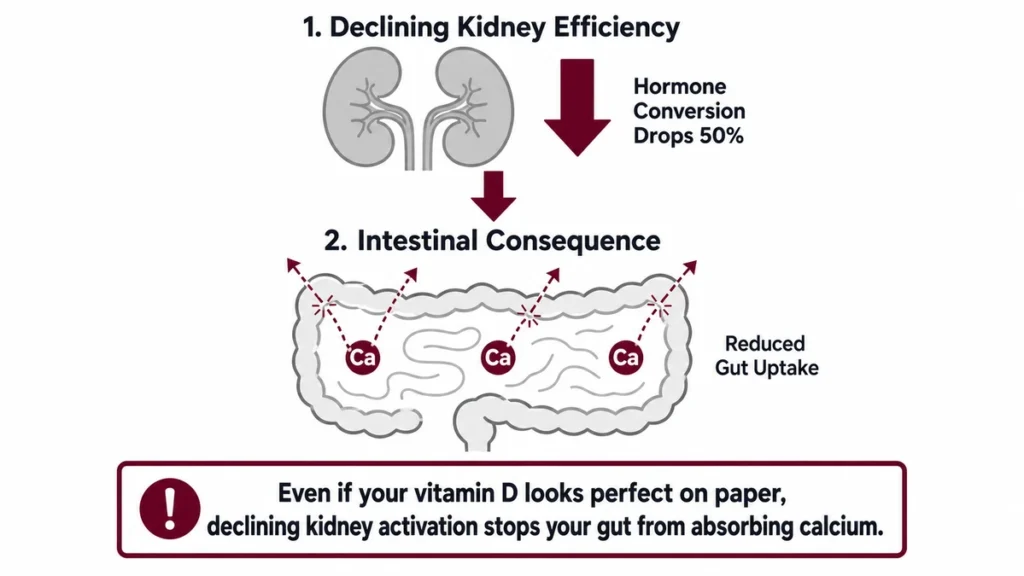
The test result and the actual absorption can tell two different stories. That is the gap most calcium conversations skip.
Magnesium Leaks Out Faster Than It Used to, and Most People Never Notice
Magnesium rarely gets the attention of calcium or vitamin D. That gap in attention does not reflect a gap in importance.
Older adults face a three-way problem with magnesium: lower dietary intake on average, reduced intestinal absorption with age, and increased loss through the kidneys.¹⁵
The NIH Office of Dietary Supplements confirms that older adults are more likely to have chronic diseases or take medications that further impair magnesium status.¹⁵
Mild magnesium deficit is almost entirely silent. Research notes that mild deficits are generally asymptomatic, and clinical signs are usually non-specific or absent.¹⁶ When symptoms do appear, they can include sleep problems, muscle weakness, and heightened irritability, all of which are easy to attribute to aging rather than to a correctable mineral gap.¹⁶

Because magnesium is needed for more than 600 enzymatic reactions in the body, a quiet deficit affects energy metabolism, nerve function, and cardiovascular regulation without the person knowing.¹⁶
A blood test for serum magnesium is considered an imperfect marker, as the body appears to maintain serum levels by drawing on magnesium stored in tissues and bone, meaning a normal result does not confirm that stores are sufficient.¹⁶
What You Prepare Determines What You Get
You cannot change your age. You can change what you do in the kitchen.
Food preparation changes how much nutrition the body extracts from the same ingredient.¹⁷ Cooking affects the nutrient matrix [the physical and chemical structure in which nutrients are embedded inside food] and can either release nutrients from plant cell walls or destroy them before they reach your gut.
Heating, soaking, fermenting, and pairing foods strategically all shift bioavailability. Adding a source of ascorbic acid (vitamin C) to plant-based iron sources significantly enhances non-heme iron absorption by keeping iron in its more absorbable form.¹⁷
A well-known principle in nutrition is that fat enhances the absorption of fat-soluble nutrients. Adding a small amount of fat to cooked carrots, kale, or sweet potatoes, for example, may help your body absorb more beta-carotene and vitamins A, D, E, and K.
From here, the responsibility shifts from your body to your kitchen. That shift is available to every reader, today, with no prescription required.
Before making changes to your diet based on a specific health condition, talk to your doctor or a registered dietitian.
Practical pairing and prep changes:

- Add a squeeze of lemon juice or a small piece of citrus to iron-rich plant foods such as lentils, spinach, or fortified cereal
- Cook carrots, kale, or sweet potatoes in a small amount of olive oil rather than boiling them in water
- Choose fortified breakfast cereals or supplements for vitamin B12 if you have low stomach acid or take a PPI, since crystalline B12 does not require stomach acid to absorb
- Combine calcium-rich foods with their vitamin D pairings (sardines with bones, egg yolks alongside cheese) rather than eating them separately across the day
- Ask your doctor about testing B12, vitamin D, and magnesium directly, as food-based estimates often overstate what aging physiology actually absorbs
What the Nutrition Label Cannot Tell You
Nutrient absorption after 50 is not a single problem with a single fix. It is a set of overlapping changes, each quiet, each biological, and each addressable once identified. Eating well is necessary but no longer sufficient on its own.
Ask your doctor to test your vitamin B12, vitamin D, and magnesium levels at your next appointment and bring this article with you. The NIH Office of Dietary Supplements at ods.od.nih.gov provides free, age-specific reference sheets on every nutrient discussed here. The full picture is not finished.
⚠️DISCLAIMER:
This article is for informational purposes only and does not constitute dietary or medical advice. The content addresses nutrient absorption decline in adults over 50 and is meant for general educational purposes only. Nutritional needs differ based on age, health status, and individual circumstances, consult a registered dietitian or your healthcare provider before making significant changes to your diet.
References
- Vara-Luiz F, Mendes I, Palma C, Mascarenhas P, Nunes G, Patita M, Fonseca J. Age-Related Decline of Gastric Secretion: Facts and Controversies. Biomedicines. 2025; 13(7):1546.
https://pmc.ncbi.nlm.nih.gov/articles/PMC12292447/ - Karhunen P, Tuomisto S, Goebeler S, Martiskainen M, Kok E. Common occurrence of atrophic gastritis in an ageing non-hospitalised population: an autopsy study. Age and Ageing. 2025; 54(3):afaf047. doi:10.1093/ageing/afaf047 https://www.ncbi.nlm.nih.gov/pmc/articles/PMC11879357/
- Bocheva G, Slominski RM, Slominski AT. The Impact of Vitamin D on Skin Aging. International Journal of Molecular Sciences. 2021; 22(16):9097. doi:10.3390/ijms22169097 https://pmc.ncbi.nlm.nih.gov/articles/PMC8396468/
- Chalcraft JR, Cardinal LM, Wechsler PJ, Hollis BW, Gerow KG, Alexander BM, Keith JF, Larson-Meyer DE. Vitamin D Synthesis Following a Single Bout of Sun Exposure in Older and Younger Men and Women. Nutrients. 2020; 12(8):2237. doi:10.3390/nu12082237
https://www.mdpi.com/2072-6643/12/8/2237 - Gallagher JC. Vitamin D and Aging. Endocrinology and Metabolism Clinics of North America. 2013; 42(2):319–332. doi:10.1016/j.ecl.2013.02.004
https://pmc.ncbi.nlm.nih.gov/articles/PMC3782116/ - Porter KM, Hoey L, Hughes CF, Ward M, Clements M, Strain JJ, Cunningham C, Casey MC, Tracey F, O’Kane M, Pentieva K, McAnena L, McCarroll K, Laird E, Molloy AM, McNulty H. Associations of atrophic gastritis and proton-pump inhibitor drug use with vitamin B-12 status, and the impact of fortified foods, in older adults. American Journal of Clinical Nutrition. 2021.
https://pmc.ncbi.nlm.nih.gov/articles/PMC8488868/ - Chong RQ, Gelissen I, Chaar B, Penm J, Cheung JMY, Harnett JE. Do medicines commonly used by older adults impact their nutrient status? Exploratory Research in Clinical and Social Pharmacy. 2021; 3:100067. doi:10.1016/j.rcsop.2021.100067
https://pmc.ncbi.nlm.nih.gov/articles/PMC9031754/ - Mohn ES, Kern HJ, Saltzman E, Mitmesser SH, McKay DL. Evidence of drug-nutrient interactions with chronic use of commonly prescribed medications: an update. Pharmaceutics. 2018. https://pmc.ncbi.nlm.nih.gov/articles/PMC5874849/
- Shahid MS, Ahmed N, Kamal Z, Nathaniel L, Singla B, Singla S, Kumawat S, Batool M, Ekomwereren O, Anika NN, Sahil M. A Systematic Review of Long-Term Use of Proton Pump Inhibitors (PPIs) in Older Adults on Polypharmacy: Do PPIs Deplete Nutrients? Cureus. 2025; 17(8):e90888.
https://www.ncbi.nlm.nih.gov/pmc/articles/PMC12456669/ - Lim MY, Nam YD. Gut microbiome in healthy aging versus those associated with frailty. Gut Microbes. 2023; 15(2):2278225. https://pmc.ncbi.nlm.nih.gov/articles/PMC10730223/
- Badal VD, Vaccariello ED, Murray ER, Yu KE, Knight R, Jeste DV, Nguyen TT. The gut microbiome, aging, and longevity: a systematic review. Nutrients. 2020. https://pubmed.ncbi.nlm.nih.gov/33297486/
- Burd NA, Gorissen SH, van Loon LJC. Anabolic resistance of muscle protein synthesis with aging. Exercise and Sport Sciences Reviews. 2013; 41(3):169-173. https://pubmed.ncbi.nlm.nih.gov/23558692/
- Zaromskyte G, Prokopidis K, Ioannidis T, Tipton KD, Witard OC. Evaluating the Leucine Trigger Hypothesis to Explain the Post-prandial Regulation of Muscle Protein Synthesis in Young and Older Adults: A Systematic Review. Frontiers in Nutrition. 2021; 8:685165. https://pmc.ncbi.nlm.nih.gov/articles/PMC8295465/
- Nordin BEC, Need AG, Morris HA, O’Loughlin PD, Horowitz M. Effect of age on calcium absorption in postmenopausal women. American Journal of Clinical Nutrition. 2004; 80(4):998-1002.
https://pubmed.ncbi.nlm.nih.gov/15447911/ - National Institutes of Health, Office of Dietary Supplements. Magnesium: Fact Sheet for Health Professionals. Current. https://ods.od.nih.gov/factsheets/Magnesium-HealthProfessional/
- Barbagallo M, Veronese N, Dominguez LJ. Magnesium in Aging, Health and Diseases. Nutrients. 2021; 13(2):463. https://www.mdpi.com/2072-6643/13/2/463
- Gibson RS, Perlas L, Hotz C. Improving the bioavailability of nutrients in plant foods at the household level. Proceedings of the Nutrition Society. 2006; 65(2):160-168. https://pubmed.ncbi.nlm.nih.gov/16672077/