

You’ve done everything right. You go to bed on time, you wake up exhausted, and somewhere around 3 a.m. your calf seizes and your mind won’t stop. You’re starting to wonder whether this is just what getting older feels like now.
After 50, your body absorbs magnesium less well, your kidneys flush out more of it, and the medications most common at this age actively drain what little remains. Adults over 50 are losing sleep, snapping at people they love, and waking with cramped legs, and most have never been told these are symptoms of the same mineral deficiency.
That mineral is magnesium. It runs more than 300 processes in your body, including the ones that control sleep, mood, and muscle relaxation. Here are nine signs that you’re running low, and what that means for your body right now.
This article is for informational purposes only and is not a substitute for professional medical advice. Some signs described here overlap with other conditions and require a doctor’s evaluation. If you are on medication or managing a kidney or heart condition, consult your healthcare provider before changing your diet or starting supplements.
Sign 1: The Mineral Behind Your Sleep Is Missing When You Wake at 3 a.m.
You lie awake at 3 a.m. and you can’t explain why. You weren’t anxious when you went to bed. Nothing woke you. Your brain just switched on and won’t switch off.
Magnesium is the mineral behind sleep because it boosts GABA [the brain’s main calming chemical]. GABA is what tells your nervous system to slow down and let you sleep.
Magnesium also supports melatonin [the hormone your brain uses to signal that it’s nighttime] production. When magnesium drops, both the GABA and melatonin systems may weaken. The brain stays alert when it should be quiet.⁴,⁷

In a double-blind clinical trial of adults aged 60 to 75 with insomnia and low magnesium intake, people who took magnesium fell asleep faster, slept longer, and produced more of the melatonin their brains need to stay down.²
That’s not a subtle effect. That’s a body responding to something it was missing.
There’s one more reason this hits harder after 50. Your gut absorbs less magnesium as you age. Your kidneys excrete more. And if you take a loop or thiazide diuretic, or have taken a proton pump inhibitor for more than a year, those drugs accelerate the loss.¹
Your magnesium level can be genuinely low while a routine blood test shows it as normal, because less than one percent of your body’s magnesium is in the blood.¹
The sleep problem isn’t only in your head. And the same deficit that keeps you awake is already working on your muscles while you sleep.
Top Magnesium Foods: What One Serving Delivers
| Food | Serving | Magnesium |
|---|---|---|
| Pumpkin seeds, roasted | 1 oz | 156 mg |
| Almonds, dry roasted | 1 oz | 80 mg |
| Spinach, boiled | 1/2 cup | 78 mg |
| Black beans, cooked | 1/2 cup | 60 mg |
| Peanut butter, smooth | 2 tbsp | 49 mg |
| Brown rice, cooked | 1/2 cup | 42 mg |
| Banana | 1 medium | 32 mg |
The recommended daily amount for adults 51 and older is 420 mg for men and 320 mg for women.¹
Sign 2: Your Muscles Cramp or Twitch Without Warning
You’re lying still and your calf locks up. You’re sitting at the table and your thigh jumps. You haven’t done anything to cause it. That’s what makes it so unsettling.
Magnesium controls how calcium moves in and out of muscle cells. Calcium triggers a muscle to contract. Magnesium helps muscles relax. Think of it like a door that calcium opens and magnesium closes.
When your magnesium is low, the closing mechanism is weakened. The muscle gets the signal to contract but doesn’t get a clear signal to let go.¹,⁷
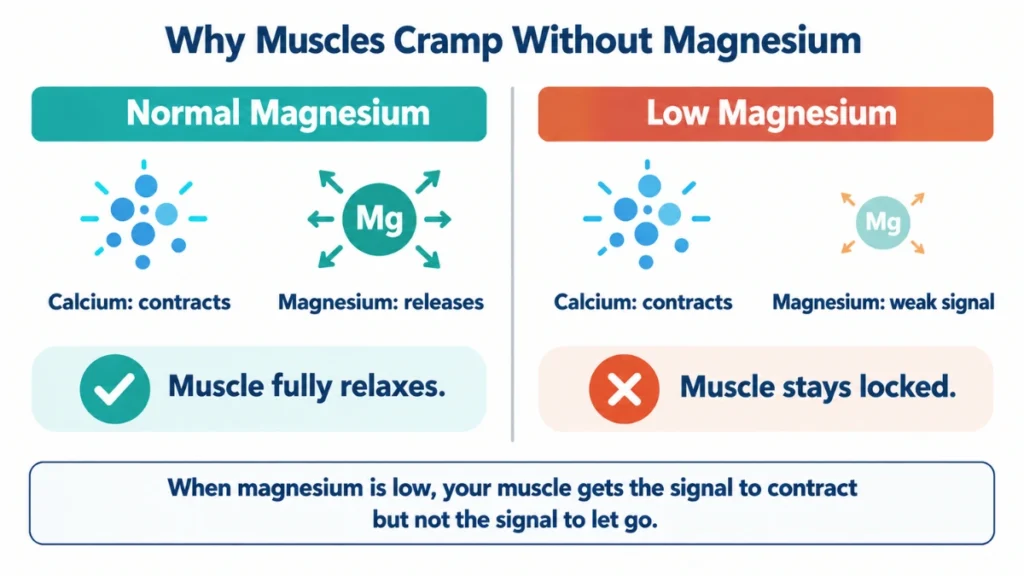
This is why the NIH lists muscle contractions and cramps as a recognized sign of worsening magnesium deficiency. It’s a documented symptom, not a guess.¹
One thing worth knowing: a clinical trial testing magnesium oxide specifically for nighttime leg cramps in older adults found no significant benefit over a placebo.³ That result matters.
It means the claim here isn’t “take magnesium and your cramps stop.” The claim is that magnesium deficiency disrupts the muscle relaxation signal, and that disruption is what produces the cramp. Addressing the deficiency is different from taking a specific supplement form and expecting a specific result.
When the twitching shows up in multiple places, not just the calf but also the thigh, the hands, the feet, that’s a stronger sign of a systemic shortage rather than a local issue.
So if magnesium governs nerve-to-muscle signaling in your calf, it governs it everywhere. Including somewhere much smaller and much more visible.
Sign 3: You Feel Anxious for No Clear Reason
The feeling arrives without a cause. You haven’t had bad news. Nothing went wrong today. But something is running in the background, like a low-level alarm you can’t locate or turn off.
That experience has a physical explanation. Your brain has a type of receptor called an NMDA receptor [a brain receptor that, when overactive, causes excessive nervous system excitation]. When NMDA receptors fire too freely, the brain becomes overexcited.
Magnesium physically sits inside those receptors and blocks them from firing without reason. When magnesium levels drop, that block weakens. The brain runs hotter than it should.²,⁴

This is not a vague wellness idea. Low magnesium removes the brain’s natural brake on excitatory signaling. The clinical evidence points the same way.
In most clinical trials that studied magnesium for anxiety, participants reported feeling calmer. Five out of seven studies measuring anxiety outcomes reported improvements.²
Note the accuracy here. These weren’t studies that resolved clinical anxiety disorders. They were studies where people with anxious symptoms showed improvement.
The research shows a link and a plausible mechanism. It does not prove magnesium cures anxiety on its own.
What it does suggest is that a nervous system running low on its natural inhibitory mineral will feel less calm. And the same chemistry that produces that free-floating anxiety shows up differently in the next sign.
Sign 4: Your Eyes Twitch or Your Eyelid Flutters
You notice it in the mirror. Or midway through a conversation when the other person glances at your eye. A tiny, involuntary flutter you can’t stop no matter how many times you blink.
Most people blame screens. Or too much coffee. And those are legitimate causes. But there’s another explanation worth knowing when the twitch shows up alongside the other signs on this list.
Magnesium helps move calcium and potassium across cell membranes, a process your nerves and muscles need to work normally. This applies to every muscle in the body, including the small muscle that rings your eyelid.¹

Here’s what the evidence actually says: an eyelid twitch on its own is not enough to confirm low magnesium.
But the nerve-to-muscle mechanism is the same one operating in your calf and your thigh. The eyelid is just a smaller, more visible location. When a twitch in that location coincides with poor sleep, muscle cramps, and unexplained anxiety, the pattern becomes harder to dismiss as coincidence.
A single sign means little. Several signs pointing in the same direction is a different conversation.
And if none of those signs are leaving you rested, the next one explains why you wake up tired no matter how long you sleep.
Sign 5: You Wake Feeling Exhausted Even After a Full Night
Eight hours in bed and you feel no different than when you went down. That’s not a mystery of willpower. That’s a physiology problem.
Sleep has stages. The deepest and most restorative one is called slow-wave sleep [the deepest stage of sleep, where the body repairs tissue and restores energy]. This is the stage where the body actually repairs tissue, balances hormones, and consolidates memory. It’s not just sleep. It’s the part of sleep that does the real work.
Magnesium may affect how long your brain spends in that deep phase. In an EEG study of adults aged 60 to 80, magnesium supplementation increased slow-wave sleep from about 10 minutes to about 16 minutes per night. The increase was confirmed by measuring brain wave activity, not by self-report.¹¹
That’s an increase of about 60 percent in the most restorative sleep stage.
Eight hours of light sleep is not the same as eight hours of deep, restorative sleep. You can be in bed long enough and still not recover.
If you’ve been waking unrefreshed for months and attributing it to aging, this is worth checking before you accept it as permanent. What feels like getting older might be a deficit that has never been identified.
That missing recovery doesn’t stay in the bedroom. By mid-morning, it changes how you treat people.
Sign 6: You Have Become More Irritable or Emotionally Reactive
You snap at someone over something small. You feel a surge of irritation before you’ve even finished processing what happened. You don’t recognize this version of yourself, and that makes it worse.
This is what a nervous system under chronic magnesium deficiency can feel like. Magnesium reduces the release of catecholamines [stress chemicals like epinephrine and norepinephrine that trigger your threat response].
When magnesium is low, those chemicals run higher than they should. The result is a shorter fuse, a faster reaction, and a baseline level of edginess that doesn’t match your circumstances.⁴

Stress depletes magnesium. Low magnesium raises stress chemicals. Raised stress chemicals make everything feel more stressful. More stress depletes magnesium further.⁴ The cycle feeds itself.
Nearly half of all Americans don’t get enough magnesium from food to meet their body’s estimated average requirement.¹
That means close to half the population may be running a nervous system that’s hotter than it should be, not because of who they are, but because of what they’re not getting.
Irritability caused by a nutrient deficit won’t improve until the deficit is addressed. And while it’s running unchecked, it’s also doing something to your head.
Sign 7: You Have Headaches That Come Back Without an Obvious Cause
You get the same headache. In the same place. With no clear reason this time either.
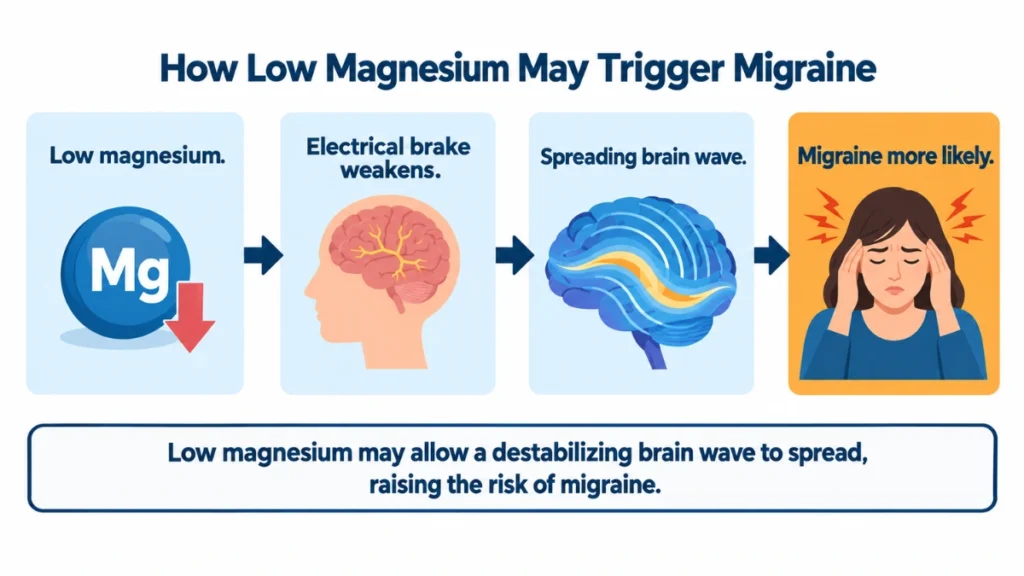
People who get migraines have lower magnesium levels in both their blood and their body’s tissues compared to people who don’t.¹ The connection is documented. So is the mechanism.
Dr. Alexander Mauskop, a board-certified neurologist and director of the New York Headache Center, has studied this connection for over 30 years.⁸,¹⁰
Mauskop and his co-author Christina Sun-Edelstein wrote: “Deficiencies in magnesium may play an important role in the pathogenesis of migraine headaches by promoting cortical spreading depression…”⁵
Cortical spreading depression [a wave of reduced electrical activity in the brain closely linked to migraine onset] is the wave the quote refers to. Low magnesium may make that wave more likely, which may leave the brain more vulnerable to headache episodes.
Before taking magnesium supplements for headaches, check with your doctor. High doses above the supplemental upper limit can cause diarrhea and cramping.¹ People with kidney disease should not supplement without medical guidance, as the kidneys manage magnesium excretion and impaired function raises the risk of toxicity.¹
The American Academy of Neurology and the American Headache Society have concluded that magnesium is probably effective for migraine prevention, at doses that should be taken only under a doctor’s supervision.¹
Recurring headaches are the brain sending a signal. The next sign is a signal from a different organ, and it’s one you shouldn’t wait on.

Sign 8: Your Heart Occasionally Flutters or Skips
You felt it once, maybe twice. A flutter. A brief skip. You told yourself it was probably nothing and moved on. That’s a reasonable response. But it’s worth knowing why magnesium is part of this picture.
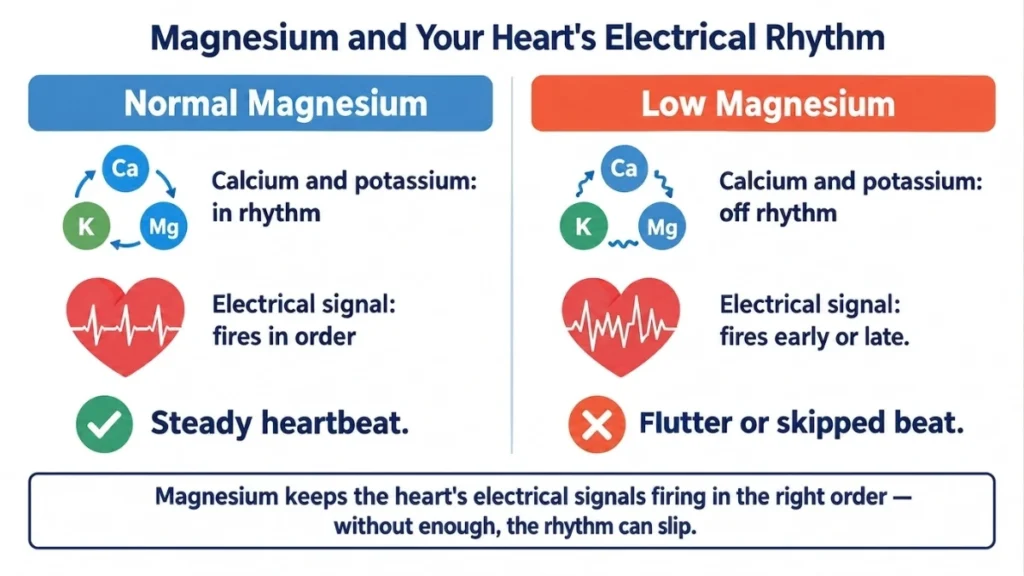
Your heart runs on electrical signals. Those signals depend on precise movement of calcium and potassium across the membranes of heart muscle cells. Magnesium regulates that movement.
When magnesium drops, the electrical system becomes unstable. The heart can fire at the wrong time or in the wrong sequence.¹ Abnormal heart rhythms are a recognized sign of worsening magnesium deficiency, documented by the NIH.¹
In a 12-year study tracking more than 14,000 adults, people with the highest blood magnesium levels were 38 percent less likely to die from a sudden cardiac event than people with the lowest magnesium levels.¹,¹² That’s a large difference, and it held up over more than a decade of follow-up.
This doesn’t mean a flutter means low magnesium. It means magnesium is a real part of cardiac health, not a side topic.
If you’re noticing a new, frequent, or worsening flutter or irregular beat, see your doctor before you change anything about your diet or supplements. Don’t self-treat a cardiac symptom.
What feels like a heart problem may involve a mineral. But it requires medical evaluation, not a dietary experiment.
Sign 9: Your Bones Are Weakening Even Though You Take Calcium
You’ve been consistent. You take your calcium. You got the bone density scan and the news wasn’t good. That’s a frustrating place to be, and there’s a reason it happens more often than people expect.
Magnesium doesn’t just sit alongside calcium in bone health. It directs how calcium gets used. Magnesium affects parathyroid hormone [a hormone that controls how much calcium your body absorbs] and the active form of vitamin D.
Both of those are what tell your body how much calcium to absorb and where to put it. Without enough magnesium, the delivery system for calcium may be impaired.¹,⁹
Calcium is the material. Magnesium is the system that moves it to where it needs to go. Taking calcium without enough magnesium is like having building supplies and no one to install them.

Women with osteoporosis [a condition where bones lose density and become fragile] show lower serum magnesium levels than women with moderate bone thinning or normal bone density.¹
In a large population study using data from more than 13,000 U.S. adults, people aged 60 and older with higher magnesium deficiency scores had a 27 percent higher risk of osteoporosis compared to those with lower deficiency scores.⁶ That association was significant only in adults 60 and older, not in younger age groups.⁶
The right question isn’t only “am I getting enough calcium?” It’s “does my body have what it needs to use the calcium I’m already taking?”
After nine signs, the pattern is clear. Sleep, mood, and muscles aren’t three separate problems. They’re one deficiency talking through three different body systems at once.
One Mineral, One Clear Starting Point
Recognizing the mineral behind sleep loss, muscle cramps, and mood changes is the first step toward doing something about it. Test your magnesium intake and add one magnesium-rich food or supplement today. You don’t need a complete overhaul. You need to start with one clear target.
References
- Office of Dietary Supplements, National Institutes of Health. Magnesium: Fact Sheet for Health Professionals. Updated January 6, 2026. https://ods.od.nih.gov/factsheets/Magnesium-HealthProfessional/
- Rawji A, Peltier MR, Mourtzanakis K, Awan S, Rana J, Pothen NJ, Afzal S. Examining the effects of supplemental magnesium on self-reported anxiety and sleep quality: a systematic review. Cureus. 2024;16(4):e59317. doi:10.7759/cureus.59317 https://pmc.ncbi.nlm.nih.gov/articles/PMC11136869/
- Roguin Maor N, Alperin M, Shturman E, Khairaldeen H, Friedman M, Karkabi K, Milman U. Effect of magnesium oxide supplementation on nocturnal leg cramps: a randomized clinical trial. JAMA Internal Medicine. 2017;177(5):617-623. doi:10.1001/jamainternmed.2016.9261 https://pubmed.ncbi.nlm.nih.gov/28241153/
- Papadopol V, Nechifor M. Magnesium in neuroses and neuroticism. In: Vink R, Nechifor M, editors. Magnesium in the Central Nervous System. Adelaide (AU): University of Adelaide Press; 2011. https://www.ncbi.nlm.nih.gov/books/NBK507254/
- Sun-Edelstein C, Mauskop A. Role of magnesium in the pathogenesis and treatment of migraine. Expert Review of Neurotherapeutics. 2009;9(3):369-379. doi:10.1586/14737175.9.3.369 https://pubmed.ncbi.nlm.nih.gov/19271946/
- Li S, Chang W, Wu G, Wang K, Sun X, Sun H, Zhou J. Association between magnesium deficiency scores and hip bone health in adults: a population-based study. Magnesium Research. 2025;38(3):81-94. doi:10.1684/mrh.2025.0549 https://pubmed.ncbi.nlm.nih.gov/41395732/
- He C, Wang B, Chen X, Xu J, Yang Y, Yuan M. The mechanisms of magnesium in sleep disorders. Nature and Science of Sleep. 2025;17:2639-2656. doi:10.2147/NSS.S552646 https://www.dovepress.com/the-mechanisms-of-magnesium-in-sleep-disorders-peer-reviewed-fulltext-article-NSS
- Mauskop A. Magnesium and Headaches. New York Headache Center. Undated. https://www.nyheadache.com/integration-categories/magnesium-and-headaches
- The Nutrition Source, Harvard T.H. Chan School of Public Health. Magnesium. Last reviewed March 2023. https://nutritionsource.hsph.harvard.edu/magnesium/
- New York Headache Center. Alexander Mauskop, MD. Undated. https://www.nyheadache.com/team-members/alexander-mauskop
- Held K, Antonijevic IA, Künzel H, Uhr M, Wetter TC, Golly IC, Steiger A, Murck H. Oral Mg2+ supplementation reverses age-related neuroendocrine and sleep EEG changes in humans. Pharmacopsychiatry. 2002;35(4):135-143. doi:10.1055/s-2002-33195 https://pubmed.ncbi.nlm.nih.gov/12163983/
- Peacock JM, Ohira T, Post W, Sotoodehnia N, Rosamond W, Folsom AR. Serum magnesium and risk of sudden cardiac death in the Atherosclerosis Risk in Communities (ARIC) Study. American Heart Journal. 2010;160(3):464-470. doi:10.1016/j.ahj.2010.06.012 https://doi.org/10.1016/j.ahj.2010.06.012