
You walked into a room and forgot why. You introduced yourself to someone you’ve already met. You searched for the right word in the middle of a sentence and it just wasn’t there.
If you’re one of the millions of adults over 50 who exercise regularly but still notice memory slipping, that’s the frustration this article is about.
Adults over 50 who exercise regularly are often doing it at the wrong time of day for it to protect their memory. That’s not a failure of effort. It’s a gap in the information most people receive.
By the end of this article, you’ll know exactly how exercise and memory after 50 connect through one timing adjustment that changes how well your brain holds on to what you experience each day.
This article is for informational purposes only and does not constitute medical advice, diagnosis, or treatment. Always consult your physician or a qualified healthcare provider before starting or changing your exercise routine. Individual results vary based on health status, age, and other factors.
What Is Happening Inside Your Brain Right Now
You can’t feel it, but a small, curved structure deep inside your brain is slowly changing with age.
The hippocampus [the part of the brain that turns new experiences into lasting memories] is the first region to shrink in normal aging, and that shrinkage is directly tied to why names slip away first.¹
That loss is slower than most people expect, but it’s steady. Cognitively healthy adults lose roughly one to two percent of hippocampal volume each year after midlife.¹
That’s not Alzheimer’s. That’s the standard rate for people with no diagnosis and no symptoms. The trouble is that even gradual loss adds up, and the hippocampus is where exercise and memory after 50 intersect most directly.
Here’s what changes the picture. Your brain isn’t locked into that trajectory. A landmark randomized controlled trial tested 120 older adults over one year.
The group that did aerobic exercise increased their hippocampal volume by two percent.¹ The control group, who did light stretching, saw their volume decrease. That two percent gain effectively reversed one to two years of typical age-related shrinkage.
The brain responds to what the body does. That response is real and measurable. But it depends on more than just showing up to exercise.
The next section explains why the timing of that exercise matters as much as the exercise itself, and why most active adults are missing the window that matters most.
The Timing Mistake Most Active People Make
You probably have a routine. Morning walk, evening run, gym at lunch. That consistency is good for your heart, your weight, your mood, and your long-term brain health.
But if you’re hoping exercise protects the specific things you experience each day, such as a conversation, a piece of news, or a name, the timing of your workout relative to those moments matters in a way that most exercise advice never addresses.

When you exercise matters more for your memory than whether you exercise on any given day.
Think about the last thing you really wanted to remember. New memories are fragile the moment they form. In the hours right after you experience something, your brain is actively working to decide whether to keep it or let it go.
This process is called memory consolidation [the biological process by which a new, unstable memory is gradually converted into a stable, long-term one].
It depends on specific chemical signals in the brain, and those signals can be boosted or missed entirely, depending on what you do next.
The timing of exercise relative to learning has been linked to that chemical window.
A narrative review of neurophysiology and behavioral research found that moderate-intensity aerobic exercise within approximately 30 minutes post-learning has been associated with improved memory retention.
That is at least in part through a rapid rise in epinephrine [a chemical the body releases under physical effort that appears to help signal the brain to preserve what it recently learned].²
That finding is from a review study, so the language around it stays cautious. But the direction of the evidence is consistent: timing is a variable, not a footnote.

The mistake isn’t skipping exercise. It’s exercising on a schedule that’s unconnected to the moments your brain is trying to consolidate.
The next section shows what the research actually found when scientists tested different timing windows head to head.
The Four-Hour Window That Changes How Memories Form
Talk to your doctor before starting or changing an exercise routine if you have a heart condition, joint problems, or haven’t been active in more than a year.
The specific timing findings surprised even the researchers who found them. In a controlled study of 72 healthy adults, researchers tested three groups. All three groups learned 90 picture-location associations.
Then one group exercised immediately after learning, one group exercised four hours later, and one group did not exercise at all. Forty-eight hours later, everyone was tested.³
The group that exercised immediately after learning did not perform better than the group that didn’t exercise at all.The group that exercised four hours later performed significantly better.³
That result surprised the researchers. The brain doesn’t appear to benefit from exercise the moment a memory is forming. It needs a stabilization period first.
Once that window passes, moderate physical effort may create conditions in the brain associated with locking the memory in.
It’s a finding that reframes what exercise and memory after 50 actually means in practice. Two chemicals are central to this effect:
- BDNF [brain-derived neurotrophic factor — a protein the brain produces that helps neurons survive and strengthen their connections with each other]
- Noradrenaline [a chemical released during physical effort that the brain uses to flag recent experiences as worth preserving]
Both are elevated by aerobic exercise. Both have roles in the consolidation process.³
The timing protocol in plain terms:
Learn something (read, talk, watch, study)
Wait roughly two to four hours
Take a 20-minute moderate walk
The walk may amplify the chemical conditions that help the memory stick
The next section tells you which type of exercise produces the best response inside that window.
What Type of Exercise Works Inside That Window
You don’t need a gym. You don’t need equipment. The type of exercise that appears to work best for memory consolidation is moderate aerobic activity, the kind where you can still talk in short sentences but can’t comfortably sing.
Not all movement produces the same response inside that window. A 2025 network meta-analysis of studies in healthy older adults ranked exercise types by their effect on memory specifically.⁴

Aerobic exercise came out with a meaningful effect size for memory function. Resistance training and mind-body exercise both showed benefits across different cognitive areas, but for memory specifically, aerobic movement has the most consistent support.⁴
What counts as moderate aerobic exercise for this purpose:
- Brisk walking (faster than a stroll, slower than a jog)
- Cycling at a comfortable pace
- Swimming laps at an easy effort
- Light jogging
Duration matters less than you might expect. Studies showing memory benefits have used sessions as short as 20 minutes.⁴
Going longer is fine, but the consolidation effect doesn’t require an hour of hard effort. It requires elevating your heart rate to a level that produces the relevant chemical response.

One note on intensity: very high-intensity exercise immediately after learning may actually interfere with early memory stabilization rather than support it.³ Inside the four-hour window, moderate beats intense.
The next section shows how to connect that protocol to the moments in a real day over 50 when consolidation actually matters.
How Exercise and Memory After 50 Work Together in a Real Day
Most people over 50 have natural learning moments scattered through every day. The protocol doesn’t ask you to add more exercise. It asks you to reposition the exercise you’re already doing, or plan a short walk, so it follows those moments.
The research on walking and memory in older adults points in a consistent direction.
A systematic review of randomized controlled trials in older adults without dementia found that walking at moderate to vigorous intensity, delivered at least three times per week, improved memory in several of the included studies.⁵
The benefit didn’t require a dramatic program. Consistent moderate effort over weeks did most of the work.
Here’s how to map that to a real day:
- Read the morning news or a chapter of a book → walk after breakfast two to four hours later
- Have a phone call worth remembering → take a 20-minute walk within a few hours
- Watch an educational video or documentary → walk before dinner if the video was in the afternoon
- Attend a grandchild’s event or family gathering → build a walk into the trip home or the hour after
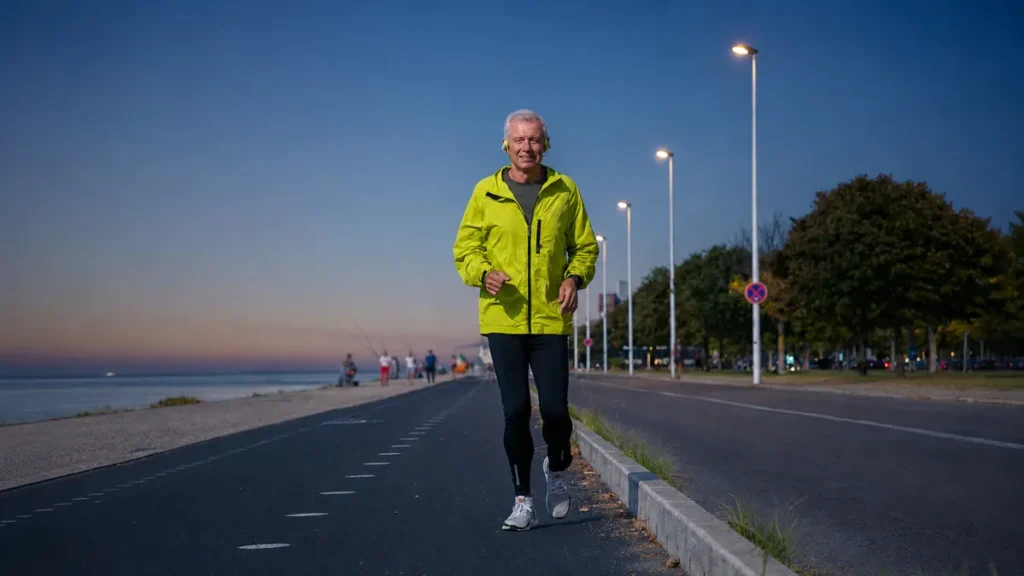
The key shift is treating the walk as attached to an experience, not attached to a time slot.
This doesn’t replace your regular exercise routine. If you already walk every morning, that habit still matters for cardiovascular health, mood, and long-term brain structure.
The timing adjustment is an additional layer, a short, deliberate walk placed near a moment you want to remember.
The next section addresses what to do if you haven’t been active in years and are wondering whether any of this applies to you.
What to Do If You Haven’t Exercised in Years
If regular exercise isn’t part of your life right now, the timing window still applies. The relationship between exercise and memory after 50 doesn’t depend on prior fitness. It requires physical effort in the right window.
Starting late still counts. The same systematic review of walking interventions in older adults found benefits for memory and executive function across a range of participants, including those who had not been exercising regularly before the study began.⁵
Getting started late doesn’t eliminate the benefit.
A reasonable starting point for the timing protocol:
- Begin with 10 minutes of brisk walking, not 20
- Aim for a pace that raises your breathing noticeably
- Do this after any activity you’d like to remember
- Add five minutes each week as it becomes comfortable
Don’t wait until you feel ready for a full routine. A 10-minute walk after a meaningful conversation still puts your brain in a better position to consolidate what happened than sitting still does.
If you have a chronic health condition, haven’t been active in more than a year, or have concerns about your heart or joints, check with your doctor before starting. That step is worth the call.

The protocol is simple and the timing is specific, but you’ll need one more thing before you’re ready to use it: a reason to start tomorrow.
Start Today
Pick one moment from tomorrow that you’d like to remember. Plan a 20-minute walk within four hours of it. That single adjustment is the most direct way to use exercise and memory after 50 together.
Take a 20-minute walk within four hours of any activity you want to remember. Memory doesn’t wait for you to be ready. The window opens, and it closes. Start with one walk.
References
- Erickson KI, Voss MW, Prakash RS, et al. Exercise training increases size of hippocampus and improves memory. Proceedings of the National Academy of Sciences of the United States of America. 2011. https://pubmed.ncbi.nlm.nih.gov/21282661/
- Acute exercise-induced epinephrine elevation promotes post-learning memory consolidation: a narrative review of mechanisms and implementation strategies. PMC / Frontiers (narrative review). 2025. https://www.ncbi.nlm.nih.gov/pmc/articles/PMC12842734/
- van Dongen EV, Kersten IHP, Wagner IC, Morris RGM, Fernández G. Physical exercise performed four hours after learning improves memory retention and increases hippocampal pattern similarity during retrieval. Current Biology. 2016. https://www.cell.com/current-biology/fulltext/S0960-9822(16)30465-1
- Optimal exercise interventions for enhancing cognitive function in older adults: a network meta-analysis. Frontiers in Aging Neuroscience / PMC. 2025. https://pmc.ncbi.nlm.nih.gov/articles/PMC12289702/
- Walking interventions and cognitive health in older adults: a systematic review of randomized controlled trials. PMC. 2025. https://pmc.ncbi.nlm.nih.gov/articles/PMC12284334/