
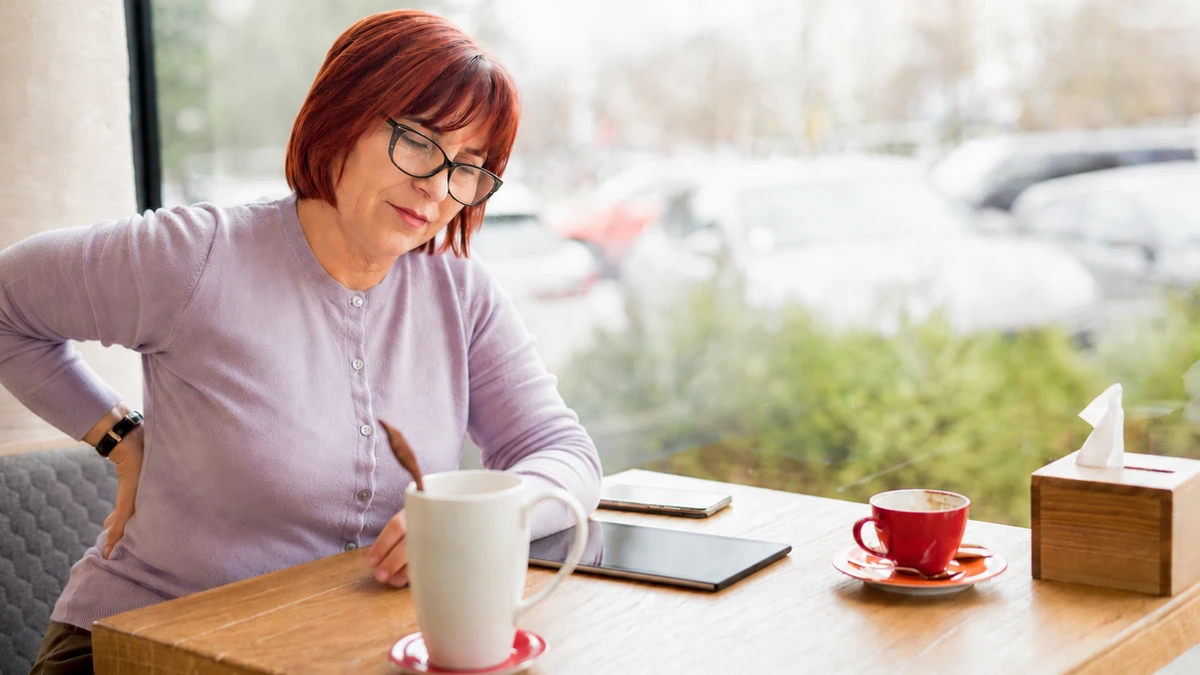
You went to the gym this morning. You did the work. And yet by 3:00 pm, your hips feel like concrete: stiff when you stand, tight when you walk, and vaguely sore in a way that your workout did not cause and will not fix.
For adults over 50 who exercise regularly but sit for most of the day, this is the part nobody explains: nine hours of sitting compresses, shortens, and slowly weakens the muscles that hold your hips in line. The workout you did this morning did almost nothing to stop it.
The problem is not your fitness level. It is the other 23 hours.
Why Read This
- What sitting actually does to the muscles around your hip, and why it’s not the same as muscle damage
- The reason your morning workout can improve your heart without fixing your hips
- A specific chain reaction that starts in your hip flexors and ends with your glutes going quiet
- How long each sitting bout needs to be before hip tissue starts adapting
- A four-step daily protocol that takes less than two minutes per hour
Why Your Hips Feel Worse in Your 50s Even When You Stay Active
The stiffness you feel standing up after a two-hour stretch at your desk is not soreness from yesterday’s workout. It is your hip flexors already locking into the shortened position they have held for the past two hours.
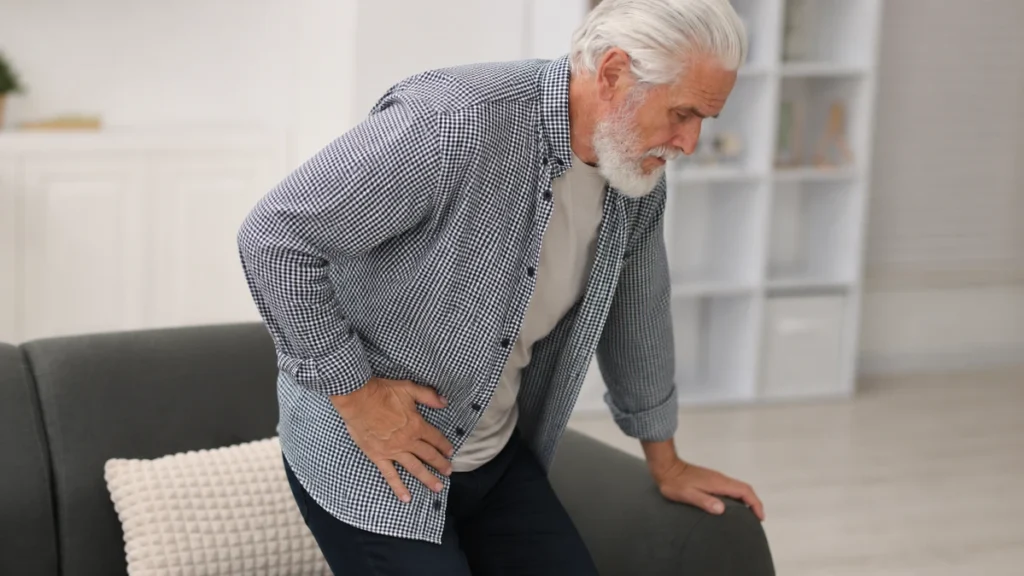
That feeling gets more common after 50. It has less to do with how hard you train and more to do with what happens to your hips between training sessions.
Hip flexor tightness [shortening and stiffening of the muscles at the front of your hip that pull your knee toward your chest] from sitting is not inevitable with age, but it is common because most adults spend far more time sitting than moving.
Adults spend roughly 70% of their waking hours in sitting or light activity, with little to no structured exercise filling the gap.¹
You probably already know that sitting is not great for you. What most articles skip is the specific mechanism.
Sitting does not cause your hips to age faster in some general sense. It causes one particular chain of physical events, starting in the hip flexors and working its way outward, that undermines the mobility your workouts are trying to build.
In a population-based study involving adults in paid employment, prolonged occupational sitting was independently associated with a significantly higher likelihood of hip pain compared to those without prolonged sitting exposure.²
That finding held even after accounting for other physical activities. Sitting, on its own, was enough to raise the odds.
What Sitting Actually Does to the Muscles Around Your Hip
Most people assume their hips hurt because something is broken. That assumption sends them toward ice packs, pain relief, and rest. The actual problem is more specific and more fixable.
The hip flexors don’t get damaged from one long day at the desk. They adapt, slowly and quietly, until the position they were stuck in all day becomes the position they think is normal.³
That distinction changes everything about how you approach the problem. Damage needs healing. Adaptation needs reversal. These are different jobs, and only one of them responds to rest.
Passive hip extension [how far your hip can stretch backward when your muscles are relaxed, a measure of how shortened the hip flexors have become] is measurably reduced in people who sit for long periods.
In a cross-sectional study of 144 adults, those who were inactive and sat for more than seven hours per day had 6.1 degrees less passive hip extension than those who were active and sat for under four hours.³
Six degrees of lost range is not a small rounding error. It is the body quietly reorganizing itself around a chair.
That gap represents how far the hip flexors have shortened as a direct adaptation to being held in one position day after day.
Prolonged sitting measurably reduces the hip’s ability to extend.³ When you stand after hours of sitting, the hip flexor muscles that have been held in a shortened position struggle to lengthen on demand, which can make the front of your hip feel stiff, tight, or pinchy.
No single study has directly tested every step of the full mechanism described in this article. The evidence comes from several independent sources, each testing a different piece of the chain.
So how far does that chain actually reach?
Why Your Morning Workout Doesn’t Fix What Your Chair Does All Day
Here is a hard thing to hear if you exercise consistently: you might be doing everything right at the gym and still losing ground on your hip health by noon.
Researchers have identified a pattern called the “active couch potato.” It describes people who meet the weekly exercise guidelines (150 minutes or more of moderate activity) but then spend the rest of their waking hours sitting.⁴
Metabolic and musculoskeletal research shows their health markers are meaningfully worse than people with similar exercise volumes who also move more throughout the day.⁴
Your workout and your sitting time act on different systems. A 45-minute walk or strength session improves cardiovascular function, builds muscle, and raises your metabolic rate for a period afterward.
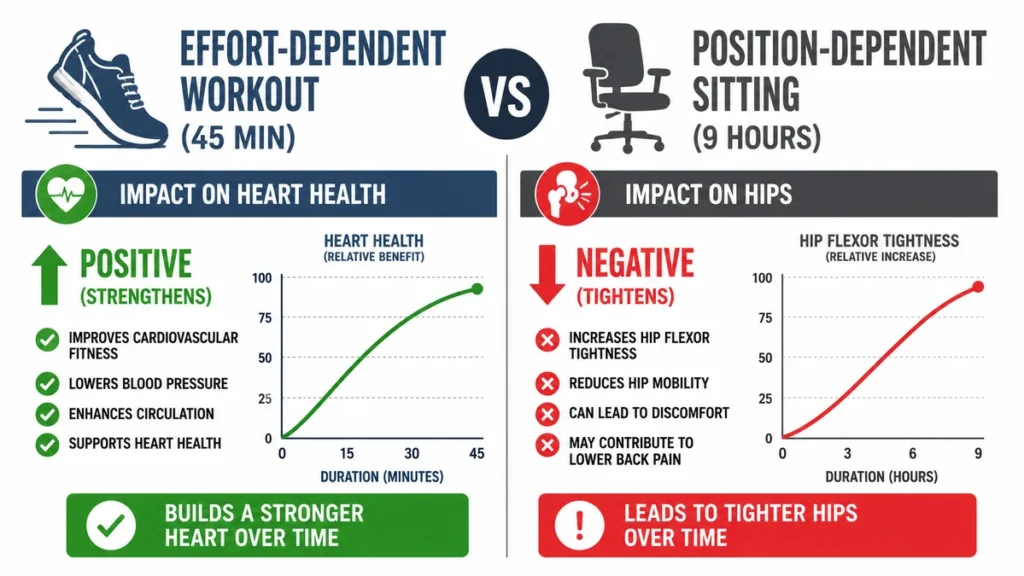
None of those adaptations reverse the structural shortening that happens when you sit in a 90-degree hip position for nine hours.
Structured exercise [deliberate physical activity done at moderate or vigorous intensity, such as walking, cycling, or strength training] addresses effort-dependent systems. Prolonged sitting addresses position-dependent ones.
A harmonized meta-analysis of data from more than one million adults found that high levels of moderate-intensity physical activity, roughly 60 to 75 minutes per day, appeared to eliminate the increased mortality risk associated with high sitting time.⁵
But most people exercising regularly are doing 30 to 45 minutes, not 60 to 75.
And that analysis addressed mortality, not hip mechanics. The hip flexors do not care how hard you worked out this morning. They respond to how long they were held in one position today.
The Glute Shutdown Nobody Warned You About
Tight hip flexors are half the story. The other half is what happens to the muscles on the opposite side.
When your hip flexors are compressed and shortened in a seated position, the muscles directly across from them go quiet.
Your gluteus maximus and gluteus medius [the large muscles in the back and sides of your hips that extend your leg backward and keep your pelvis level when you walk] disengage.
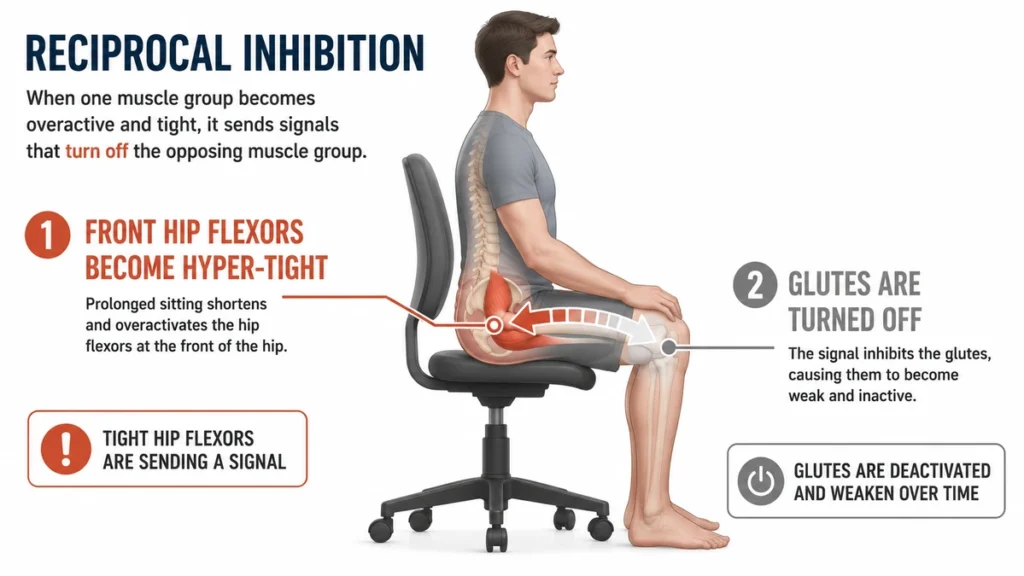
This is not metaphorical. Extended sitting is associated with reduced neuromuscular activation of the gluteal muscles, a pattern sometimes called gluteal amnesia [a clinical term for when the glutes fail to fire properly during movement, leaving other muscles to compensate].⁶
The glutes shut down because they do not need to work while you are seated. The hip flexors take over, the glutes disengage, and the body accepts this as normal. The longer and more frequently this happens, the harder it becomes to recruit the glutes on demand.⁶
The research on gluteal amnesia includes 47 publications from 2000 to 2024, covering clinical assessment and rehabilitation. ⁶ Most of that evidence is observational or clinical, not drawn from large controlled trials. The pattern is clinically well-recognized but less experimentally tight than the hip extension data.
Glute inhibition from prolonged sitting matters because the glutes are not just gym muscles. They extend your hip when you climb stairs, stabilize your pelvis when you walk, and absorb load when you land from any step.⁶
When they are not firing properly, the lower back steps in. The hamstrings overwork. The knee tracks poorly.
And you may not feel any of this directly. If your lower back has been aching or your knee feels off without a clear cause, your hips may be where the answer starts.
How to Break the Sitting Pattern Without Quitting Your Job
The fix is not a longer workout. It is a different relationship with the hours between workouts.
Research on short bouts of activity inserted throughout the day, sometimes called “exercise snacks,” shows consistent benefits for older adults, including significant gains in lower-limb strength and mobility.⁷
A 28-day pilot study of community-dwelling older adults found that brief, home-based exercise snacking improved scores on mobility tests and reduced the time needed to complete sit-to-stand transitions.⁷ Those are exactly the movements that prolonged sitting degrades.
The principle is position reversal. Every time you stand up and move through a full hip extension, you temporarily counter the shortening your hip flexors accumulated in the last hour of sitting. You also prompt the glutes to fire. Repeated throughout the day, these interruptions prevent the adaptation from cementing.
Talk to your doctor before starting any new exercise routine if you have existing hip, knee, or back pain, or if you are managing a chronic condition.
The following protocol takes under two minutes per interruption. Set a phone alarm every 60 minutes while seated.
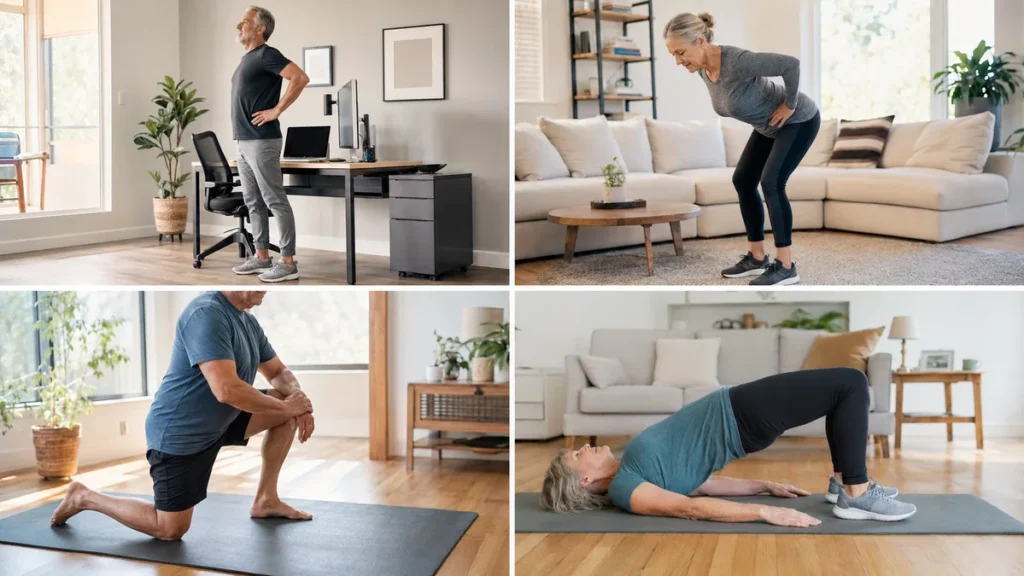
60-Minute Hip Reset Protocol
- Stand and hold: Rise fully, no desk lean. Stand for 10 seconds. Let the hip flexors lengthen under your own weight.
- Hip hinge x10: Push hips back slowly, back flat, then drive forward to full standing. This is what your glutes are designed for.
- Hip flexor stretch (90 seconds): Half-kneeling, tuck pelvis, shift weight forward until you feel a pull at the front of the rear hip. Hold 45 seconds per side.
- Glute bridges x10 (optional): On your back, feet flat, push through heels to lift hips. Squeeze two seconds at the top.
The first two items take 90 seconds and require nothing but floor space.
What Hips That Work Well Actually Feel Like
Most articles end with a list of stretches. This one ends differently.
The goal of reversing the effects of prolonged sitting is not to reach a certain number on a flexibility test or to complete a set protocol without pain. It is to restore the function your hips had before the chair became the dominant position in your day.
When hip flexors are at a working length, you stand up from a chair and your body simply rises. There is no stiffening through the first few steps. No catching sensation at the front of the hip. No low-level ache that fades after you have been walking for a minute.
Glutes that are firing properly change how climbing stairs feels: the push comes from behind you, not the pull from the front. Walking becomes propulsive rather than shuffled. The lower back does not do the work the glutes were supposed to do.⁶

Anterior pelvic tilt [a forward tipping of the pelvis that compresses the lower spine and shortens the hip flexors, caused by prolonged sitting and weak glutes] is the structural consequence of hips that have been in a chair too long.
When it corrects, even partially, it is reasonable to expect that the lower back may decompress, the glutes can re-engage, and the stride may lengthen. Targeted hip flexor stretching has been shown to reduce anterior pelvic tilt, with research showing improvements in pelvic position following consistent stretching interventions.⁸
That is the target. Not flexibility for its own sake. Hips that carry you the way they were built to.
The Chair Is the Problem. The Day Is the Fix.
Your hips are not failing because you are aging. They are adapting to the position you hold for most of the day. Hip mobility after 50 declines when sitting becomes the default and movement becomes the exception.
Set a phone alarm for every 60 minutes today, stand up, and do 10 hip hinges or a 90-second hip flexor stretch before sitting back down.
That one change, repeated throughout the day, does more for your hips than another workout. How quickly people respond to sitting interruptions, and whether 60 minutes is the optimal interval, remains open.
⚠️DISCLAIMER
This article is for informational purposes only and does not constitute medical or professional fitness advice. The content addresses prolonged sitting and its effects on hip flexor and glute function after 50 and is intended for general educational purposes only. Exercise carries inherent risk, consult a qualified healthcare or fitness professional before beginning or modifying any training program, particularly if you have an existing injury or medical condition.
References
- Owen N, Sparling PB, Healy GN, Dunstan DW, Matthews CE. Sedentary behavior: emerging evidence for a new health risk. Mayo Clinic Proceedings. 2010;85(12):1138-1141. doi:10.4065/mcp.2010.0444. https://pmc.ncbi.nlm.nih.gov/articles/PMC2996155/
- Pope DP, Hunt IM, Birrell FN, Silman AJ, Macfarlane GJ. Hip pain onset in relation to cumulative workplace and leisure time mechanical load: a population based case-control study. Annals of the Rheumatic Diseases. 2003. https://pmc.ncbi.nlm.nih.gov/articles/PMC1754510/
- Boukabache A, Preece SJ, Brookes N. Prolonged sitting and physical inactivity are associated with limited hip extension: a cross-sectional study. Musculoskeletal Science and Practice. 2021. https://www.sciencedirect.com/science/article/abs/pii/S2468781220305877
- Farrahi V, Rostami M, Dumuid D, Chastin SFM, Niemela M, Korpelainen R, Jamsa T, Oussalah M. Joint profiles of sedentary time and physical activity in adults and their associations with cardiometabolic health. Medicine and Science in Sports and Exercise. 2022. https://doi.org/10.1249/MSS.0000000000003008
- Ekelund U, Steene-Johannessen J, Brown WJ, et al. Does physical activity attenuate, or even eliminate, the detrimental association of sitting time with mortality? A harmonised meta-analysis of data from more than 1 million men and women. The Lancet. 2016. https://pubmed.ncbi.nlm.nih.gov/27475271/
- Nikolova D, Nedev N. Gluteal amnesia and neuromuscular inhibition: clinical significance and evidence-based approaches to assessment and intervention. Journal of the Medical College – Varna. 2026;9(1):26-30. https://journals.mu-varna.bg/index.php/jmk/article/view/10668
- Hu Z, Li S, Shi X, Huang K, Huang H, Yuan X. Feasibility and acceptability of a remotely delivered, home-based “exercise snacking” to improve physical function in community-dwelling older adults: a 28-day pilot study. Frontiers in Medicine. 2026;13:1755508. doi:10.3389/fmed.2026.1755508 https://www.frontiersin.org/journals/medicine/articles/10.3389/fmed.2026.1755508/full
- Preece SJ, Tan YF, Alghamdi TDA, Arnall FA. Comparison of pelvic tilt before and after hip flexor stretching in healthy adults. Journal of Manipulative and Physiological Therapeutics. 2021;44(4):289-294. https://pubmed.ncbi.nlm.nih.gov/34090549/