
You go to the doctor. The blood work comes back fine. The heart monitor shows nothing. The doctor says it is probably stress, or maybe just getting older, and sends you home. But the tightness in your chest does not leave. The low hum of dread is still there when you wake up at 3:00 am, still there at noon, still there for no reason you can name.
After 50, anxiety often stops looking like worry and starts showing up as physical symptoms that get blamed on aging, making it one of the most missed and undertreated conditions in this age group.
What your body may actually be signaling is a structural shift in your nervous system, one that is measurable, documented, and rarely explained in a doctor’s office.
Why keep reading:
- Why the feeling that you cannot calm down is often a physical fact, not a personality trait
- What your heart rate reveals about your nervous system’s capacity to recover from stress
- The specific physical symptoms most people in their 50s and 60s are told to live with, and what they actually indicate
- Why anxiety after 50 is underdiagnosed even when patients bring it up directly
- What the evidence says works, and what the limitations of that evidence are
What Your Body Is Actually Doing When Anxiety Won’t Go Away
You have probably been told that what you are feeling is stress, that it will pass, or that it is just part of getting older. That explanation feels wrong because it is incomplete.
Anxiety is common among adults over 50, far more than most people realize. A 2024 systematic review pooling data from 23 studies found the overall prevalence of anxiety among older adults at 18.7%.¹
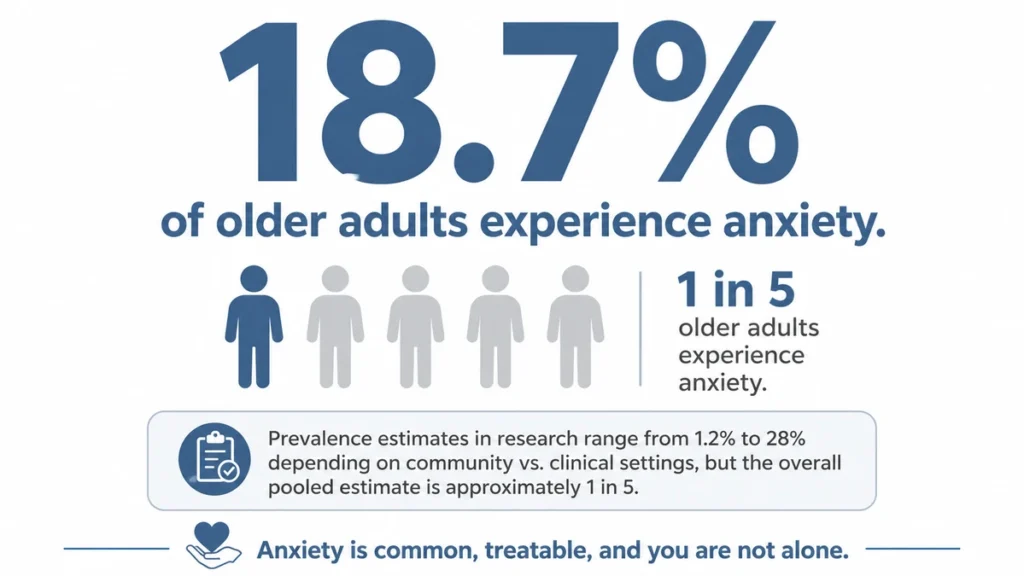
A separate comprehensive review of community-based research found that the prevalence of anxiety symptoms in older adults ranges from 1.2% to 15% in community samples and from 1% to 28% in clinical settings, with the wide spread reflecting how differently anxiety looks in this age group compared to younger adults.²
The feeling that will not quit is not simply emotional. When anxiety becomes persistent and hard to explain, the body is doing specific things. The heart beats faster than the situation calls for. Muscles stay slightly tensed without any obvious trigger.
Sleep breaks apart in the early morning hours before the alarm. Digestion becomes unreliable. These are not separate problems. They are outputs of a nervous system that has shifted its baseline, spending more time in a state of alert than it used to.
The body’s signal is worth listening to, not dismissing. Anxiety after 50 that feels different from earlier-life anxiety often is different, and the reason sits inside a physiological change most articles never mention.
The Autonomic Shift That Happens After 50
Your nervous system has two branches that are supposed to work as a team. One accelerates your body when a threat appears. The other slows it back down when the threat passes. After 50, that second branch gets weaker, and the first one does not.
This two-branch system is called the autonomic nervous system [the part of your nervous system that runs your heart, breathing, digestion, and stress response without conscious control].
Research on autonomic nervous system aging has consistently found that resting sympathetic activity, the branch responsible for alertness and the stress response, increases with age.³ At the same time, parasympathetic activity, the branch responsible for recovery and calm, appears to decline.³
That gap between those two branches is measured by something called heart rate variability [the natural variation in the time between each heartbeat, which reflects how quickly your nervous system can shift gears].
In a dataset representing more than eight million people, heart rate variability was estimated to be 80% lower at age 60 than at age 20.⁴ That is not a small change.
That is the real finding here: the body’s built-in brake weakens decades before most people ever hear the word autonomic, and the feeling of unrelenting anxiety is often the brake’s absence, not a mind out of control.
The nervous system after 50 is not broken, it has simply lost the counterweight it used to have, and that loss is measurable, reversible to a degree, and almost never discussed when a doctor hands you a blood pressure reading.
Elevated basal norepinephrine [a stress-signaling chemical released by sympathetic nerves] levels have been documented in healthy older adults across multiple lines of evidence including catecholamine studies and microneurographic recordings from muscle sympathetic nerves.⁵
No single study tests all of this simultaneously in adults over 50 experiencing anxiety.
Taken together, the picture is assembled from research on autonomic aging in one group, heart rate variability across the lifespan in another, and anxiety prevalence in older adults in a third. The direction of evidence is consistent, but the conclusion is assembled from parts.
Why Your Doctor Might Be Missing What Your Nervous System Is Saying
You have probably mentioned these feelings to a doctor and come away with no clear answer. You are not imagining the gap. In older adults, anxiety disorders are underdiagnosed and undertreated as a population-level fact, not an individual failure.⁶
One reason is how anxiety presents differently after 50. Older adults are more likely to report anxiety as physical complaints, not as worry or fear.⁷
A racing heart, persistent fatigue, gut discomfort, and disrupted sleep often get investigated as cardiac or gastrointestinal problems, while the underlying anxiety goes unnamed.⁷ Each test comes back inconclusive, and the patient leaves with nothing resolved.

Recognition rates are strikingly low. A study of adults aged 60 and older in a multi-specialty medical organization found that physicians diagnosed generalized anxiety disorder in only 1.5% of patients, while recognition of anxiety symptoms in patients who had the condition reached just 34%.⁸
The direct challenge here is worth stating plainly: a nervous system showing measurable signs of autonomic imbalance is not a patient complaining about stress, and treating those two things as equivalent means the actual problem remains untreated.
Part of the problem is diagnostic criteria built around how anxiety looks in younger adults. Younger patients tend to report persistent worry as the central complaint. Older patients more often report that something in their body feels off, without knowing what to call it.⁷
The Physical Symptoms Most People Blame on Aging Instead
Anxiety after 50 rarely announces itself as anxiety. The body sends different signals, and each one is easy to explain away as a natural part of getting older.
Somatic symptoms [physical complaints that arise from or are worsened by a psychological or nervous system state] are a recognized feature of anxiety disorders across all age groups.⁹
In older adults, they tend to dominate the picture. Research on older adults with anxiety has found that this population often presents anxiety primarily through physical complaints, minimizing or not recognizing the emotional component.⁷
The list of physical symptoms associated with late-life anxiety includes:
- A heart that races or pounds without clear cause
- Muscle tightness in the shoulders, jaw, or chest that does not resolve with rest
- Sleep that breaks apart in the early morning hours, usually between 2:00 and 4:00 am
- A digestive system that becomes unpredictable or uncomfortable under no obvious stress
- Fatigue that feels different from tiredness, more like a wired-but-drained state
- Dizziness or lightheadedness that medical tests do not explain

None of these are unique to anxiety. But when several show up together without a medical explanation, and especially when they arrived or worsened around a major life transition, they are worth evaluating as a nervous system pattern, not as separate unrelated complaints.
If you have had most of these investigated and found nothing wrong, what has actually been ruled in?
What the Evidence Says About Calming an Aging Nervous System
Calming a nervous system that has shifted its baseline is not the same task as managing stress at age 30. The interventions with the best evidence in older adults work through the autonomic system directly, not through willpower.
Deep and slow breathing [a technique involving deliberate slowing of the breath to around five to six breaths per minute, extending the exhale longer than the inhale] is one of the most studied approaches for restoring parasympathetic tone.
One 2021 study in adults found that a single session of this breathing pattern significantly increased heart rate variability in both younger and older participants, and that the increase in parasympathetic activity was meaningfully larger in the older group than in the younger one.¹⁰
Breathing slowly appears to benefit aging nervous systems more, not less.
Aerobic exercise is the other area with strong support. A meta-analysis of 11 randomized controlled trials involving 770 older adults found that physical activity was associated with a significant overall reduction in anxiety symptoms.¹¹
Mind-body forms of exercise, including tai chi and qigong, showed particularly consistent effects on psychological stress reduction in a separate systematic review of supervised exercise trials in adults aged 50 and older.¹²
Anxiety is a nervous system issue. Interventions that engage the nervous system directly, through breath, through sustained movement, tend to produce results that passive approaches do not.
Talk to your doctor before starting a new exercise program if you have a heart condition, joint problems, or any condition that limits physical activity.
A starting protocol based on available evidence:
- Practice slow breathing (5-6 breaths per minute, 4-5 seconds inhale, 6-8 seconds exhale) for 10 minutes daily
- Choose aerobic movement you can sustain for 20-30 minutes, three to five days per week
- Consider tai chi or qigong if joint pain limits conventional aerobic exercise
- Track sleep quality as a secondary indicator: improvements in nervous system regulation often show up in sleep before mood
How to Know When You Need More Than Self-Help
Breathing exercises and regular movement can shift the nervous system’s baseline over time. For many people over 50, they are not enough on their own.
Cognitive behavioral therapy [a structured form of talk therapy that teaches specific skills for identifying and changing thought and behavior patterns that maintain anxiety] is a well-established, evidence-based treatment for anxiety.
Alongside CBT, emerging research also supports other approaches. A systematic review of seven randomized controlled trials in adults with late-life anxiety found that mindfulness-based meditation was associated with meaningful reductions in anxiety symptoms compared to control conditions, with 355 participants across the included studies.¹³
The evidence on other approaches, including medication management and combined therapy protocols, is thinner in adults over 50 specifically. Most clinical trials for anxiety interventions have used younger or mixed-age samples, and extrapolating those results directly to older adults involves assumptions the research does not fully support.

This is a genuine gap, not a minor one.
When to consider a referral rather than self-managed approaches:
- Anxiety symptoms have persisted for more than six months without clear situational cause
- Sleep is disrupted four or more nights per week as a direct result
- You have reduced or avoided activities, relationships, or situations because of anxiety
- Physical symptoms have been medically investigated and no organic cause found
- Breathing and exercise approaches have been tried consistently for eight or more weeks without meaningful change
You deserve a specific evaluation of your nervous system, not a general reassurance that stress is normal at your age.
Your Nervous System Is Telling You Something Real
Anxiety after 50 that feels physical and hard to explain is not an overreaction. It reflects a measurable shift in how the autonomic nervous system manages stress and recovery.
Talk to your doctor specifically about anxiety as a nervous system issue, not just a mood problem, and ask whether a referral to a therapist trained in cognitive behavioral therapy for older adults makes sense for you.
For free guidance, visit nimh.nih.gov/health/topics/older-adults-and-mental-health. Research on what works best for this population is still catching up.
⚠️DISCLAIMER
This article is for informational purposes only and does not constitute medical advice, diagnosis, or treatment. The content addresses anxiety and autonomic nervous system changes in aging adults and is intended for general educational purposes only. Health conditions vary significantly between individuals, always consult a licensed physician or qualified healthcare provider before making any decisions about your health or medical care.
References
- Patel M, Mantri N, Joshi N, et al. Is anxiety a public health problem among older adults in India: Results from a systematic review and meta-analysis. Journal of Family Medicine and Primary Care. 2024;13(7):2545-2554. https://journals.lww.com/jfmpc/fulltext/2024/13070/is_anxiety_a_public_health_problem_among_older.3.aspx
- Bryant C, Jackson H, Ames D. The prevalence of anxiety in older adults: methodological issues and a review of the literature. Journal of Affective Disorders. 2008. https://pubmed.ncbi.nlm.nih.gov/18155775/
- Hotta H, Uchida S. Aging of the autonomic nervous system and possible improvements in autonomic activity using somatic afferent stimulation. Geriatrics and Gerontology International. 2010. https://onlinelibrary.wiley.com/doi/10.1111/j.1447-0594.2010.00592.x
- Nashiro K, Yoo HJ, Cho C, et al. Heart rate and breathing effects on attention and memory (HeartBEAM): study protocol for a randomized controlled trial in older adults. Trials. 2024. https://www.ncbi.nlm.nih.gov/pmc/articles/PMC10941428/
- Shimazu T, Tamura N, Shimazu K. Aging of the autonomic nervous system [Article in Japanese]. Nihon Rinsho. 2005;63(6):973-977. PMID: 15948378.https://pubmed.ncbi.nlm.nih.gov/15948378/
- Sable JA, Jeste DV. Anxiety disorders in older adults. Current Psychiatry Reports. 2001;3(4):302-307. DOI: 10.1007/s11920-001-0023-0. https://pubmed.ncbi.nlm.nih.gov/11470037/
- Welzel FD, Stein J, Röhr S, et al. Prevalence of anxiety symptoms and their association with loss experience in a large cohort sample of the oldest-old. Results of the AgeCoDe/AgeQualiDe Study. Frontiers in Psychiatry. 2019.https://www.ncbi.nlm.nih.gov/pmc/articles/PMC6518947/
- Calleo J, Stanley MA, Greisinger A, et al. Generalized anxiety disorder in older medical patients: diagnostic recognition, mental health management and service utilization. Journal of Clinical Psychology in Medical Settings. 2009 https://pubmed.ncbi.nlm.nih.gov/19152056/
- Liu Y, Zhao J, Fan X, Guo W. Dysfunction in serotonergic and noradrenergic systems and somatic symptoms in psychiatric disorders. Frontiers in Psychiatry. 2019. https://www.ncbi.nlm.nih.gov/pmc/articles/PMC6537908/
- Magnon V, Dutheil F, Vallet GT. Benefits from one session of deep and slow breathing on vagal tone and anxiety in young and older adults. Scientific Reports. 2021. https://www.ncbi.nlm.nih.gov/pmc/articles/PMC8481564/
- Goodarzi S, Teymouri Athar MM, Beiky M, et al. Effect of physical activity for reducing anxiety symptoms in older adults: a meta-analysis of randomized controlled trials. BMC Sports Science, Medicine and Rehabilitation. 2024 https://link.springer.com/article/10.1186/s13102-024-00947-w
- Churchill R, Teo K, Kervin L, Riadi I, Cosco TD. Exercise interventions for stress reduction in older adult populations: a systematic review of randomized controlled trials. Aging & Mental Health. 2022. https://www.ncbi.nlm.nih.gov/pmc/articles/PMC9518651/
- Hatch S, Webber J, Rej S, Finlayson M, Kessler D. The effectiveness of mindfulness-based meditation treatments for late life anxiety: a systematic review of randomized controlled trials. Aging & Mental Health. 2022. https://pubmed.ncbi.nlm.nih.gov/35912637/