
You have probably tried a few things. The fish oil. The vitamin D. The turmeric capsule someone swore by at the office.
Most adults past 50 do exactly this: stack the cabinet and hope the numbers improve. But something large keeps turning up in the research that no supplement company is selling: the sense of purpose after 50 that comes from feeling your life has direction.
Not happiness. Not optimism. Not gratitude. Specifically, the sense that you have things you want to build or contribute.
That one variable keeps appearing in the data next to outcomes that pills can’t match.¹
Why this article is worth reading:
- Purpose scores predicted fewer hospital nights per year, and not by a small margin, even when researchers controlled for baseline health.
- One cognitive finding from the Rush Alzheimer’s Disease Center is so counterintuitive that most health sites never mention it.
- There are three separate physical pathways through which purpose appears to work, and only one of them has anything to do with stress.
- The biggest drop in purpose for most people happens at a specific, predictable moment, and knowing when it comes is the first step to preventing it.
What researchers actually measured when they studied purpose and health
You probably assume that “purpose” is the kind of thing researchers can’t measure: too personal, too fuzzy, too far from a blood test or a scan. That assumption is reasonable, and it’s also wrong.
Scientists have been measuring sense of purpose after 50 for decades using validated psychological scales that score how strongly a person feels their life has direction and goals.
The largest of these studies tracked 6,985 adults over the age of 50 across the United States for more than four years. Every participant answered questions from a standardized scale measuring purpose.
Researchers then tracked who died and from what cause. People with the lowest purpose scores had more than twice the mortality risk of those with the highest scores, even after adjusting for health behaviors, socioeconomic factors, and existing conditions.¹
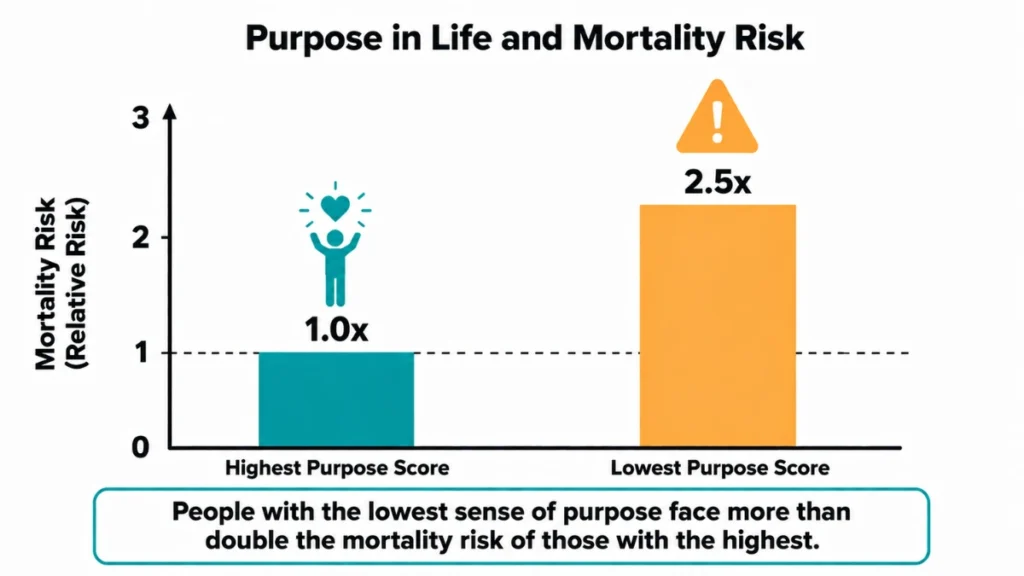
More than twice. Not a modest edge. Not a trend. A doubling of all-cause mortality risk tied to a psychological variable that most annual physicals never ask about.
This is not a single study’s finding. A systematic review of 10 separate studies found that high purpose scores were linked to a 17% reduction in all-cause mortality and cardiovascular events across populations.² The consistency across studies is what makes this hard to dismiss.
The connection appears to run through three distinct physical pathways, not one. The distinction is important: purpose isn’t simply a proxy for being healthy and happy. Each pathway is independently documented in its own cohort evidence.
The three ways purpose changes your body without you noticing
Most people expect that the purpose-in-life health benefits come from stress reduction. Less stress, lower blood pressure, longer life. That story is tidy, and it’s incomplete.
Behavior comes first. Adults with higher purpose scores are more likely to stay physically active over time.²
In a study of 13,770 adults over 50 tracked for eight years, those in the top purpose quartile had 24% lower odds of becoming physically inactive and 33% lower odds of developing sleep problems compared to those in the bottom quartile.³
They weren’t more disciplined by nature. They had more reasons to stay well.
The second pathway runs through the cardiovascular system. In a prospective study of US adults over 50 who were stroke-free at baseline, each standard deviation increase in purpose score was linked to a 22% lower risk of stroke over the four-year follow-up, even after adjusting for depression, blood pressure, smoking, and exercise.⁴
That’s not the stress pathway. That’s a direct association between a psychological variable and a specific vascular outcome.
A third pathway runs through the brain, and it gets its own section because the findings there are unusual enough to need space.
The research does not show that purpose makes sick people well; it shows that purposeful people tend to stay out of the doctor’s office in ways that the standard supplement conversation never touches.
Taken together, these three pathways make clear that this is not assembled from one study’s finding. Each pathway draws from a different cohort, a different outcome, and a different mechanism. Does any of that change what you should do today?
Your brain on purpose: why cognitive decline slows when life has direction
You can picture what cognitive decline looks like: names that won’t come, sentences that drift, a general slowing you tell yourself is just tiredness.
What you probably can’t picture is a brain that has the physical damage of Alzheimer’s disease but is still functioning better than expected, because of a psychological variable measured on a questionnaire.
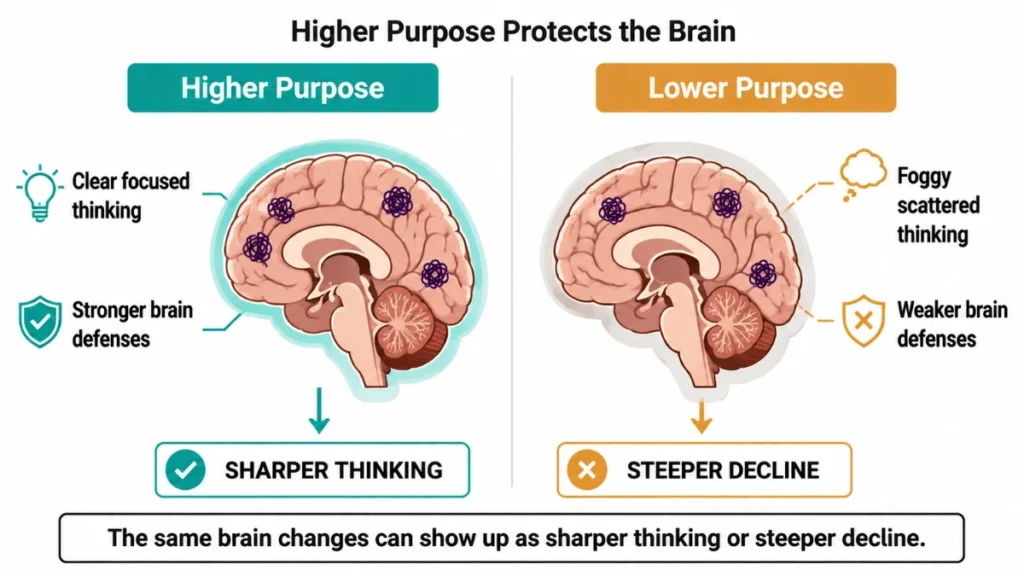
That is what researchers at the Rush Alzheimer’s Disease Center found. In a study of older adults who agreed to brain autopsies after death, those who had reported higher purpose in life during their lifetime showed better cognitive function than their brain tissue alone would predict.⁵
The tangles and plaques were present. The purpose scores appeared to reduce their impact on actual thinking ability.
This is the direct challenge to how most people think about brain health. Exercise, diet, and sleep are real protective factors. But the Rush data suggest that a psychological state can act as a buffer against the physical damage already accumulating in the brain, independently of those behaviors.
Purpose was also associated with a 28% lower risk of developing cognitive impairment across racial and ethnic groups, even among people who carried genetic risk for dementia, in a population-based US cohort.⁶
For every one-point rise in meaning and purpose on a validated scale, a large UK Biobank study found a 35% decrease in all-cause dementia risk, with similar patterns for both Alzheimer’s disease and vascular dementia.⁷
None of these studies prove that building purpose will prevent dementia. They are observational, and the relationship between health and purpose runs in both directions. But the size and consistency of the association is hard to ignore.

The doctor’s-office finding that surprises most people
If you have a strong sense of purpose, you are probably getting your screenings. That is not intuition. It is a documented pattern.
A six-year study tracking 7,168 US adults over 50 found that each unit increase in purpose score (on a six-point scale) was linked to 17% fewer nights spent in the hospital per year.⁸
People with higher purpose were also more likely to get cholesterol tests, colonoscopies, and gender-specific cancer screenings compared to those with lower scores.⁸
17% fewer hospital nights. Per year. Across six years of follow-up.
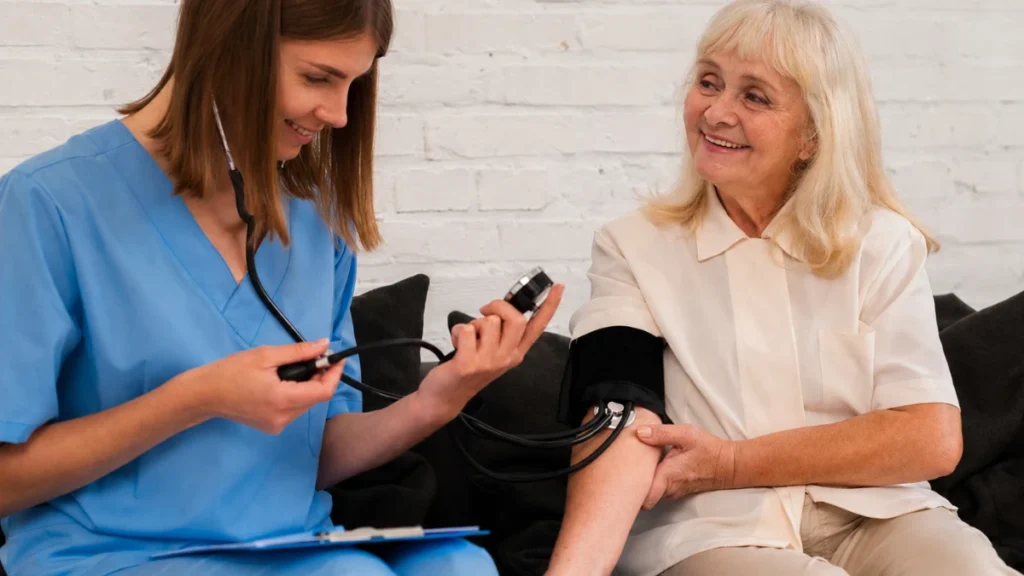
That number belongs in every conversation about preventive care, and it almost never appears there.
The mechanism is behavioral, not mystical. People with a strong sense of purpose use preventive healthcare [health services that catch problems before symptoms appear] more reliably. They have a reason to show up for the appointment that might deliver bad news. They follow through.
This matters because the standard health conversation focuses on what you do: what you eat, how much you move, which supplements you take.
The hospitalization finding points somewhere different: purpose changes whether you show up at all, which turns out to be among the most powerful things you can do for your long-term health.
Purpose-driven healthcare use is one way the body stays out of crisis. The behavior changes are another. If you are over 50 and your last checkup was more than a year ago, this is the section worth sitting with.
Why your sense of purpose after 50 drops and what makes it fall faster
You may have noticed a quiet shift a few years back: the sense that each day had a clear point, that your presence somewhere mattered in a specific way. For many adults, that feeling begins to thin after 50. That is not imagination.
Research tracking purpose scores across thousands of older adults over time confirms that purpose tends to decline in later life.² Two events accelerate the drop faster than most: retirement and significant physical illness.
Retirement is the more surprising one. It removes the daily structure, the social role, and the sense of being needed that work provided, often all at once.

A reanalysis of Health and Retirement Study data found that the relationship between retirement and purpose is complicated. Planned retirement, particularly for adults with lower socioeconomic resources and those leaving dissatisfying jobs, can actually raise it.⁹
Physical illness matters because purpose and health are a two-way street. Poor health lowers purpose, and lower purpose is associated with worse health outcomes. This bidirectional relationship makes the causal story genuinely hard to untangle.
Researchers have been honest about that limit.
A 2022 analysis using a lagged design found that health conditions, such as stroke and depression, predicted lower purpose scores years later, suggesting that poor health may erode purpose over time.¹⁰
The authors found that reverse causation explained a meaningful portion of the association.
That finding matters. It means the strength of purpose as an independent health driver may be somewhat smaller than the most striking headlines suggest. The association is real. The direction is less clean.
What research does identify as genuinely predictive of future purpose in adults over 50: physical activity at least once a week, time spent with friends, and volunteering.¹⁰ Each was independently associated with higher purpose scores four years later in the same 13,771-person cohort.
Six small actions that build purpose from where you are right now
The good news is that purpose is not a fixed trait.
The 2022 study identifying antecedents of purpose in 13,771 adults over 50 found that specific behaviors predicted higher purpose scores four years later.¹⁰
Three of them are low-cost and repeatable: physical activity, time with friends, and volunteering.

Building a stronger sense of purpose after 50 does not require a dramatic reinvention. Small, consistent actions in the right categories do most of the work.
Talk to your doctor before changing your exercise routine or taking on new physical activities if you are managing a chronic condition, on medication, or recovering from illness.
- Move at least once a week with other people. Group exercise, a walking partner, or a community class counts. Physical activity is associated with higher purpose scores; social physical activity compounds both.¹⁰
- Volunteer in a structured role, not just informally. Research on older adults found that formal volunteering in multiple activities was associated with better wellbeing outcomes than occasional helping.¹⁰
- Schedule time with friends, not just family. The HRS analysis found that time specifically with friends predicted future purpose scores in ways that general social contact did not.¹⁰
- Take on a role that requires you. Mentoring, teaching, leading a group, or being someone’s regular contact creates the sense of being needed that retirement often removes.
- Write down what you want to contribute in the next six months. Vague good intentions don’t anchor purpose. A specific contribution goal does.
- Use the NIH PROMIS purpose-in-life self-assessment to get a baseline score. It is free, takes about five minutes, and gives you a number to track over time. Find it at healthmeasures.net.
You do not need to feel purposeful before you act. Most people wait for the feeling first. The evidence says act first, and the feeling tends to follow.
Start with one thing you want to build
The supplement industry will keep growing. The research on sense of purpose after 50 keeps showing that the most protective thing may not be in the cabinet at all.
Write down one thing you want to contribute or build in the next six months, then share it with someone you trust.
Purpose works through behavior, through the brain, and through the doctor’s office. No pill does all three. Whether purpose is ever proven to cause better health in a controlled trial remains an open question. What the evidence shows right now is consistent enough to act on.
⚠️DISCLAIMER
This article discusses general health and wellness information based on published research and is not medical advice. Individual results may vary, and the studies cited show associations, not proven cause-and-effect. Please consult your doctor before making changes to your exercise, diet, or health routine, especially if you have an existing condition.
References
- Alimujiang A, Wiensch A, Boss J, et al. Association Between Life Purpose and Mortality Among US Adults Older Than 50 Years. JAMA Network Open. 2019. https://pmc.ncbi.nlm.nih.gov/articles/PMC6632139/
- AshaRani PV, Lai D, Koh J, Subramaniam M. Purpose in Life in Older Adults: A Systematic Review on Conceptualization, Measures, and Determinants. International Journal of Environmental Research and Public Health. 2022 https://pmc.ncbi.nlm.nih.gov/articles/PMC9141815/
- Kim ES, Shiba K, Boehm JK, Kubzansky LD. Sense of Purpose in Life and Five Health Behaviors in Older Adults. Preventive Medicine. 2020. https://pubmed.ncbi.nlm.nih.gov/32593729/
- Kim ES, Sun JK, Park N, Peterson C. Purpose in Life and Reduced Incidence of Stroke in Older Adults: The Health and Retirement Study. Journal of Psychosomatic Research. 2013. https://pubmed.ncbi.nlm.nih.gov/23597331/
- Boyle PA, Buchman AS, Wilson RS, Yu L, Schneider JA, Bennett DA. Effect of Purpose in Life on the Relation Between Alzheimer Disease Pathologic Changes on Cognitive Function in Advanced Age. Archives of General Psychiatry. 2012. https://pubmed.ncbi.nlm.nih.gov/22566582/
- Howard NC, Gerasimov ES, Wingo TS, Wingo AP. Life Purpose Lowers Risk for Cognitive Impairment in a United States Population-Based Cohort. American Journal of Geriatric Psychiatry. 2025. https://pubmed.ncbi.nlm.nih.gov/40555597/
- Sutin AR, Luchetti M, Aschwanden D, Stephan Y, Sesker AA, Terracciano A. Sense of meaning and purpose in life and risk of incident dementia: New data and meta-analysis. Archives of Gerontology and Geriatrics. 2023 https://pubmed.ncbi.nlm.nih.gov/36347158/
- Kim ES, Strecher VJ, Ryff CD. Purpose in Life and Use of Preventive Health Care Services. PNAS. 2014. https://pubmed.ncbi.nlm.nih.gov/25368165/
- Yemiscigil A, Powdthavee N, Whillans AV. The Effects of Retirement on Sense of Purpose in Life: Crisis or Opportunity? Psychological Science. 2021. https://pubmed.ncbi.nlm.nih.gov/34714705/
- Nakamura JS, Kim ES, Rentscher KE, et al. Social Predictors of Purpose in Life: The Health and Retirement Study. SSM Population Health. 2022. https://pubmed.ncbi.nlm.nih.gov/36203472/