

You know the routine. You sit up, plant both feet on the floor, and for the next ten or twenty minutes everything moves like it belongs to someone else. Then, by mid-morning, you’ve forgotten it happened.
Adults over 50 who wake up stiff most mornings tend to file this under “getting older” and move on. But morning stiffness after 50 is not one thing. It is two very different things that feel almost identical from the inside, and the only number that separates them is how long they last.
What You Will Learn
- Why your joints feel worst in the exact window right after waking, and why that timing is not random
- The one number rheumatologists use to separate a normal overnight pattern from something worth investigating
- Why stiffness that clears fast is not a green light to stop moving
- What a condition affecting 1 in 133 adults over 50 shares with ordinary joint wear, and how to tell them apart
- How seven days of notes changes what your doctor can do at your next appointment
Why Your Joints Stiffen While You Sleep
Your joints are not resting as quietly as the rest of you during sleep. Inside each movable joint is a fluid called synovial fluid [a slippery liquid that coats the joint surfaces and keeps bones from grinding against each other].
When you stop moving for hours, synovial fluid circulates less efficiently, and the joint gets less of the movement it depends on for lubrication.¹
That reduced circulation is only part of the picture. Your body also runs an overnight chemistry shift. Certain proteins that drive inflammation, called cytokines [chemical messengers that tell your immune system to respond], follow a 24-hour cycle, and their levels rise during the night while you sleep.²
By the time you wake up, they’ve reached their daily peak. Cortisol, which helps counter inflammation, peaks later in the morning.² That window between those two peaks lines up with when stiffness tends to feel worst.
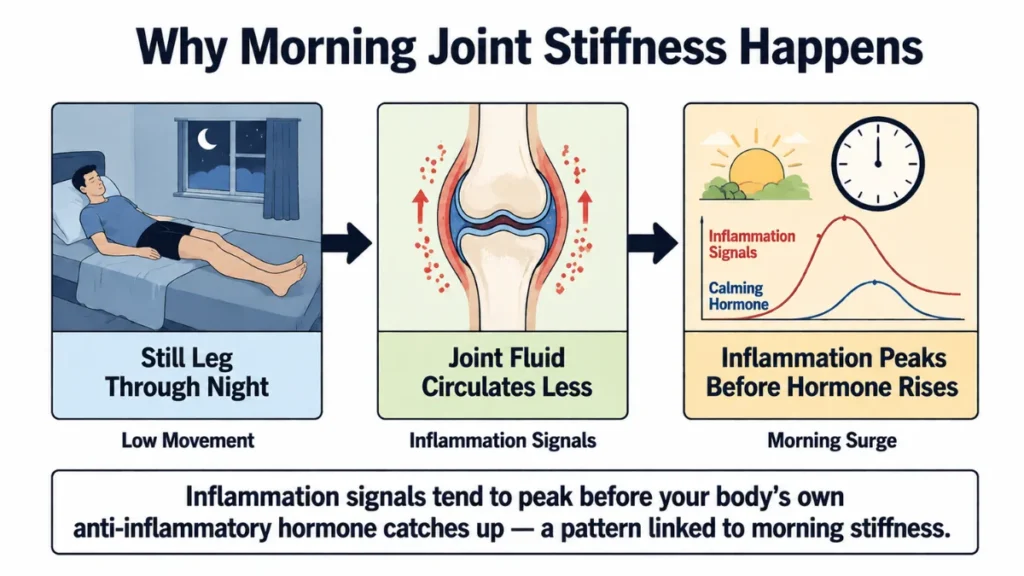
Movement likely helps redistribute joint fluid and calm inflammatory activity. For most people, that process brings stiffness down within 20 to 30 minutes, and morning stiffness after 50 that follows this short pattern is the body working through a predictable overnight reset.
Duration is where that overnight reset ends and something different begins.
The One Number That Changes Everything
You’ve probably never timed your stiffness. Most people don’t. They just know it goes away eventually, and they stop tracking it the moment they feel normal. That habit of not watching the clock is, it turns out, the thing worth changing.
The stiffness you walk off by 9am and the stiffness that is still with you at 10am belong to different biological stories, and the clock is the only tool you need to tell them apart.
Rheumatologists use 30 minutes as the first threshold and 60 minutes as the second.³
Mechanical stiffness [the kind caused by joint wear and reduced lubrication, not inflammation] typically clears in under 30 minutes.³ Inflammatory stiffness [stiffness driven by the immune system attacking joint tissue] can begin as early as 30 minutes and commonly extends past 60.³
A study measuring overnight blood samples in adults with rheumatoid arthritis [an autoimmune disease in which the immune system attacks the joint lining] found that levels of the inflammatory protein interleukin-6 [a cytokine that rises during active immune activity] began climbing roughly three hours before cortisol did.⁴
That same research found IL-6 peaked about 40 minutes before cortisol reached its anti-inflammatory high.⁴
In people with rheumatoid arthritis, IL-6 levels rise to a clear morning peak that is not seen in healthy adults at all. Serum IL-6 was undetectable in healthy controls in one study while RA patients showed substantially elevated, morning-peaking levels.⁵
The immune system attacks joints most aggressively during the hours when the body’s own defense against that attack is still building. That timing is the mechanism underneath a symptom most people write off as stiffness.
No single study has tested the full chain from overnight cytokines to morning stiffness duration to long-term joint damage. The picture here is built from several sources, each testing a different piece of the same process.
You feel it as a rough start to the morning. Your body is, in some cases, running a measurable inflammation cycle while you sleep.
Thirty minutes is the number to watch first.
What It Means When Stiffness Clears Fast
Stiffness that fades within 20 to 30 minutes of getting up is the pattern most commonly associated with osteoarthritis [the most common joint condition, caused by cartilage wearing down over time, not by the immune system].
Osteoarthritis affects roughly 32.5 million adults in the United States, and 88% of those people are 45 or older.⁷
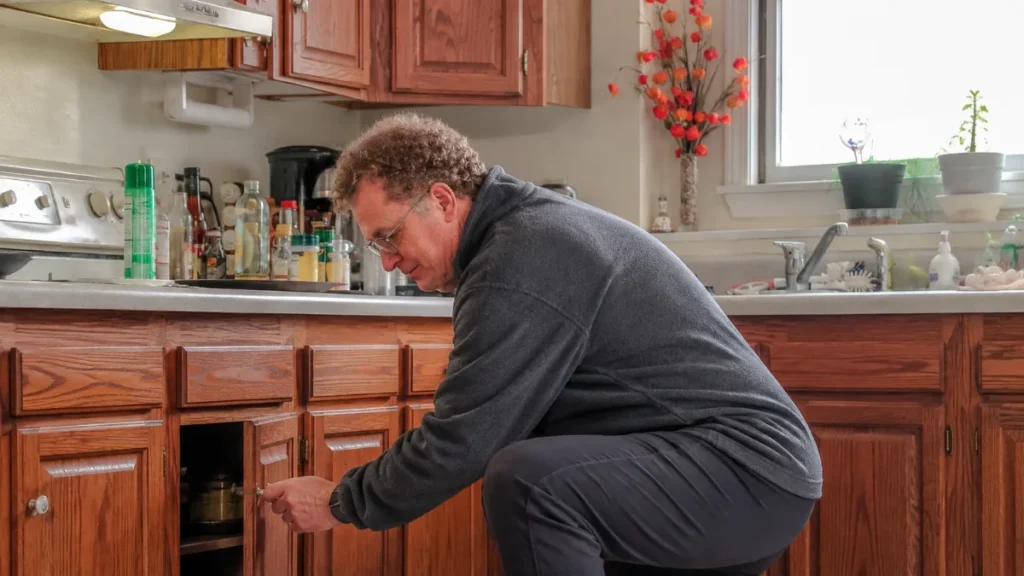
That is not a small number. It means the most likely explanation for brief morning stiffness in someone over 50 is the most common joint disease in the country.
Yet brief stiffness does not mean the joint is fine. It means the joint is responding well to movement. Cartilage has no blood supply of its own. It gets its nutrients from synovial fluid, and that exchange depends on the joint moving.¹
When you’re sedentary, those nutrients don’t circulate well. When you move, they do. The reason brief stiffness resolves is that movement is doing exactly what the joint needs.
The stiffness clearing fast is the sign your joints are still responsive. The risk is not the stiffness. It’s using the fact that it cleared as a reason to stay still for the next several hours.
Joints that don’t move regularly lose that responsiveness over time.
The direct challenge is this: short stiffness is not permission to skip movement. It is a report that movement is working.
Your stiffness clearing by 9am is good news. What you do with the rest of the morning is the question.
What It Means When Stiffness Hangs On
Stiffness that persists for 60 minutes or more after waking, especially if it affects both sides of the body at once, is a pattern rheumatologists treat as a signal worth investigating.³
It does not mean a diagnosis is certain. It means the body may be producing more inflammation than a worn joint can explain.
Two conditions account for a large share of prolonged morning stiffness after 50. The first is rheumatoid arthritis, discussed above. The second is polymyalgia rheumatica [an inflammatory condition that causes aching and stiffness in the shoulders, neck, and hips, typically in adults over 50].
In one well-studied U.S. population, a Minnesota county with a largely Scandinavian-descent community, the incidence of PMR runs roughly 63.9 per 100,000 people aged 50 and older each year, and it occurs 2 to 3 times more often in women than men.⁸
Morning stiffness lasting more than 45 minutes is one of the formal scoring criteria used to identify polymyalgia rheumatica.⁹ That threshold is not arbitrary. It reflects where the clinical evidence separates normal joint cycling from patterns that respond to anti-inflammatory treatment.

Stiffness that lasts well past an hour and is accompanied by fatigue, shoulder or hip aching on both sides, or a general sense of being unwell warrants a conversation with a doctor.
This is especially true if the pattern has lasted more than six weeks and is not linked to a specific injury or unusual exertion.
If you’re adjusting exercise habits or activity levels because of persistent stiffness, talk to your doctor before making any changes, particularly if you’re on medication or managing another condition.
Sixty minutes is not a diagnosis. It is a threshold worth knowing.
Other Causes That Are Not Arthritis
Not every stiff morning traces back to a joint condition. Sleep position, muscle tension, and dehydration can all produce stiffness that mimics the arthritic pattern closely enough to confuse.
A scoping review of sleep posture research found that side-lying sleep was generally protective against waking spinal pain and stiffness compared to other positions, though the total evidence base for this is small and the finding is preliminary.¹⁰

What is clearer is that spending seven or eight hours in one position, particularly on a sagging mattress that holds the spine in a bent position, loads the same tissues throughout the night.
Dehydration is a second factor. Synovial fluid is an ultrafiltrate of plasma, and its lubricating properties come mainly from hyaluronic acid and a protein called lubricin, with water contributing to its volume and viscosity.⁶
This is not a replacement for addressing underlying joint disease.
Spinal morning stiffness [stiffness felt specifically in the back on waking] deserves a separate note.
A 2024 study of older adults with back pain found that the severity of spinal morning stiffness was associated with multilevel disc space narrowing rather than with elevated C-reactive protein [a blood marker of systemic inflammation].¹¹
In other words, spinal stiffness in this group appeared to reflect structural changes in the spine more than body-wide inflammation.
That finding matters because it means spinal stiffness and joint inflammatory stiffness can look nearly identical from the outside but have different drivers.
Someone with multilevel disc narrowing and someone with early rheumatoid arthritis may both describe 45 minutes of back and hip stiffness on waking. One is a structural wear pattern and the other is an immune response.
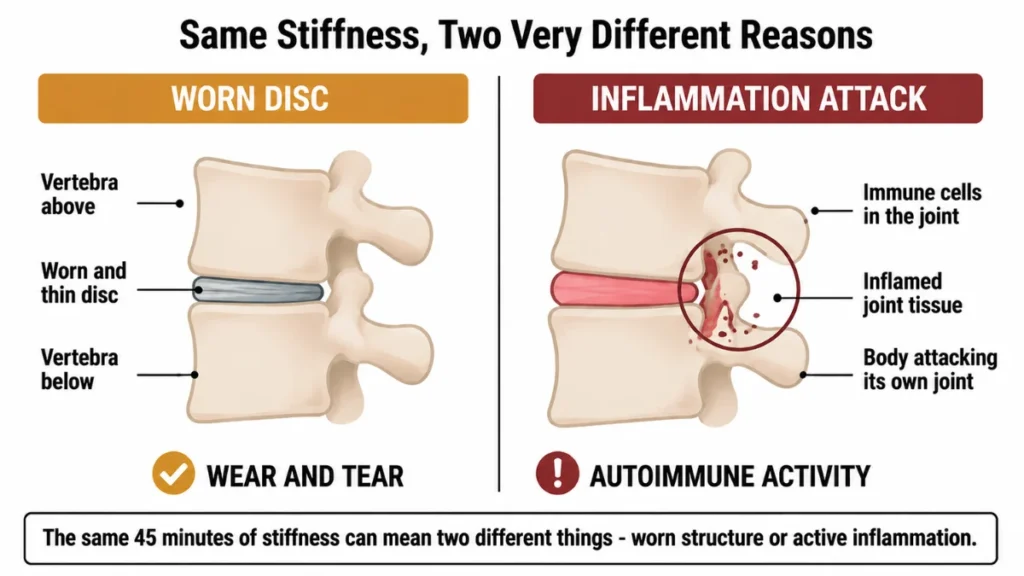
The evidence here is limited: only one study tested this specific relationship in an older adult back pain population. The duration clock is useful regardless of cause.
Is your stiffness joint-driven or spine-driven or something else entirely? Most people have never been asked to think about it that way.
How to Build Your Seven-Day Log
The seven-day log is the simplest diagnostic tool available to you before any doctor’s appointment, and it costs nothing.
Before you do anything else in the morning, note the time you wake up. When you can move through a normal range of motion without stiffness, note that time too. The gap between those two numbers is your duration.

Do this for seven days in a row. Write it on paper, type it in your phone, use whatever you will actually do consistently. At the end of the week, you will have a pattern rather than a single data point.
Before starting this tracking routine, check with your doctor if you have a diagnosed joint condition, are on medication that affects inflammation, or have been told to limit certain movements.
These thresholds come from clinical research on people already being evaluated for joint disease, so think of them as a reason to start a conversation with your doctor, not a self-diagnosis.
Your Seven-Day Stiffness Log
Each morning, record three things:
- Wake time
- Time stiffness cleared
- Which joints or areas felt stiffest (back, hips, hands, shoulders)
At the end of seven days, look for the pattern. Under 30 minutes most days: mechanical stiffness pattern, consistent with osteoarthritis or inactivity. Over 60 minutes on most days, or affecting both sides symmetrically: bring this log to your doctor.
Six weeks or more of persistent stiffness over 45 minutes: worth a rheumatology referral.
In one patient registry study, rheumatology patients consistently ranked duration of morning joint stiffness among their top symptoms to track digitally over time, a sign that patients themselves see real value in following it closely.¹²
Whatever the format, converting a subjective morning sensation into a number is what actually gives a clinician something concrete to work with.
Seven days of data is more than most people bring to any appointment about their joints.
Duration Is the Number Worth Tracking
Morning stiffness after 50 is not one thing, and it does not deserve one response. The duration tells you which biological story you are living inside, and a doctor can do far more with a number than with a general complaint.
For the next seven days, note the time you wake up and the time you can move freely without stiffness. Write it down. Bring those numbers to your next doctor’s visit.
No log can tell you what the stiffness means. Only your doctor can do that.
⚠️DISCLAIMER
This article is for general educational purposes only and is not a substitute for professional medical advice, diagnosis, or treatment. The duration thresholds discussed here are drawn from clinical research and are meant to help you have a more informed conversation with your doctor, not to diagnose yourself. Always talk to a qualified healthcare provider about your specific symptoms before starting, stopping, or changing any treatment or activity based on what you read here.
References
- Hui AY, McCarty WJ, Masuda K, Firestein GS, Sah RL. A systems biology approach to synovial joint lubrication in health, injury, and disease. Wiley Interdisciplinary Reviews: Systems Biology and Medicine. 2012. https://pubmed.ncbi.nlm.nih.gov/21826801/
- Cutolo M, Masi AT. Circadian rhythms and arthritis. Rheumatic Disease Clinics of North America. 2005. https://pubmed.ncbi.nlm.nih.gov/15639059/
- ScienceDirect Topics. Morning Stiffness. ScienceDirect. 2024. https://www.sciencedirect.com/topics/medicine-and-dentistry/morning-stiffness
- Perry MG, Kirwan JR, Jessop DS, Hunt LP. Overnight variations in cortisol, interleukin 6, tumour necrosis factor alpha and other cytokines in people with rheumatoid arthritis. Annals of the Rheumatic Diseases. 2008. https://www.ncbi.nlm.nih.gov/pmc/articles/PMC2596304/
- Arvidson NG, Gudbjörnsson B, Elfman L, Rydén AC, Tötterman TH, Hällgren R. Circadian rhythm of serum interleukin-6 in rheumatoid arthritis. Annals of the Rheumatic Diseases. 1994. https://pmc.ncbi.nlm.nih.gov/articles/PMC1005392/
- ScienceDirect Topics. Synovial Fluid. ScienceDirect. 2024. https://www.sciencedirect.com/topics/medicine-and-dentistry/synovial-fluid
- Osteoarthritis Action Alliance. OA Prevalence and Burden. University of North Carolina. 2025. https://oaaction.unc.edu/oa-module/oa-prevalence-and-burden/
- Lundberg IE, Sharma A, Turesson C, Mohammad AJ. An update on polymyalgia rheumatica. Journal of Internal Medicine. 2022. https://www.ncbi.nlm.nih.gov/pmc/articles/PMC9796644/
- Acharya S, Musa R. Polymyalgia Rheumatica. StatPearls. NCBI Bookshelf. 2025. https://www.ncbi.nlm.nih.gov/books/NBK537274/
- Cary D, Briffa K, McKenna L. Identifying relationships between sleep posture and non-specific spinal symptoms in adults: A scoping review. BMJ Open. 2019. https://pubmed.ncbi.nlm.nih.gov/31256029/
- Feller D, van den Berg R, Enthoven WTM, Oei EH, Bierma-Zeinstra SM, Koes BW, Chiarotto A. The association of spinal morning stiffness with lumbar disc degeneration and C-reactive protein: The back complaints in older adults (BACE) study. Osteoarthritis and Cartilage Open. 2024. https://www.ncbi.nlm.nih.gov/pmc/articles/PMC11566339/
- Nowell WB, Gavigan K, Kannowski CL, Cai Z, Hunter T, Venkatachalam S, Birt J, Workman J, Curtis JR. Which patient-reported outcomes do rheumatology patients find important to track digitally? A real-world longitudinal study in ArthritisPower. Arthritis Research and Therapy. 2021. https://www.ncbi.nlm.nih.gov/pmc/articles/PMC7873115/