

You’ve kept your training consistent for months, maybe years. You’ve shown up when you didn’t feel like it, and you’ve watched other people quit while you kept going.
So the idea of taking a full week off doesn’t just feel like rest. It feels like giving up.
Here’s what adults over 50 who train consistently rarely hear: the week you take off may be the only time your muscles can finish the job your workouts started.
Every set you lift creates a signal. But the signal doesn’t build muscle. Rest does. And after 50, your body needs more rest than most training programs ever build in.
This article is for informational purposes only and is not a substitute for professional medical advice. Individual recovery needs vary based on age, fitness level, and health status. Always consult your doctor or a qualified fitness professional before making changes to your training program.
When You Take Off a Week, Your Muscles Finally Get to Work
Most people think the workout is where the growth happens. It isn’t. The workout breaks tissue down. Growth happens after, during recovery. After 50, that recovery window needs to be longer than most training programs allow.
Research from the University of Texas Medical Branch found something that changes how you should think about rest. After a bout of resistance exercise, muscle protein synthesis rose in younger adults. In older adults, it did not.¹
Muscle protein synthesis is the process your body uses to build and repair muscle fibers. It’s the biological step that turns the stress of your workout into actual strength gains.
After exercise at around age 70, the building signal doesn’t turn on in the first 24 hours.¹ Your younger counterpart is already rebuilding before you’ve finished cooling down.
This is not a flaw. It’s biology. The older body is capable of exactly the same adaptation. It just needs more time between sessions to get there.
When you take off a full week, the training stress lifts completely. The repair process that has been getting interrupted every two or three days finally runs without stopping. The build your body has been trying to complete for weeks can actually finish.
Think of it this way: every workout you do is the start of a sentence. Rest is the period at the end. Without it, you’re stacking incomplete sentences that never say anything.
This doesn’t mean training doesn’t work after 50. It works better than almost anything else you can do for your body. What it means is that the recovery window is part of the training, not separate from it.
Why Training Without a Break Can Stall Your Progress
You’ve probably felt it. You’re doing everything right, same program, same effort, same food, but the gains aren’t coming the way they used to. You tell yourself you need to push harder. That’s usually the wrong answer.

After 50, the body produces less growth hormone than at 30, and men’s testosterone gradually declines as well.²
Whether you take off a week or push through, the hormonal picture looks different after 50 than it did before. Recovery from each session takes more out of you. When you stack training session after training session without real rest, stress accumulates faster than your body can clear it.
There’s a hormonal side to this. Research on overtraining shows that when training stress builds past what the body can handle, the normal hormonal response to exercise gets suppressed. The rise in growth hormone and cortisol that normally signals recovery and rebuilding after a hard session actually decreases.³
Cortisol is the stress hormone your body releases during hard training. In the right amount, it’s part of normal recovery. When it stays elevated because you never gave it room to drop, it starts breaking tissue down instead of building it up.
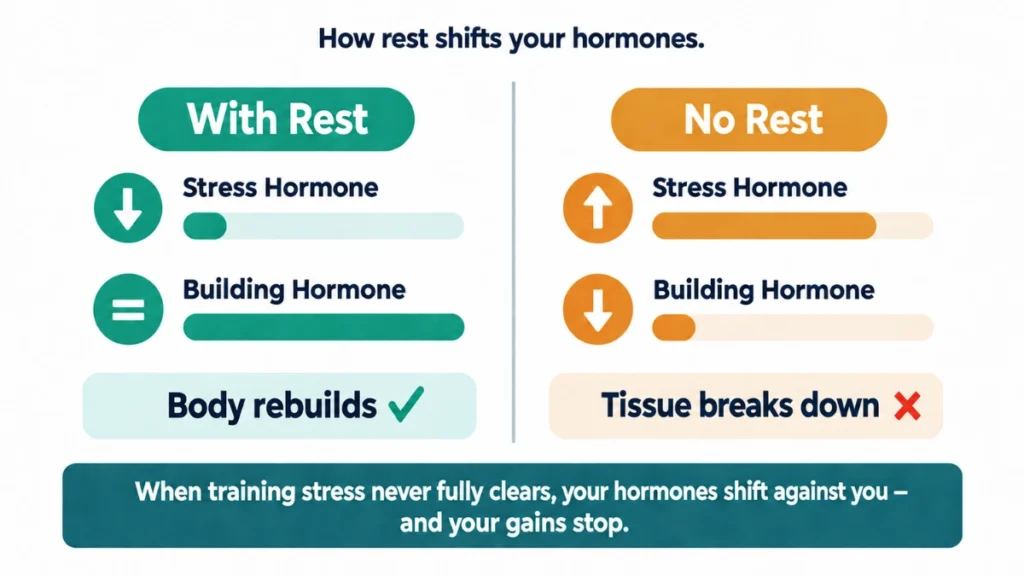
Here’s what you’ll notice before you notice anything else: strength plateaus before muscle loss. The weights feel heavier. You’re working just as hard but moving less. That’s the cortisol-to-testosterone balance shifting in the wrong direction. It’s not a permanent state. A proper rest week can reset it.
You don’t have to be a competitive athlete for this to happen. A milder version of that same hormonal suppression settles in for anyone who trains consistently without real recovery.
The gains stop not because you stopped working hard enough. They stop because your body stopped responding.
What the Research Shows About Taking a Week Off
Here’s the fear most people carry into a rest week. They’ll lose everything they built. Their muscles will shrink. They’ll come back weaker. The research doesn’t back this up.

A 2024 peer-reviewed study compared two groups of resistance-trained adults following a nine-week training program. One group trained continuously for all nine weeks. The other took one complete week off at the midpoint. At the end, there were no meaningful differences between the groups in lower-body muscle size, local muscular endurance, or power.⁴
Taking a full week off did not cause people to fall behind in muscle size or endurance compared to those who kept training.
Now for the honest part. The continuous training group did show slightly greater gains in lower-body strength by the end of the nine-week block. The deload group did not match them on that one measure.
And the participants were between 18 and 40 years old. The authors stated the findings cannot necessarily apply to people over 40.⁴
This matters because the case for a rest week grows stronger with age, not weaker. If young, healthy, trained adults lost nothing in muscle size or endurance from taking a full week off, then older adults who recover more slowly have at least as much reason to expect the same protection.
The research specific to people over 50 is still catching up. The biology points in a clear direction.
One week away won’t undo what you’ve built. What’s happening inside your muscle during that week is what most people have never been told.
The Repair Crew Your Body Has Been Waiting to Send In
When you stop training for a week, your muscles don’t go idle. They get to work.
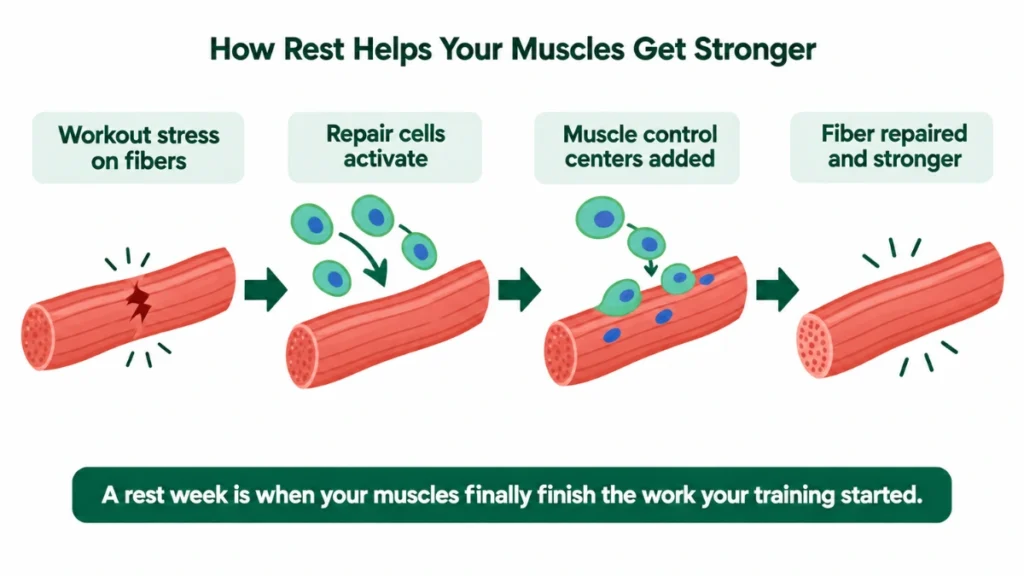
Inside each muscle fiber are structures called myonuclei. These are the control centers that decide how much protein your muscle produces. Myonuclei stay in place even when training stops.
Around them, satellite cells wait. Satellite cells are muscle stem cells, the repair crew your body activates to fix and strengthen fibers after stress. They don’t vanish during a rest week. They finally get room to finish the job.
Research from KU Leuven tracked 30 older men through 12 weeks of resistance training, then 12 weeks without training, then 12 more weeks back in the gym. After the long break, the older men had kept part of their strength gains. When they resumed training, they regained their post-training one-rep max in under 8 weeks.⁵
Muscle memory isn’t a motivational phrase. It’s cellular. The myonuclei built during training stay in place.
The structural foundation your training built persists through rest. A rest week doesn’t dismantle what you built. It protects the infrastructure that lets you rebuild quickly when you return.
The real danger isn’t the week you take off from training. It’s what happens when that week never comes.
Satellite cells that should be finishing repairs get reactivated before they’re done. Recovery stays incomplete. You come back to every session starting from a deficit you can’t see and can’t name. The week you take off is the first full chance the repair crew has had to finish.
Your Nervous System Was Exhausted Before Your Muscles Were
There’s something that happens to many consistent trainees after 50. The workout feels heavier than it should. Every rep is a grind.
The weight hasn’t changed, but your body feels like it has. You assume your muscles are tired. They might not be. Your nervous system may be the problem.
The hormonal side above is one half of this. The other half sits in your nervous system, and it shows up as the same feeling. Your central nervous system controls how your muscles fire. It decides how many muscle fibers to switch on at once during a lift. This is called motor unit recruitment.
When your nervous system is fatigued, it recruits fewer fibers. Your available strength doesn’t drop. The amount of it your brain switches on does.
You feel weak. You are not weak. Your engine is fine. The control system is overloaded.

As we age, recovery from hard training can take longer. Push through block after block without a break, and that recovery falls further behind. Fatigue that builds up faster than it clears may be one reason progress stalls.
A rest week is when your nervous system resets. Motor unit recruitment comes back to full capacity. Movement quality sharpens. Coordination returns.
This is why many people who track their numbers lift some of their best weights in the week after genuine rest. They didn’t get stronger during the week off. The fatigue masking their existing strength finally cleared.
What you find when you return is different from what you feared. The week off didn’t take anything from you. It gave it back.
How to Take the Week Off Without Losing Your Edge
A rest week doesn’t mean a week on the couch. It means removing the structured training load and letting your body finish what your workouts started. The week you take off from the gym is not a gap in your program. It’s the final step of the block.

Stuart Phillips, Professor of Kinesiology at McMaster University, puts it clearly:
“Resistance training is king, and good nutrition is queen.”⁶
Take the king off the board for a week and the queen is the only piece still moving. During a rest week, nutrition matters more than usual, not less. Keep your protein intake consistent. Your muscles are actively repairing during this week.
The raw material for that repair comes from what you eat. You can adjust overall calories slightly if your appetite drops. Don’t cut protein.
Light movement is fine. Walking, stretching, and easy movement won’t interfere with recovery. Hard training sessions will. The goal is to remove the load, not all activity.
Your Rest Week Protocol
If you are managing a health condition, on medication, or recovering from injury, talk to your doctor before changing your training schedule or return-to-exercise load.
- Movement: Walk daily. Stretch. Skip resistance training and high-intensity cardio.
- Protein: Keep it at your normal intake. Repair requires raw material.
- Schedule: Every eight to 10 weeks of consistent training, plan one rest week before you need it.
- Return: Start back at 70 to 80 percent of your normal load. Resume full training in week two.
- Mindset: You are not pausing your progress. You are finishing it.
Plan this week before fatigue forces it. Waiting until you’re exhausted means the rest comes too late.
When you come back, don’t test your limits in the first session. What you’ll find is that the weights feel lighter, not heavier. The grinding feeling you’d been carrying for weeks is gone.
The week you take off isn’t lost time. It’s the session your muscles never got to finish.
The Week Off Is the Work
When you take off a full week, you give your muscles the only uninterrupted window they’ve had to complete the work your training started. Schedule one complete rest week into the next eight weeks of your training. That decision is not a step back. It’s how people over 50 keep moving forward.
References
- Fry CS, Drummond MJ, Glynn EL, Dickinson JM, Gundermann DM, Timmerman KL, Walker DK, Dhanani S, Volpi E, Rasmussen BB. Aging impairs contraction-induced human skeletal muscle mTORC1 signaling and protein synthesis. Skeletal Muscle. 2011;1(1):11. doi:10.1186/2044-5040-1-11. https://pubmed.ncbi.nlm.nih.gov/21798089/
- Biagetti B, Puig-Domingo M. Age-Related Hormones Changes and Its Impact on Health Status and Lifespan. Aging and Disease. 2023;14(3):605-620. doi:10.14336/AD.2022.1109. https://pmc.ncbi.nlm.nih.gov/articles/PMC10187696/
- Urhausen A, Gabriel H, Kindermann W. Blood hormones as markers of training stress and overtraining. Sports Medicine. 1995;20(4):251-276. doi:10.2165/00007256-199520040-00004. https://pubmed.ncbi.nlm.nih.gov/8584849/
- Coleman M, Burke R, Augustin F, Piñero A, Maldonado J, Fisher JP, Israetel M, Androulakis Korakakis P, Swinton P, Oberlin D, Schoenfeld BJ. Gaining more from doing less? The effects of a one-week deload period during supervised resistance training on muscular adaptations. PeerJ. 2024;12:e16777. doi:10.7717/peerj.16777. https://www.ncbi.nlm.nih.gov/pmc/articles/PMC10809978/
- Blocquiaux S, Gorski T, Van Roie E, Ramaekers M, Van Thienen R, Nielens H, Delecluse C, De Bock K, Thomis M. The effect of resistance training, detraining and retraining on muscle strength and power, myofibre size, satellite cells and myonuclei in older men. Experimental Gerontology. 2020;133:110860. doi:10.1016/j.exger.2020.110860. https://pubmed.ncbi.nlm.nih.gov/32017951/
- Entzminger I. The science of staying strong. ASBMB Today. 26 December 2025. https://www.asbmb.org/asbmb-today/science/122625/the-science-of-staying-strong