

You’re sitting still. Not overdoing it. Not sick. Your foot goes numb, or a thought simply vanishes.
You haven’t told anyone because it sounds dramatic. But part of you wonders whether something inside your nervous system is quietly breaking down.
Specific daily habits accelerate myelin breakdown in adults over 50 far faster than time explains.
Myelin is the coating that wraps your nerve fibers the way rubber wraps an electrical wire. When it thins, signals slow, misfire, or stop.
For adults over 50 noticing unexplained neurological symptoms, the habits below are the most common accelerants.
This article is for informational purposes only and is not a substitute for professional medical advice, diagnosis, or treatment. The habits and corrections discussed are general wellness starting points and may not apply to everyone, particularly those managing chronic conditions such as diabetes, kidney disease, or cardiovascular disease. Always consult your doctor or a qualified healthcare provider before making changes to your diet, lifestyle, or health routine.
Habit 1: Broken, Fragmented Sleep and Your Nerve Coating After 50
Most people know sleep matters. Few know it’s the primary window when your body repairs nerve coating after 50.
Your brain contains cells called oligodendrocytes. They build and maintain the myelin sheath around nerve fibers. These cells do most of their repair work during sleep.
When sleep is cut short or fragmented, that repair window closes before the work is done.
In rats, sleep deprivation impairs myelin integrity and slows nerve signal transmission.
It also reduces the pool of precursor cells that mature into myelin-making cells in white matter.¹ That’s not a gradual slide. That’s a measurable structural change.
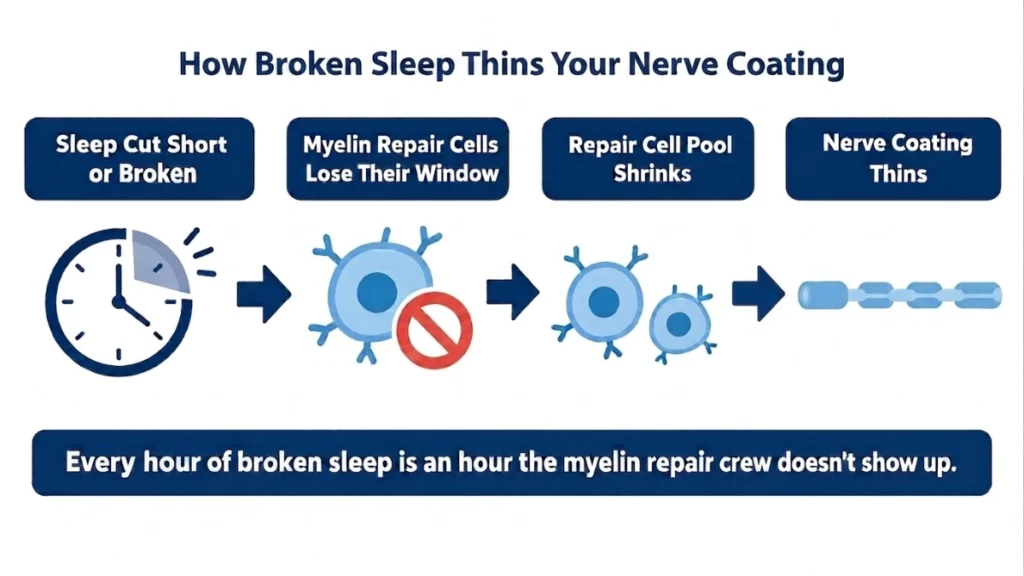
What this means for you: Ten days of poor sleep can visibly shrink the coating around your nerve fibers.
After 50, your sleep architecture shifts toward lighter stages. You spend less time in the deep phases where repair happens most.
Fragmentation hits harder because the recovery window was already shorter.
The correction: Seven to nine hours of consolidated sleep is the starting point. Not seven hours of interrupted sleep. Consolidated.
If you’re reading until midnight and waking at six, that’s the pattern to change first.

The damage from missed sleep doesn’t reset cleanly the next night. It compounds.
Save-worthy fact: Myelin repair happens primarily during sleep. Every hour of fragmented rest is an hour the repair crew doesn’t show up.
Habit 2: Daily Ultra-Processed Food
You might eat something you consider reasonable: a packaged snack with a “high protein” label, a frozen meal, a processed breakfast food. The label looks fine. The ingredient list doesn’t.
Ultra-processed foods trigger a chronic low-grade inflammatory response. They are linked to raised levels of cytokines.
Cytokines are small chemical messengers that signal inflammation. IL-6 and TNF-alpha are two of them.²
Those messengers cross into the nervous system. They disrupt the cells that maintain your nerve coating.
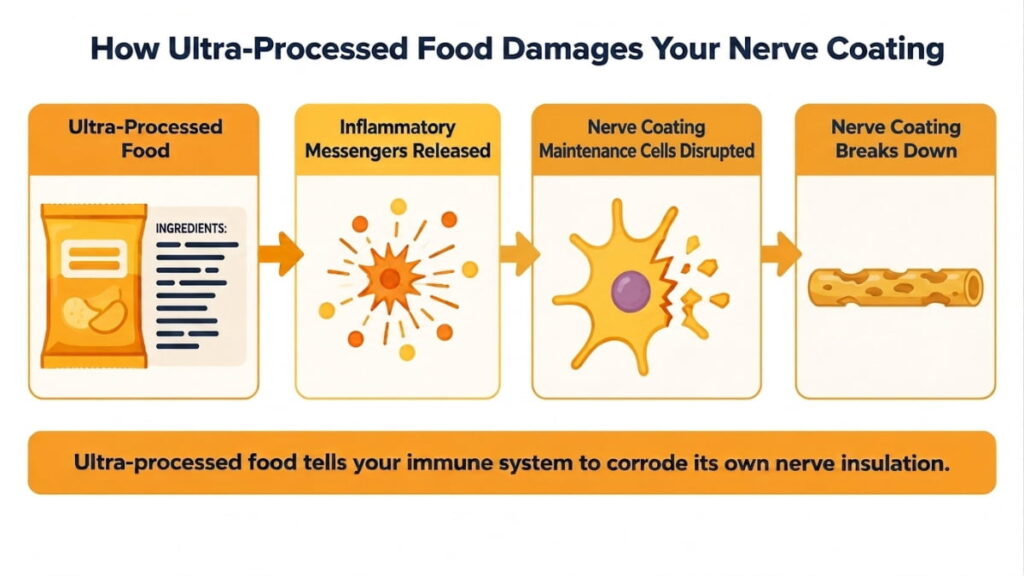
Higher consumption of ultra-processed foods has been associated with greater severity in multiple sclerosis, a condition driven by loss of the nerve coating.³
The link isn’t just about poor nutrition. The additives and processing by-products play a direct role.
What this means for you: Eating ultra-processed food regularly tells your body to produce chemicals that corrode the insulation on your nerve fibers. This is one of the clearest myelin damage habits to break.
The correction isn’t a total overhaul. Replace one ultra-processed meal per day with a whole food option.
Myelin is roughly 70% fat by dry weight.⁴ It needs healthy lipids to stay intact. Ultra-processed food undermines that supply while adding the very chemicals that degrade it.

Look at what you ate yesterday. How many of those items had more than five ingredients listed?
Habit 3: Prolonged Uninterrupted Sitting
Here’s the habit that trips up even the most active adults: you exercise every morning and still sit for eight hours straight.
Exercise and sedentary time are separate problems. High activity levels don’t cancel the physiological damage of prolonged sitting.⁵
When you sit in one position for extended periods, you compress peripheral nerves in the lower back and legs. Compressed nerves can develop neurapraxia.
Neurapraxia is a temporary but real disruption to the myelin coating caused by sustained pressure on a nerve.⁶
It produces numbness, tingling, and foot drop. These are the exact symptoms many adults assume are permanent.

Peripheral neuropathy affects between one in four and two in five adults aged 70 and over in U.S. cohort studies.⁷ Most haven’t been told.
The correction: Break sitting every 30 to 45 minutes with two minutes of standing or walking. Set a timer.
Blood flow to peripheral nerves drops during prolonged sitting. Keeping your nerve tissue oxygenated and pressure-free is the goal.
That’s the contradiction this habit creates, and it’s one most people never think to resolve.
Habit 4: Chronic Low-Level Dehydration
You already know dehydration is bad for your joints and your skin. Here’s what you probably don’t know: it directly slows nerve signal speed.
Nerves fire through a system of charged particles. Sodium, potassium, calcium, and magnesium dissolved in fluid power every nerve impulse.
Dehydration concentrates those particles unevenly. The balance breaks. Signals slow, misfire, or produce false sensations like tingling.
Chronic dehydration also reduces blood volume, which means less oxygen and fewer nutrients reach the body’s tissues.⁸
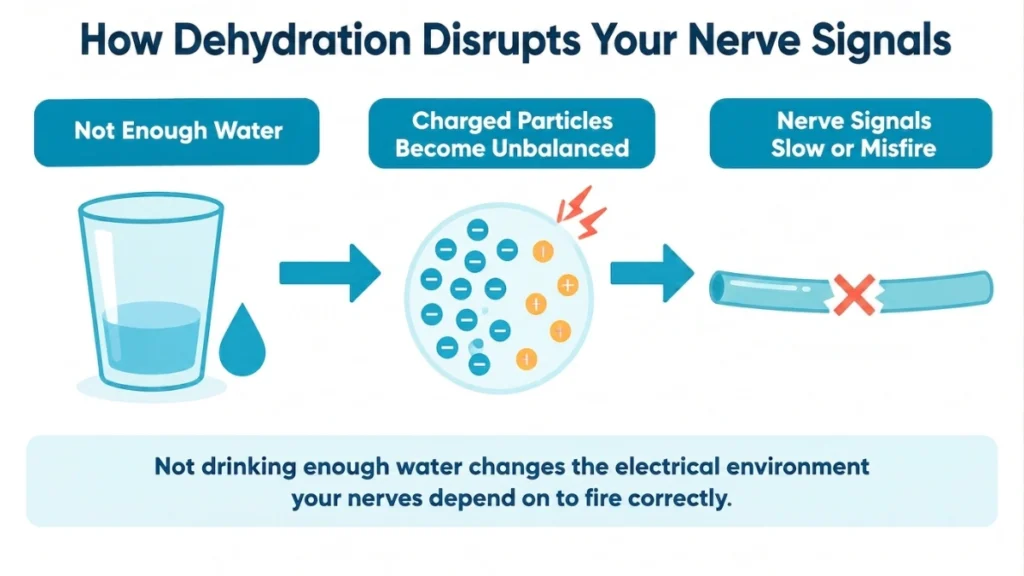
What this means for you: Not drinking enough water changes the electrical environment your nerve fibers depend on.
As we age, the thirst signal weakens. Your body becomes less accurate at telling you when it needs water. You can be meaningfully dehydrated and feel fine.
The correction: Drink on a schedule, not on sensation. If you wait until you’re thirsty after 50, you’re already behind.
You’ve been managing this as a hydration issue. It’s also a nerve fiber health over 50 issue. That reframe changes how urgent it feels.
Habit 5: Alcohol at “Moderate” Levels
This is the habit most people are certain doesn’t apply to them. An evening drink. A glass of wine for heart health. A social routine they’ve had for years.
On nerve coating after 50, there is no verified safe floor.
The single largest risk factor for alcohol-related nerve damage is total lifetime ethanol dose. Duration and amount both matter.⁹
Ethanol breaks down into acetaldehyde inside the body. Acetaldehyde is directly toxic to nerve membranes. It creates oxidative stress and disrupts myelin proteins.
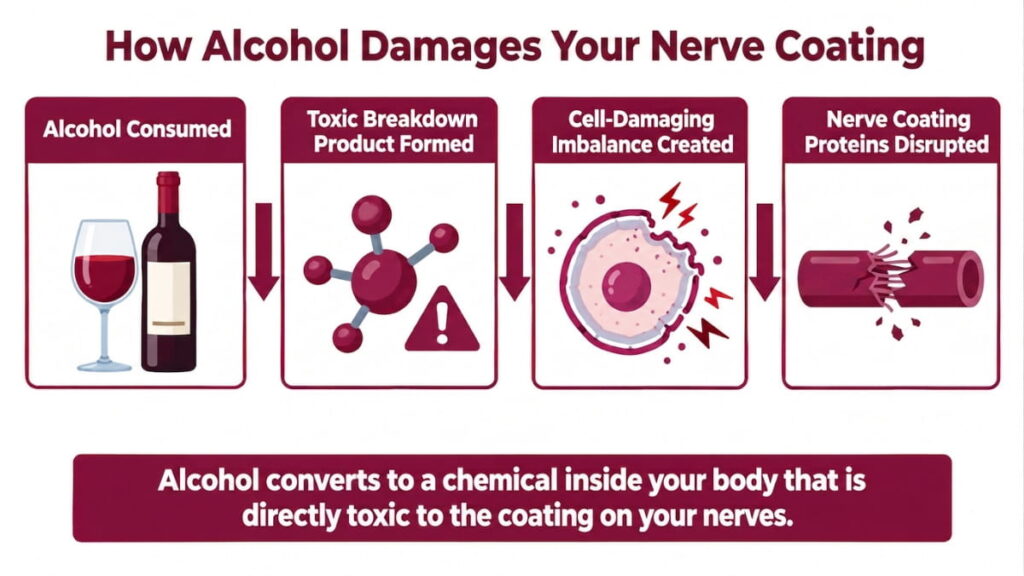
In rats, eight weeks of heavy alcohol intake produced measurable thinning of myelin sheaths in peripheral nerves.¹⁰ Eight weeks.
What this means for you: Your nerve coating after 50 doesn’t distinguish between a social drink and a clinical intake level. It responds to the acetaldehyde either way.
Alcohol also depletes thiamine, a vitamin your body uses to maintain myelin. Separately, B12 absorption already declines after 50.¹¹
The correction: For nerve health, the evidence supports reducing intake toward zero.
The nerve damage from alcohol starts before a diagnosis appears. You won’t feel the threshold being crossed.
Habit 6: Unmanaged Blood Sugar Fluctuation and Nerve Coating After 50
That afternoon fog. The heavy feeling after lunch. The dip in focus at 3 p.m. that you’ve written off as normal.
These may be early signs that blood sugar volatility is reaching your nervous system.
You don’t need a diabetes diagnosis for this to apply.

High blood glucose levels have been directly associated with damage to the peripheral nerve and the myelin sheath.¹²
Nerve damage is already common before blood sugar reaches diabetic levels.¹³
High blood sugar disrupts the function of Schwann cells. Schwann cells are the cells that wrap and maintain the myelin coating in your peripheral nerves.
When blood sugar stays high, Schwann cells shift out of their maintenance role. Myelin repair slows. Damage accumulates.¹⁴
Diabetic peripheral neuropathy affects up to 50% of people with diabetes. Some studies place the figure in pre-diabetes as high as 77%.¹³
The damage often starts before anyone calls it diabetes.
in some studies
up to
The correction: Reduce refined carbohydrate load at meals. A lower post-meal spike means more myelin repair time.
After 50, insulin sensitivity naturally declines. The same meal that produced a moderate spike at 40 may produce a sharper one at 55.
What’s happening to your nerve coating between meals is a question your last blood test probably didn’t answer.
Habit 7: Chronic Stress With No Daily Recovery Period
“I know stress is bad. I just can’t do much about it.” That thought is the problem. Not the stress itself.
What damages your nerve coating is the absence of a daily recovery event. Your body needs a point where cortisol cycles back down.
Research links chronically elevated cortisol to impaired oligodendrocyte function. Oligodendrocytes are the cells that maintain your nerve coating.
Animal and cell studies link elevated cortisol to increased pro-inflammatory cytokines, which indirectly disrupt myelin-making cells.¹⁵
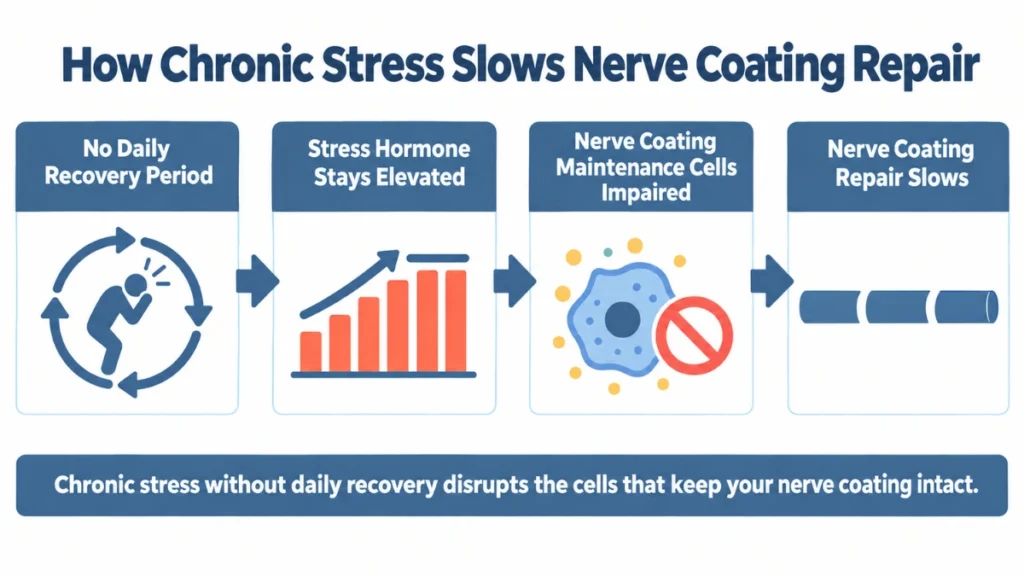
What this means for you: Long-term stress doesn’t just wear you down emotionally. It chemically disrupts the cells that keep your nerve coating after 50 intact.
Brad Zuchero, PhD, assistant professor of neurosurgery at Stanford, noted that even within Alzheimer’s research the structure is underappreciated: “Despite being essential for the health and normal function of the brain, myelin has been vastly overlooked in the Alzheimer’s field.”¹⁶
The HPA axis is the brain-to-adrenal-gland relay that controls cortisol release. After 50, overall cortisol output tends to be higher and the daily decline flatter, and the stress response may take longer to switch off.¹⁷
The correction: One daily parasympathetic reset. Ten minutes of diaphragmatic breathing, a slow outdoor walk, or progressive muscle relaxation.
The nerve coating after 50 isn’t damaged by how stressed you get. It’s damaged by how rarely you fully recover.
Your One-Week Starting Point
You don’t need to fix all seven habits this week. Fixing all seven at once means fixing none of them.
Pick the habit from this list that shows up most in your current daily routine:
- Fragmented sleep: set a hard sleep window tonight
- Ultra-processed food: identify one daily item and replace it
- Prolonged sitting: set a 40-minute timer and stand at every alarm
- Low hydration: drink a glass of water at three fixed times each day
- Alcohol: track total weekly units for seven days before deciding on a change
- Blood sugar spikes: remove refined carbohydrates from one meal per day
- No recovery period: schedule one 10-minute daily reset as a non-negotiable event
Start With the One Habit You See Today
Start with the habit that appears most in your current daily life and change that one first. Identify the one habit from this list that appears most in your current daily routine and remove it this week. Your nerve coating after 50 is slowed only by the habits you subtract.
References
- Simayi R, Ficiara E, Faniyan O, et al., Bellesi M. Sleep loss induces cholesterol-associated myelin dysfunction. Proceedings of the National Academy of Sciences. 2026;123(4):e2523438123. https://www.pnas.org/doi/full/10.1073/pnas.2523438123
- Poon E, Li C, Schweitzer D, Akefe I. Neurobiological insights into the effects of ultra-processed food on lipid metabolism and associated mental health conditions: a scoping review. Frontiers in Nutrition. 2026;12:1754492. https://pmc.ncbi.nlm.nih.gov/articles/PMC12871063/
- Guglielmetti M, Grosso G, Ferraris C, et al. Ultra-processed foods consumption is associated with multiple sclerosis severity. Frontiers in Neurology. 2023;14:1086720. https://pmc.ncbi.nlm.nih.gov/articles/PMC9902937/
- Kister A, Kister I. Overview of myelin, major myelin lipids, and myelin-associated proteins. Frontiers in Chemistry. 2023;10:1041961. https://pmc.ncbi.nlm.nih.gov/articles/PMC9989179/
- Pinto AJ, Bergouignan A, Dempsey PC, Roschel H, Owen N, Gualano B, Dunstan DW. Physiology of sedentary behavior. Physiological Reviews. 2023;103(4). https://doi.org/10.1152/physrev.00022.2022
- Afacan MY, Ozturk B, Akbaba D, Sahin AN, Ozsahin MK. Complete Recovery From Acute Peroneal Nerve Palsy With Neurapraxia After Prolonged Cross-Legged Sitting. Cureus. 2025;17(2):e78465. https://pmc.ncbi.nlm.nih.gov/articles/PMC11883195/
- Hicks CW, Wang D, Windham BG, Matsushita K, Selvin E. Prevalence of peripheral neuropathy defined by monofilament insensitivity in middle-aged and older adults in two US cohorts. Scientific Reports. 2021;11(1):19159. https://pubmed.ncbi.nlm.nih.gov/34580377/
- Taylor K, Tripathi AK. Adult Dehydration. In: StatPearls. StatPearls Publishing; updated 2025-03-05. https://www.ncbi.nlm.nih.gov/books/NBK555956/
- Laker SR, Osborne MC, Sullivan WJ. Alcoholic Neuropathy. Medscape eMedicine; updated 2026-05-11. https://emedicine.medscape.com/article/315159-overview
- Tessitore ME, Pereira-Rufino LS, Panfilio CE, et al. Alcoholic neuropathy associated with chronic alcohol intake. IBRO Neuroscience Reports. 2022. https://doi.org/10.1016/j.ibneur.2022.08.004
- Stover PJ. Vitamin B12 and older adults. Current Opinion in Clinical Nutrition and Metabolic Care. 2010;13(1):24-27. https://pmc.ncbi.nlm.nih.gov/articles/PMC5130103/
- Malone JI. Diabetic Central Neuropathy: CNS Damage Related to Hyperglycemia. Diabetes. 2016;65(2):355-357. Commentary. https://doi.org/10.2337/dbi15-0034
- Akhtar S. Diabetes-induced peripheral neuropathy: Is prescribing physical exercise the answer? Biomolecules and Biomedicine. 2024;24(3):436-439. https://pmc.ncbi.nlm.nih.gov/articles/PMC11088892/
- Abd Razak NH, Vijakumaran U, Idris IM, et al. Hyperglycemia Modulates mTOR Signaling and Myelin Protein Expression in Schwann Cells. International Journal of Molecular Sciences. 2025;26(19):9724. https://pmc.ncbi.nlm.nih.gov/articles/PMC12524631/
- Jiang X, Gou M, Yin Y, et al., Tan Y. Cortisol response patterns to stress correlated to white matter integrity and duration of illness in patients with schizophrenia. Psychoneuroendocrinology. 2025. https://www.sciencedirect.com/science/article/abs/pii/S0306453025002240
- Sill K. Stanford researcher awarded McKnight grant to uncover myelin’s connection to Alzheimer’s disease. Stanford Medicine, Department of Neurosurgery news; 17 July 2025. https://med.stanford.edu/neurosurgery/news/2025/zuchero-mcknight-grant.html
- Gaffey AE, Bergeman CS, Clark LA, Wirth MM. Aging and the HPA axis: Stress and resilience in older adults. Neuroscience and Biobehavioral Reviews. 2016;68:928-945. https://pmc.ncbi.nlm.nih.gov/articles/PMC5621604/