

You bought the kombucha. You added the yogurt with the live cultures label. Three weeks in, something is off and you can’t explain it.
Here’s the thought most people don’t say out loud: maybe your body is broken. It’s not. The food was never designed for your gut’s current state.
Adults over 50 who eat fermented foods for gut health are often working from bad advice. The advice is built for population averages, not for you.
Fermented foods do help many people. For a real subset of adults over 50, the same foods trigger symptoms instead of relieving them. The difference is not the food. It is the gut that receives it.
This article is for informational purposes only. It does not diagnose or treat any medical condition. Symptoms of histamine intolerance and SIBO overlap with other gastrointestinal conditions. If your symptoms are severe, persistent, or worsening, speak with a licensed gastroenterologist before changing your diet.
Two People Eat the Same Yogurt. One Heals. One Does Not. Here Is What Fermented Foods After 50 Actually Do Inside the Gut.
You’re not imagining things if fermented foods made you feel worse.
Fermented foods help some guts and hurt others.
In a 10-week Stanford clinical trial, a diet high in fermented foods led to a drop in 19 different inflammation signals.¹
That sounds like a clear win. It is not the whole picture.
Response to fermented foods varies a great deal between people.
Your genetics, the bacteria already in your gut, your daily diet, and your environment all shape how you respond to those foods.²
That means the yogurt working for your neighbor is not proof it will work for you.
Three things in your gut decide which side you’re on.
First is the acid level in your stomach. Second is whether harmful bacteria have taken over your small intestine. Third is your body’s ability to break down histamine.
Histamine builds up in fermented foods.⁵
If all three are in good shape, fermented foods tend to help. If any one is off, the same foods can make your gut worse.
Which profile are you? That question is the one no label answers.
The Gut Profile That Makes Fermented Foods Work, and What Many People Over 50 Are Missing
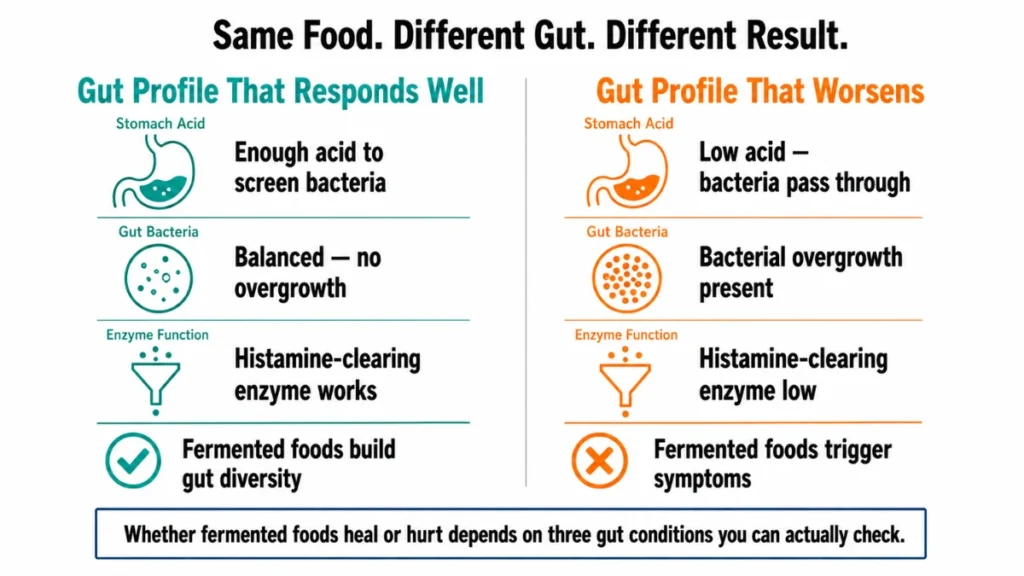
Think about someone who heals on fermented foods. Their stomach makes enough acid to screen incoming bacteria. Their small intestine does not have an overgrowth of wrong bacteria.
Their gut lining produces enough of an enzyme called diamine oxidase, or DAO for short.
DAO is the protein your gut uses to clear histamine. When DAO works well, your body handles fermented foods without trouble.
One 2025 trial randomized 147 healthy adults across three 8-week diets. Among those assigned to the fermented food arm, microbial diversity increased in participants over 50.³
The result was statistically meaningful (p = 0.04).³
Note: this is a preprint study, not yet peer-reviewed.
In plain terms: in that trial, older participants in the fermented food arm showed the largest diversity gains. The key word is arm. This was one group of three, not everyone in the trial.
Stanford professor Justin Sonnenburg, PhD, said it plainly:
“In eating a variety of fermented foods until we know more, I’m kind of bet hedging and trying to maximize diversity, which we believe is a good feature for the microbiota.”⁴
He is describing uncertainty about which strains help, not doubt about fermented foods themselves.
Most adults over 50 who respond well share one thing: their gut was already in decent shape before they started.
They were not on long-term acid-blocking medication. They had no history of chronic bacterial imbalance.
Their gut lining was intact enough to produce DAO in useful amounts.
Here is where the split begins.
Why Kombucha Can Worsen Bloating in Certain Gut Environments
Kombucha is made using a SCOBY, a living culture of bacteria and yeast that ferments tea into the drink you buy at the store.
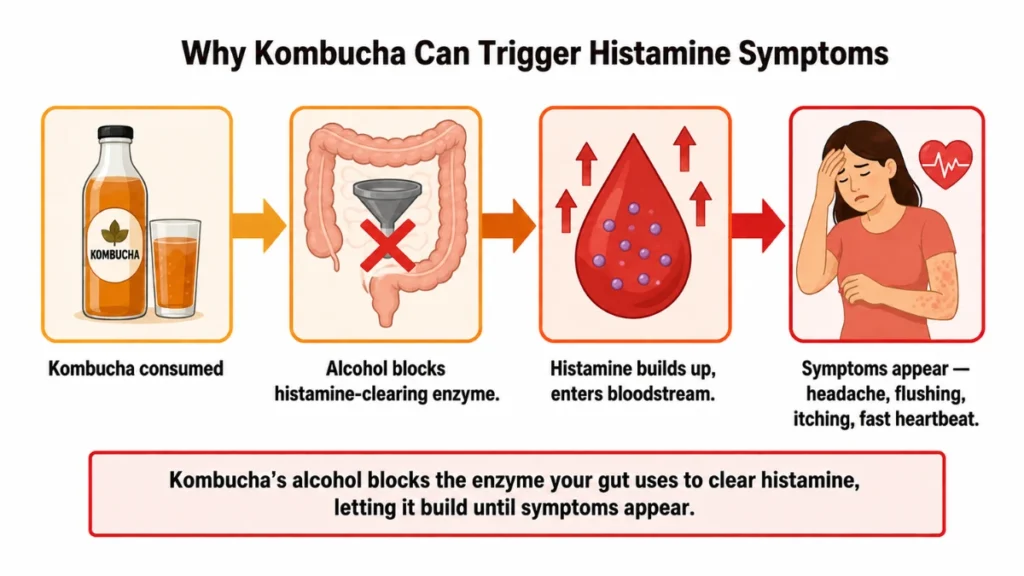
Fermentation produces histamine. Kombucha also contains a small amount of alcohol, which blocks DAO, the enzyme your gut uses to clear histamine.²,⁵
Histamine is a chemical your body produces for immune response, among other uses. Your gut also takes in histamine from food.
When dietary histamine enters, your gut wall is supposed to break it down using DAO. When DAO is not working well, histamine builds up instead. It then moves into circulation and causes symptoms that look like a mild allergic reaction. Headaches, flushing, runny nose, skin itch, and fast heartbeat are common signs.
Histamine intolerance affects about 1% of the population. About 80% of those patients are middle-aged.⁵
Middle-aged is exactly where you are.
If you already have SIBO, kombucha adds sugar to an environment where bacteria are already fermenting carbohydrates in the wrong place.
SIBO stands for small intestinal bacterial overgrowth. It means bacteria that belong only in the large intestine have moved into the small intestine where they don’t belong.
Small intestinal bacterial overgrowth causes abdominal pain, bloating, diarrhea, and gas.⁶
If that is your gut, kombucha is not a probiotic. It is more fuel on a fire that is already lit.
Why Yogurt Causes Problems for Some Over-50 Guts That Have Nothing to Do With Lactose
Most people blame yogurt symptoms on lactose. That’s understandable. It’s what they were told.
But for many adults over 50, lactose is not the issue. The problem is the bacterial strains inside the yogurt and the acid environment those bacteria walk into.
Certain strains of Lactobacillus delbrueckii subsp. bulgaricus and Lacticaseibacillus casei can produce histamine during fermentation, though this varies strain by strain rather than across the whole species.⁷
Yogurt is a short ferment, so its histamine load is lower than aged cheese. But it is not zero.
For a person with low DAO function, even a moderate histamine load can cross the threshold.

There is a second issue that matters just as much. Age alone may not directly lower your stomach acid.
But a 2025 scoping review found that conditions common in older adults do reduce acid output frequently.⁸
Those conditions include atrophic gastritis, long-term H. pylori infection, and regular use of proton pump inhibitors, or PPIs.⁸
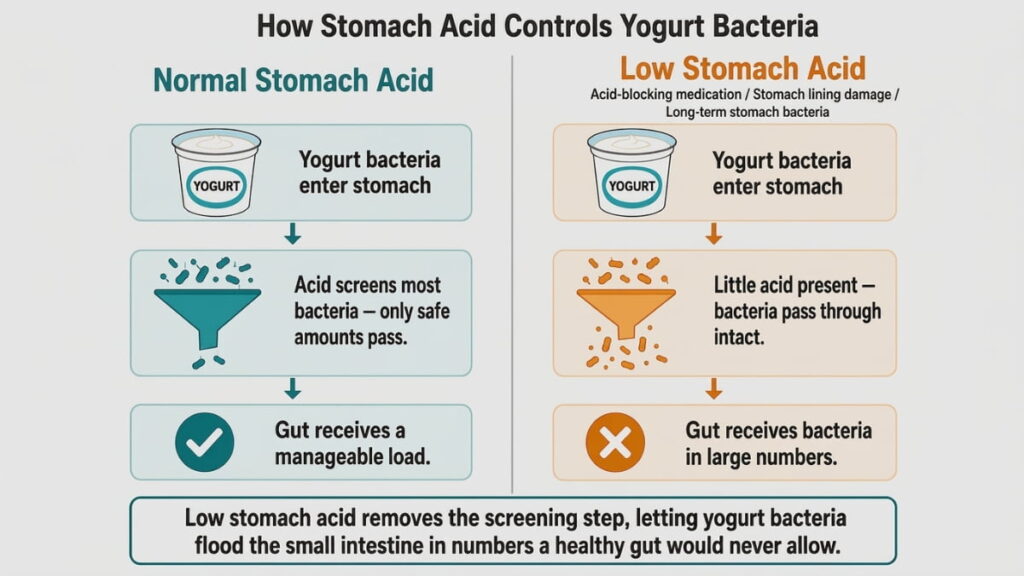
Here’s what low stomach acid does to yogurt: it removes the screening step.
Your stomach acid normally slows or destroys incoming bacteria before they reach the small intestine.
With less acid, more bacteria from your yogurt arrive in the gut intact and in larger numbers than a well-functioning stomach would allow.
In a gut already prone to bacterial imbalance, this adds to the problem rather than solving it.
Do you take a PPI daily? That one fact may explain your yogurt response.
4 Signals Your Gut Is Worsening on Fermented Foods, Not Healing
If three or more of these match what you’ve noticed, your gut may not be in the right state for fermented foods right now.
Talk to your doctor before making dietary changes if you are on medication, managing a chronic condition, or have a history of gastrointestinal illness.
- Bloating after eating
Fast bloating after fermented food means your gut is reacting to the bacteria or histamine, not slowly processing fiber the way a balanced gut does. - Allergy-like symptoms with no known allergen
Flushing, headache, runny nose, or skin itch after eating, with no known allergy trigger. Histamine building up from fermented food can trigger the same signals as a mild allergic reaction, even when no allergy test comes back positive.

- Loose stools after kombucha or a large yogurt serving
Live bacteria entering a disrupted gut environment can speed up motility in the wrong direction. Your gut is trying to move things out fast. - Brief improvement, then symptoms return
You feel better at first. Then the symptoms come back, sometimes worse. A short improvement followed by a reversal may mean the food helped briefly but is now feeding a gut that can’t sustain the benefit.
Tracking these signals for two to three weeks gives you real data.
The 14-Day Pause Protocol
Stop all fermented foods for 14 days. Track symptoms daily.⁷
At day 14, review your notes. Did symptoms improve? That is your answer.
If improved: reintroduce one food at a time. Start with fresh plain yogurt. Wait about three days before adding the next food.
If no change: histamine may not be the issue. Look at other factors with a provider.
What to Do Instead, and When Fermented Foods Become Safe Again
One caution: some yogurts are high in added sugar. Check labels if you have blood sugar concerns.
Fermented foods high in histamine can also worsen symptoms in people with gut inflammation or mast cell conditions.
If three or more signals from the previous section matched your pattern, start with the 14-day pause.
This is not permanent avoidance. It is a short test to find out whether the foods are helping or harming you.
After 14 days, review your results. If symptoms cleared, reintroduction is your next step.
Start with one tablespoon of plain yogurt made with simple strains. Wait about three days. If no symptoms appear, slowly increase the amount. Wait about three days before trying kombucha.

If you take a PPI daily, ask your provider whether it is still needed. PPIs lower stomach acid, which changes how fermented foods are processed.
Many PPIs are prescribed for short-term use and kept long-term by default.
If symptoms return each time you reintroduce fermented foods, the root issue may need more than a diet change. SIBO and histamine intolerance are both treatable, though neither has a single definitive test.
Fermented foods after 50 are not off-limits. The research on their benefits is solid.
The problem is how they’re recommended: for everyone, at any dose, with no check on what’s inside the gut. Read your body’s response before adding more.
Read Your Gut Before You Feed It
Stop guessing and start tracking your gut’s response. Identify which gut profile matches yours before adding kombucha or yogurt to your daily routine. Your body’s signals are not a failure. They’re the most useful data you have.
References
- Weaver, Janelle. Fermented-food diet increases microbiome diversity, decreases inflammatory proteins, study finds. Stanford Medicine News Center. 2021. https://med.stanford.edu/news/all-news/2021/07/fermented-food-diet-increases-microbiome-diversity-lowers-inflammation.html
- Park, Inmyoung; Mannaa, Mohamed. Fermented Foods as Functional Systems: Microbial Communities and Metabolites Influencing Gut Health and Systemic Outcomes. Foods. 2025. https://pmc.ncbi.nlm.nih.gov/articles/PMC12249102/
- van den Belt, Maartje; van de Put, Marieke; Yuksel, Ecem; et al. Distinct modulatory effects of high-fiber and fermented-food diets on gut microbiota, immune function, transit time, and sleep quality in a citizen science randomized controlled trial. medRxiv. 2025. https://www.medrxiv.org/content/10.1101/2025.08.05.25332853v1.full
- Wosen, Jonathan. Do probiotics live up to the hype? Part II. Stanford Medicine Insights. 2019. https://med.stanford.edu/news/insights/2019/08/do-probiotics-live-up-to-the-hype-part-ii.html
- Maintz, Laura; Novak, Natalija. Histamine and histamine intolerance. American Journal of Clinical Nutrition. 2007. https://ajcn.nutrition.org/article/S0002-9165(23)28053-3/fulltext
- Sorathia, Sufian J.; Chippa, Venu; Rivas, John M. Small Intestinal Bacterial Overgrowth. StatPearls, StatPearls Publishing. 2023. https://www.ncbi.nlm.nih.gov/books/NBK546634/
- Hrubisko, Martin; Danis, Radoslav; Huorka, Martin; Wawruch, Martin. Histamine Intolerance: The More We Know the Less We Know. A Review. Nutrients. 2021. https://pmc.ncbi.nlm.nih.gov/articles/PMC8308327/
- Vara-Luiz, Francisco; Mendes, Ivo; Palma, Carolina; Mascarenhas, Paulo; Nunes, Goncalo; Patita, Marta; Fonseca, Jorge. Age-Related Decline of Gastric Secretion: Facts and Controversies. Biomedicines. 2025. https://www.mdpi.com/2227-9059/13/7/1546