

You’ve Been Taking Calcium. So Why Are Your Bones Still Getting Weaker?
You take your calcium tablet every morning. You drink milk. Maybe you added vitamin D too. You’re doing everything the doctor said.
Then your bone density scan comes back. The numbers haven’t improved.
This happens to millions of people over 50. It’s not their fault. They were given half the information.
Calcium alone can’t fix your bones. It needs a partner. Without that partner, the calcium you swallow doesn’t go where you think it does.
That partner is vitamin K2. Most adults over 50 have never heard of it.
By the end of this article, you’ll know what K2 does, why you’re probably not getting enough, and what to do about it starting this week.
Why This Problem Gets Worse Specifically After 50
Calcium absorption doesn’t just stay flat as you age. It actively gets harder. Several things happen to your body after 50 that make this worse, and most people are never told about them.
Estrogen drops. For women, menopause triggers a sharp fall in estrogen. Estrogen helps slow the breakdown of old bone. When it drops, bone resorption speeds up fast. You start losing bone faster than your body can replace it. This is why post-menopausal women are the highest-risk group for osteoporosis.
Stomach acid decreases. Your body needs stomach acid to dissolve calcium from food and supplements. After 50, stomach acid production drops in many adults. Less acid means less calcium absorbed, even when you’re eating well or taking supplements.
Skin makes less vitamin D. Vitamin D is made when your skin is exposed to sunlight. After 50, your skin becomes less efficient at this conversion. You can stand in the sun for the same amount of time as a 30-year-old and produce significantly less D3. Lower D3 means less calcium absorbed from your gut.

K2 intake tends to fall. Many adults over 50 shift toward “cleaner” diets, cutting out fermented foods, full-fat dairy, and organ meats. These happen to be the exact foods richest in K2. The result is a diet that’s lower in the one nutrient needed to direct calcium to bones.
These four changes stack on top of each other. And they all converge at the same point: calcium that doesn’t reach your bones. This is why the K2 problem matters more at 50 than at 30. Your body has less margin for error.
The Calcium Paradox: Why Calcium Can End Up in the Wrong Place
Over 56.6 million Americans aged 50 and older have low bone mass or osteoporosis, according to the National Osteoporosis Foundation. Half of all women over 50 will break a bone because of it. One in four men will too.
Most of these people eat dairy. Many take supplements. So what’s going wrong?
Calcium is a mineral, not a GPS. When it enters your bloodstream, it doesn’t automatically go to your bones. It needs to be directed. Without that direction, it drifts. Sometimes it settles in the walls of your arteries instead.
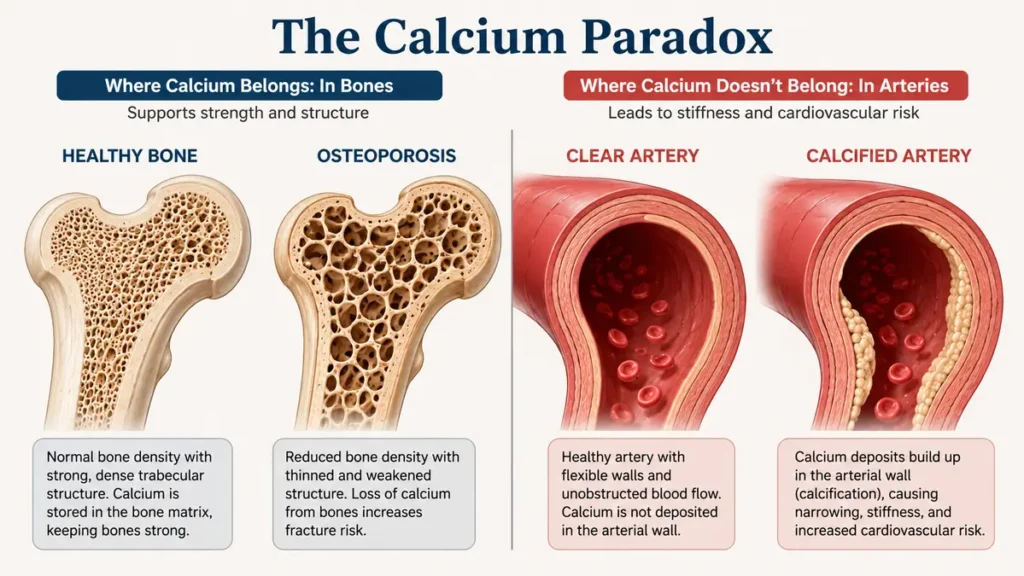
This is called the calcium paradox. Your bones get weaker while your arteries get harder. At the same time.
People with low K2 levels tend to develop both conditions together. Both share one root cause: calcium going to the wrong place.
A 2025 meta-analysis in Current Osteoporosis Reports found that calcium supplements without proper co-factors can raise heart attack risk by 10 to 20 percent. Dietary calcium from food showed no such risk.
Taking calcium alone isn’t just ineffective. It may work against you.
What Is Vitamin K2 and Why Haven’t You Heard of It?
Most people think “vitamin K” is one thing. It’s not.
Vitamin K1 is found in leafy greens. It mainly controls blood clotting in the liver. Most people get enough K1 from vegetables.
Vitamin K2 is found in fermented foods and animal products. Its main job is to control where calcium goes in your body. Most people don’t get enough of it.
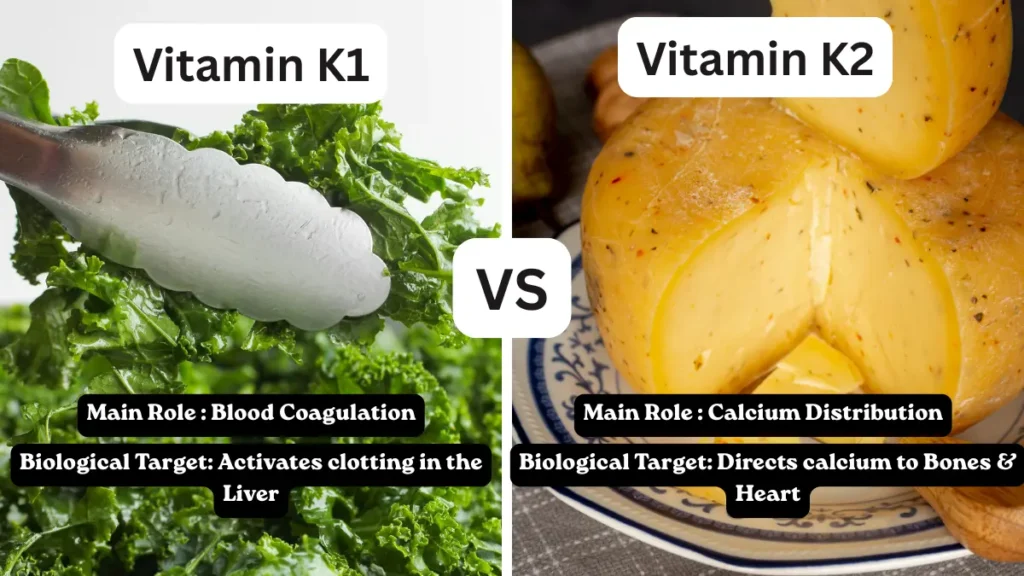
In the average Western diet, roughly 90% of all vitamin K consumed is K1. K2 intake is very low. Government guidelines still haven’t set a specific recommended amount for K2. Most multivitamins use K1 because it’s cheaper to produce.
So even if you eat well, you’re likely low on K2.
There are two forms of K2 worth knowing:
MK-4 is found in animal foods like egg yolks, liver, and butter. It leaves your system within a few hours.
MK-7 is found in fermented foods, especially natto (a Japanese fermented soy dish). It stays active in your blood for about 72 hours. One daily dose works around the clock.
For bone health, MK-7 is the practical choice. One small daily supplement keeps K2 levels steady without needing multiple doses.
How Vitamin K2 Actually Works Inside Your Body
Your bones contain a protein called osteocalcin. Its job is to grab calcium from your blood and lock it into your bone tissue.
But osteocalcin is born inactive. It can’t do its job until something switches it on.
That switch is vitamin K2.
When K2 is present, it triggers a process called carboxylation. This adds calcium-grabbing arms to osteocalcin, turning it from a passive protein into an active calcium transporter. A 2024 study in Nutrients confirmed that activated osteocalcin imports calcium from the blood into bone, improving bone mineralization and reducing fracture risk. Without K2, this step simply doesn’t happen.
K2 “activates” this protein to grab calcium from the blood and lock it into the bone matrix.
K2 activates MGP to sweep excess calcium OUT of artery walls, preventing “hardening.”
K2 also activates a second protein called Matrix Gla Protein (MGP). MGP’s job is to prevent calcium from hardening inside your arteries. Without enough K2, MGP stays inactive and arterial calcification speeds up.
So K2 does two things at once. It pulls calcium into bones. And it keeps calcium out of arteries.
The Rotterdam Study followed 4,807 adults over age 55. People who consumed at least 32 mcg of K2 daily had a 50% lower risk of dying from cardiovascular disease tied to arterial calcification, and a 25% lower risk of all-cause mortality.
A second study tracked 16,000 women aged 49 to 70 over 8 years. For every additional 10 mcg of dietary K2, heart disease risk dropped measurably. Neither study found the same benefit from K1.
K2, D3, and Magnesium: The Three Nutrients Your Bones Actually Need
Vitamin D3 helps your body absorb calcium. That part you probably knew.
Here’s what most people miss: D3 brings calcium into your bloodstream but cannot tell it where to go. That’s K2’s job. If you take high doses of D3 without K2, you may absorb more calcium than usual. But without K2 to direct it, that extra calcium can end up in soft tissues and arteries.
This is why many researchers now say: if you’re taking D3, you should also be taking K2.
And there’s a third player: magnesium.
Your body needs magnesium to convert D3 into its active form. Without it, D3 can’t do its job properly, no matter how much you take.
Think of it this way: D3 brings calcium in through the door. K2 tells it where to go. Magnesium keeps the whole system running.
A 2025 systematic review described this as “a multi-step biological cascade where each component is an essential prerequisite for the effective functioning of the others.” Remove any one piece and the whole system weakens.
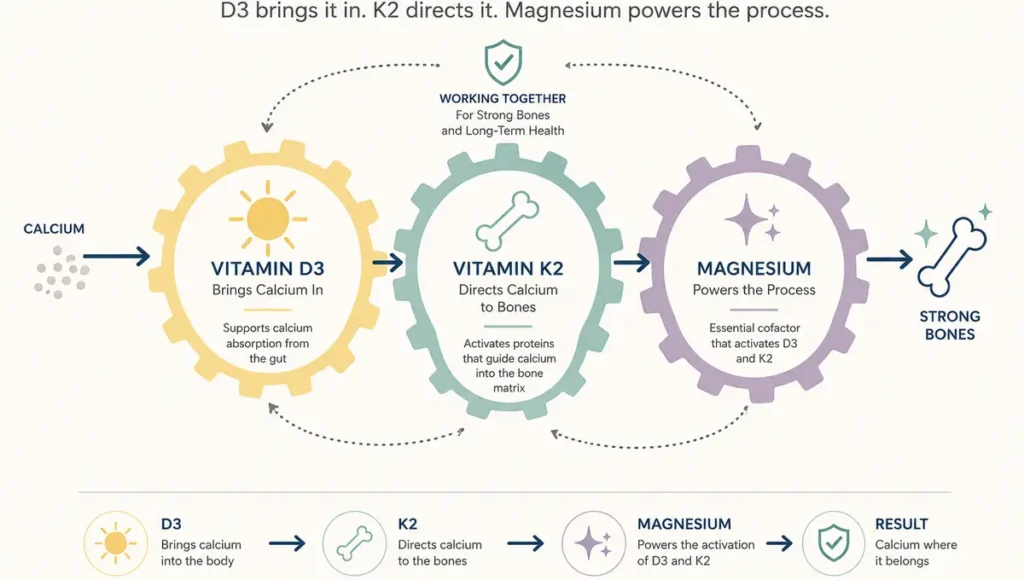
This explains why someone can take D3 faithfully for years and still have poor bone density. If magnesium is low, D3 never fully activates. If K2 is low, calcium never reaches the bone matrix.
One clinical trial found participants taking D3 and K2 together had 25% greater improvements in bone density compared to those taking D3 alone.
Best Foods High in Vitamin K2 (Be Honest About What You’re Eating)
Getting enough K2 from food alone is harder than it sounds. Most K2-rich foods are not everyday staples in Western diets. But knowing which foods to add, even a few times a week, makes a real difference.
04:39 — Why fat-soluble matters (and why lean meats have less K2)
04:54 — MK-4 Sources: Pork, beef, lard, and organ meats
05:02 — The “Power” Meats: Chicken liver and grass-fed dairy
05:13 — MK-7 Sources: Natto, Sauerkraut, and fermented legumes
05:22 — The Natto Fact: Why 1 tablespoon provides 200% of your daily value
| Food | K2 Content | Form |
|---|---|---|
| Natto (fermented soybeans) | ~1,000 mcg per 100g | MK-7 |
| Jarlsberg cheese | ~74 mcg per 100g | MK-7/MK-9 |
| Gouda cheese | ~73 mcg per 100g | MK-7/MK-9 |
| Blue cheese | ~36 mcg per 100g | MK-9 |
| Cheddar | ~21 mcg per 100g | MK-4 |
| Egg yolk (pastured) | ~30 mcg per yolk | MK-4 |
| Chicken liver | ~14 mcg per 100g | MK-4 |
| Sauerkraut (fermented) | ~2.75 mcg per half-cup | MK-7 |
Natto is the clear winner. One tablespoon gives you more than double most daily K2 targets. But it’s an acquired taste with a strong smell and sticky texture. Most people outside Japan find it difficult to eat regularly.
Aged hard cheeses are the most practical option. Gouda and Jarlsberg are excellent choices. Fresh mozzarella and ricotta have almost none.
Egg yolks from pasture-raised hens are notably richer in K2. The yolk is where it lives. Egg white omelets give you almost zero K2.
To reach 100 mcg of K2 from food daily, you’d need roughly 6 oz of chicken dark meat, two eggs, and a serving of European hard cheese, every day. For most people, that’s inconsistent at best.
Four simple swaps to start today:
- Grass-fed butter instead of margarine
- Aged Gouda or Jarlsberg instead of mozzarella
- Whole eggs instead of egg-white omelets
- Fermented sauerkraut (refrigerated section) instead of vinegar pickles
How to Choose a K2 Supplement That Actually Works
If your diet doesn’t include K2-rich foods consistently, a supplement is a sensible option. Here’s what to look for.
Look for MK-7 specifically. Many products say “vitamin K2” but use lower-quality forms. The label should say “Vitamin K2 as MK-7” or “Menaquinone-7.”
Check the dose. Clinical trials showing clear bone density improvements used 180 mcg of MK-7 daily over 3 years. A starting range of 100 to 200 mcg per day is well-supported by research.

Take it with fat. K2 is fat-soluble. It absorbs much better with a meal that contains healthy fats, like eggs, olive oil, or avocado. Taking it on an empty stomach cuts absorption significantly.
Consider a combo product. Many supplements pair K2 with D3 and magnesium. A reasonable starting point for adults over 50:
- K2 (MK-7): 100 to 200 mcg
- D3: 1,000 to 2,000 IU
- Magnesium (glycinate): 300 to 400 mg
Magnesium glycinate is gentler on digestion than magnesium oxide.
Who must talk to a doctor first:
- Anyone taking warfarin or blood thinners. Vitamin K directly affects how these drugs work. This interaction can be serious.
- People with kidney disease or hyperparathyroidism
- Anyone on orlistat or cholesterol medications that affect fat absorption
For most healthy adults, K2 at normal doses is very well-tolerated. But a quick conversation with your doctor is always worth it before adding anything new.
Your 5-Step Plan to Start This Week

Step 1: Get a baseline. Ask your doctor for a DEXA scan if you haven’t had one. Also ask for a 25-hydroxyvitamin D blood test. These two numbers show exactly where you’re starting from.
Step 2: Check your supplement labels. Pull out every supplement you take. Look for K2 specifically. If you see only K1, or nothing, that’s a gap worth filling.
Step 3: Add K2 foods to your weekly rotation. You don’t need a diet overhaul. Add aged Gouda a few times a week. Eat whole eggs. Try fermented sauerkraut with one meal.
Step 4: Start the K2 + D3 + Magnesium trio. Discuss with your doctor, then consider 100 to 200 mcg K2 (MK-7), 1,000 to 2,000 IU D3, and 300 to 400 mg magnesium glycinate, all taken with dinner.
Step 5: Add weight-bearing exercise. Bone responds to mechanical stress. Walking, stair climbing, light resistance training, and dancing all send your bones the signal to rebuild. Supplements support this process. They don’t replace it.
The Bottom Line
Calcium is necessary. But it’s not enough on its own.
Without K2 to activate osteocalcin, calcium can’t bond to your bones. Without magnesium, D3 can’t fully activate. Without D3, you don’t absorb enough calcium to begin with. And after 50, all three of these gaps tend to widen at the same time.
For adults over 50, better bone health isn’t about taking more calcium. It’s about making sure the right co-factors are in place so the calcium you take actually reaches your bones.
Start with one step this week. Check your supplement label. Swap one cheese. Talk to your doctor about a DEXA scan. Small moves made consistently build real results over time.
⚠️MEDICAL DISCLAIMER
This article is for informational purposes only. It does not replace medical advice, diagnosis, or treatment. The information covers calcium absorption, vitamin K2, vitamin D3, magnesium, bone density, osteoporosis, osteocalcin activation, arterial calcification, estrogen and menopause, stomach acid and aging, supplement dosing (MK-7, D3, magnesium glycinate), K2-rich foods, DEXA scan, blood tests, weight-bearing exercise, drug interactions (warfarin/blood thinners), and kidney disease considerations. Individual results vary based on age, health status, and fitness level.
Before changing your exercise routine, diet, or supplement use, talk to your doctor or a qualified health professional first. If you experience chest pain, dizziness, severe joint pain, or any sudden symptom during or after exercise, stop immediately and seek medical care.