

That nagging ache in your hips or shins might be a cellular hunger for the right kind of light. When you turn 50, your body changes how it handles the sun.
By around age 70, the skin makes roughly 75% less vitamin D from sunlight than it did at 20, and the decline is well under way before that.¹
Many people grab the first supplement they see, but most pick the wrong one. You need to know the facts about Vitamin D3 vs D2 absorption to protect your skeletal health.
In this guide, you will find out why Vitamin D3 is the human identical form your bones crave. We will also look at why pairing D3 with K2 helps your vitamins actually work.
This article is for informational purposes only and does not constitute medical advice. Vitamin D needs vary by age, weight, skin tone, and health status. Always consult your doctor before starting or changing any supplement routine.
Why Your Bones Hurt More After 50?
Why does it feel like your bones are throbbing? It is not just your joints. Two systems fail at once.
Your skin becomes a weaker solar panel with every decade, and your kidneys lose their ability to convert raw vitamin D into the active form your body can actually use. That conversion declines by roughly half as you age, though the body compensates quietly for years before blood levels drop.²
This creates a specific problem called osteomalacia [a condition where bones soften due to severe Vitamin D deficiency]. It feels like a dull, aching bone pain. It is different from the sharp pain of a creaky knee. This lack of Vitamin D lowers your bone mineral density.³
Without enough of it, your bones cannot stay hard. They become soft and sensitive. If you have Vitamin D deficiency symptoms after 50, your body is literally starving for minerals.

Why D3 Wins the D3 vs. D2 Battle?
When you go to the store, you see two types: D2 and D3. Doctors used to prescribe D2 most of the time. But the difference between D2 and D3 is substantial, and the research makes clear which one wins.⁴
- Vitamin D3 (cholecalciferol): This is the same form your body produces from sunlight.
- Vitamin D2 (ergocalciferol): This is produced by plants and fungi.
D2 often washes out of your body before it can do any real work. D3 shows an 87% higher potency in keeping your serum 25 OH D levels steady.⁴ If you want to fix bone pain, D2 is like using a flickering candle when you need a floodlight.
For real Vitamin D3 vs D2 absorption, D3 is the clear winner every time. Your body treats D2 like a guest who leaves the party too early. D3 stays in circulation long enough for the difference to show up over weeks.⁵
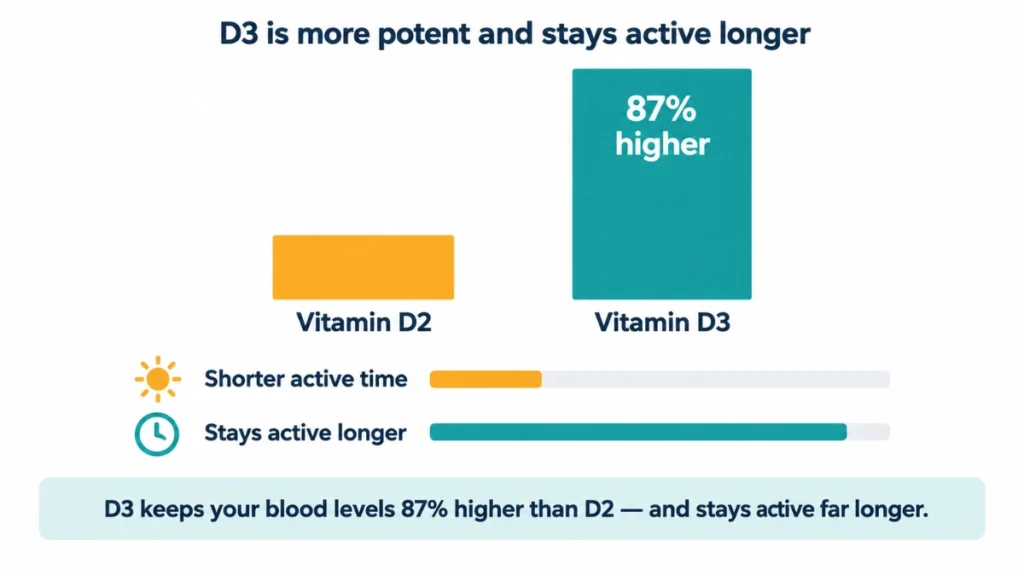
This happens because D3 has a longer half life.⁵ This means it stays active in your body long enough to actually reach your bones and do its job. If you use D2, your levels might go up for a moment and then crash back down. With D3, your levels stay steady, so your bones get a steady supply.
Can You Get Enough D3 from Food Alone?
Many people hope to fix their bone aches after 50 just by changing their diet. While foods like fatty fish, egg yolks, and fortified milk contain some Vitamin D, the amounts are usually very small.
For example, you would need about 15 eggs a day to reach the recommended 600-800 IU from food alone. A single serving of sockeye salmon nearly covers the same target, which is why fatty fish does the heavy lifting and almost nothing else does.⁶
From around age 65 to 70, the gut absorbs calcium less efficiently, which is part of why vitamin D matters more with age.²
Food can help maintain your levels, but a D3 supplement is often the tool needed to correct a deep deficiency. Relying only on your plate often leads to a slow leak in your skeletal health that food alone cannot patch.

Talk to your doctor before changing your supplement routine if you are pregnant, on medication, or managing a chronic condition.
Why Summer Sun Isn’t Always Enough?
Even if you spend time outside every day, you may not be making enough vitamin D. Two things work against you as you get older.
The Solar Threshold: Vitamin D production is entirely dependent on the strength of the sun. When the sun is too low in the sky, which is common in northern climates or at certain times of day, your body cannot trigger D3 production at all.⁷
Reduced Skin Efficiency: As you age, your skin produces fewer vitamin D precursors per minute of sun exposure. The same hour outside at 60 triggers far less synthesis than it did at 30, regardless of how strong the sun is.

Why Testing Your Levels Is the Only Way to Start?
You cannot guess your way to healthy bones. Many people take a random pill and hope for the best, but that is like trying to fill a gas tank without looking at the gauge. A simple blood test called the 25 OH D test tells you exactly where you stand.
Some researchers have proposed a higher target of 40 to 60 ng/mL, based on cancer-risk data rather than bone health. Mainstream US guidance puts sufficiency at 20 ng/mL, and the Institute of Medicine has not adopted the higher figure.⁶,⁸
If your levels are below 20 ng/mL, your bones are actively losing minerals.² Once you have your numbers, you can pick the right dose.
Most people find that a standard multivitamin doesn’t have enough D3 to move the needle. Getting a baseline test helps you and your doctor create a plan that actually works for your specific body.

Every person absorbs Vitamin D differently. Factors like your weight, your skin tone, and even your genetics determine how much D3 actually makes it into your system. For example, people with obesity tend to have lower blood levels at the same intake and may need more.⁶
The Hidden Danger of Calcium Without D3
Some people try to fix bone pain by eating more cheese or taking calcium pills. But calcium is a bit like a brick without mortar. It cannot build a wall on its own.
Without enough Vitamin D3, your body only absorbs about 10% to 15% of the calcium you eat. When vitamin D is sufficient, that absorption rises to 30% to 40%.⁹
Vitamin K activates a protein that keeps calcium out of artery walls, and low vitamin K status tracks with more arterial calcium. Whether taking K2 prevents arterial stiffening is still unsettled: across nine randomised trials the results have not been consistent.¹⁰
What is clear is that skeletal health depends on getting the balance right. When your Vitamin D3 levels are where they need to be, you absorb the calcium you are already eating, which makes your bones harder.
Calcium supplements carry their own risk, and how you take them matters. Calcium cannot enter your bone matrix without a chemical key.
Calcium supplements, not calcium from food, have been linked to more kidney stones: in one large trial of post-menopausal women taking calcium with vitamin D, stone risk rose about 17%. Taking calcium with meals rather than between them appears to matter, because calcium eaten with food binds oxalate in the gut instead of passing into the urine.¹¹
D3 is the bridge that carries calcium from your digestive tract into your blood. Without it, the calcium cannot reach the construction site.
This is why many people who think they are helping their bones by loading up on dairy or calcium pills still experience bone aches after 50.
Why Winter Makes Bone Pain Worse?
Many people notice their bone aches after 50 feel much sharper during the colder months. This is often called Winter Blues for your bones.
When the sun stays low on the horizon, the atmosphere blocks the UVB rays your skin needs to make Vitamin D. In many places above about 51 degrees north, it is impossible to make any Vitamin D from the sun between October and March.⁷

During this time, your blood level drifts without a source to maintain it. Using a high quality D3 supplement keeps your levels steady, even when the sun goes into hiding.
Start With Your Blood Panel
Bone aches after 50 are a signal from your body. It is telling you that your bones need better fuel. The evidence is clear: Vitamin D3 holds blood levels roughly 87% better than D2, and it does so for weeks rather than days.⁴
Don’t let a simple deficiency slow you down. Check your latest blood panel and ask your doctor whether switching from D2 to D3 makes sense for you.
References
- Nowak J, Hudzik B, Jagielski P, Kulik-Kupka K, Danikiewicz A, Zubelewicz-Szkodzińska B. Lack of seasonal variations in vitamin D concentrations among hospitalized elderly patients. Int J Environ Res Public Health. 2021;18(4):1676. https://doi.org/10.3390/ijerph18041676
- Gallagher JC. Vitamin D and aging. Endocrinol Metab Clin North Am. 2013;42(2):319-332. https://doi.org/10.1016/j.ecl.2013.02.004
- Zimmerman L, Anastasopoulou C, McKeon B. Osteomalacia. StatPearls. Treasure Island (FL): StatPearls Publishing; updated 2 September 2024. https://www.ncbi.nlm.nih.gov/books/NBK551616/
- Heaney RP, et al. Vitamin D3 is more potent than vitamin D2 in humans. J Clin Endocrinol Metab. 2011;96(3):E447-E452. https://doi.org/10.1210/jc.2010-2230
- Jones KS, Assar S, Harnpanich D, Bouillon R, Lambrechts D, Prentice A, Schoenmakers I. 25(OH)D2 half-life is shorter than 25(OH)D3 half-life and is influenced by DBP concentration and genotype. J Clin Endocrinol Metab. 2014;99(9):3373-3381. https://doi.org/10.1210/jc.2014-1714
- Office of Dietary Supplements, National Institutes of Health. Vitamin D: Fact Sheet for Health Professionals. https://ods.od.nih.gov/factsheets/VitaminD-HealthProfessional/
- Engelsen O, et al. Daily duration of vitamin D synthesis in human skin with relation to latitude, total ozone, altitude, ground cover, aerosols and cloud thickness. Photochem Photobiol. 2005;81(6):1287-1290. https://doi.org/10.1562/2004-11-19-RN-375
- Khan QJ, Fabian CJ. How I treat vitamin D deficiency. J Oncol Pract. 2010;6(2):97-101. https://doi.org/10.1200/JOP.091087
- Khazai N, et al. Calcium and vitamin D: skeletal and extraskeletal health. Curr Rheumatol Rep. 2008;10(2):110-117. https://doi.org/10.1007/s11926-008-0020-y
- Vlasschaert C, et al. Vitamin K supplementation for the prevention of cardiovascular disease: where is the evidence? A systematic review of controlled trials. Nutrients. 2020;12(10):2909. https://doi.org/10.3390/nu12102909
- Bargagli M, et al. Calcium and vitamin D supplementation and their association with kidney stone disease: a narrative review. Nutrients. 2021;13(12):4363. https://doi.org/10.3390/nu13124363